
In 2019, Stanley quietly stopped restocking one of its own products.
The Quencher had launched in 2016 and had not caught on. Stanley sold to outdoorsmen and to blue collar workers who carried its hammertone green bottles in their lunchboxes, and had done since 1913. The Quencher did not fit that customer, so the company stopped marketing it and let it drift.
Then an employee mentioned something odd. A group of women in Utah were running a commerce blog called The Buy Guide, and they had built a following around the cup. The blog placed a wholesale order for 5,000 units. It sold out. Stanley started making the Quencher again.
CNBC later laid out the arc. Revenue of $73 million in 2019, rising to $94 million in 2020. By December 2023 the cup was a TikTok phenomenon and annual sales were projected to top $750 million.
Here is the part worth sitting with. Stanley did not find this in a dashboard. They had stopped selling the thing, so there was almost no sales data left to read. The buyer who was about to build them a far larger company was invisible in every document they owned, and the signal arrived from outside the building. Women were a group Stanley had not spent much time catering to in its first hundred years.
The persona said tradesman. The wallet said something else. The wallet was right.
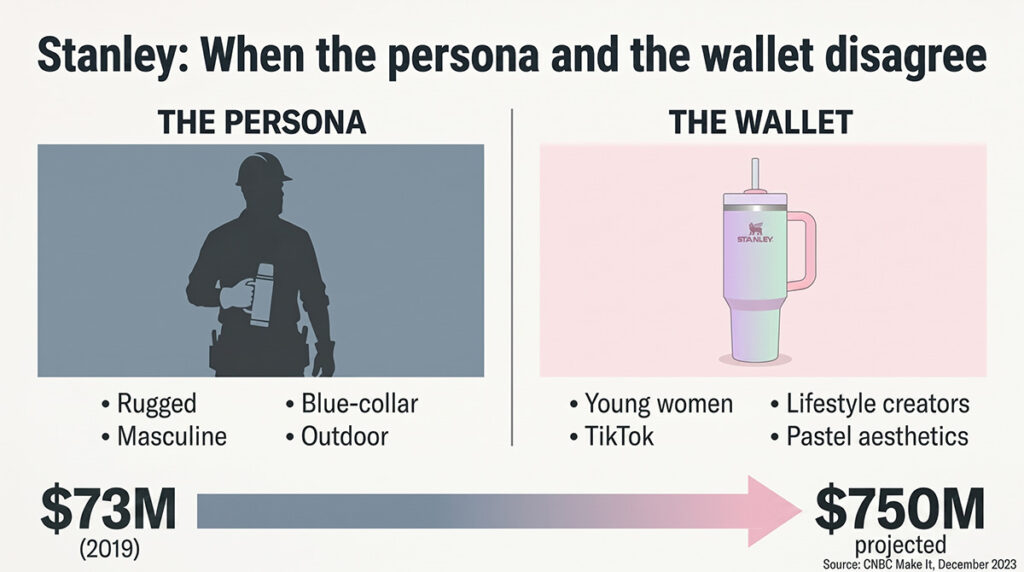
That gap, between the audience that engages and the audience that pays, is the most expensive blind spot in marketing. It is sitting inside most persona documents.
The persona problem is not bad research. It is the wrong subject.
I have lost count of how many persona documents clients have handed me. They arrive as beautifully designed PDFs, complete with stock photos of people who do not exist, alliterative names like Marketing Mary and Founder Frank, and sections filled with information that could not have come from research, because nobody did any research.
You can always tell which sections were guessed. They have a particular texture. Vague enough to sound plausible, specific enough to look like someone did the work. Reads industry blogs during her morning commute. Values work life balance. Prefers email over phone calls. It reads like a horoscope. True of almost everyone, predictive of almost nothing.
Konrad Sanders, who runs the copywriting agency The Creative Copywriter, wrote about this for the Content Marketing Institute in 2018. An agency he worked with, unnamed in the piece, kept sending his team four page persona documents, each one walking through a day in the fictional character’s life at Dickensian length. One opened with Sarah Cunningham, a CMO at a firm called Vertus Capital Limited, recently divorced, two children called Jess and Jimmy. She drinks Earl Grey in the morning while leafing through the Guardian. She drops the kids at school. She gets stuck in traffic on the way to work. Sanders’ verdict: “Four endless pages of frankly useless detail.”
His point is not that detail is bad. It is that a persona has two halves and most people build only one. He calls them the buyer profile and the buyer insight. The profile explains who your ideal customer is. The insight explains what moves them to spend. The tea is profile. Almost every template on the internet is all profile.
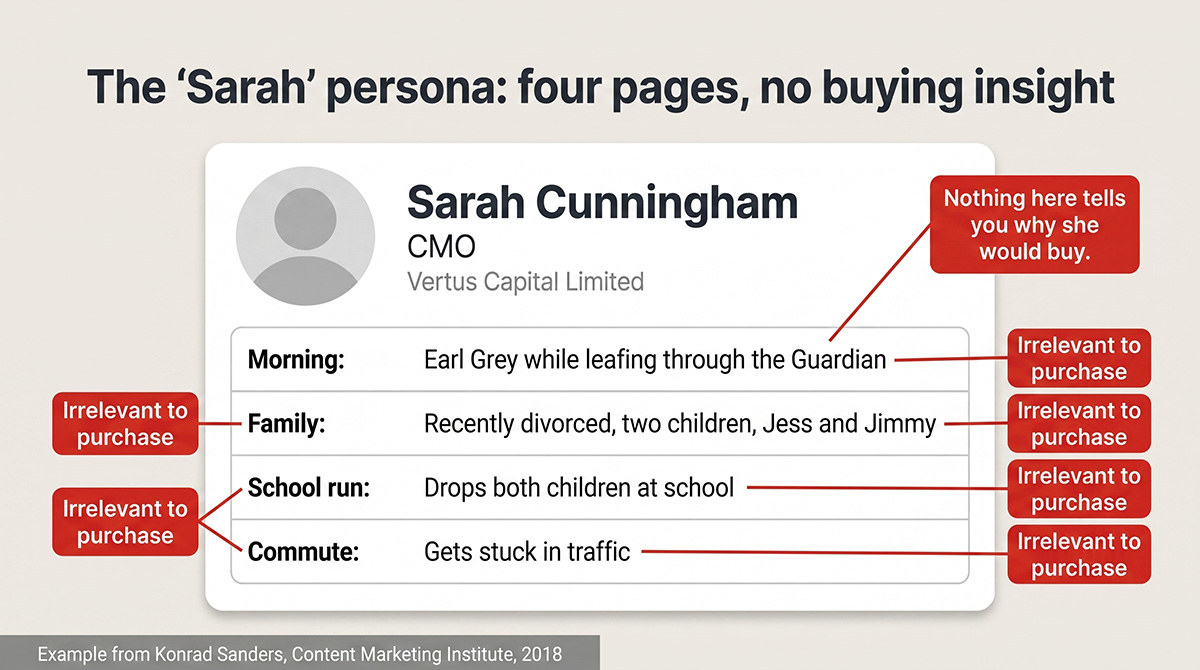
That is what happens when you hand someone a template with empty fields and no behavioural data to fill them with. Somebody writes fiction. Then an entire marketing strategy gets built on top of it.
What you end up with is a document describing the public performance of your customer. The version who answers surveys thoughtfully, behaves rationally in focus groups, and presents a tidy professional identity to anyone who asks. The version who fills out your form.
The version who clicks buy is someone else.
The buying self and the performing self
Here is an example that has been circulating in research training for years. Charles III and Ozzy Osbourne were both born in 1948. Both British. Both male. Both married twice. Both wealthy. Both lived on large estates. On every standard persona field, they are the same buyer.
They were obviously, comically, not the same buyer. Osbourne died in July 2025, which is a reminder of its own: a profile built entirely on demographics goes stale without telling you.
Demographics describe the container. They tell you nothing about what is inside. The beliefs, the fears, the identity someone is reaching for, the private logic that decides whether they reach for a card or close the tab.
The buying version of your customer is the person at 11pm wondering if they are falling behind their peers. The one who will not admit in a focus group that they chose your competitor last time because the sales rep made them feel like a bigger company than they actually are. The one whose real objection is not “I need to check with my team”. It is “I do not believe this will work for someone like me”.
Your persona captured their job title and their pain points. It missed the belief that governs whether they ever convert.
When I build customer profiles now, I feed the model actual behavioural data. Purchase history, support tickets, the words customers use themselves. The output goes places the template never does, and not because the machine is clever. It is because a template rewards completeness over depth. It asks what this person reads instead of asking what this person believes about themselves that stops them buying.
The gap runs inside live ad accounts too
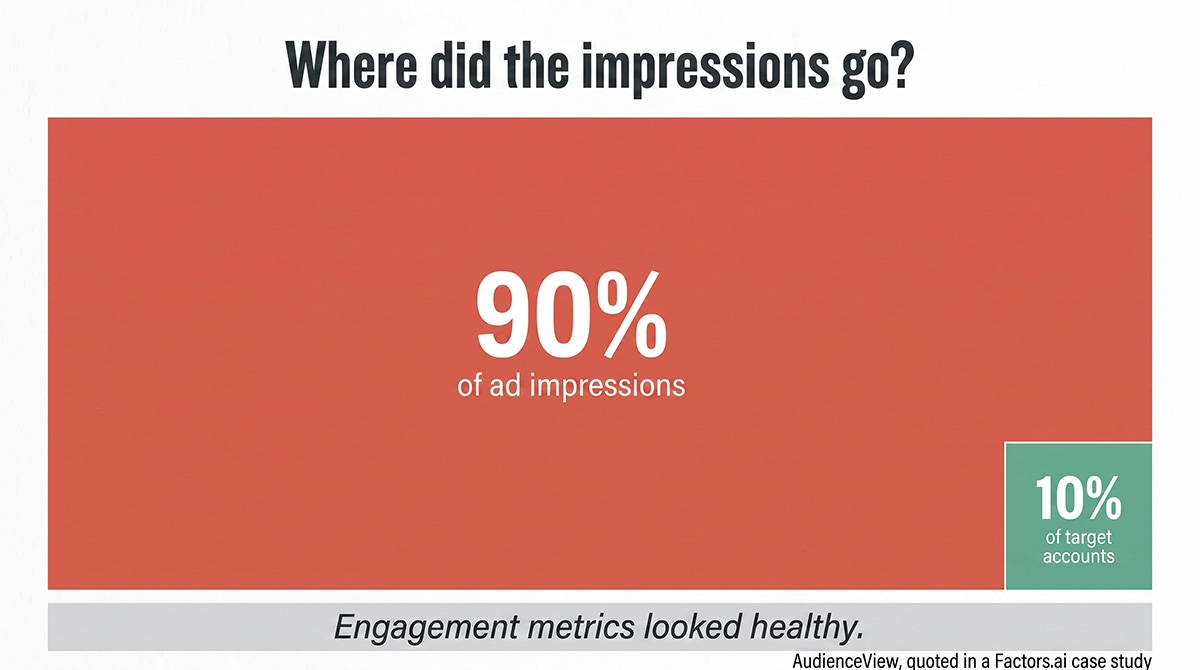
AudienceView sells ticketing software to venues and promoters. They ran LinkedIn campaigns against a carefully defined ideal customer profile, and engagement looked healthy. Then they consolidated their campaign data. Their Director of Demand Generation, Saurabh Wahegaonkar, described the finding in a case study for the analytics firm Factors.ai: “just 10% of our accounts consume nearly 90% of ad impressions.”
Read that again, because it is not the problem it first sounds like. The account list was fine. The delivery was not. Nine out of ten times the ad was served, it went to the same narrow slice of the list, and the rest of the accounts they had deliberately chosen to reach were barely seeing anything.
Worth flagging: Factors.ai sells the analytics that surfaced this, so the story is vendor collateral. Discount it accordingly. The mechanic is real either way, and you can check it in your own account this afternoon.
"But we've done our customer research"
I know. You have spent money on this. Maybe serious money. You have documents with names and demographics and pain points and buying triggers, and I have just spent a thousand words telling you they are incomplete.
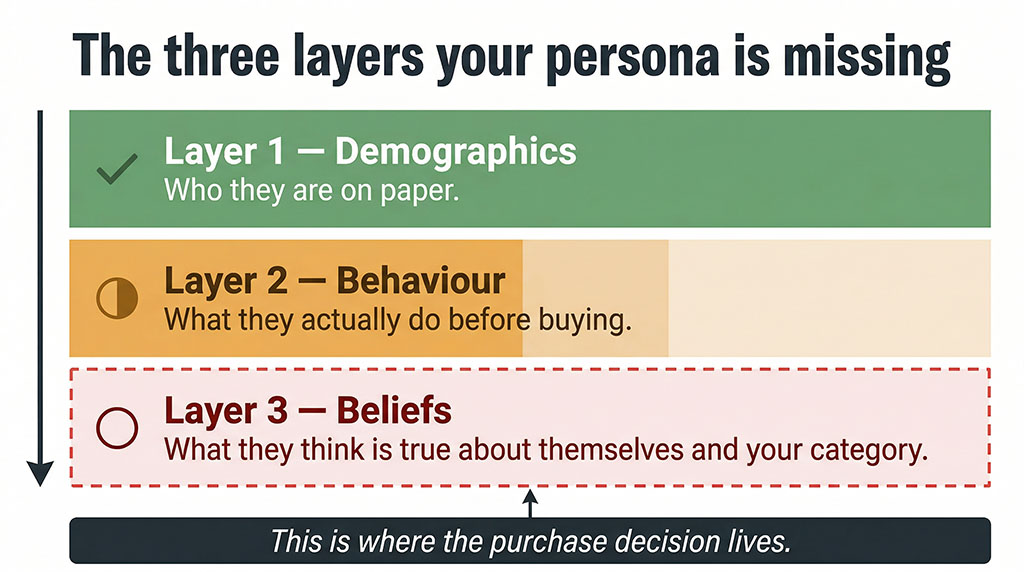
So let me be specific about what is missing. The problem is not that your research is wrong. It is that it captured one layer out of three, and the two it missed are the ones that decide whether money changes hands.
This is how I break it down. It is a model I use, not a finding from a study.
Layer one is who they are on paper. Demographics, firmographics, job title, company size. Most personas capture this well. It also matters least. Two companies with identical headcounts and industry codes can buy in completely different ways. The Charles and Ozzy problem applies to B2B just as brutally.
Layer two is what they actually do before buying. Not what they say they do. What the data shows. The sequence of pages visited, the content consumed, the moment they shift from browsing to checking pricing. This layer stays invisible unless your ad platform, your website analytics and your CRM talk to each other. If you run separate agencies for each channel, one for Google, one for Meta, one for email, those systems almost certainly do not connect. Each team reports on its own slice. Nobody sees the whole picture.
Layer three is what they believe. About themselves, their situation, and solutions like yours. This is the layer that never surfaces in surveys, because people cannot articulate it and often do not recognise it. It is the freelance designer who thinks your tool looks great but also believes, without ever putting it into words, that project management software is for real businesses and not for someone working alone. No feature list beats a belief the customer cannot name.
Standard templates are almost entirely layer one with a thin coat of layer two. Layer three has no field, so nobody fills it in. That is where the purchase decision lives.
What the mismatch actually costs
Nexford University sells online MBA programmes. In a case study published by HubSpot, whose software they use, Nexford describes generating “lots of leads” from people who wanted to study with them but were not eligible because of small differences in their credentials. No percentage is given. The mechanic is the point: the ad platforms had been optimising toward form fills, and a form fill from someone who can never enrol looks identical to a good one until somebody checks it against admissions criteria.
After connecting the data and feeding eligibility back into targeting, HubSpot reports a 400% increase in lead to customer rate. That is one in a hundred becoming five in a hundred. Enrolments rose 205% in a year and acquisition costs fell 20%. Those figures cover different reporting periods and they are self reported by a vendor about its own product, so read them as direction rather than benchmark.
They did not change their copy. They changed who they were talking to.
None of this is new. In 2008, Chapman, Love, Milham, ElRif and Alford ran the maths. Using an analytic model across six survey datasets, they showed that the share of real people matching a persona description “decreases rapidly” as you add attributes to it. Their conclusion was not that personas are worthless. It was that a persona should be checked against data before anyone assumes it describes a real group of people. Most never are.
Add enough attributes and you are not narrowing your audience. You are writing a character and then wondering why real people will not behave like them.
How to catch the mismatch before it catches you
You do not need to burn your persona docs. You need to check them against what actually happened.
Start with one question. Does the profile of the person your ads reach match the profile of the person who pays? Pull your top of funnel audience data and your closed won customer data into the same view. If you cannot do that, because those datasets sit in different tools run by different teams with nothing connecting them, that is your first problem and your most urgent one.
Check your delivery, not just your targeting. Look at whether a small slice of your audience is absorbing most of your impressions. Algorithms chase engagement. Engagement is not intent. The people who click most are not necessarily the people who buy.
Audit your persona for guesswork. Go section by section. For each data point, ask whether it came from real customer behaviour or whether someone typed it because the field was empty. If you cannot trace it to a source, it is fiction, and fiction is driving your targeting.
Connect one data loop. You do not need a $200K data warehouse to start. Feed your CRM conversion data back into one ad platform. Just one. When the algorithm can see who converts downstream, not who clicks and not who downloads but who pays, it recalibrates in ways no amount of manual persona tweaking will match.
Test layer three with five customers. Take your five most recent buyers and ask what they believed about themselves, their situation or your category before they bought. Not what problem they had. What they held to be true. If you cannot answer that, your marketing is addressing a character who may not exist.
The buyer was already there
Stanley did not find its customer by thinking harder about its persona. It found her because somebody mentioned a blog, and then the order numbers confirmed it.
You will probably not get an employee walking in with the answer. What you can do is put the two datasets side by side. Who your ads reach, and who actually pays. Most businesses have never seen those two things in the same view, which is exactly why the gap survives for years without anyone noticing.
The person who fills out your survey and the person who clicks buy are not always the same human. The sooner you connect the data, the sooner you stop funding a character somebody invented to fill in a template, and start reaching the buyer who has been there the whole time.
Your marketing, looked at properly
Thirty minutes on your current setup — what’s working, what’s quietly leaking budget, and what I’d fix first. You’ll leave with a clearer picture whether we work together or not.
Got something specific bugging you? Flag it when you book and I’ll have it looked at before we talk.

AboutBruce Marjoribanks
Bruce Marjoribanks has spent 27 years in marketing, including building, running and selling his own agency before going independent. He now runs every channel - paid, organic, social, email, creative and automation - as one integrated system, with AI ehancing production and the judgment staying human.