
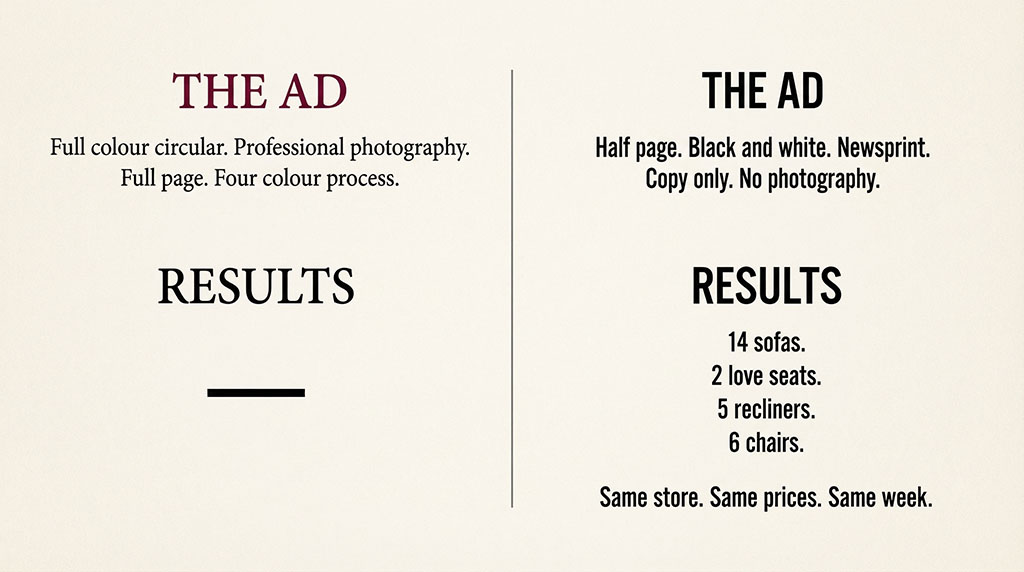
Charles Prince had high expectations. The full-color circular looked magnificent — luscious photographs of leather sofas, professionally printed on slick paper, mailed to homes across Nashville. His new leather gallery sat front and center in the store, prime position just inside the main entrance.
The customers didn’t come.
Perplexed, he called the Bedells for counsel. Their answer should have been obvious, but apparently wasn’t: beautiful pictures don’t sell furniture. Words sell furniture. Specifically, the right words — the ones that answer the only question a prospect actually cares about: what’s in it for me?
So they ran a different ad. Vertical half-page, black and white, regular newsprint. Copy that sold the leather. Same merchandise. Same prices. Same store.
Fourteen sofas. Two love seats. Five recliners. Six chairs with ottomans.
The gallery was cleared.
Design-First Has a Coherent Argument
You’re not wrong that design matters. Great design stops the scroll. The right image earns attention before a single word is read. Clyde Bedell himself — the advertising consultant who cleared Charles Prince’s gallery — hired the best illustrators in the country when he became Advertising Manager at Marshall Field’s. He wasn’t anti-design. He understood that a photograph or illustration gets seen, briefly, by virtually everyone who turns the page. In a fraction of a second, it either earns the next step or loses it.
The modern case for design-first advertising is coherent: in a world drowning in content, visual identity is the shorthand that builds recognition, trust, and preference before the sales conversation even starts. Beautiful ads prime the pump. They signal quality. They do slow brand-building work that copy alone can’t.
Most agencies are built around this thinking. Most clients accept it. It has the ring of sophistication.
The Flaw Nobody Names
Here’s the problem: nobody checks.
I have spent 20 years watching creative teams present work, defend work, refine work, and celebrate work. In those 20 years, I have never once seen a designer come back into the room with the conversion data. They come back with the concept rationale. The aesthetic brief. The mood board logic. Sometimes, if things went well, the award entry.
Results happen somewhere else — in a performance spreadsheet someone in a different department runs — or they don’t happen at all.
Ask yourself: when did your designer last ask what happened after the ad ran?
Barrie Bedell, son of advertising legend Clyde Bedell, described the problem plainly. People with design software skills, he said, “have grown like fungus” — people who’ve mastered the craft of making things look good, with no framework, and often no interest, in whether the thing sells.
This isn’t a character flaw. It’s a structural one. Designers are measured on what they can control: execution, composition, typography, whether the work gets noticed by peers. Nobody hands them a CPA report six weeks after launch. Nobody connects their creative decisions to the revenue line.
So they optimise for the thing they can see.
The result is an industry full of people making high-confidence creative decisions in a complete information vacuum.
Sixty Years of the Same Experiment
Sears paid $1.9 billion for Land’s End in 2002. Land’s End was a catalog business — built entirely on long-form copy that sold product, feature by feature, benefit by benefit. Dense, specific, relentlessly customer-focused writing that moved merchandise at scale.
Sears took that business and ran picture ads with no copy. They never asked why Land’s End worked. They saw good merchandise and assumed the merchandise would sell itself.
They tried to unload Land’s End for $1.2 billion. Seven hundred million dollars in brand value, destroyed by removing the words.
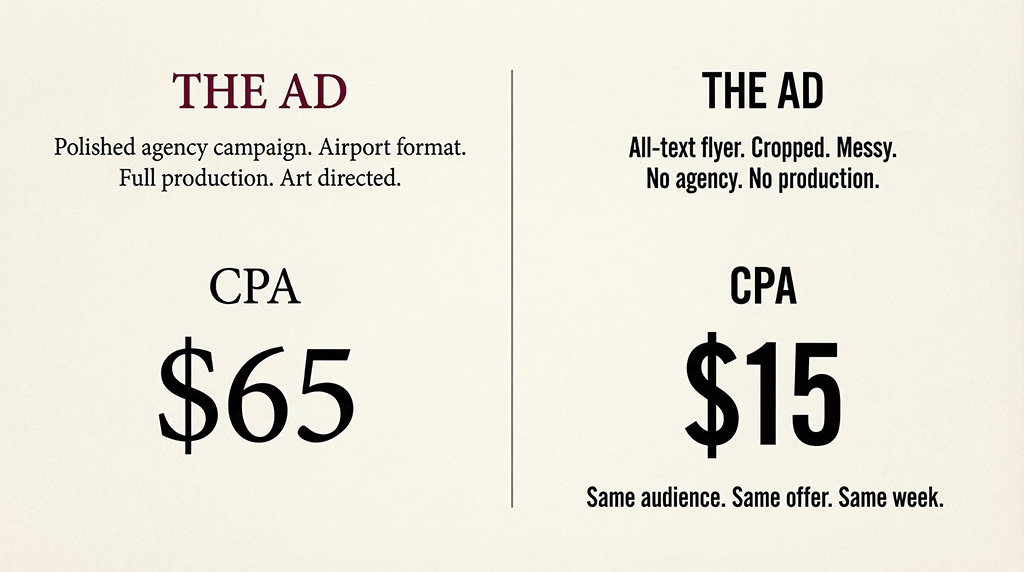
Now here’s a more recent example. An online education client came to us after working with another agency. That agency had been running polished campaigns — what you’d call airport ads. The kind you see on a billboard or in a magazine spread. Image. Catchy headline. Brand colours dialled in. Cost per lead: $65.
The client posted one of our flyers to their own Facebook page. All text. An offer. And here’s the detail that makes this useful: they posted it wrong. It was cropped. Messy. The kind of thing a graphic designer would wince at.
Cost per lead: $15.
A broken, ugly, text-heavy flyer — accidentally disfigured in the posting — outperformed a polished agency campaign by more than four to one. Not because design doesn’t matter. Because copy, a real offer, and someone who’d thought about the reader’s question — what’s in it for me? — matter more.
That gap, from $65 to $15, has a name. It’s what you pay when aesthetic decisions get made without a feedback loop.
Those figures are from my own client account. Unaudited, and one business’s results — not a benchmark, and not a promise.
This Doesn't Mean Ugly Wins
Here’s where the contrarian position earns its credibility by being honest about its limits.
Design genuinely does work. The right illustration captures the right prospect in a fraction of a second. A badly designed ad can bury a strong message just as effectively as weak copy buries a strong visual. Nobody serious is arguing for deliberately ugly ads.
And “we do both” is real. Some agencies have integrated teams where copy and design iterate together against a shared outcome metric. Some clients have internal teams who close the loop. That work is worth paying for.
But “we do both” and “someone is accountable for both” are not the same sentence.
The question isn’t whether your agency values copy and design in theory. It’s whether the same thinking that wrote your headline also determined your layout. Whether the person who made the visual decision ever looked at what it produced. Whether, when the results came in, anyone in the creative team was in the room.
Charles Prince’s color circular looked beautiful. It failed completely. The designer who made it almost certainly never found out.
The 60-Year Gap
Sixty years separate Charles Prince’s empty leather gallery from that cropped, mangled Facebook flyer.
The gap between them isn’t technology. It isn’t platform, targeting, or creative sophistication. It isn’t even talent.
It’s accountability.
One person asked what the ad actually needed to do. One person thought about the leather sofa buyer sitting at home, asking what’s in it for me? One person connected the creative decision to the result.
Ask your designer what happened to the last ad they made.
Watch what they say.
Your marketing, looked at properly
Thirty minutes on your current setup — what’s working, what’s quietly leaking budget, and what I’d fix first. You’ll leave with a clearer picture whether we work together or not.
Got something specific bugging you? Flag it when you book and I’ll have it looked at before we talk.

AboutBruce Marjoribanks
Bruce Marjoribanks has spent 27 years in marketing, including building, running and selling his own agency before going independent. He now runs every channel - paid, organic, social, email, creative and automation - as one integrated system, with AI ehancing production and the judgment staying human.