
The ad is printed. The email is sent. The campaign is live.
Nothing is happening.
Not yet. Not until the ad gets off the page.
The most important idea in advertising that nobody talks about
Clyde Bedell spent forty years watching ads fail. Not fail obviously — not zero clicks, not zero response. Fail quietly. Fail expensively. Fail while the people who made them pointed at delivery numbers and called it a job well done.
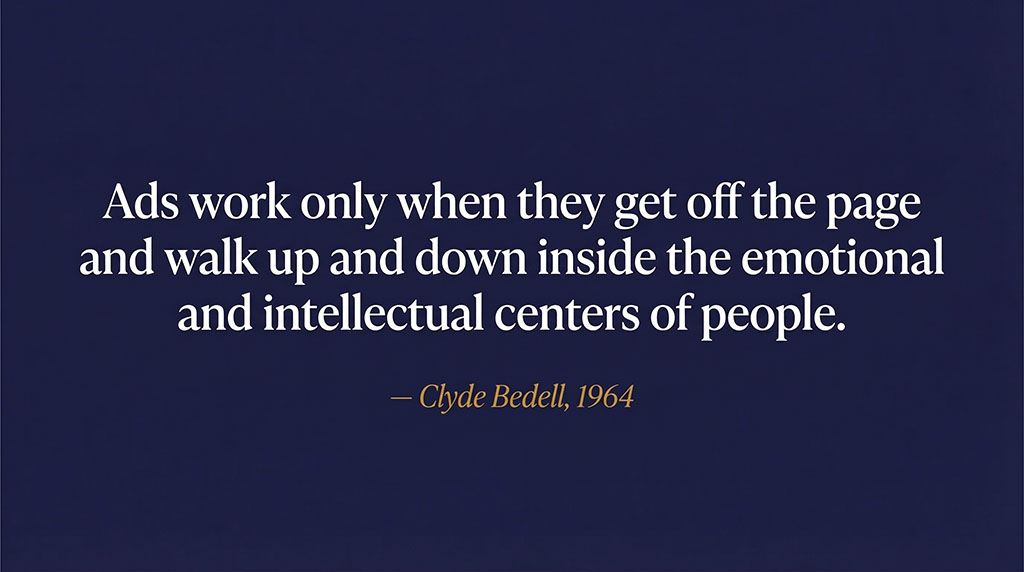
His diagnosis was precise: “Ads work only when they GET OFF THE PAPER and walk up and down inside the emotional and intellectual centers of people.”
Read that again. Walk up and down inside.
The ad sitting on the page is not working. The email sitting in the inbox is not working. The post sitting in the feed is not working. The artifact — the thing you made, the thing you paid for, the thing you can point to and say “we ran that” — is inert. It is doing nothing. It is white space with words on it until it makes the journey from the page into the mind of a specific human being.
Relatively few ads make that journey. Bedell knew it in 1964. The number hasn’t improved.
Delivery is not penetration
Here is the confusion that costs the marketing industry more money than any other single mistake.
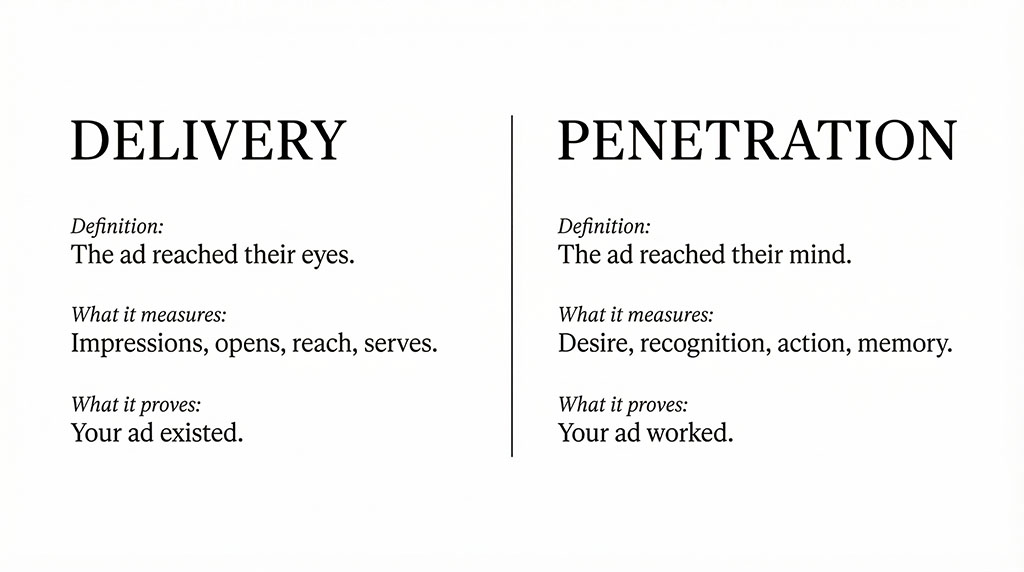
Delivery is the ad reaching someone’s eyeballs. An impression. A send. A serve. These are measurable, reportable, and almost entirely meaningless as indicators of whether your ad is working.
Penetration is the ad getting off the page. Walking up and down inside the emotional and intellectual centers of a specific person who might buy. Changing something. Creating desire, or urgency, or recognition, or need. These are harder to measure — and they are the only thing that actually matters.
Most marketing measurement tracks delivery. It counts the impressions, the opens, the reach. It benchmarks those numbers against industry averages and reports improvement or decline. It almost never asks the prior question: did this ad actually get off the page?
The answer, most of the time, is no.
The average person is exposed to thousands of messages daily. The mind has developed extraordinary defenses against all of them. It scans, dismisses, moves on. “Move on, move on,” Bedell wrote, describing the mental traffic cop that governs attention. Only rarely does it say: “Stop and read.”
Your ad represents a fraction of a fraction of what a person’s eyes will touch in a week. Most of it — virtually all of it — stays on the page.
The benchmark that measures collective failure
Most marketers push back here. The pushback is worth taking seriously.
We have proof people engaged. 40,000 impressions. 8% engagement rate. Above industry benchmark.
This sounds like evidence. It isn’t.
An industry benchmark measures what everyone else’s content also failed to do. When the average email open rate is 21%, that number doesn’t tell you that 21% of recipients were penetrated by the message. It tells you that 21% opened it. Most of them read the subject line and moved on. The ad never got off the page. It just got slightly further than the ads that didn’t get opened at all.
Beating the benchmark means you’re failing slightly less than your competitors. It does not mean your ad is walking up and down inside anyone’s emotional and intellectual centers.
Bedell was almost contemptuous of this kind of thinking. The professional, he argued, doesn’t want to beat the average. The professional asks whether the ad could have penetrated more deeply, reached more of the right people, moved more of them to act. The benchmark is irrelevant to that question. It’s a comparison to other people’s mediocrity.
What it looks like when an ad actually gets off the page
Bedell documented this. It’s worth knowing what it looks like, because most marketers have never seen it — or haven’t recognised it when they have.
When an ad genuinely gets off the page, readers re-read it. They cut it out. They show it to someone else. They come back to it days later. They walk into the store already sold, already certain, already knowing what they want — because the ad did its work days or weeks before they arrived.
He described stores that ran this kind of copy reporting not just increased response, but sustained response. The second and third weeks stronger than the first. Prospects keeping the ad, re-reading it, talking it over before coming in to buy.
That is penetration. That is an ad that got off the page.
It doesn’t happen by accident. It doesn’t happen because you hit publish. It happens because the ad was built to make the journey — built to stab, as Bedell put it, “the just right words into their busy, harassed, preoccupied lives.” Built to flash an idea that’s appealing and pertinent to a need or desire. Built to claim the center of the stage and shut everything else out for a few moments.
Most ads are not built that way. They are built to exist. To be deliverable. To clear the brief and hit the deadline and generate the report.
The question your brief isn't asking
The application is uncomfortable — but it’s simple.
Before you write a word of copy, design a single frame, or set a single targeting parameter, ask this: What would it take for this ad to get off the page?
Not: what’s the click target? Not: what’s the budget? Not: what’s the timeline?
What would it take for this specific ad to walk up and down inside the mind of the specific person we’re trying to reach? What does she need to feel? What does he need to recognise? What belief needs to shift, what desire needs to be named, what question needs to be answered — before this thing moves from inert artifact to working advertisement?
That question changes what you make. It changes the copy. It changes the creative. It changes what you cut and what you keep. An ad built to get off the page looks different from an ad built to be delivered — because it was made for a mind, not a medium.
Bedell’s three requirements for every ad were interest, persuasion, and communication with utmost clarity. Not reach. Not frequency. Not brand consistency across channels. The first job was always the same: get off the page.
The email has been sent. The campaign is live. The post is up.
Somewhere, right now, a specific person is scanning a feed, an inbox, a page. Their mental traffic cop is running. Move on, move on, move on.
Your ad is in there somewhere. Sitting on the page.
The only question that matters is whether it’s about to get off it.
Most won’t. The ones that do — those are the ones that sell.
Sixty years ago, Bedell knew why the others stayed on the page. The answer hasn’t changed. We just got better at measuring the failure and calling it performance.
Your marketing, looked at properly
Thirty minutes on your current setup — what’s working, what’s quietly leaking budget, and what I’d fix first. You’ll leave with a clearer picture whether we work together or not.
Got something specific bugging you? Flag it when you book and I’ll have it looked at before we talk.

AboutBruce Marjoribanks
Bruce Marjoribanks has spent 27 years in marketing, including building, running and selling his own agency before going independent. He now runs every channel - paid, organic, social, email, creative and automation - as one integrated system, with AI ehancing production and the judgment staying human.