
The report landed in your inbox on a Tuesday. Impressions up. Click-through rate improved. Cost-per-click down 11%. The agency was clearly pleased with themselves.
You read it twice trying to find the part that explained why revenue hadn’t moved.
That gap — between what agencies measure and what business owners actually need — has a name. Most people in marketing have never heard it. A philosopher named Schumacher identified it in 1977, and it explains almost everything that’s broken about how small businesses buy marketing today.
He called it the difference between convergent and divergent problems.
The Split Nobody Told You About
Convergent problems have correct answers. The more intelligent people study them, the more their solutions agree. Bid optimisation is convergent. Keyword selection is convergent. Audience segmentation, subject line testing, retargeting sequences — all convergent. They have right answers. Given enough data and processing power, those answers are findable.
Divergent problems don’t work that way. What does this business actually stand for? Which customer problem is worth solving before all the others? Why does one customer stay loyal for a decade while another identical customer churns after 90 days? Push any single answer to its logical conclusion and it starts breaking down. These problems require judgment — the capacity to hold competing truths simultaneously and make a call anyway.
Here’s what AI has done: it has become the most powerful convergent problem-solver ever built. Faster than any team. Cheaper than any specialist. It doesn’t miss a signal. It doesn’t need a briefing document.
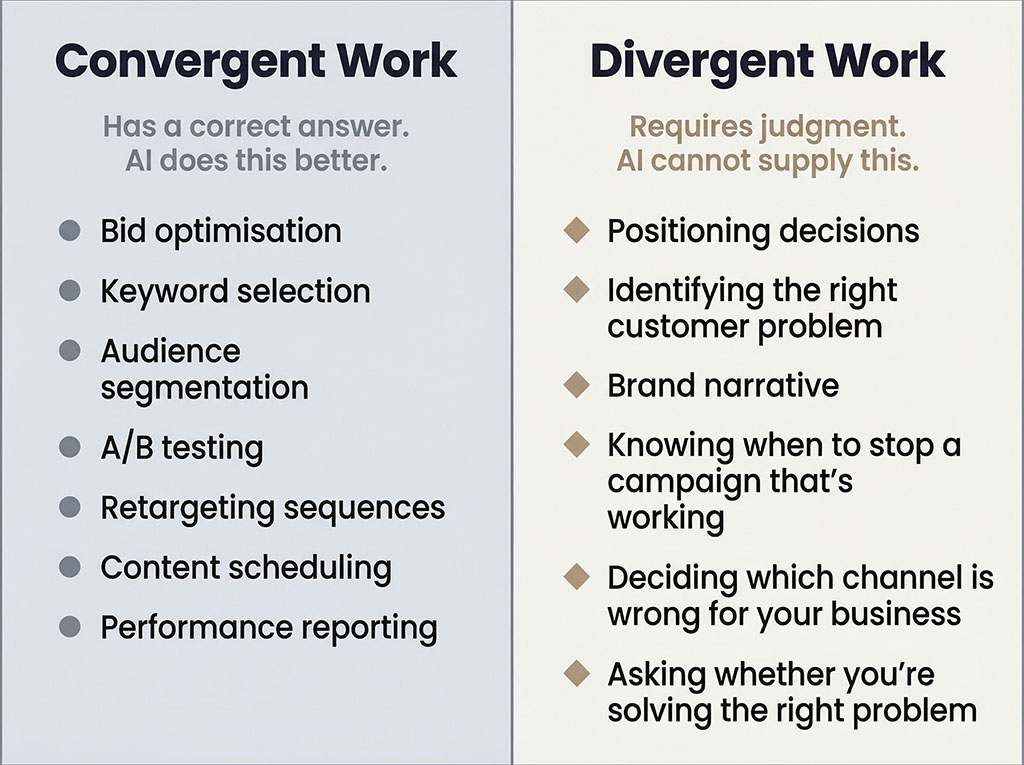
Which means the entire category of convergent marketing work — the work with correct answers — has collapsed in value. Not declined. Collapsed. The click-through rate optimisation your agency charges four figures a month to manage? A well-configured AI system does it better. The audience segmentation your strategist spent two weeks building? A model trained on your own data produces something more precise in hours.
This isn’t a future risk. It’s the current market.
What's Actually on Your Invoice
Most of what gets sold to small businesses as marketing is convergent work. Not because agencies are dishonest — though some are. Because convergent work is what’s easiest to invoice, easiest to report on, and easiest to defend in a quarterly review. Impressions. Click costs. Open rates. These are the metrics of convergent problems well-managed.
The divergent work — figuring out whether you’re solving the right problem before you solve it efficiently — doesn’t produce a clean slide. It produces a decision. Sometimes an uncomfortable one. Often one that changes what you do with the convergent work entirely.
Most small business marketing budgets have never bought that. They’ve bought execution dressed up in strategic language. Persona documents that are surveys with nicer formatting. Competitive audits that produce a positioning grid nobody updates. Channel strategies that are really just budget allocation recommendations.
Strip the language away and ask the harder question: of everything you paid for last month, how much of it had a correct answer that a sufficiently powerful system could now find faster and cheaper?
The Part Where You Think You're Fine
This is where most people’s thinking stops. AI is coming for the cheap stuff. My agency does the real work. I’m fine.
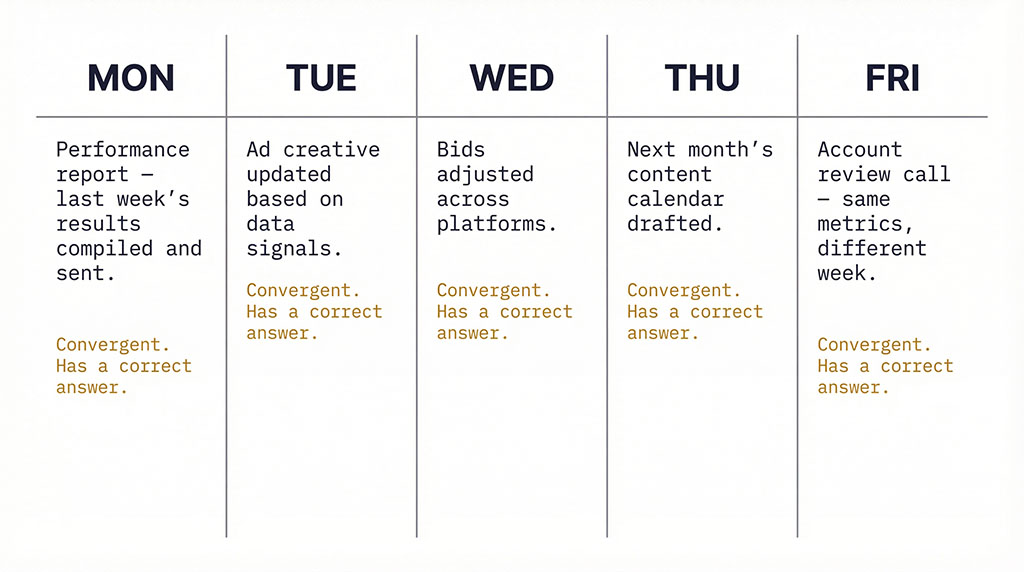
But consider what “the real work” actually looks like week to week inside most agencies managing your account. Monday: reporting on last week’s performance. Tuesday: updating ad creative based on what the data said. Wednesday: adjusting bids. Thursday: building next month’s content calendar. Friday: account review call.
These are convergent tasks. Every one of them. They have correct answers. Some agencies are better at finding those answers than others — but the answers exist, and AI is systematically getting better at finding them at a fraction of the cost.
Divergent work looks different. It’s the conversation where someone tells you your funnel is fine but you’re selling to the wrong customer. It’s the realisation that your best clients share a characteristic your targeting has never captured. It’s the decision to stop optimising a campaign that’s working on paper and burning your positioning in the market.
That work doesn’t generate a report. It generates a reckoning.
Why Better Tools Don't Fix This
Schumacher’s insight, applied here, is simple: you cannot solve a divergent problem by getting better at convergent tools. Running more A/B tests does not reveal whether you’re solving the right problem. Better attribution modelling does not tell you whether your positioning is eroding your margins. A lower cost-per-click does not mean you’re winning.
The businesses that will navigate the next five years aren’t the ones who find cheaper ways to do convergent work — AI has already solved that problem for anyone willing to use it.
They’re the ones who finally start buying divergent work. The kind where someone is accountable not for the click, but for the question underneath the click.
Back to that Tuesday report. Impressions up. CTR improved. CPC down 11%.
The right question was never why revenue hadn’t moved. The right question was why nobody asked that before the campaign launched.
That’s the job that still requires a human. It’s also, notably, the one you’ve probably never paid for.
Your marketing, looked at properly
Thirty minutes on your current setup — what’s working, what’s quietly leaking budget, and what I’d fix first. You’ll leave with a clearer picture whether we work together or not.
Got something specific bugging you? Flag it when you book and I’ll have it looked at before we talk.

AboutBruce Marjoribanks
Bruce Marjoribanks has spent 27 years in marketing, including building, running and selling his own agency before going independent. He now runs every channel - paid, organic, social, email, creative and automation - as one integrated system, with AI ehancing production and the judgment staying human.