
Five faces stared back at the business owner across the conference table. The account manager opened with a warm introduction, shuffled some papers, and then — nothing. She sat there for the next fifty minutes like an extra on a film set, occasionally nodding, while four specialists took turns explaining whether numbers went up or went down.
That single meeting cost the client roughly $1,000. Not the ongoing work. Just the meeting. The account manager’s contribution to that thousand dollars was the greeting.
But the meeting isn’t the real problem. The meeting is a symptom. The real problem is what that account manager’s existence on the org chart tells you about the agency you’re paying: they haven’t updated their model since the Obama administration, and you’re funding the overhead of a structure that stopped making sense the moment Slack replaced conference rooms.
If your agency still has account managers, that’s not a staffing choice. It’s a red flag.
The role that exists to justify itself
Let’s be precise about what an account manager actually does in a typical agency.
A client sends a question about their Google Ads performance. The account manager doesn’t know the answer — they’re not a specialist in any channel. They’re not hired for technical knowledge. So they forward the question to the internal Google Ads specialist. The specialist writes a response. The account manager lightly rewords it, maybe adds a pleasantry, and sends it back to the client.
Client to account manager. Account manager to specialist. Specialist to account manager. Account manager to client. Four steps for a conversation that needed two.
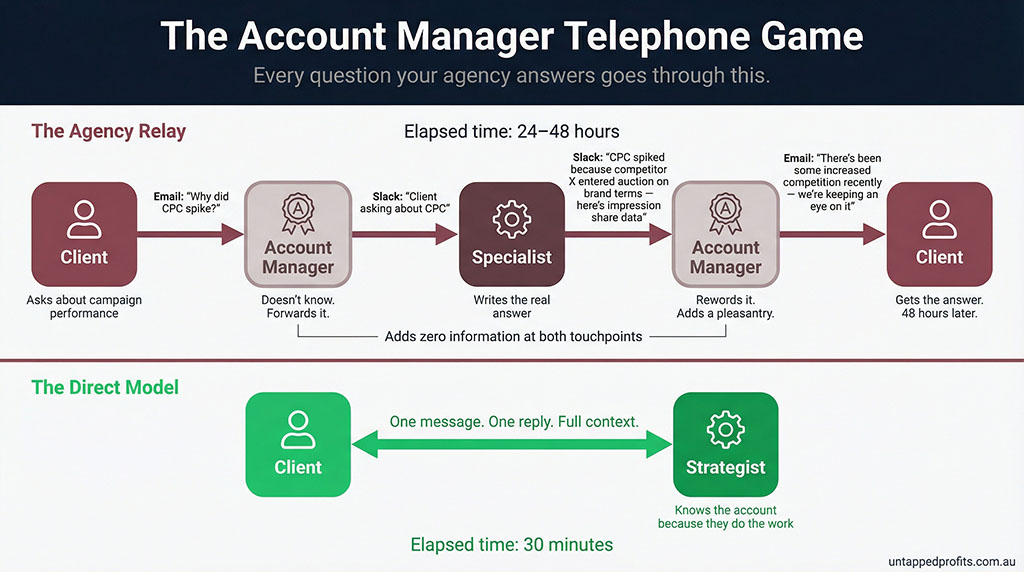
You’re paying premium agency rates for a human email relay.
Outside of that relay function, account managers schedule meetings, compile reports from other people’s data, and — this is the part that should bother you — have a single KPI that matters to the agency: client retention. Not campaign performance. Not revenue growth. Not return on ad spend. Retention. Their job is to keep you from leaving, not to make your marketing work.
Think about what that incentivises. An account manager isn’t motivated to tell you something’s broken. They’re motivated to make you feel like everything’s fine. That’s not a partner. That’s a professional reassurance service.
The maths your agency hopes you never do
A $1,500 monthly Google Ads retainer at standard agency rates works out to roughly $180 per hour. That buys about eight hours of work per month.
Sounds reasonable. Until you see where those hours actually go.
The monthly client meeting — the one with the account manager, the Google Ads specialist, maybe a designer and a strategist all on screen — burns an hour. Internal meetings where your account is discussed eat another. Pre-meeting prep and post-meeting notes chew through at least one more. Progress reporting, those beautifully formatted PDFs that tell you what Google Analytics already shows for free, takes another hour or two.
You’re down to three or four hours of actual Google Ads work. Maybe.
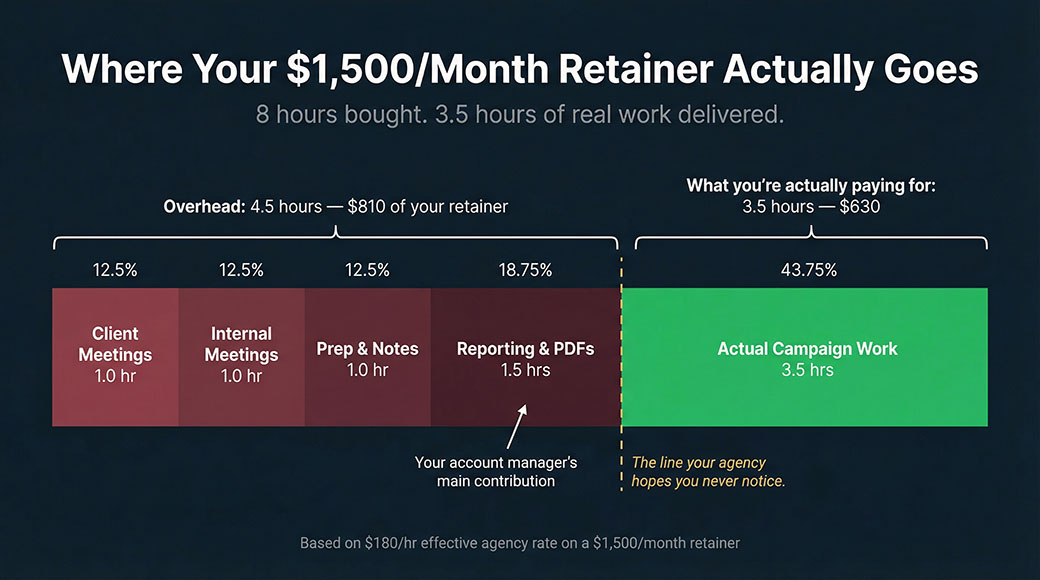
Three hours per month. That’s not enough time to run a proper search term analysis, let alone conduct creative strategy reviews, competitor research, or the kind of deep data audits that actually shift performance. So what fills those three hours? Busy work. Minor bid adjustments. Swapping one ad headline for another. The kind of activity that looks productive in a timesheet but produces nothing measurable.
And who scheduled all those meetings that ate your retainer? The account manager.
That’s one channel. One $1,500 retainer bled dry of real working hours. Now multiply it across every “specialist” your agency claims to have — SEO, Meta, TikTok, email, content. The same meeting bloat. The same reporting theatre. The same account manager booking the same calls, eating the same hours, across every line item on your invoice. Each channel is supposedly getting dedicated expertise. Each channel is actually getting three hours of real work buried under the same coordination overhead. You’re not paying for a team of specialists. You’re paying for a team of part-timers managed by someone who couldn’t do any of their jobs.
What "a team of specialists" actually means
Here’s how the pitch goes. The agency tells you that you’ll have a dedicated team: an account manager, a Google Ads specialist, a Meta specialist, maybe an SEO consultant and a content person. It sounds impressive. Five people on your account.
In practice, it means five people who never talk to each other about your business except in a monthly meeting the account manager booked, where they each get ten minutes to say whether their numbers went up or down.
Your Google Ads specialist is optimising Google Ads. Your Meta specialist is optimising Meta. Your email person is optimising email. Nobody is looking across all channels asking the question that actually matters: where should the next dollar go for maximum revenue impact?
That question can’t be answered from inside a single channel. It requires someone who sees the entire business — the funnel, the margins, the seasonal patterns, the competitive dynamics. Account managers can’t answer it because they lack technical depth. Channel specialists can’t answer it because they lack cross-channel visibility.
One of my clients, Swimming Pool Kits Direct, came from a national agency that pitched exactly this “team of specialists” model. What they actually had was an account manager sitting on top of outsourced freelancers producing mediocre work that nobody internally was reviewing. The “team” was a fiction dressed up on a slide deck. The account manager was the only full-time person touching the account, and they didn’t know the difference between a broad match keyword and a bathroom tile.
"But someone has to manage the client relationship"
This is the objection every agency owner reaches for. And on the surface, it’s reasonable.
Clients can be chaotic. They send requests at odd hours. They change direction mid-campaign. They need someone who picks up the phone and makes them feel heard. Without a dedicated account manager, who absorbs that chaos? You can’t have a Google Ads specialist fielding calls about brand strategy at nine on a Tuesday night.
Fair enough. But consider why the chaos exists in the first place.
When a client has to brief an account manager, who briefs a specialist, who feeds back to the account manager, who relays it to the client — every step introduces delay, miscommunication, and frustration. The client gets more chaotic because the system forces them to repeat themselves, wait for answers, and deal with someone who doesn’t understand their business at a technical level.
Remove the relay. Put the client directly in front of someone who both understands the strategy and executes the work, and something interesting happens. Calls get shorter. Questions get answered in one exchange instead of four. The “chaotic” client becomes perfectly manageable, because they’re not fighting a bureaucratic structure just to get a straight answer.
The account manager isn’t solving chaos. The account manager is generating it.
What happens when you strip them out
I know the difference because I’ve been on both sides.
Inside agencies, the maximum uninterrupted working time I had in a single month — between client meetings, internal syncs, status updates, and “quick catch-ups” — was two hours. Not two hours per day. Two hours total in the month. Every other block was fragmented by meetings booked by account managers who didn’t care how the work got done, because their KPI wasn’t work quality. It was whether the client was still on the roster next quarter.
That experience is what made me build the opposite model.
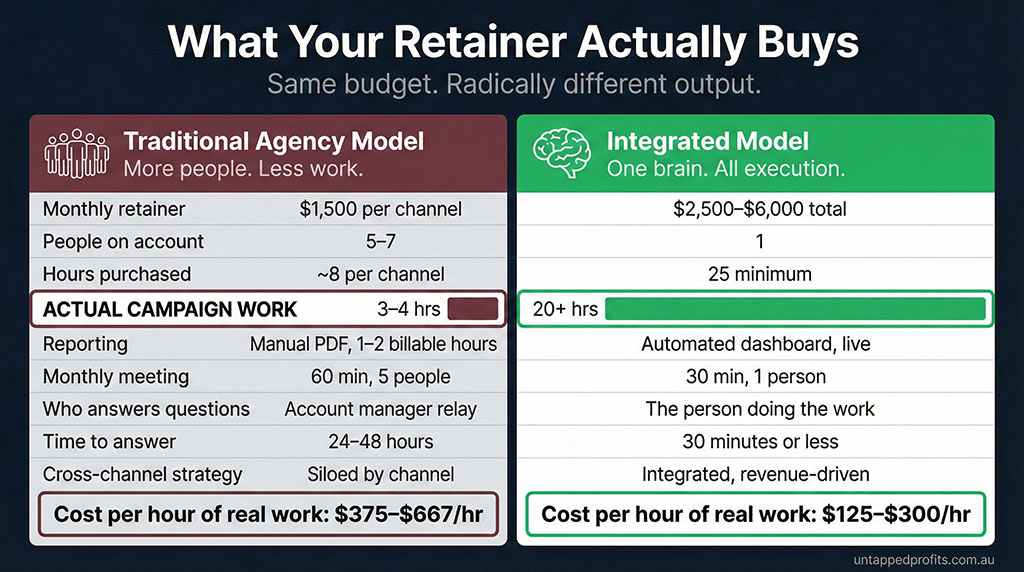
A 25-hour monthly package. One person. All reporting automated — dashboards the client can check any time, not PDFs assembled over two billable hours. The monthly conversation is 30 minutes, not 60. One person on the call who knows the account end to end. Not five people justifying their headcount.
That structure gives a small business 20-plus hours of actual strategic and execution work per month. Not bid tweaks. Not reformatted reports. Deep performance analysis, creative strategy, landing page audits, competitor intelligence, and cross-channel budget allocation based on what’s actually driving revenue.
Sunday Drive — a client running auctions, consignment, finance, vehicle sales, and storage under one brand — is a good example of why this works. The complexity of their marketing is beyond what any account manager could coordinate, because an AM would need to brief five different specialists across five different workstreams and somehow keep the strategy coherent through a relay chain. Instead, one marketer owns the whole picture. Every channel talks to every other channel. Nothing falls between the cracks of a departmental handoff.
The model died. Agencies just haven't buried it.
I’ll give the industry this: twenty years ago, account managers had a reason to exist. Campaign management was manual. Reporting required specialist tools most clients couldn’t access. Communication was slow enough that someone needed to sit between the client and the technical team as a translator.
That world is gone.
Reporting is automated. AI handles the mechanical optimisation that used to eat 60% of a specialist’s time. Communication tools mean a client can message their marketer directly and get an answer in minutes. The infrastructure that justified account managers has evaporated, but the role persists — not because it serves clients, but because it serves the agency’s billing model. More people on the account means a larger retainer looks justified.
If you’re an enterprise with 14 markets and a $2 million monthly spend, fine, you need coordination layers. But if you’re a small-to-mid business spending $5,000 to $20,000 a month on marketing, every dollar that goes to internal coordination is a dollar stolen from the work that actually grows your business.
The five-face test
Next time you’re in an agency meeting, count the faces. Then ask yourself two questions.
First: what did each person in this meeting contribute that couldn’t have been handled in a 30-minute call with one person who actually knows my business?
Second — and this is the one that changes things: of the money I pay this agency each month, how many hours of actual campaign work — not meetings, not reporting, not internal coordination — land on my account?
If the answer is less than half your retainer, you’re not paying for marketing. You’re subsidising an organisational structure that exists for the agency’s benefit, not yours.
That business owner staring at five faces across the conference table doesn’t need a bigger team. They need a smaller one. One strategist. One call. Thirty minutes. And then the actual work that moves revenue.
Account managers had their era. If your agency still employs them, that’s your sign. It’s not a feature. It’s a fossil.
See what your retainer looks like without the relay chain
Map your current agency setup against the integrated model — and find out how many of your retainer hours are going to meetings, reporting, and account management overhead instead of actual campaign work.
Most clients discover they’re getting 3–4 hours of real work from a retainer that should deliver 20. The maths takes 30 minutes. The regret lasts longer.
You don’t need a bigger team on your account. You need a smaller one that actually does the work.