
The meeting always goes the same way.
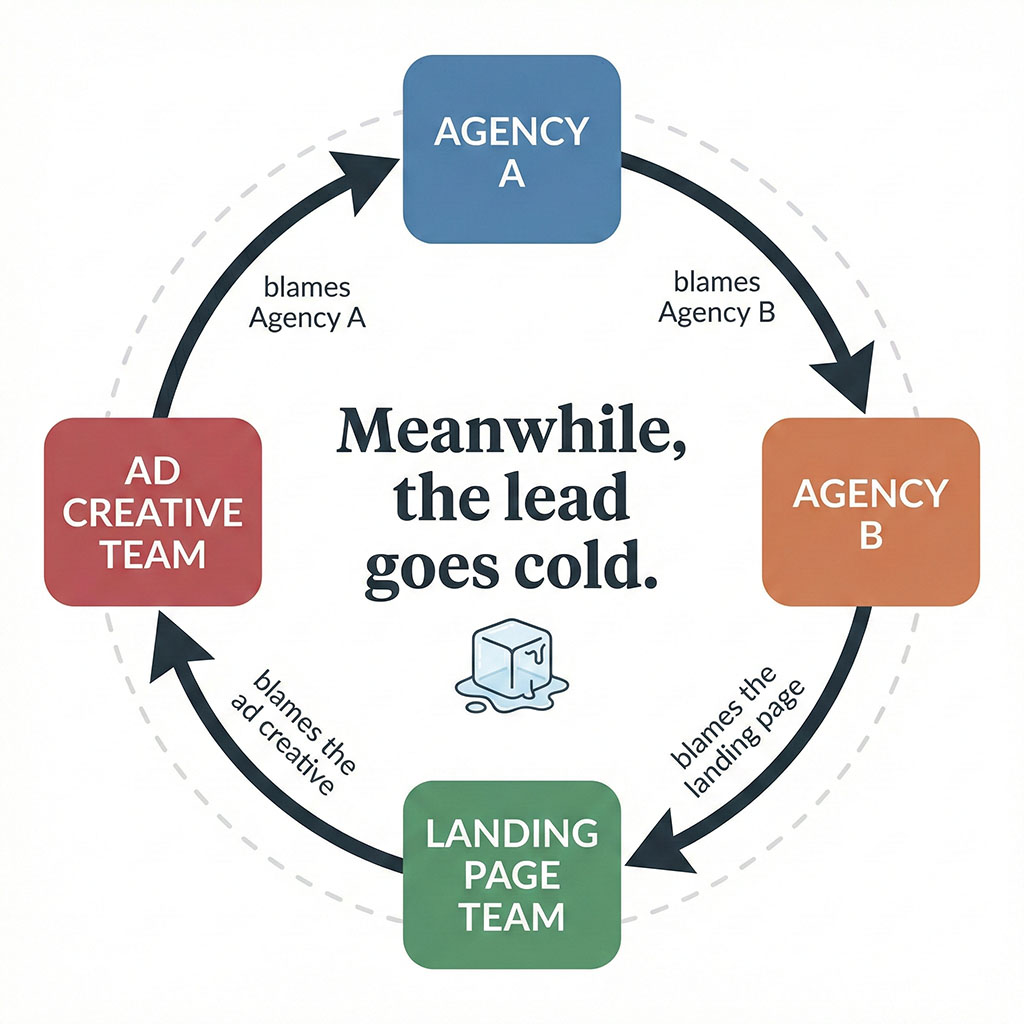
Google Ads manager opens with the dashboard. Cost per click is down. Impressions are up. “Strong month,” he says. Then comes the but. “Facebook is cannibalising our conversions. The attribution is messy.”
The Facebook manager clears her throat. “Our click-through rate is 3.2%—well above benchmark. The problem is the landing page. It doesn’t match the creative we’re running.”
The email team chimes in from the corner. “We can’t nurture what we’re getting. The traffic is unqualified. These aren’t real leads.”
Three agencies. Three dashboards. Three explanations for why the numbers aren’t working. And one business owner sitting at the head of the table wondering who, if anyone, is telling the truth.
You’ve been in this meeting. Maybe you’re in it right now, every month, writing cheques to people who’ve gotten very good at one skill: pointing fingers at each other.
Here’s the part nobody in that room will say out loud: every lead that didn’t convert is a confession—not about the lead, but about the system that touched them.
The lie the entire industry runs on
The default explanation in marketing is comfortable and clean: “The leads were bad.”
It’s the universal get-out clause. Didn’t hit target this quarter? Lead quality. Pipeline dried up? The leads weren’t qualified. Prospects ghosting after the first call? They were tyre-kickers. Shouldn’t have been in the funnel to begin with.
And the industry has built an entire infrastructure to support this story. Lead scoring. MQLs and SQLs. Qualification frameworks with acronyms—BANT, MEDDIC, CHAMP. All designed around the same premise: some leads are good, most leads are bad, and the job of marketing is to sort the wheat from the chaff.
The premise isn’t wrong, exactly. It’s just incomplete in a way that costs you thousands every month.
What the ancient Greeks knew about your conversion rate
There’s an old comparison between two Greek speakers that most people get wrong.
Demosthenes was the polished one. Silver-tongued, meticulous, technically flawless. When he finished a speech, the crowd would say, “What a brilliant speaker.”
Pericles was the rough one. Uneducated, blunt, no rhetorical polish whatsoever. But when he spoke—from deep, bone-level conviction about something that mattered—the crowd didn’t compliment his technique. They stood up and said, “Let us march.”
You know which one most marketing sounds like? Demosthenes. Every single time.
Look at the last five ad campaigns your agency showed you. Beautiful creative. Strong click-through rates. Impressive dashboards with upward-trending lines. And at the end of the presentation, you nodded and thought, “That looks professional.”
But did it make anyone march?
The gap between “impressive” and “effective” is where most marketing budgets go to die. Your agencies are optimising for eloquence—for metrics that look good in a slide deck. Nobody is optimising for the moment a stranger decides to trust you with their money.
That moment doesn’t happen because of a well-designed ad. It happens because every single touchpoint—the ad, the landing page, the follow-up email, the retargeting sequence—tells the same story with the same conviction. And that only works when one brain controls the entire narrative.
When five different agencies each own one piece? You get Demosthenes five times over. Impressive at every stage. Convincing at none of them.
The accountability no one wants to accept
Jay Abraham—the strategist behind billion-dollar growth programmes—has a principle that makes most business owners deeply uncomfortable: if a prospect doesn’t buy, it’s your fault. Full stop.
Not the lead’s fault. Not the market’s fault. Not the economy, or the timing, or the competition. Yours.
The failure, Abraham argues, belongs to whoever couldn’t communicate the value clearly enough, couldn’t demonstrate the outcome convincingly enough, couldn’t reduce the perceived risk sufficiently enough. The prospect had a problem. You had a solution. The gap between those two things? That’s not a “lead quality” issue. That’s a communication breakdown.
Sit with that for a second. It burns.
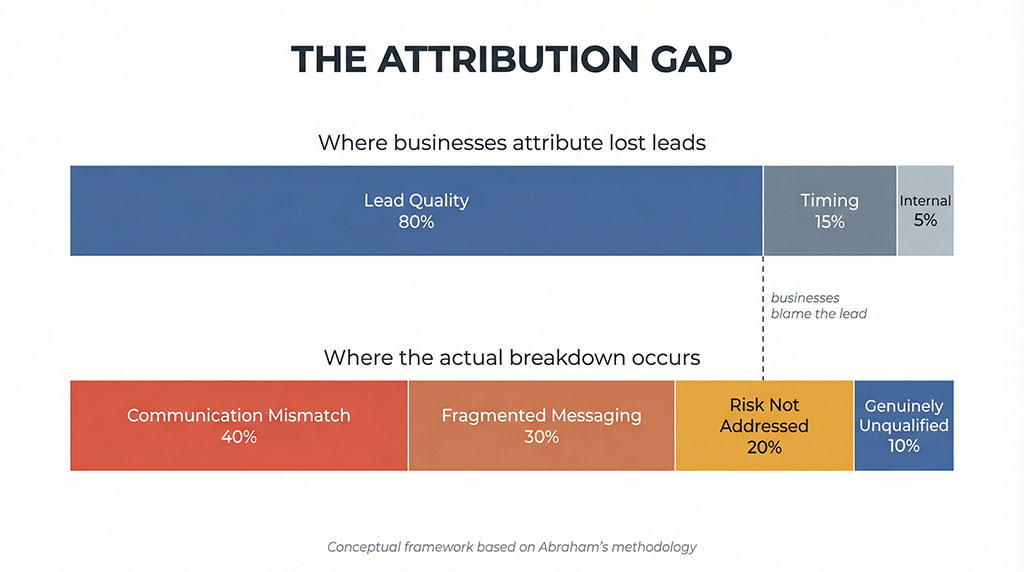
It burns because it means the comfortable story—”the leads were bad”—is actually a confession. It’s your system admitting, in real time, that it failed to do the one job it exists to do: take a stranger with a problem and give them enough clarity, confidence, and trust to act.
And here’s what makes it worse. When you’re running three, four, five separate agencies, nobody is in a position to take that accountability. The Google Ads manager only sees the click. The landing page designer only sees the bounce rate. The email team only sees the open rate. Each one is optimising their fragment and calling it success.
The lead—the actual human being who clicked an ad because something in their life needed fixing—falls through the cracks between dashboards.
"But some of those leads really are garbage"
I know what you’re thinking. And you’re not entirely wrong.
Mickey Mouse does fill in lead forms. People with zero budget do request quotes. Competitors do download your resources just to spy on you. These aren’t messaging failures. These are noise.
If 100% of your unconverted leads were form-spammers and competitors, you’d have a lead quality problem. But that’s never the ratio, is it? It’s maybe five percent. Ten, on a bad month.
What about the other ninety?
Those are real people who had a real problem. They saw your ad—which your Google Ads manager wrote. They landed on your page—which your web team built. They received your follow-up—which your email agency drafted. And somewhere in that chain, the story broke.
Maybe the ad promised speed, but the landing page led with quality. Maybe the landing page asked for a phone number, but the follow-up email felt like it came from a stranger. Maybe the retargeting showed them a discount after they’d already been quoted full price, making them wonder what else you’d been inflating.
These aren’t hypotheticals. These are the exact fractures I find in the first week of every audit. And they don’t happen because anyone is bad at their job. They happen because the jobs were never connected in the first place.
The Google Ads manager is genuinely skilled. The Facebook specialist knows her platform inside out. The email writer crafts solid sequences. The problem isn’t talent. The problem is that talented people working in isolation produce a fragmented experience—and fragmented experiences don’t build the one thing that makes people buy.
Trust.
Trust isn't a feeling. It's a sequence.
Abraham maps out something most marketers never think about: the precise cognitive progression a stranger goes through before they hand over money.
It runs like this: focus → clarity → confidence → understanding → certainty → trust → commitment.
A prospect starts in a fog. They know something’s not working, but they can’t name the exact problem. Your first job—before any pitch, any offer, any CTA—is to give them focus. Name their problem better than they can name it themselves.
You’ve experienced this. You’ve been to a doctor who, in thirty seconds, described your symptoms more precisely than you could after living with them for months. What happened? You trusted them immediately. Not because of their credentials. Because they understood you.
Focus creates clarity. Clarity creates confidence. Confidence becomes understanding. Understanding breeds certainty. And certainty—that feeling of “yes, this is the right move”—is the only thing that produces trust deep enough to open a wallet.
Now look at that sequence and ask yourself: can five disconnected agencies produce it?
Can a Google Ads manager give a stranger focus when he doesn’t know what the landing page says? Can a landing page build clarity when it doesn’t know what the ad promised? Can an email sequence create certainty when it’s never seen the retargeting creative?
Each agency optimises one step. Nobody owns the sequence. And without the sequence, trust doesn’t form. Without trust, leads don’t convert. Without conversions, everyone blames the leads.
The loop closes. The confession continues.
What changes when one brain owns the whole chain
When a single strategist controls every touchpoint—ads, landing pages, email, retargeting, analytics—something shifts that’s hard to quantify but impossible to miss.
The ad doesn’t just generate a click. It pre-qualifies by setting an honest expectation. The landing page doesn’t just capture a form fill. It continues the exact conversation the ad started, in the same voice, with the same promise. The follow-up email doesn’t feel like a stranger wrote it. It feels like the next sentence in a conversation that’s already been going well.
The stranger moves through focus, clarity, certainty, trust—not because you manipulated them, but because you removed every contradiction from their experience.
And when a lead doesn’t convert? There’s no meeting with three agencies pointing fingers. There’s one person who says, “That’s on me. Here’s what I’m changing by Friday.”
That’s not a slogan. That’s the structural difference between a system designed for accountability and one designed for plausible deniability.
Back to that meeting room
Picture the table again. Same business owner. Same open chequebook. But instead of three agencies delivering three dashboards with three excuses, there’s one person sitting across from them.
The numbers aren’t perfect—they never are in the early weeks. But when the business owner asks why a campaign underperformed, the answer isn’t “Facebook stole our attribution” or “the traffic was unqualified.”
The answer is: “The ad-to-landing-page handoff was inconsistent. The promise in the headline didn’t match the proof on the page. I’ve already rebuilt the page. New version goes live Thursday.”
No finger-pointing. No translation required. No wondering who’s telling the truth.
Every lost lead is still a confession. The difference is that now, someone is actually listening to what it’s saying—and fixing it before the next one walks away.
Stop Blaming the Leads. Start Seeing the Breaks.
Your agencies each show you their dashboard. Nobody shows you what happens between the dashboards — the handoffs where trust fractures and leads go cold.
Book Your Free Agency Waste Audit →
In 30 minutes, I’ll map every touchpoint a lead passes through and show you exactly where the story breaks — the ad-to-page mismatches, the follow-up gaps, the channels bidding against each other that nobody caught because nobody could see both.
You don’t need better leads. You need one brain that owns the confession.