
Sam Jones told you himself, over the garden fence, with the confidence of a man who has never been wrong about anything:
“You’ll never catch me getting stuck with a set of books. Matter of fact, I hear the salesman’s still in the neighbourhood. Hope, for his sake, he doesn’t come to my house. He’d never sell me anything in a million years.”
Three days later, Sam Jones spent $400 on the deluxe edition. All the extras.
Harry Browne tells this story in a manuscript written in 1966 and unpublished for forty years. He tells it not to mock Sam — but to make a point so obvious it should end most positioning arguments before they start.
Sam Jones did not buy something he didn’t want.
What Sam Actually Bought
The salesman who knocked on Sam’s door didn’t ask if Sam wanted to buy a set of books. He knew better than that. Sam had already answered that question at the garden fence.
What the salesman did was ask Sam about the local schools.
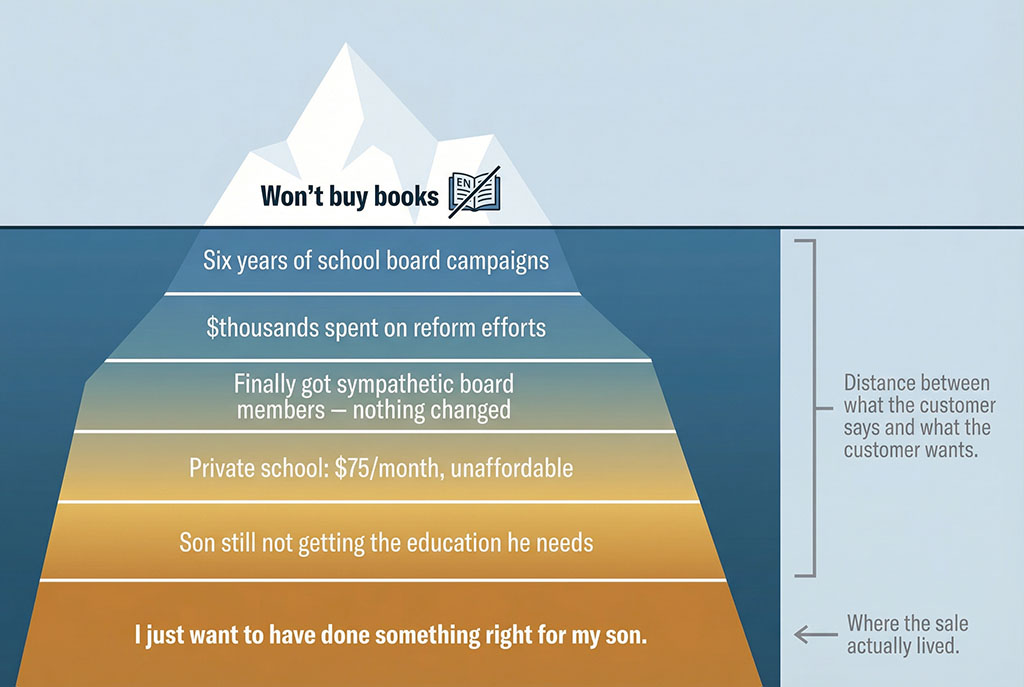
That question opened something. Sam talked for over an hour. He talked about the overemphasis on non-academic subjects. About the years he and his wife had spent campaigning for new school board members — attending meetings, funding elections, writing letters. About how they’d finally got sympathetic members elected and discovered the system was too entrenched to change anyway. Six years of effort, thousands of dollars, and their thirteen-year-old son was still getting an education Sam considered inadequate.
The salesman listened. Then he summarised what he’d heard: what’s needed is a way to give your son the education he’s missing, at a cost far less than $75 a month for private school. Is that about right?
Sam agreed. That was exactly right.
Then — and only then — the salesman introduced the product. Not as a set of encyclopedias. As a supplementary education programme, structured around what Sam’s son was missing, costing $20 a month.
Sam didn’t feel like he’d been sold something. He felt like he’d finally found a way to solve something he’d been failing to solve for six years.
“I didn’t buy a set of books,” Sam would tell you afterward. “I bought a good education for my son — just like I’ve been trying to do for the past six years.”
Browne’s conclusion is blunt: “A salesman cannot change a buyer’s desires; he can only demonstrate better methods of satisfying them.”
The Part That Gets Skipped in the Brief
Every product brief contains a version of the same sentence. It’s usually in the second paragraph, under “Target Audience” or “Customer Insight,” and it says something like: “Our customer is a -demographic descriptor- who wants -product benefit-.”
That sentence is Sam Jones at the garden fence.
It’s the surface statement. The thing the customer would say if you stopped them in the street and asked “what do you want?” It’s accurate enough to pass a research review and almost completely useless for writing creative that actually lands.
Because what Sam said at the fence wasn’t what Sam wanted. What Sam wanted was six years of his life back. What Sam wanted was to stop sitting in school board meetings at 9pm watching nothing change. What Sam wanted was to look at his son and feel like he’d done something useful.
The encyclopedia was a method of satisfying those wants. A new, cheaper, less humiliating method than the one Sam had been using. The moment the salesman found that — the moment he understood what Sam had already been trying to do — the sale was already made. The product presentation was almost a formality.
This is the gap between a brief built on stated desires and a brief built on underlying motivation. One produces creative that describes the product. The other produces creative that recognises the customer — and recognition, as anyone who has ever felt genuinely understood by an advertisement can tell you, converts differently than description.
The B2B Objection (And Why It Doesn't Hold)
Here’s the pushback that arrives at this point, reliably, in every strategy session where someone tries to apply this framework.
“Sam Jones is a consumer making an emotional purchase. Our client sells enterprise software to buying committees who evaluate on rational criteria. There’s no hidden six-year frustration sitting under the surface. Our buyers use feature matrices.”
The feature matrix is Sam Jones at the garden fence. Just in a spreadsheet.
The buying committee member who chairs those evaluation sessions has a reason she’s chairing them. There’s a problem she’s been trying to solve for longer than this procurement process has existed. There’s a way her current solution is failing her that she mentioned to her manager twelve months ago and was told wasn’t a priority. There’s a thing she’s been unable to prove to the CFO for three quarters running.
Find that thing, and the feature matrix is suddenly a different conversation. Not because you manipulate her — but because your product stops being a line item on a comparison chart and becomes the answer to a question she’s actually been asking.
This is what Browne called “finding the prospect’s motivation.” The mechanism is identical in B2B and consumer contexts. The surface statement differs. The structure of what’s underneath it doesn’t.
The salesman who sold Sam Jones knew this. He didn’t knock on the door and ask if Sam wanted an encyclopedia. He asked about the schools. He asked what Sam had tried. He asked what was missing. He was looking for the same thing your best account managers look for when they do discovery calls properly — the real question, buried under the stated one.
The difference is that most briefs are written from the surface statement. And most creative is made to answer the surface statement. Which is why it performs the way it does.
Writing the Brief That Finds Sam
The question a brief built on Browne’s principle asks is different from the standard one. Instead of “what does our customer want?” it asks “what has our customer already been trying to do, and why hasn’t it worked yet?”
That’s a research question before it’s a creative question. It requires actual conversations with actual customers — not to ask them what they want, but to ask them what they’ve tried. What they were doing before this product existed. What kept failing. What they’d given up on.
The answers almost never match the stated desire. They’re messier, more specific, more emotionally charged. A customer who says they want “better project visibility” is almost always a manager who got blindsided by a missed deadline in front of someone they needed to impress, and never wants to feel that again. Find that — not the stated desire, but the originating failure — and you have something to write from.
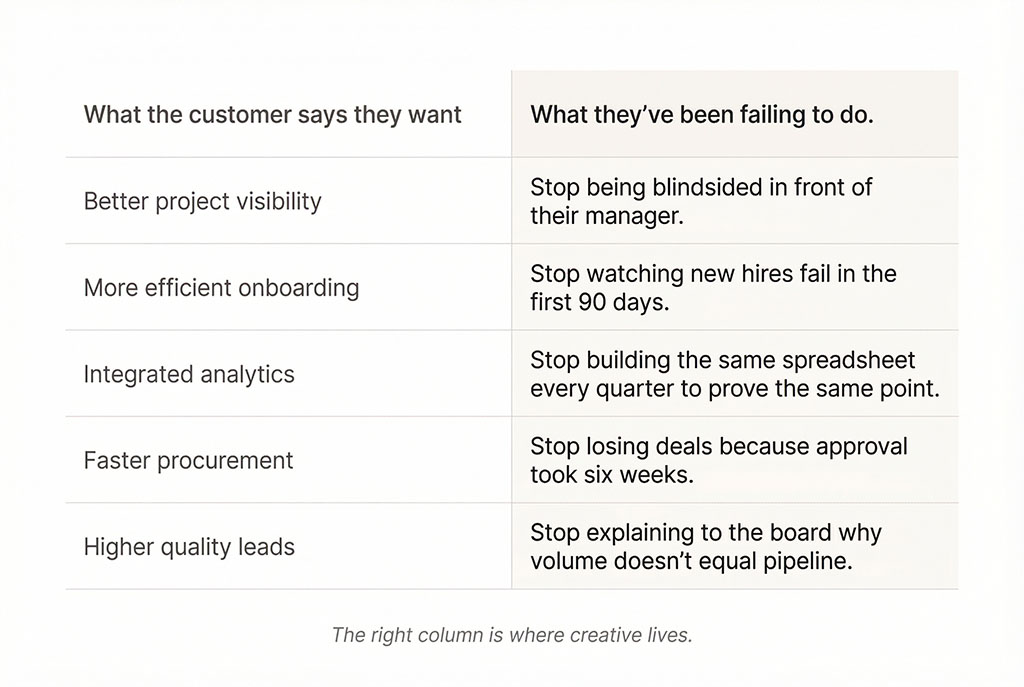
The creative direction shifts entirely. You stop writing about features and start writing about recognition. You stop saying “here’s what our product does” and start saying “here’s the thing you’ve been carrying around that we can actually help with.” That’s the difference between advertising that interrupts and advertising that arrives.
Sam Jones wasn’t sold an encyclopedia. He was found.
What Sam Saw on the Shelf
The salesman left with a cheque and a list of employees. Sam went home with two years of monthly folders, a structured curriculum, and the first concrete plan he’d had since the school board campaigns started failing.
He didn’t think of himself as someone who’d bought something. He thought of himself as someone who’d finally done something right for his son.
That’s the sale. Not the product — the before and after. Not the feature set — the resolution. Not what the brand makes, but what the customer has been failing to make happen without it.
The next time a brief says “our customer wants -product benefit-,” remember Sam at the fence. That’s the surface. The brief worth writing is the one that goes six years deeper.
Your marketing, looked at properly
Thirty minutes on your current setup — what’s working, what’s quietly leaking budget, and what I’d fix first. You’ll leave with a clearer picture whether we work together or not.
Got something specific bugging you? Flag it when you book and I’ll have it looked at before we talk.

AboutBruce Marjoribanks
Bruce Marjoribanks has spent 27 years in marketing, including building, running and selling his own agency before going independent. He now runs every channel - paid, organic, social, email, creative and automation - as one integrated system, with AI ehancing production and the judgment staying human.