
The brief landed on a Thursday. Page four, third bullet, twelve words that contain the entire mythology of modern marketing:
“Campaign objective: create demand where none currently exists.”
Nobody in the room questioned it. The strategist nodded. The creative director opened a new Figma file. The account lead started building a timeline. Six weeks of work, a respectable media budget, and a campaign that did everything the textbooks said — awareness at the top, consideration in the middle, a conversion push at the bottom. They educated the market. They built the narrative. They moved the needle.
By 4%.
The product manager called it a success. The account lead had a different feeling she couldn’t quite name.
Harry Browne could have named it in 1966. He’d watched it happen a thousand times.
The Salesman Who Worked 20 Hours a Week
“Probably 99 out of 100 salesmen try to motivate their prospects,” Browne wrote in a manuscript that sat unpublished for four decades. “And that’s their mistake. You’re not capable of motivating anyone — no matter how persuasive you think you are.”
Browne was a sales consultant and lecturer in Los Angeles at the time, writing during fifteen to twenty working hours a week while routinely outselling everyone around him. He had a simple explanation for why: he stopped trying to create desire in people and started finding the desire that was already there.
His reasoning was almost philosophical. Every human being, Browne argued, operates from a fixed set of motivations — the accumulated hopes, fears, plans, and wants built up over a lifetime of experience. Those motivations don’t develop in a single afternoon because a salesperson made an interesting case. They were already there before you walked in the room. The prospect had been carrying them around for years.
Which means the question was never “how do I motivate this person?” It was always “what motivates this person, and does what I’m offering connect to it?”
What "Demand Generation" Actually Gets Wrong
This is not a subtle distinction. It reshapes everything.
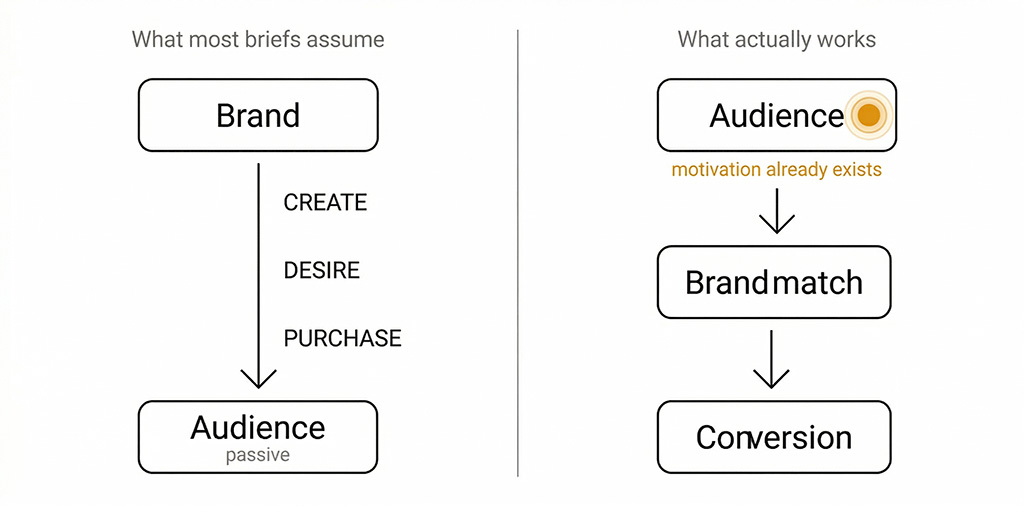
When a brief says “create demand,” it’s built on the assumption that desire is something you manufacture and inject into a market. You build the right message, reach the right people often enough, and eventually — through the sheer weight of repetition — you install a want that wasn’t there before.
Browne thought this was a category error. You can’t install a motivation. You can only surface one that was already running. Think about the last product you bought without being consciously in the market for it. Go back and look at what was actually happening in your life when you bought it — the problem you were already trying to solve, the thing you’d been vaguely dissatisfied about, the upgrade you’d been half-considering for months. The advertisement didn’t create that. It arrived at the right moment for a motivation that was already doing the work.
The campaign that appears to “create” demand is almost always doing something different: it’s reaching people whose existing motivation was already primed, framing a solution they were already looking for, at a moment when they were already looking for it.
The difference matters because one of these is possible and the other is not.
The Apple Objection (And Why It Doesn't Hold)
Here’s where it gets harder.
Apple created the desire for a touchscreen smartphone. Red Bull created the energy drink category. Airbnb convinced people to sleep in strangers’ houses. If you can’t manufacture motivation, how do you explain these?
It’s a fair objection. And it’s where the “demand generation” mythology has its strongest footing. These brands didn’t find an existing market — they invented one.
Except they didn’t.
Apple didn’t create the desire to have the internet in your pocket. That desire had been building since the first person looked at a chunky laptop and thought “this is too much.” The desire to manage your whole life from a single device — to have your calendar, your email, your music, your maps — was already there, fragmented across a dozen inadequate products. Apple didn’t install the motivation. They found it, and then built the first product that could actually satisfy it.
Red Bull didn’t create the desire to stay alert and perform. That desire existed in every long-haul truck driver, every student pulling an all-nighter, every shift worker who needed to be sharp at 2am. Red Bull found a river already flowing underground and gave it somewhere to go.
Airbnb didn’t convince people to value price over comfort — that trade-off existed everywhere, playing out in the minds of every budget traveler who’d ever resented a $300 hotel room for a conference they didn’t want to attend. The motivation was present. The solution wasn’t.
This is the pattern, every time: what looks like “created desire” is actually discovered desire — a motivation that existed but had no adequate outlet. The brand that appears to build a category from nothing is actually building the first product that fits the shape of a motivation that was already there.
Browne saw this in 1966. “A salesman cannot change a buyer’s desires,” he wrote. “He can only demonstrate better methods of satisfying them.”
What This Means for How You Write a Brief
The practical consequences for how agencies do their work are significant. Picture your own client roster. How many briefs are built around what the product does versus what the customer is already trying to do? How much of your audience research is about surfacing existing motivation versus confirming assumed motivation?
The brief that says “create demand” is almost always a brief that starts with the product and works outward — here’s what we make, here’s why it’s good, here’s how we’ll tell people. Browne’s framework inverts this entirely. You start with the customer’s world, find the motivation that’s already running, and then — only then — show how the product fits it. Not as a message, but as a match.
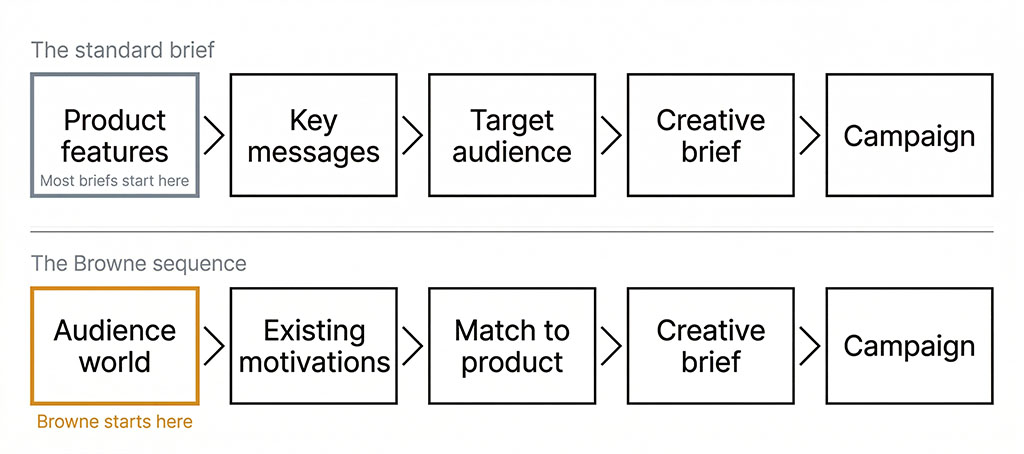
The distinction between these two approaches shows up most clearly in creative direction. When you start from the product, you produce advertising that talks about the product — its features, its benefits, the story of how it was made. When you start from the motivation, you produce advertising that talks about the customer’s world — their situation, their frustration, the thing they’ve been trying to solve. The first kind of advertising requires repetition to work. The second kind resonates on first contact, because it’s recognising something the audience already knows.
This is why some campaigns feel like they’re interrupting you and others feel like they’re reading your mind. It’s not a creative quality difference. It’s a structural one.
The Brief, Reread
Back to that brief. Page four, third bullet.
“Create demand where none currently exists.”
Here’s what the account lead couldn’t name: the demand did exist. Every brief for every product in a functioning market is a brief where demand exists — it’s just unarticulated, scattered across dozens of unresolved frustrations, half-formed wants, and situations that don’t have a good solution yet.
The job was never to create it. The job was to find it, name it, and show up with something that fits.
That’s not a smaller ambition. It’s a more honest one — and a more achievable one. Because you cannot motivate anyone. You can only meet the motivation that’s already there.
The campaign that accepts this stops trying to install desire and starts trying to earn recognition. And recognition, it turns out, converts considerably better than repetition.
Browne knew this while working twenty hours a week. The brief was written on a Thursday. The reframe takes about thirty seconds.
Your marketing, looked at properly
Thirty minutes on your current setup — what’s working, what’s quietly leaking budget, and what I’d fix first. You’ll leave with a clearer picture whether we work together or not.
Got something specific bugging you? Flag it when you book and I’ll have it looked at before we talk.

AboutBruce Marjoribanks
Bruce Marjoribanks has spent 27 years in marketing, including building, running and selling his own agency before going independent. He now runs every channel - paid, organic, social, email, creative and automation - as one integrated system, with AI ehancing production and the judgment staying human.