
It’s Monday morning and you’re already behind. The SEO agency wants more content—they’ve sent a brief that conflicts with what the social team posted last week. The paid media buyer is asking for a budget increase, but their report measures success differently than the email platform’s report, and neither lines up with the numbers in HubSpot. Your social manager has Slacked you three times asking what the SEO agency is doing so they don’t duplicate effort. By 11am, you’ve been on two agency calls, answered fourteen emails, and reconciled exactly nothing.
You haven’t done a minute of actual business work. You are the most expensive, least qualified integration layer in your own marketing.
That’s not an insult. It’s a structural diagnosis—and the data says you’re not alone.
The coordination tax nobody talks about
The World Federation of Advertisers surveyed 70+ multinationals controlling over $50 billion in ad spend. Only 11% believe their current agency model fits their future needs. Not “could be better.” Not “needs some tweaking.” Eighty-nine percent of the world’s biggest advertisers look at their agency setup and see something fundamentally broken.
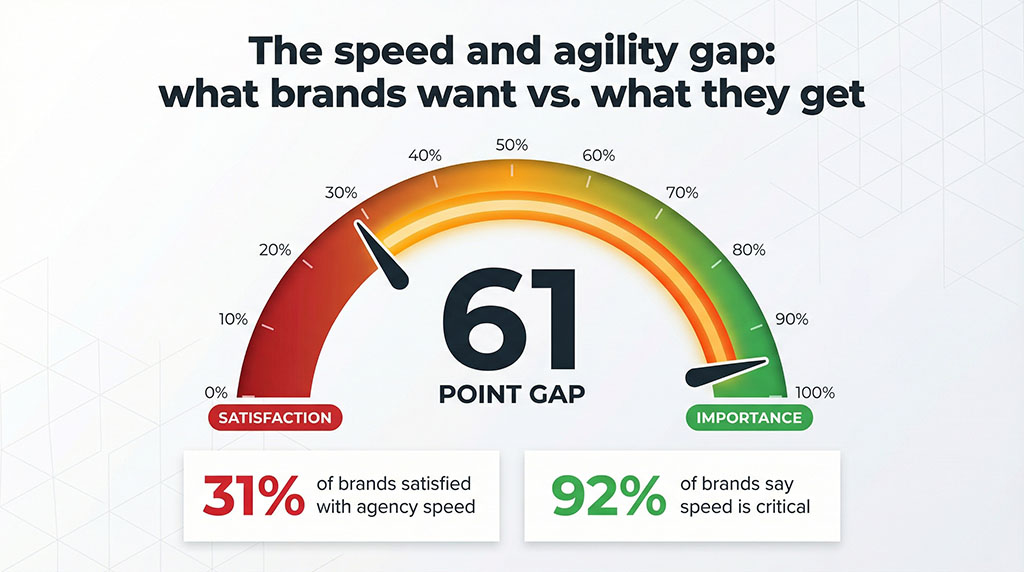
And the gap between what they want and what they’re getting is enormous. Brands rated speed and agility as 92% important—but satisfaction with delivery sat at 31%. A 61-point chasm. They’re asking for centralisation (53%), flexibility (45%), and simplified services (37%). In plain language: fewer relationships, faster decisions, less friction.
You’ve felt this even if you’ve never seen the research. It’s the feeling of paying five invoices to five different companies and still not knowing which channel is actually driving revenue.
Think about the last time you tried to coordinate a dinner reservation for six people over a group text. Now imagine doing that every day, except the six people all work for different companies, have competing incentives, and each one thinks their contribution matters most. That’s multi-agency marketing management.
The numbers are staggering when you zoom out. Industry analysis estimates this coordination tax—the cost of simply moving information between disconnected teams—drains roughly $120 billion annually from the global advertising ecosystem. Not from bad creative. Not from wrong audiences. From friction. From the 23 people across 7 departments that one Fortune 500 company needed just to publish a single landing page. That took 67 days.
You’re running a smaller operation than a Fortune 500. Which means you don’t have 23 people to absorb the friction. You are the 23 people.
The confidence crisis hiding inside your dashboard
Here’s a stat that should trouble every agency in the industry: only 18% of small business owners feel “very confident” in their marketing effectiveness. That’s down from 27% the prior year. Despite more tools, more platforms, more data than any previous generation of business owners has ever had access to—confidence is cratering.
Constant Contact surveyed 2,500 SMBs and found the single biggest frustration wasn’t cost. It was simply not knowing what’s working.
Separately, Disruptive Advertising documented over 600 conversations with business owners and found the frustrations stack: 41% have no clear view of what’s working. 34% say their agency never brings new ideas. 28% are constantly re-introducing themselves to new reps because of turnover. And 25% get reports full of data but zero insight—dashboards that measure activity, not outcomes.
As Frank Vella, CEO of Constant Contact, put it: businesses feel like they’re guessing, and that uncertainty erodes confidence even when effort is high.
You know this feeling. You open the SEO report and the traffic numbers look good. You open the paid media report and ROAS looks acceptable. You open the social report and engagement is “up.” But when someone on your team asks “so… is our marketing working?”—you hesitate. Because no single report answers that question. And nobody is responsible for connecting them.
What 70% churn actually means
Forty percent of SMBs who outsource marketing to agencies churn. Sixty percent of those who leave cite “lack of perceived value”—double the rate from 2023. And 70% of businesses switch marketing partners within 6 to 12 months.
Seven out of ten businesses blow up their agency relationship before it’s a year old. They’re not chasing a better ad. They’re chasing alignment.
The Setup Marketing Relationship Survey found 40% of clients plan to switch agency partners within six months—up 33% from 2021. And the reason agencies assume drives churn (budget cuts) isn’t the actual reason. The #1 driver is dissatisfaction with delivery, at 48% and climbing 14% year over year.
Meanwhile, the DBA’s annual study of 680 client interviews paints a damning picture from the other side: 85% say client service needs to improve. Only 7% say their agency regularly exceeds expectations. And 45% describe account management as “transactional, not experience-led.”
Both sides are frustrated. Neither side is wrong. The system just wasn’t designed for where we are now.
"But isn't that what full-service agencies are for?"
This is where the smart buyer pushes back. And it’s a reasonable thought—if the problem is fragmentation, just hire one big agency that does everything. Problem solved.
Except it isn’t. Because most full-service agencies are just multiple specialists sitting under the same roof who never sit in the same room.
When Swimming Pool Kits Direct came to me, they were paying one agency. A “full-service” agency. That agency had four separate staff on the account: an account manager, a Facebook specialist, a Google Ads specialist, and an SEO specialist. Four people, four swim lanes, four sets of reports—and the client was still the one connecting the dots between them. The account manager relayed messages. The specialists stayed in their silos. The agency’s org chart looked integrated. The client’s experience was identical to managing four separate agencies. They just got one invoice instead of four.
That’s the dirty secret of the “full-service” model. Consolidation on paper, fragmentation in practice. If your Facebook specialist and your Google Ads specialist don’t share a strategy—if they optimise their channel in isolation while nobody watches how the channels interact—you haven’t solved the coordination problem. You’ve hidden it under a logo.
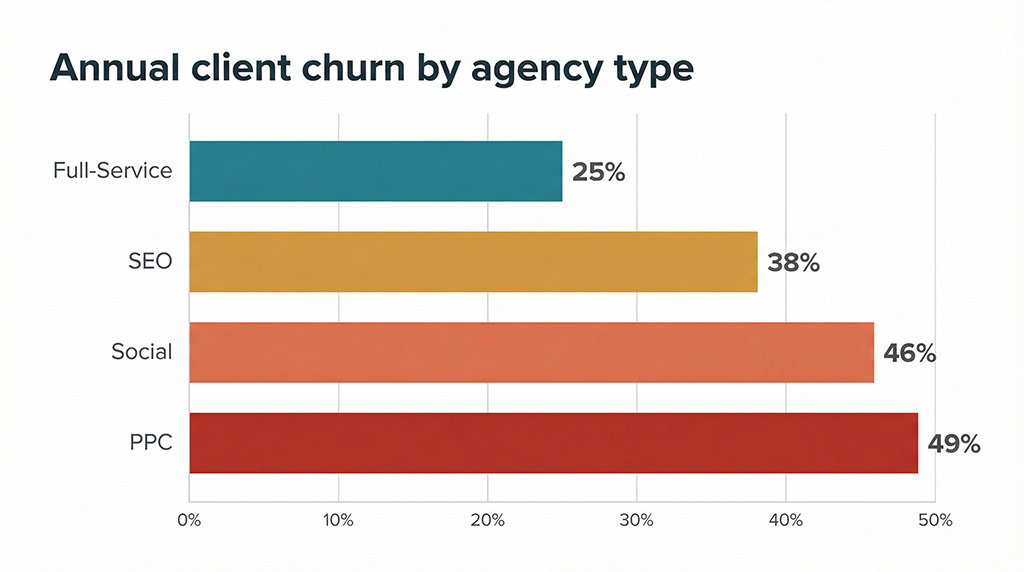
The data backs this up. Focus Digital’s 2026 churn analysis broke retention rates by agency type. Truly integrated full-service agencies churn at 25% annually. PPC specialists? 49%. Social media agencies? 46%. But the key word is truly integrated. An agency with siloed departments isn’t full-service in any way that matters to the client. It’s a holding company in miniature.
The CMO Club surveyed 106 chief marketing officers and found that only 14% using a traditional agency-of-record model reported being “very satisfied.” The top complaint? Lack of innovation, at 55%. When everyone owns their lane and nobody owns the intersection, the most valuable work—the creative connections between channels—never gets done.
The question isn’t whether you hire one agency or five. The question is whether anyone in your marketing operation holds the complete picture. One brain that sees how paid media feeds email, how social content supports SEO, how CRM workflows connect to ad targeting—not in theory, but in a single person’s head, every day.
What one brain actually looks like
When Sunday Drive came to us, they had separate agencies running paid social media and Google Ads, plus disconnected creative work for print. Each agency had their own strategy, their own reporting, their own idea of what “success” meant. Sunday Drive’s team spent their time coordinating between all of them rather than growing their business.
We consolidated everything—paid social, Google Ads, print creative—under one strategic brain. Not one team. One person holding the complete picture, with the ability to execute across every channel. We designed Salesforce dashboards that connected results across channels into one view, because when you own all the inputs, you can finally build reporting that tells the truth instead of telling each channel’s version of it.
We work alongside their team on video ads and social publishing. And the model proved itself: Sunday Drive has since given us full responsibility for growing the Sunday Finance brand—all paid media, conversion optimisation, and social media strategy. They didn’t expand the relationship because we pitched them on it. They expanded it because one brain seeing the full picture produced results that fragmented specialists never could.
The story at Swimming Pool Kits Direct followed the same arc. I replaced four agency staff with one operator running all creative and ad strategy across paid channels, social, email, HubSpot workflows, email marketing, video scripts, copywriting, and project management. Not because one person is four times faster—but because one person doesn’t waste hours routing information between silos that shouldn’t exist in the first place. Every decision factors in every channel, because every channel lives in the same brain.
The coordination tax disappeared. And with it, the cost of paying four salaries to do work that’s better when it’s unified.
The economics aren't even close
The hidden cost goes beyond agency fees. If a business owner’s time is worth $150 to $300 an hour—and they’re spending 5 to 10 hours a week coordinating agencies—that’s $39,000 to $156,000 a year. On top of what they’re already paying.
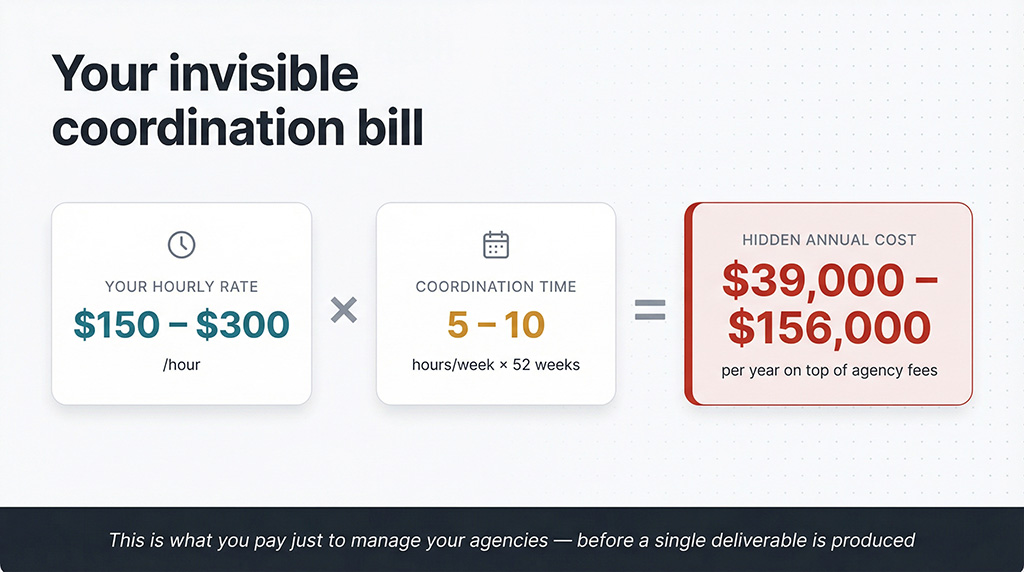
That number isn’t theoretical. It’s the maths most business owners have never run because nobody frames it this way. The agencies don’t mention it. They can’t—their model depends on the client absorbing that cost silently.
And the industry is restructuring around this truth. The five major holding companies eliminated an estimated 25,000 to 30,000 positions in 2024–2025, with Forrester projecting another 15% cut in 2026. Eighty-five percent of US B2C marketing executives plan to review their media agencies this year. The old model is unravelling in real time.
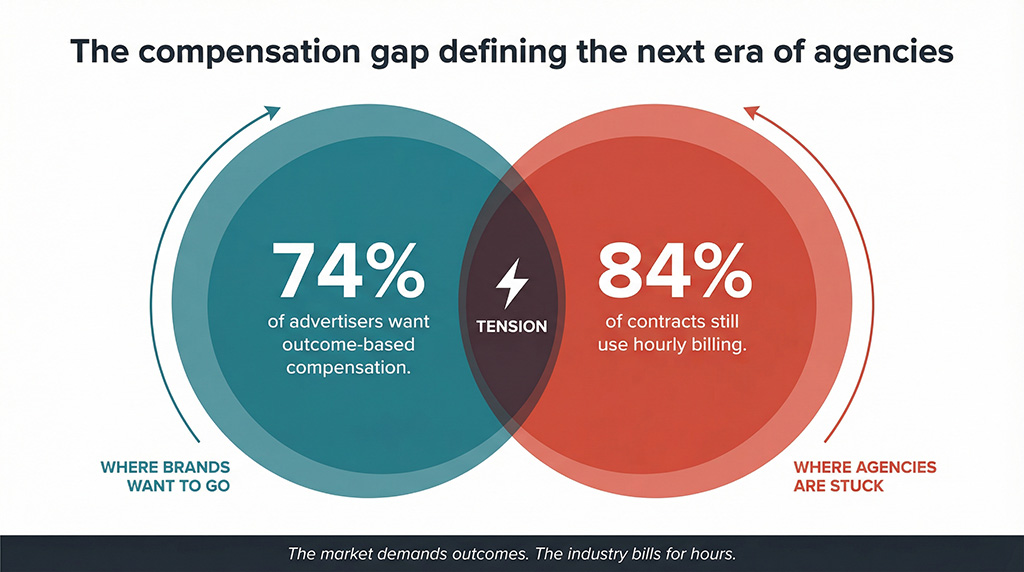
The tension that defines the next two years is simple: the WFA found 74% of global advertisers want compensation aligned to business performance. But the ANA’s 2025 compensation study reveals 84% of contracts still use labour-based billing—the highest figure in over 50 years of tracking. Three quarters of clients want to pay for outcomes. Five-sixths of contracts still charge for hours. That gap is the entire opportunity.
Meanwhile, the fractional and solo-operator model has exploded—120,000 fractional leaders in 2024, double the number from 2022. Eighty percent of companies using fractional CMOs report higher marketing impact than their previous full-time arrangements. The market is telling you what it wants. One senior brain. Outcomes over hours. Integration over fragmentation.
Three reports that finally agree
Remember those three reports from Monday morning? The SEO numbers that looked good in isolation. The paid media ROAS that seemed acceptable on its own. The social engagement that was “up” but disconnected from everything else.
Now imagine one report. One view where search traffic, paid acquisition, email nurture, and social engagement connect—tied not to vanity metrics but to revenue. Where you can see that the blog post your SEO strategy surfaced is feeding the retargeting audience your paid media is converting, which is entering the email sequence your CRM is automating. Not because three agencies happened to align. Because one brain designed it that way from the start.
You don’t need a better agency. You don’t need a bigger agency. You definitely don’t need more agencies.
You need to stop being the integration layer. And start being the business owner again.
See What One Brain Would Change
Map your current agency setup against the integrated model — and find out where the gaps, overlaps, and wasted spend are hiding.
Most clients find 2–3 channels working against each other that nobody spotted because nobody could see both. Takes 15 minutes.
You don’t need a better agency. You need to stop being the one holding it all together.