
Fifty pieces of content in an hour. That was the pitch, and it was true.
A marketer I know, let’s call her Priya, wired up the full stack in late 2025. Claude for copy. Midjourney for visuals. n8n orchestrating the entire workflow. She described the emotional tone she wanted for a product launch, “90s retro luxury with a cynical edge,” and watched her agents produce a landing page, three email sequences, a dozen social variants, and a set of ad creatives before lunch.
Every piece was competent. Grammatically flawless. On-brand in the way that a paint-by-numbers portrait is technically accurate. When she compared her output to what three competitors had published that same week using the same tools, she couldn’t tell the difference. Neither could her customers.
Priya had become a conductor standing on a podium, baton raised, orchestra playing. Every orchestra in the city was performing the exact same piece.
The consensus is intoxicating
The rise of the vibe marketer is one of the fastest professional identity shifts in recent memory, and the origin story is smaller than the movement it produced.
In February 2025, James Dickerson was sharing AI automation workflows in a private Slack channel, using n8n, Claude, and APIs to do what small marketing teams couldn’t. Greg Isenberg saw the workflows and told him to post about it under the name vibe marketing. Jordan Mix joined the conversation. By Dickerson’s own account, the three of them riffed on it for about twenty minutes and came out with a rough definition. Dickerson posted first, on 17 February 2025. Isenberg’s post on 22 March is the one that travelled.
Twelve months later there was a community of more than 2,600 members and companies were advertising for the job title.
Two things about those numbers, because they get repeated everywhere without a second look. The community is a paid product, $49 a month on Skool, not a movement that spontaneously assembled. And the two figures you see quoted most often, 686% search growth and members across 47 countries, both trace back to a single source: the sales page for that community. No methodology is published. No baseline is given for the 686%. The 47 countries appears nowhere else at all. I am not saying the numbers are wrong. I am saying they come from the person selling the subscription, and nobody who quotes them mentions that.
The job listings are more modest than the headlines suggest too. The ones with actual pay attached run $25 to $40 an hour for a part-time fractional role, and around $39,000 to $45,000 a year for a full-time one. The six-figure vibe marketer is, so far, secondary commentary with no job ad linked to it.
The promise is still seductive, because some of the underlying math is real.
Michaels Stores used Persado’s AI to scale email personalisation from 20% to 95% of campaigns and lifted click-through rates 25%. Worth knowing that every trace of that result leads back to Persado’s own case study from March 2022, and the same page reports a stronger 41% lift on SMS.
Tata Harper used Klaviyo’s AI to test 20 sign-up form placements and timings, and grew form submissions by more than 65%. Revenue attributed to their flows rose 139% year over year in Q1 2024. Hold onto the word “flows.” Total Klaviyo-attributed value that quarter grew 43%. If you have seen 139% quoted as company revenue growth, and you have, it has been inflated roughly threefold in the retelling.
Kraft Heinz ran “A.I. Ketchup” with Rethink in 2022. The award submissions report over 850 million earned media impressions and a 2,500% return on media investment. Media investment, which excludes production and agency fees, and says nothing about sales. The 1.15 billion impression figure that circulates appears only in blogs written later.
These are real results. They are also smaller, older, and more heavily caveated than the versions you meet on LinkedIn.
The structural shift underneath is real as well, but it is not the five-firm consensus you keep reading about.
PwC is the one that says it plainly. Its January 2026 report No more pyramids uses the exact phrase “the rise of the generalist.” It is also a claim about the whole workforce, illustrated with software engineering, not a claim about marketing teams. McKinsey goes halfway and then deliberately stops, because it keeps specialists in the picture: “T-shaped experts… deep specialists who reimagine workflows, handle exceptions, and safeguard quality.” BCG comes closest on marketing and recommends building smaller, more senior, broad-skilled teams, but frames the destination as deeper expertise in fewer areas rather than generalism. Gartner frames the same shift as human-AI hybrid roles. Deloitte makes no claim about team compression at all.
One firm supports the headline as it is usually phrased. What the rest support is quieter and more useful: fewer people, doing more, with their expertise concentrated rather than dissolved.
Deloitte does project that half of companies using generative AI will have launched agentic AI pilots or proofs of concept by 2027. Pilots or proofs of concept. Not deployments. That second half of the sentence gets dropped almost every time, and dropping it turns an experiment into an industry.
You’ve heard most of this. You’ve probably read a version of this article three times this month. Here’s what those articles leave out.
The part nobody wants to publish
When the cost of production drops to near zero, the only thing left to separate you is the quality of your thinking. That is where the vibe marketing narrative quietly falls apart. Not because the tools don’t work. Because the tools work for everyone equally, which means they differentiate no one.
Marc Sirkin made the point in MarTech’s Vibe Marketing manifesto in December 2025: “Using AI in marketing accentuates the value of human taste. Taste becomes the differentiator when everyone has the same tools.”
That line tends to get buried under the tool recommendations and the workflow diagrams and the “look what I built in 20 minutes” threads. It deserves to be the headline, because it carries an implication the movement’s loudest champions rarely say out loud.
If taste is the differentiator, then taste is also the bottleneck.
A mediocre strategist with AI agents produces mediocre work at a hundred times the speed and volume. Most of what goes wrong with AI in marketing is not the model. It is that people are asking it to do a job they could not do themselves and would not recognise done well. The tool cannot supply the standard. You have to bring it.
The old model, the factory model of linear handoffs between copywriters, designers, developers, and analysts, was inefficient. It also had a hidden feature. The friction created checkpoints. A bad idea had to survive several people scrutinising it. A weak strategy got pressure-tested when the copywriter couldn’t make it compelling, or the designer couldn’t make it visual, or the developer flagged a technical impossibility. The handoff wasn’t just a process. It was a filter.
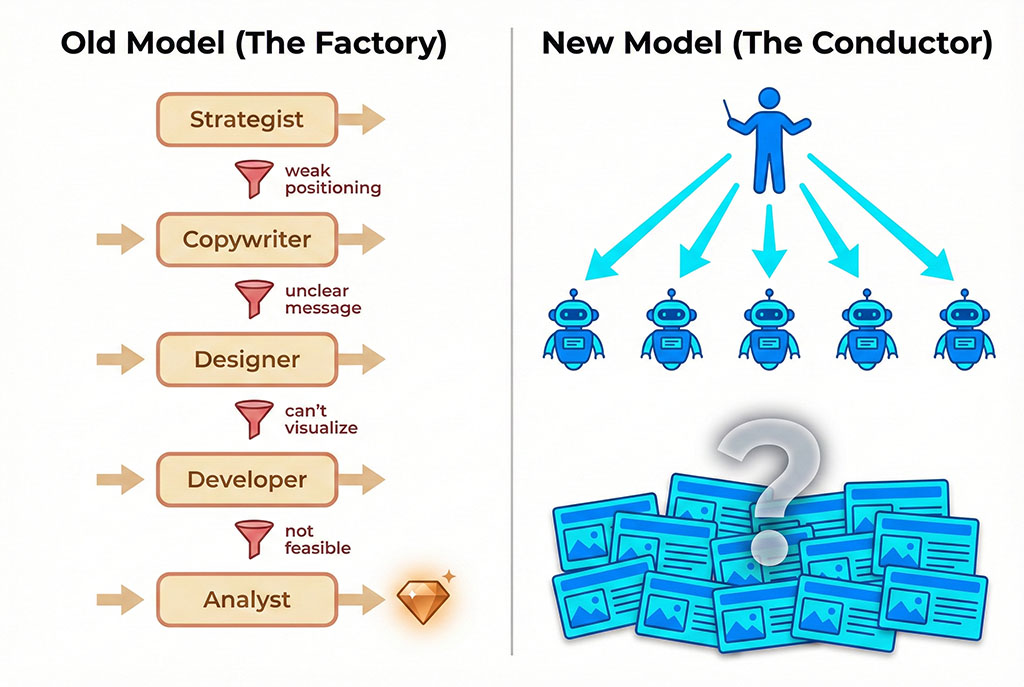
The vibe marketer has removed the filter. The distance between an idea and a live campaign is now measured in minutes. That’s extraordinary if the idea is good. It’s dangerous if it isn’t.
The evidence is already piling up
This isn’t hypothetical.
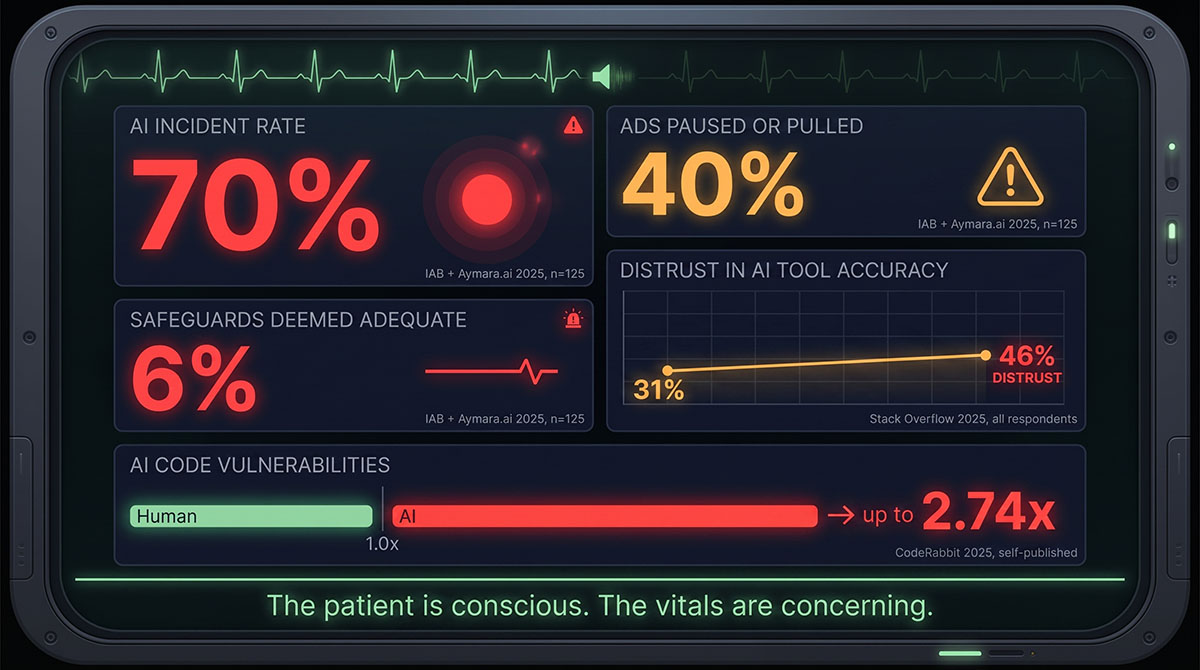
The IAB, working with Aymara.ai, surveyed 125 marketers and published the results in August 2025. Seventy percent had experienced at least one AI incident in advertising. Forty percent had to pause or pull ads because of one. Six percent said their current safeguards were adequate. It’s a small sample and the fieldwork was done in July 2024, so treat it as a signal rather than a census. It is still the clearest signal anyone has published.
Kevin Roose spent a week building small personal apps with AI for the New York Times, written up in February 2025. The one he actually kept using scanned his fridge and suggested lunch. One of the throwaway builds was an online store, and the AI populated it with fabricated product reviews. In marketing, where trust is the product, that isn’t a bug report. That’s a brand problem waiting for a customer to find it.
The code quality data tells the same story from a different angle, with a caveat you should hear before the numbers.
CodeRabbit reviewed 470 GitHub pull requests in December 2025 and reported that AI co-authored code carried 1.7x more major issues, 75% more logic errors, and up to 2.74x more security vulnerabilities than human-written code. CodeRabbit sells AI code review and published the study itself. It also did not confirm authorship. In its own words, it assumed that pull requests without AI attribution were human authored, which means the human baseline is an assumption rather than a measurement. Directionally useful. Not independent.
A scan of 1,645 web apps built with Lovable found 170 of them, 10.3%, leaking user data including names, emails, financial records, and API keys, through missing Supabase row-level security policies. The flaw has a CVE, CVE-2025-48757. The numbers hold. The provenance needs stating: the scan was run by two Replit employees, at a direct competitor, and Semafor reported it in May 2025. An article arguing for scrutiny of sources doesn’t get to skip that line.
Fast Company covered the hangover in September 2025. Jack Zante Hays, a senior PayPal engineer, described a complexity ceiling where AI tools start to break more than they solve. He isn’t a blanket critic, and it would be dishonest to use him as one. In the same piece he says Claude Code has been earning more of his trust lately. What he’s describing is a limit, not a verdict.
Stack Overflow’s 2025 survey found 46% of respondents distrust the accuracy of output from AI tools, up from 31% the year before. That’s all respondents rather than professional developers only, and it covers AI tools generally rather than coding assistants specifically. Fifteen points of distrust, added in twelve months, among the people closest to the technology.
Marketing hasn’t hit its hangover yet. The bottles are piling up.
"But you're just gatekeeping"
Here’s where I can hear the objection forming. It sounds something like this:
You’re telling a generation of marketers who finally have access to enterprise-level tools that access isn’t enough? A solo founder can now do what used to require a team of 15 and a $500K agency retainer, and your response is to warn them they’re not ready? That sounds like the old guard pulling up the ladder.
I get why it reads that way. I want to be precise about what I’m not saying.
I’m not saying the tools don’t work. They work spectacularly. I’m not saying you need a decade of experience or an MBA or some anointed career path. You don’t. I’m not arguing the old model was better. It wasn’t. The factory model was slow, expensive, and produced a staggering amount of mediocre work by committee.
What I’m saying is narrower and harder to argue with. When every marketer has the same engine, only the driver matters. Vibe marketing as currently evangelised spends most of its energy on the engine.
The stack recommendations are everywhere. n8n for orchestration. Claude for copy. Make.com for workflows. Bolt.new for microsites. Isenberg’s n8n workflow template is publicly available, hosted on Dickerson’s site. Gralio has published a catalogue of 17 tools attributed to his stack, and it’s an undated reconstruction by an aggregator rather than a list Isenberg published himself. That makes the point better than a verified list would. The stack is guessable.
Which means the stack is a commodity.
The thing that can’t be templated, shared, or subscribed to is the judgment of what to build, who to build it for, and why it matters. That’s the strategic layer, the “what.” It is exactly the layer the manifesto identifies as the vibe marketer’s actual job, and exactly the layer the movement’s content, community, and energy mostly skip in favour of the “how.”
The homogenization problem is already visible
There’s a second-order effect almost no one in the vibe marketing ecosystem is discussing, and it’s the one that should worry you most.
If every vibe marketer uses Claude for writing and Midjourney for visuals, with prompts like “make it witty and professional” or “confident but approachable,” and they do, because those are the templates being shared, then brand voices converge. Not gradually. Rapidly.
I want to be careful here, because this is where the citations usually get sloppy.
Edelman’s 2024 tech-sector report found that trust in AI companies in the US fell from 50% to 35%, a 15-point drop. You will see that figure quoted as proof that consumers have turned against AI-generated content. It doesn’t say that. It measures trust in the companies, not the output. Nobody has published a clean number for what I actually want to claim here, so I’ll make the claim as an observation and label it as one.
AI content is recognisable. There’s a sameness to it. Frictionless, perfectly grammatical, relentlessly upbeat. Readers flag it as synthetic before they can explain why, and they’re doing it more often, not less.
Gartner predicts that by 2028, 60% of brands will use agentic AI to run streamlined one-to-one interactions, persistent digital concierges spanning marketing, sales, and support. Picture that for a moment. The majority of brand interactions, handled by agents built on the same foundation models, trained on the same internet, optimising for the same engagement metrics.
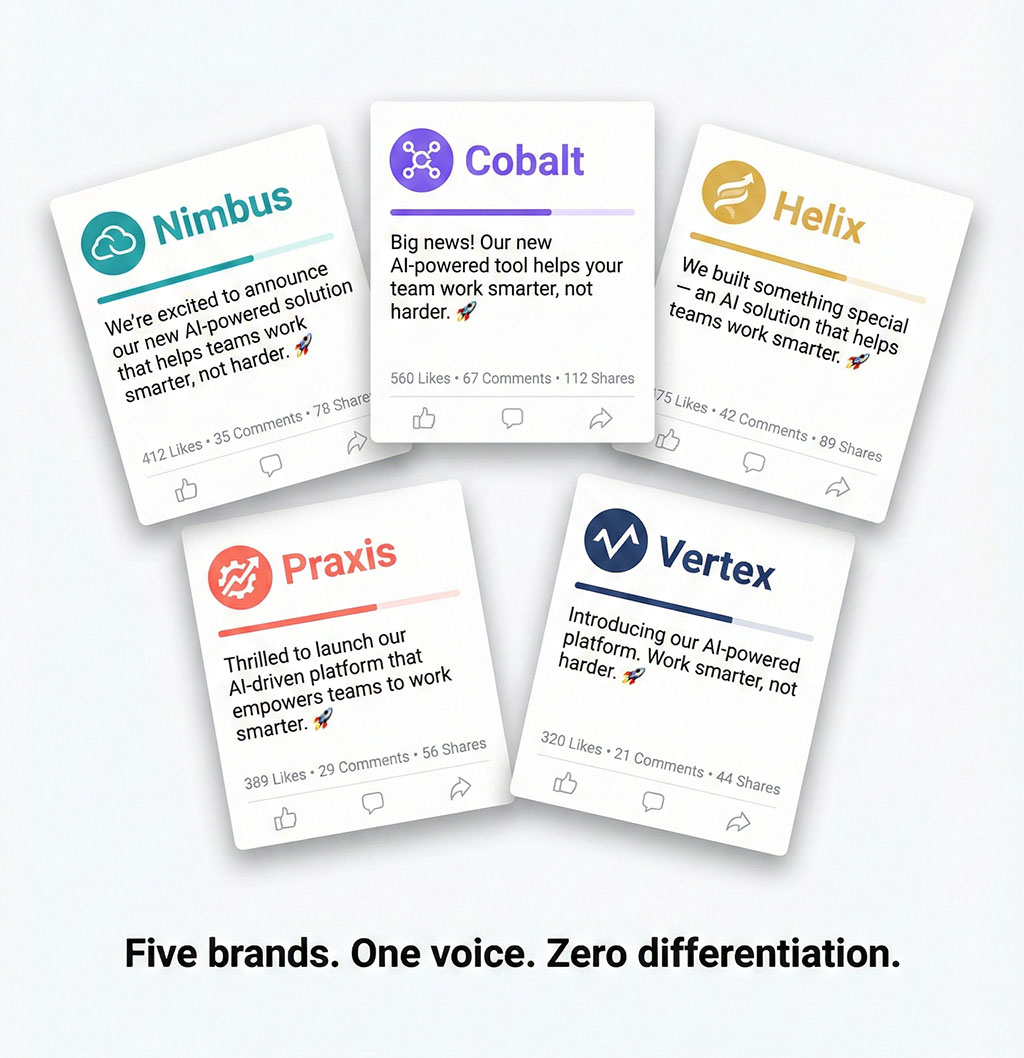
The winners in this environment won’t be the marketers with the best stack. The stack is table stakes. The winners will be the ones who bring something the stack can’t generate. A genuine point of view. Deep domain knowledge. The willingness to say something the probabilistic median of a language model would never produce, because it’s too specific, too weird, too human.
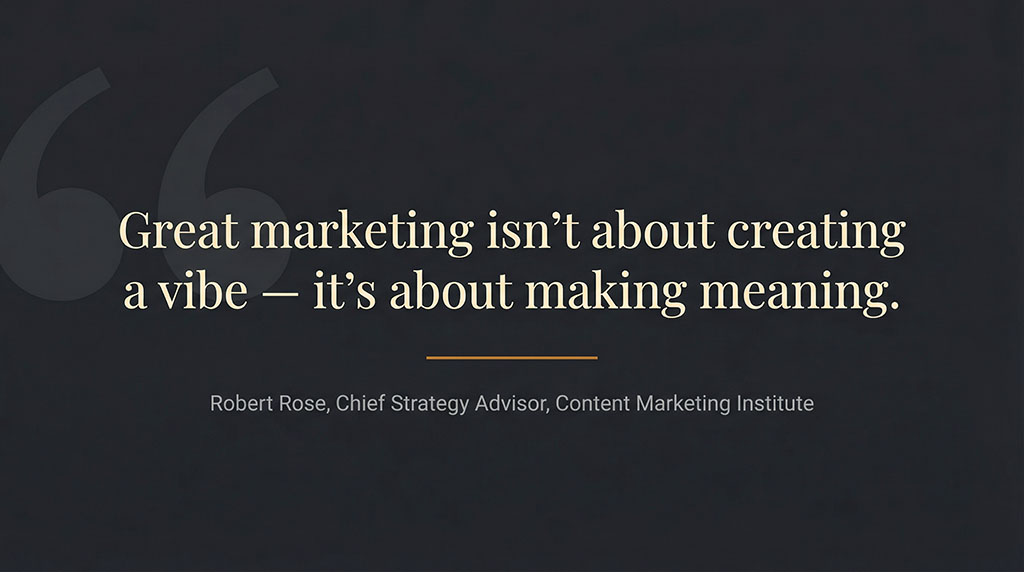
Robert Rose, Chief Strategy Advisor at the Content Marketing Institute, put it with surgical precision: “Great marketing isn’t about creating a vibe — it’s about making meaning.” Meaning requires a perspective. Perspective requires experience. Experience can’t be prompted.
What the smart money is actually doing
The vibe marketers pulling ahead, the ones building real advantages rather than just producing more content faster, have worked this out already, even if the broader narrative hasn’t caught up.
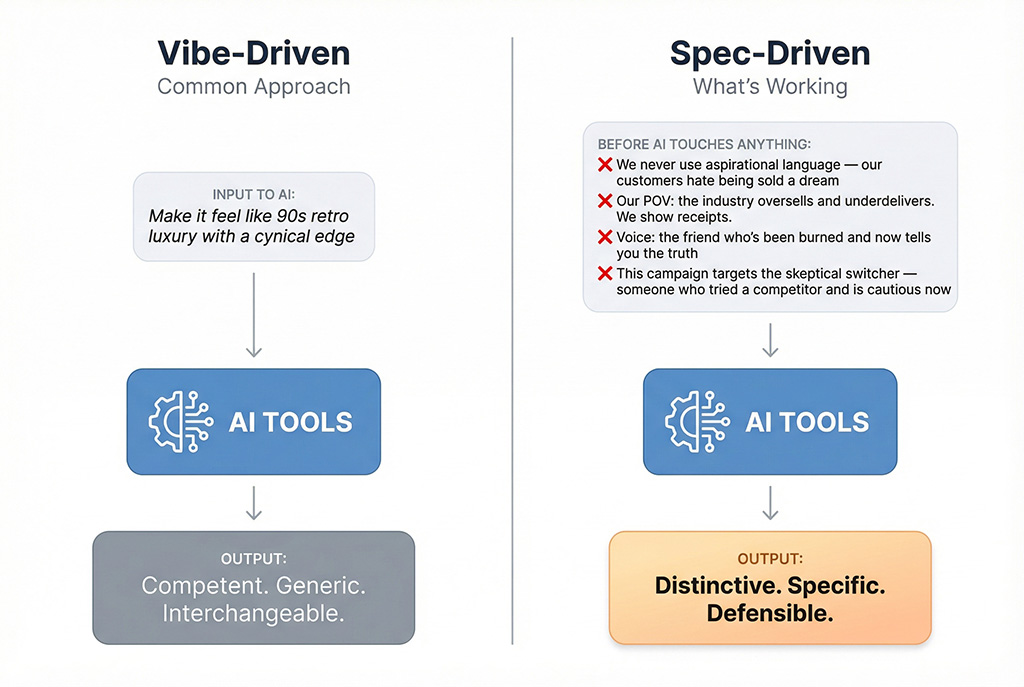
They’re investing time upstream of the tools. Before opening n8n, they’re clarifying positioning. Before prompting Claude, they’re defining what their brand would never say, because constraints produce distinctiveness in a way open-ended generation never does. They treat AI as an execution layer for creative decisions a human has already made, not as a creative partner.
Merry Carole Powers, founder of Unicorn Kreative, said it clearly in an eMarketer interview in November 2025: “You cannot automate your brand promise. You cannot automate your brand purpose, and you cannot automate your brand voice. You have to take those steps first, then AI can create something that’s uniquely yours.”
This tracks with what’s happening on the developer side. GitHub’s answer to the vibe coding hangover was Spec Kit, released in September 2025, a framework that makes the specification the single source of truth before any code is generated. Specify, then plan, then tasks, then implement. The insight is that AI is extraordinary at execution and unreliable at judgment. So you don’t ask it to judge. You give it the specification and let it build.
The marketing equivalent is overdue. Whatever replaces raw vibe marketing will probably look more like context engineering or agent orchestration, terms already circulating. Same tools, fundamentally different relationship to them. Not “give in to the vibes and forget the strategy exists,” but “define the strategy with ruthless precision, then let the vibes execute.”
The conductor who learned the score
Priya, the marketer from the opening, eventually worked this out. Not from a conference talk or a thread, but from watching her engagement metrics flatten while her output volume tripled. More content, same results. The AI was doing exactly what she asked. The problem was what she was asking for.
She spent two weeks away from the tools entirely. No n8n. No Claude. Just a notebook, her customer interview recordings, and the question she’d been avoiding. What do we actually believe that nobody else in this market is willing to say?
When she came back to the stack, everything changed. Not the tools. Those were identical. The inputs. She had a point of view now, and the AI could hear it. The specificity of her prompts shifted from “make it feel like 90s retro luxury” to something that could only have come from someone who understood her customers’ real frustrations, aspirations, and language. Her agents were still playing. Now they were performing a score only her orchestra could play.
The baton was never the point. The music was.
The vibe marketing stack is a commodity. Your taste, your judgment, and your willingness to say something only you could say are the moat. The tools won’t build it for you. Once you have it, the tools will make sure the world hears it.
Your marketing, looked at properly
Thirty minutes on your current setup — what’s working, what’s quietly leaking budget, and what I’d fix first. You’ll leave with a clearer picture whether we work together or not.
Got something specific bugging you? Flag it when you book and I’ll have it looked at before we talk.

AboutBruce Marjoribanks
Bruce Marjoribanks has spent 27 years in marketing, including building, running and selling his own agency before going independent. He now runs every channel - paid, organic, social, email, creative and automation - as one integrated system, with AI ehancing production and the judgment staying human.