
The invoice said $4,200. Three agencies. One for Google Ads, one for Meta, one handling email. Each doing respectable work. Open rates looked fine. Click-through rates were in range. Reports arrived on time with green arrows pointing up.
The business was bleeding $6,000 a month and the owner had no idea.
Not because the agencies were bad. Because they were good enough—each one operating in its own silo, each one hitting its own KPIs, and nobody looking at the whole picture. The Google Ads agency was bidding on branded terms that organic already owned. The Meta agency was retargeting people who’d already bought. The email team was sending campaigns that contradicted whatever the ad team promised that week.
Every vendor was earning their B+. The business was getting a D.
The comfortable lie business owners tell themselves
There’s a story most business owners believe about marketing talent, and it goes like this: if you hire decent professionals—people with experience, solid portfolios, reasonable rates—you’ll get decent results. Not spectacular, but reliable. And reliability is what you need when you’re running a business with a thousand other things demanding your attention.
This was true three years ago. It is quietly becoming a trap.
AI has changed what “decent” means. Not by replacing marketers—but by making B+ work trivially easy to produce. The copywriter who used to charge $150 for a solid email sequence is now competing against a business owner’s intern and a ChatGPT prompt that gets 80% of the way there in ten minutes. The media buyer running competent campaigns is using the same automated bidding tools your nephew could figure out on a weekend.
The floor rose. And when the floor rises, the middle disappears.
You’d think that’s a problem for the marketers. It is. But it’s a much bigger problem for the business owners hiring them—because the markers you used to rely on to identify good help no longer mean what they meant.
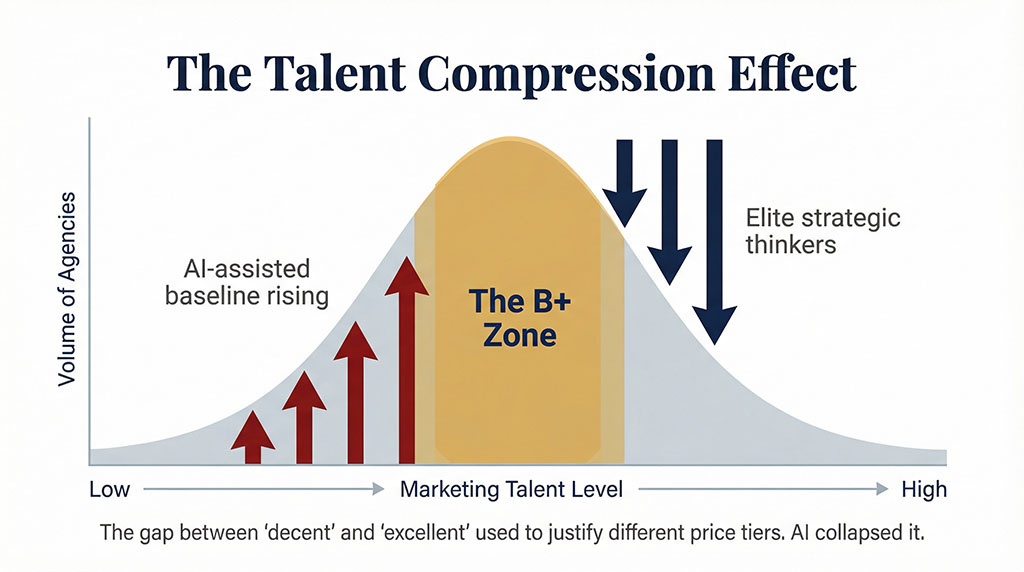
The real cost isn't bad work—it's invisible coordination failure
Here’s what makes the B+ Trap so expensive: you never see a single piece of bad work. Every deliverable looks professional. Every report shows activity. Every agency can defend their numbers in isolation.
The destruction happens in the seams between them.
Your Google Ads agency doesn’t know what your email team promised this week. Your Meta agency is optimising for conversions that your landing page isn’t set up to capture. Your SEO consultant is building content around keywords your paid team is already dominating. Nobody’s wrong. Nobody’s talking to each other. And the business owner—you—becomes the unpaid project manager trying to stitch it all together over Slack threads and Monday morning calls.
This is the B+ Trap in practice. You’re not paying for poor execution. You’re paying a coordination tax that compounds every month, and it doesn’t show up on any single agency’s report because no single agency is responsible for the whole.
Think of it like a restaurant kitchen where each chef is genuinely talented—but they’re all cooking from different menus. The pasta station is making something beautiful. The grill is flawless. The dessert is exquisite. The meal is inedible.
"But my agencies have years of experience"
This is the objection that keeps business owners stuck in the trap longer than they should be.
You’ve been with your Google Ads person for two years. They know your account. They know your margins. You’ve built a relationship. Switching feels risky, and the devil you know feels safer than the devil you don’t.
All of that is real. None of it addresses the actual problem.
Because the issue isn’t whether your individual agencies are competent. The issue is that competence at the channel level no longer translates to results at the business level. And the more agencies you have—each one competent, each one siloed—the wider the gap between what you’re paying for and what you’re getting.
Here’s a question most business owners never think to ask: When’s the last time your Google Ads agency and your email team were on the same call? When’s the last time anyone looked at your full customer journey—from first click to final purchase—as one connected system instead of six disconnected channels?
If the answer is “never,” you’re not running a marketing operation. You’re running a collection of vendors who happen to share a client.
And AI just made every one of those vendors easier to replace individually. Which means the only thing that’s getting harder to replace—and more valuable by the day—is the strategic brain that connects it all.
What actually separates a B+ hire from an A+ hire in 2026
It’s not execution quality. AI closed that gap.
The difference between marketing help that drains your budget and marketing help that compounds your growth comes down to three things that no individual channel agency can provide:
Cross-channel vision. When one person sees your Google Ads, your Meta campaigns, your email sequences, and your landing pages as a single system, they catch the waste that siloed agencies create by default. They notice that your retargeting audience includes existing customers. They see that your email offer contradicts your ad creative. They reallocate budget from a channel that’s cannibalising another. None of this requires genius. It requires line of sight—and fragmented agencies structurally cannot have it.
Accountability for outcomes, not activity. A B+ agency reports on impressions, clicks, and open rates. An A+ operator reports on revenue, cost per acquisition, and customer lifetime value. The difference isn’t sophistication—it’s incentive structure. When five agencies each own a piece of your funnel, each one optimises for their piece. When one brain owns the whole thing, they optimise for your bank account. This sounds obvious. It is. And yet most businesses with $10K+ monthly marketing spend are still paying for activity reports from agencies that have zero visibility into whether any of it actually produced a sale.
The willingness to kill what’s not working. This is the one nobody talks about. A Google Ads agency will never tell you to pause Google Ads and move that budget to email. A Meta agency will never suggest you’re over-investing in paid social. Every specialist has a structural conflict of interest—their revenue depends on you continuing to invest in their channel. The only person who’ll tell you to cut a channel is someone whose income doesn’t depend on that channel existing. And in a market where AI is making channel-level execution cheaper every month, the strategic judgment of where to spend is becoming far more valuable than the execution of how to spend it.
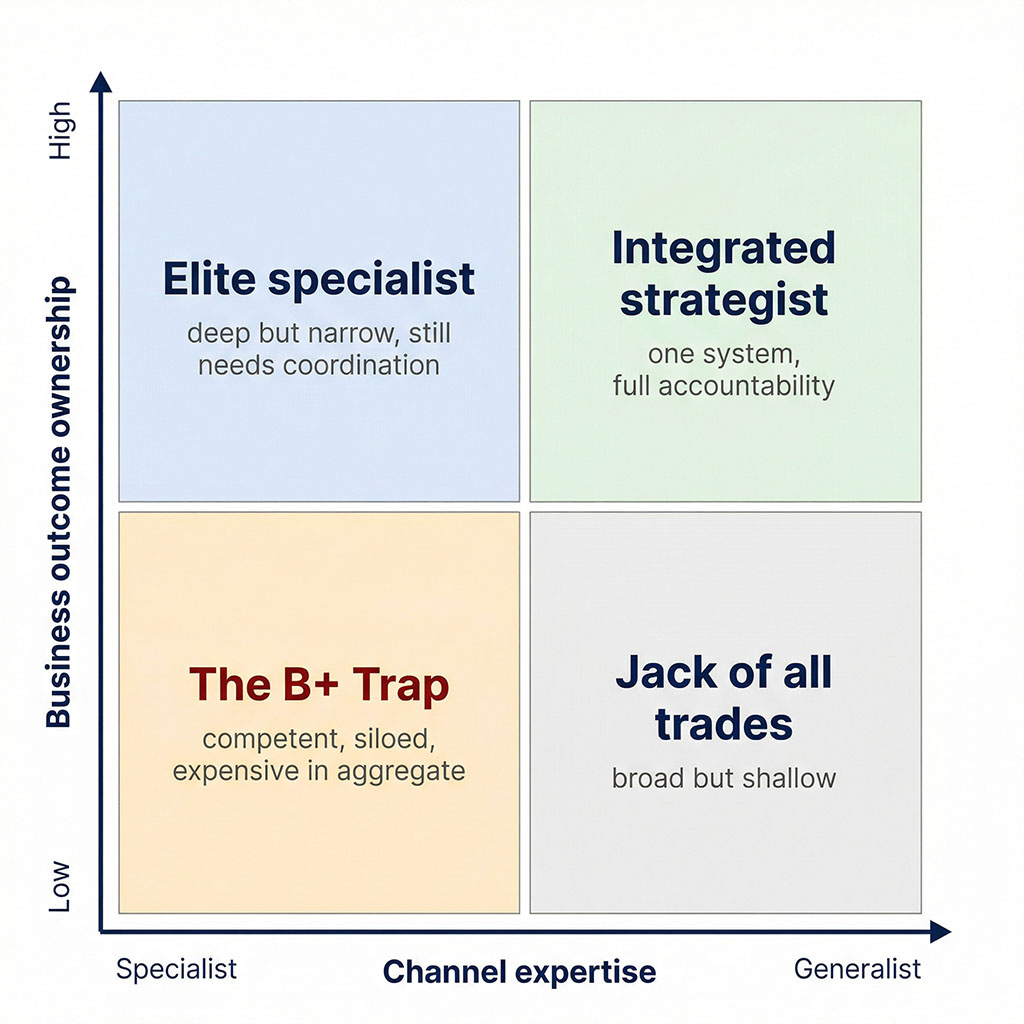
The audit that reveals the trap
Most business owners don’t know they’re in the B+ Trap because the symptoms look like normal marketing challenges. But three questions tend to expose it fast.
How much of your marketing budget is being spent to compete against yourself? When agencies don’t share data, your paid search bids against your organic rankings, your retargeting hits existing customers, and your email promotions undercut your ad offers. In a fragmented setup, 15-25% of your spend is typically working against itself. Nobody’s tracking it because nobody has the full picture.
How many hours per week do YOU spend coordinating between agencies? If the answer is more than zero, you’re subsidising a structural problem with the most expensive resource your business has—your time. Every hour you spend translating between vendors is an hour you’re not spending on the thing only you can do: running your business.
Could any of your agencies tell you, right now, what your true cost per acquired customer is across all channels? Not cost per click. Not cost per lead. The actual, fully-loaded cost of acquiring a paying customer. If no single vendor can answer that—and in a fragmented setup, none of them can—then you’re making budget decisions blind. You’re allocating capital based on channel-level metrics that may have no relationship to business-level profitability.
The trap has a timer on it
Here’s what makes this urgent rather than merely interesting: AI is accelerating the compression.
Every quarter, the tools get better. The floor rises higher. Channel-level execution gets cheaper and more automated. Which means the premium you’re paying for B+ agencies erodes while the cost of coordination failure stays constant or grows.
Twelve months from now, the business owner paying three agencies $4,200 a month for siloed B+ work will be paying the same amount for work that an AI-assisted intern could approximate at 80% quality. But the 20% that intern can’t replicate isn’t the copywriting or the media buying or the email design. It’s the strategic integration. The cross-channel visibility. The single brain that looks at the whole system and makes it pull in one direction.
That invoice from the opening? The one for $4,200 across three agencies? The owner eventually did the math. Overlapping spend. Self-cannibalising campaigns. Twenty hours a month of her own time playing coordinator. The true cost wasn’t $4,200. It was closer to $9,000—with no one accountable for the result.
She didn’t need better agencies. She needed fewer of them. She needed one brain that could see the whole board.
The B+ Trap isn’t a talent problem. It’s an architecture problem. And the longer you stay in it, the more expensive “pretty good” becomes.
See what one brain would change
Map your current agency setup against the integrated model—and find out where the gaps, overlaps, and wasted spend are hiding.
Most clients find two or three channels working against each other that nobody spotted because nobody could see both. Takes 30 minutes.
You don’t need a better agency. You need to stop being the one holding it all together.