
The carbon lamp had been losing for years.
Every lighting manufacturer knew the tungsten filament was better — brighter, more efficient, cheaper to run. They said so in their advertising. They’d been saying so for years.
Nobody particularly believed it.
Then Claude Hopkins sat down to write an ad for one of them. He had one fact to work with: tungsten produced more light than carbon. The question was how to say it.
He could write: “The new tungsten lamp gives significantly more light.” True. Accurate. Also exactly what every lamp advertiser had been saying, in some form, for years. Nobody was discounting the claim because it was false. They were discounting it because it looked like every other claim.
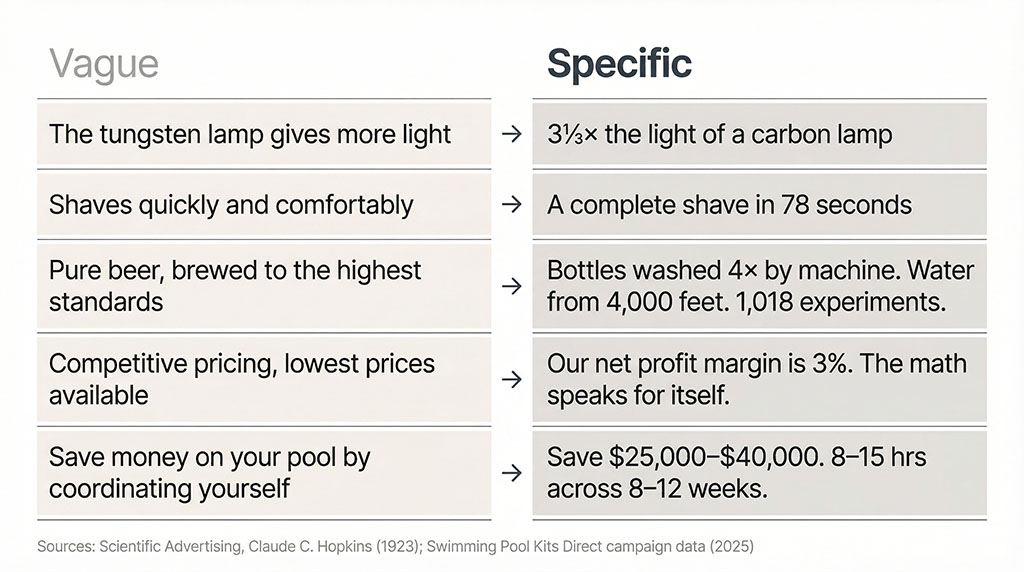
He wrote: “Three and one-third times the light of a carbon lamp.”
One number. Same product. Different result.
Why vague claims get discounted
In the last piece, we looked at the Schlitz problem — businesses sitting on a compelling story about what they do that never makes it into their marketing. Today’s problem is adjacent, and just as expensive.
It’s not only about telling the story. It’s about telling it in a way that can actually be believed.
Hopkins spent a chapter of Scientific Advertising on this. Not because he thought specificity was a clever technique. Because he’d watched precision work, repeatedly, at scale — and watched vagueness fail just as reliably.
His observation: superlatives destroy credibility even when they’re true. “Best in the world.” “Unmatched quality.” “Superior results.” These phrases register as boasting, and boasting triggers an automatic discount. Readers don’t consciously decide not to believe you. They just… don’t. The claim slides off.
A specific number does something different. It implies measurement. Measurement implies someone checked. When a claim carries the fingerprints of an actual test, it earns a different kind of belief.
You’ve experienced this from the other side. You’ve read “dramatically improved performance” and filed it away. You’ve read “23% faster” and actually paused. Not because you verified the number. Because it was clear someone else had.
Hopkins catalogued what this looked like across campaign after campaign. A shaving soap that claimed to soften a beard “in one minute” — not quickly, not fast-acting, one minute — became one of the fastest-growing products in a saturated category. A razor maker who advertised a “78-second shave” made a dramatic jump in sales. A brewer who described his process in precise terms — bottles washed four times by machine, water drawn from 4,000 feet, 1,018 experiments conducted before settling on the recipe — overtook competitors who had been shouting “pure beer” for years.
None of these were better products. They were more precisely described products.
Where most businesses stall
Here’s where most conversations about specificity stall.
You’re reading this thinking: That’s fine for a lamp. Or a razor. Or a brewery. But I don’t have numbers like that. We do good work, but we haven’t timed it or tested it or run 1,018 experiments. I can’t make specific claims because I haven’t done the measurement.
And so you go back to “quality you can trust” and “customer-focused service” and move on.
This is where Hopkins would tell you to start, not stop.
Before writing a campaign for a food product, he commissioned 130 researchers to interview households door to door. He sent a drink to a laboratory and found it contained 425 calories per pint — the equivalent of six eggs in nutritional value. That number, discovered in a lab, became the campaign’s headline claim. Before writing a single line about shaving cream, he interviewed a thousand men about what they most wanted from a shaving soap. He spent weeks reading medical literature for a coffee campaign, looking for the one fact that would change how the product was understood — and found it: caffeine stimulation arrives two hours after drinking, not immediately. Removing caffeine therefore doesn’t change the immediate feeling of the drink.
The numbers weren’t sitting in the marketing department waiting to be used. They were earned. Measured. Counted. Timed. Sent to laboratories. Gathered from a thousand interviews.
The question isn’t whether you have specific claims. It’s whether you’ve done the work of finding them.
What this looks like when someone does the work
This year we worked on the marketing strategy for Swimming Pool Kits Direct — a direct supplier of fibreglass pool shells across NSW, Queensland, and Victoria.
Their existing marketing was doing the emotional work well. The pool. The summer. The lifestyle. The before-and-after. People engaged with it. But engagement wasn’t converting into decisions, and the number of inbound enquiries wasn’t where it needed to be.
The shift was almost counterintuitive. Less aspiration. More arithmetic.
Because the real question in a prospect’s mind — when they’re staring down a $70,000–$85,000 full-service pool installation — isn’t “will this improve my life?” They’ve already answered that. The question is: “By how much can I reduce this cost, and through which path?”
So we built the answer. Two DIY coordination paths, each broken down to exact savings by line item:
- Direct shell purchase (bypassing retail markup): $10,000–$15,000 saved
- No project management fees: $7,000–$10,000 saved
- Independent contractors vs company margin: $5,000–$8,000 saved
- Off-season timing: $3,000–$5,000 saved
Total across both paths: $25,000–$40,000. As a percentage: 40–50% of what a traditional pool company charges. In time: 8–15 hours of coordination across 8–12 weeks.
That’s not a dream. That’s a calculation a homeowner can verify against their own quotes.
The results were not gradual. Quote requests — the actual conversion event, people going directly to the quote page ready to buy — increased by 1,691% between the two campaign periods. Website leads up 75%. Messaging conversations, a channel that hadn’t registered before, started generating enquiries.
General contacts dropped sharply, down 88%. That’s not a failure metric. It means the “so how does this all work?” questions were being answered by the content before anyone picked up the phone. People who previously called to understand the category were now arriving already sold on it, bypassing awareness entirely and going straight to quote.
The product didn’t change. The credentials didn’t change. The claim became specific enough to act on, and the people ready to act knew exactly where to go.
Where your numbers are hiding
Three questions worth working through this week — not in a meeting, on a notepad, by yourself.
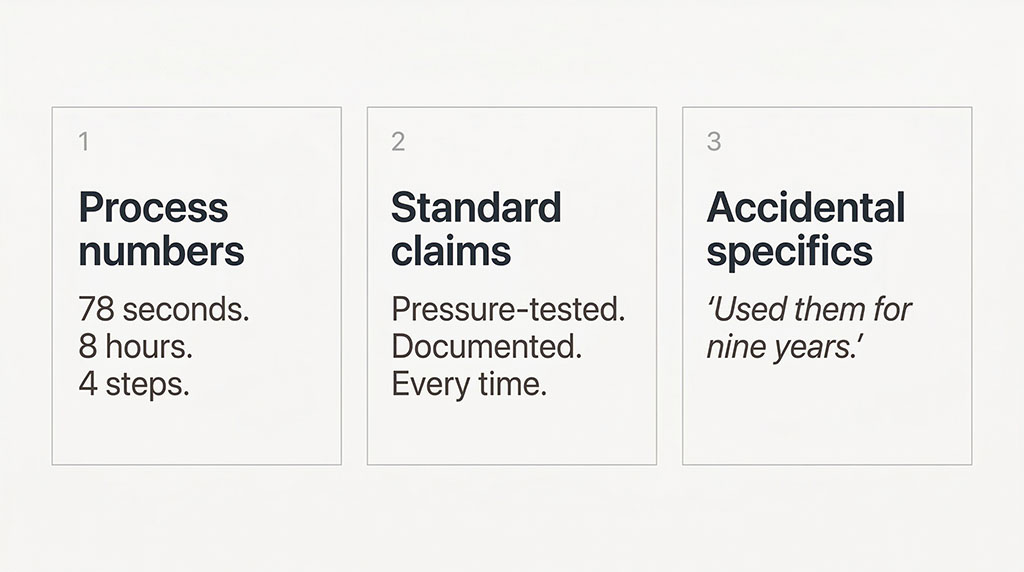
What do you do that has a number attached, even one you’ve never thought to record? Not approximately — precisely. How long does a job take from start to completion? How many steps are in your standard process? What percentage of your clients see a measurable outcome, and over what timeframe?
What do you check, test, or verify that could be stated as a specific fact? Not “we check our work” — that’s what everyone says. “We pressure-test every plumbing connection before the deck goes on, and document it.” “We call back within 90 minutes, every time, during business hours.” “We’ve completed 340 installations without a single structural callback.” The specific version of what you already do.
What have clients told you that contains a number they weren’t trying to give you? Testimonials are full of accidental specifics — “saved me about three weeks,” “I’ve used them for nine years,” “the only tradie who showed up when they said they would, three times in a row.” Most businesses hear these and say thank you. Hopkins would have made them the headline.
The 78-second shave wasn’t invented by the razor company’s marketing team. It was timed by someone, somewhere in the operation, for an entirely different purpose. Hopkins recognised it for what it was: the most important fact in the entire product story.
The lamp was always producing the light
The tungsten filament didn’t change when Hopkins wrote “three and one-third times.” It had been producing that light since the day it was manufactured.
Your business is doing the same work it’s always done. The light is already there. The question is whether you’ve measured it — and whether your marketing is showing the number, or just saying it’s bright.
Most audits we run surface the same finding: specific, credible, belief-shifting numbers sitting unused somewhere inside the operation. Finding them takes about 30 minutes of the right questions.
Book Your Audit →