
Eleven seconds.
That’s how long the silence lasts. You ask a business owner one question, and the room goes quiet. Not a polite pause — an uncomfortable one. The kind where they shift in their chair, look at the ceiling, and start a sentence three times before finishing it.
The question isn’t complicated. It isn’t a trick. A child could understand it.
“If I had a magic wand and could grant your one wish for your business — what would it be?”
And what comes out of their mouth in the next 30 seconds will tell you more about where their business is stuck than a year of financial statements ever could.
The answer isn't the point. The gap is.
Here’s what most people expect: the magic wand question is a goal-setting exercise. Some coaching cliché designed to get you “thinking big.” It’s not.
It’s a trap door.
Because the answer itself is almost irrelevant. What matters is what happens after the answer — when you start asking about what they’re actually doing day-to-day. The distance between the wish and the reality is the diagnostic. Every time.
Picture this pattern. A business owner says their one wish is to double revenue. Reasonable. Ambitious but not delusional. Then you ask: “What’s your closing ratio?” They guess — they don’t actually know. “Maybe 30%?”
So 70% of the people who express interest walk away. “What happens to that 70%?” Nothing. No follow-up call, no email sequence, no second attempt. Nothing.
They wished for more customers while ignoring the ones already knocking on the door.
That contradiction — the gap between desire and behavior — isn’t a fluke. It’s a pattern so consistent it might as well be a law of physics. And it shows up in three predictab
Gap #1: The "More" Delusion
The most common magic wand answer, by a wide margin, is some version of “more.” More customers, more revenue, more leads, more traffic. It sounds logical. Growth means more, right?
But “more” is almost never the actual problem.
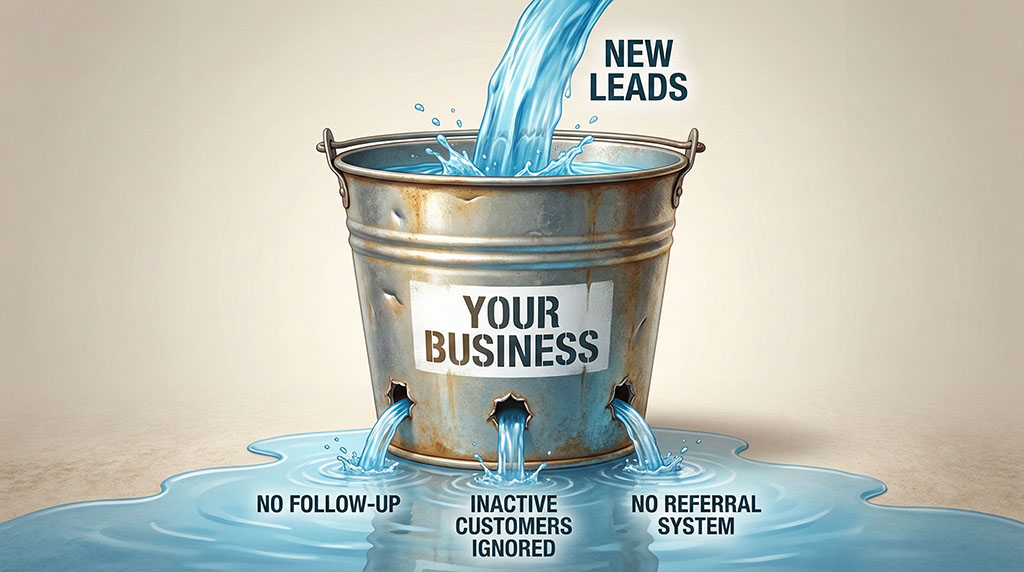
Think about it like a kitchen sink. If you turn the faucet on full blast but the drain is half-clogged, adding more water doesn’t help — it just floods the counter faster. The business equivalent: pouring money into Facebook ads while your follow-up system is a sticky note that says “call back maybe.”
When you dig into the operations behind a “more customers” wish, you typically find three drains wide open:
No follow-up system. Not a bad one — none. Leads come in, get a quote or a conversation, and then… silence. The business moves on to the next shiny inquiry. Meanwhile, the prospect who was 80% ready to buy goes to a competitor who bothered to send a second email.
No reactivation. Past customers — people who already gave you money, already trusted you, already liked you enough to complete a transaction — sit in a dusty spreadsheet (if they’re tracked at all). The cheapest, easiest sale in business is to someone who already bought from you. Yet most businesses spend 100% of their energy chasing strangers.
No referral process. When asked “what percentage of your business comes from referrals?” most owners say something like 30-40%. When asked “what’s your system for generating referrals?” the answer is almost always: “We just do good work and people tell their friends.” That’s not a system. That’s a prayer.
The “more” wish reveals a business that’s trying to fill a bathtub with the plug pulled out. The fix isn’t a bigger faucet.
Gap #2: The Identity Crisis
The second most common magic wand answer is some version of differentiation: “I wish people understood what makes us different” or “I wish we could stand out from the competition.”
Then you ask: “Why should someone buy from you instead of your competitor?”
And you get… mush. “We provide great service.” “We really care about our customers.” “We’ve been in business for 20 years.”
These aren’t differentiators. They’re the business equivalent of a dating profile that says “I like to laugh and go on adventures.” Everyone says that. It means nothing.
The identity gap works like this: the business owner feels different — they know their craft, they care deeply, they’ve built something real — but they can’t articulate the difference in a way that matters to someone choosing between them and three competitors. And because they can’t articulate it, neither can their staff. Which means their marketing is generic, their sales conversations are feature-dumps, and their customers have no ammunition to refer them with.
You’ve experienced this yourself. Think about the last time someone asked you to recommend a restaurant. You didn’t say “they have food and tables.” You said something specific: “their handmade pasta is incredible” or “it’s the only place in town where the chef comes to your table.”
That specificity is what gets people to act. Without it, you’re invisible — not because you’re bad, but because you’re undescribed.
The cruelest version of this gap: a business with a genuinely superior product losing to a competitor with a better story. It happens constantly. The owner wished they could stand out, but the problem was never the product — it was the inability to name, in one sentence, why they exist.
Gap #3: The Stranger Obsession
The third pattern is subtler but potentially the most expensive.
The business owner wishes for “better marketing” or “more effective advertising.” Fair enough — marketing matters. But when you examine where their current marketing dollars go, you find a near-total obsession with strangers.
All the budget goes to acquisition. Ads targeting people who’ve never heard of them. Cold outreach. Trade shows. SEO. None of it goes toward the people who already know them.
Here’s the math that makes this painful. Acquiring a new customer costs — depending on the industry — five to twenty-five times more than retaining an existing one. A business spending $5,000 per month on ads to acquire customers at $200 each, while sitting on a database of 800 past customers they haven’t contacted in a year, is essentially burning cash to dig a well while standing next to a lake.
And it gets worse. Those 800 past customers are slowly forgetting you exist. They’re not angry. They didn’t leave because of a bad experience. They left because you stopped showing up.
Absence doesn’t make the heart grow fonder in business — it makes the heart grow elsewhere.
The “better marketing” wish reveals a business that’s trying to fill a gap with advertising that could be filled with a phone call.
"Knowing your gap doesn't close it"
Here’s where I have to be honest with you, because everything above sounds clean and diagnostic — and reality is messier than that.
You might be reading this, nodding along, and even recognizing yourself in one of these gaps. But recognition and action are very different animals. Knowing you should follow up with leads is not the same as having a system that follows up with leads. Knowing you need a clearer message is not the same as writing a clearer message.
Awareness without a system is just anxiety with extra steps.
I’ve watched business owners identify their gap, get genuinely excited about fixing it, and then… do nothing. Not because they’re lazy or stupid — because the gap felt too wide. They tried to fix everything at once, got overwhelmed, and defaulted back to the only thing that felt productive: chasing more new business. Which, of course, is the exact problem they identified.
So if the magic wand question is the diagnostic, what’s the treatment?
It’s smaller than you think.
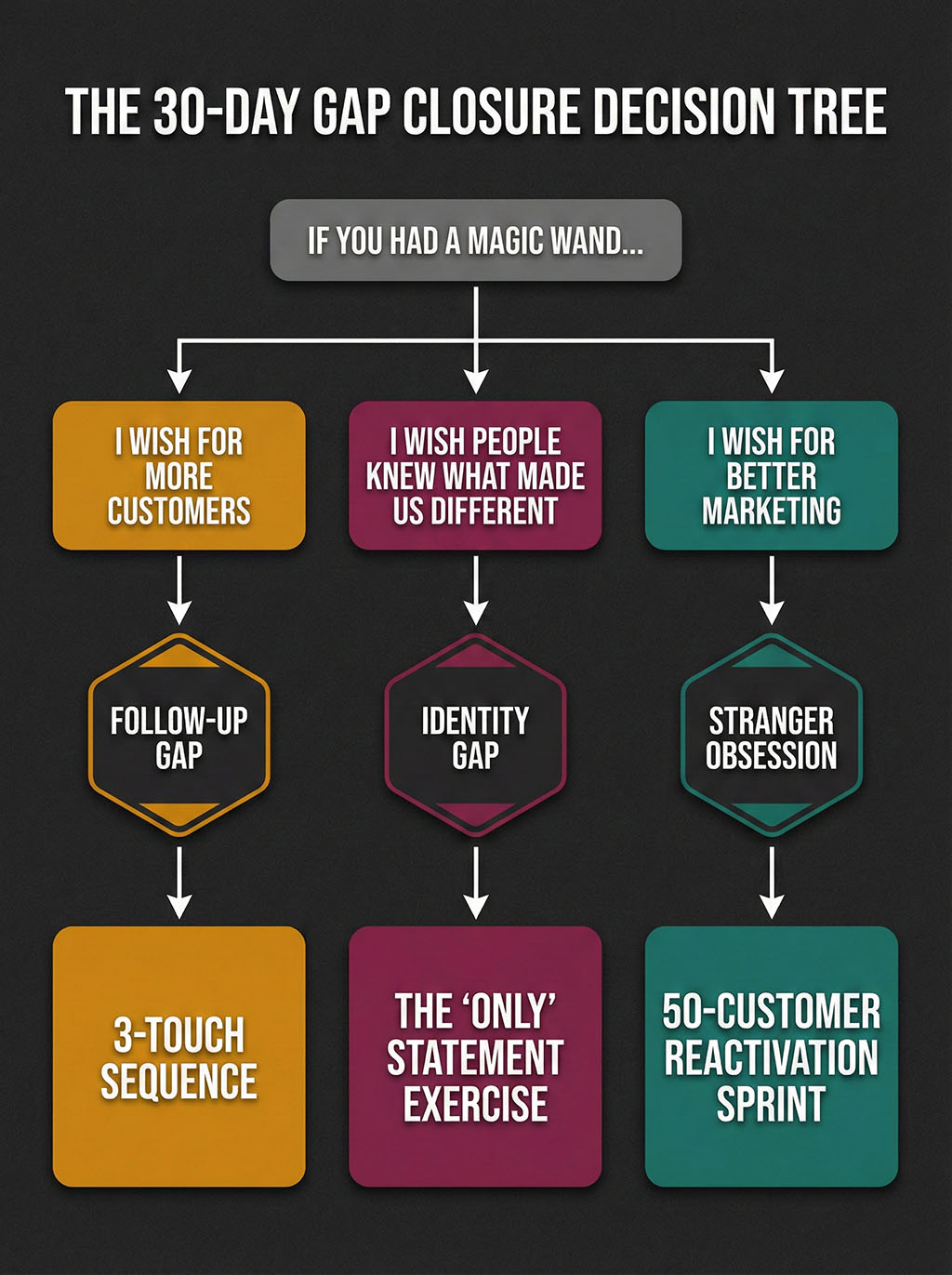
The 30-Day gap closure (pick one, only one)
The mistake is trying to plug all three holes simultaneously. Don’t. Pick the one that showed up in your magic wand answer, and spend 30 days on that single gap.
If your gap is follow-up: Build a three-touch sequence. When a lead doesn’t convert, they get a follow-up at 48 hours, seven days, and 21 days. Email, phone, carrier pigeon — the medium matters less than the consistency. You’re not being pushy. You’re being present.
Most leads don’t buy on first contact because the timing isn’t right, not because the interest isn’t real. Showing up a second and third time catches them when the timing shifts.
If your gap is identity: Complete this sentence and test it on 10 people: “We’re the only [your category] that [specific differentiator].” If you can’t finish that sentence, ask your three best customers why they chose you. Their words — not yours — are your differentiator. You’ll be surprised. What you think makes you special and what they think makes you special are rarely the same thing.
If your gap is the stranger obsession: Before you spend another dollar on acquisition, email or call 50 past customers this month. Not a blast — a personal note. “We haven’t heard from you in a while. Anything we can help with?” Track the response rate. I’d wager it outperforms your ad spend by a factor you’ll find embarrassing.
One gap. One system. Thirty days. That’s it.
The temptation will be to do all three. Resist it. A business that closes one gap completely will outperform a business that half-addresses three.
What the silence actually means
Those 11 seconds of silence after the magic wand question — they’re not what you think.
It’s not confusion. Business owners aren’t slow. They’re fast, decisive people — that’s how they built a business in the first place. The silence is something else.
It’s the sound of someone realizing they’ve never been asked to choose. They’ve been operating in reaction mode — putting out fires, chasing opportunities, responding to whatever’s loudest — for so long that they’ve forgotten what they actually want. The magic wand question doesn’t reveal their biggest problem. It reveals that they haven’t stopped long enough to define one.
And that pause — that 11 seconds of quiet — is the most productive moment a business owner can have. Because you can’t close a gap you haven’t named.
So here’s your magic wand question. Not from me — to yourself.
If you could fix one thing in your business tomorrow, what would it be? Say it out loud. Then look at your calendar from last week and count how many hours you spent on that one thing.
The distance between your answer and your calendar is your gap.
Now close i
Find Your Gap in 10 Minutes
Run the magic wand question on yourself — then check your answer against the three gaps. Our free assessment tells you exactly which one is costing you money and what to fix first.
[Book Your Assessment →]
Most business owners discover they’re spending thousands chasing new customers while ignoring the ones who already said yes. Takes one conversation.
You don’t need more leads. You need to stop ignoring the ones you’ve already got.