
Picture a relay race. Four runners, four handoffs. Each runner is fast—genuinely talented. But every baton pass costs two seconds. The other lane? One runner. No handoffs. They crossed the finish line while your team was still transferring the baton for the third time.
That’s the modern agency model. And the baton is your campaign.
The 47-step odyssey nobody talks about
The average marketing campaign passes through 47 distinct steps before it goes live. Forty-seven. Not because anyone designed it that way on purpose—but because decades of departmental specialisation created a workflow that functions like an assembly line built for a product that expired while it was still on the conveyor belt.
Here’s where the time actually goes. Before a single creative asset exists, teams burn 2–4 weeks on pre-campaign preparation: alignment meetings, brief creation, brief review, brief revision, kickoff scheduling. This period produces zero market-facing output. Then the real bottleneck hits: 9 out of 10 marketers cite approval delays as the primary reason for missed deadlines (Averi). And here’s the part that should make you angry—42% of marketing leaders say those delays happen because stakeholders are simply unavailable to provide feedback. Not because anyone’s scrutinising the work. Because someone’s in another meeting.
The result? A one-week timeline routinely becomes four once it hits the review queue. Approving content now takes longer than creating it (EasyContent, 2025).
Marketing executives attend 17 meetings per week—more than double the eight meetings typical employees sit through (Lyzr AI). Nearly half the senior marketing leader’s work week is consumed by coordination, not creation. Not strategy. Not the thing they were hired to do.
And 60% of marketing budgets get wasted on execution inefficiencies—coordination overhead, version control chaos (48% of marketers still route approvals through email), and the endless chase for sign-off (Averi). Marketers spend 16 hours per week on routine tasks that could be automated. That’s two full working days, every week, doing work that produces nothing.
The 61-point chasm
If this were just an operational annoyance, it would be a process story. It’s not. It’s a defection story.
The WFA/MediaSense “Future of Media Agency Models” report surveyed 70-plus multinationals representing over $50 billion in ad spend and found the starkest gap in the data: 92% of respondents say speed and agility are important. Just 31% are satisfied with how their agency delivers it. That’s a 61-percentage-point chasm between what clients need and what they’re getting.
Agencies don’t even see the gap. A Wpromote/Ascend2 survey of over 500 decision-makers confirmed that speed of delivery is the number-one challenge brands face working with agencies. Only 34% of brands report high satisfaction with agency speed—but 65% of agencies are confident in theirs. That 31-point perception gap means agencies are losing clients and don’t understand why.
The switching data is brutal. 40% of companies said they were likely to switch agencies within six months—33% higher than 2021 levels (Gradient Group, 2024). And they’re doing the maths on the cost: an average agency search runs $408,500, with total review costs exceeding $1 million across all parties (ANA/4A’s). Clients are paying seven figures just to escape slowness.
Where is the money going instead? Inward. 54% of marketers now manage the majority of marketing in-house, up from 44% in 2023 (RSW/US). P&G saved $620 million by cutting its agency roster in half. Ford’s in-house model is projected to save $150 million annually. And 22% of CMOs say generative AI has already enabled them to reduce reliance on external agencies (Gartner 2025 CMO Spend Survey).
Speed has overtaken expertise
Here’s the data point that should reshape how you think about this market.
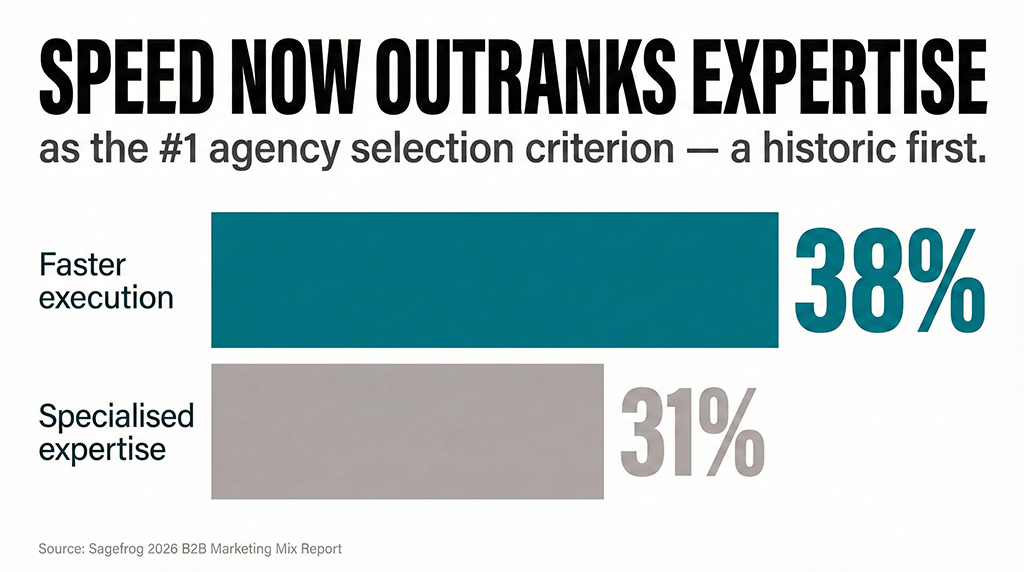
Sagefrog’s 2026 B2B Marketing Mix Report found that “faster execution” now leads at 38% as the top agency selection criterion. Specialised expertise dropped to 31%. Read that again. For the first time in the modern agency era, clients would rather you be fast than brilliant.
This isn’t anti-intellectualism. It’s economics. Wpromote/Ascend2 found that brands reporting high satisfaction with their agencies are 61% more likely to experience substantial revenue growth. Since speed is the number-one dissatisfaction driver, the connection is direct: speed satisfaction correlates with revenue performance.
The hybrid model—in-house team plus agency support—grew from 36% to 46% in a single year, becoming the most common approach (Sagefrog 2026). Clients aren’t abandoning outside help entirely. They’re restructuring it around velocity.
As Dave Rolfe, Global Head of Production at Hogarth/WPP, put it: “A new consumer trend can explode and disappear within a week, yet many agencies remain locked into months-long campaign cycles of handoffs and revisions—a fundamental disconnect that renders traditional creative slow, reactive, and ultimately irrelevant once it reaches the market.”
The compound maths agencies can't escape
Speed isn’t just about getting campaigns out faster. It’s about learning faster. And the maths of compounding turns this from an advantage into an unbridgeable gap.
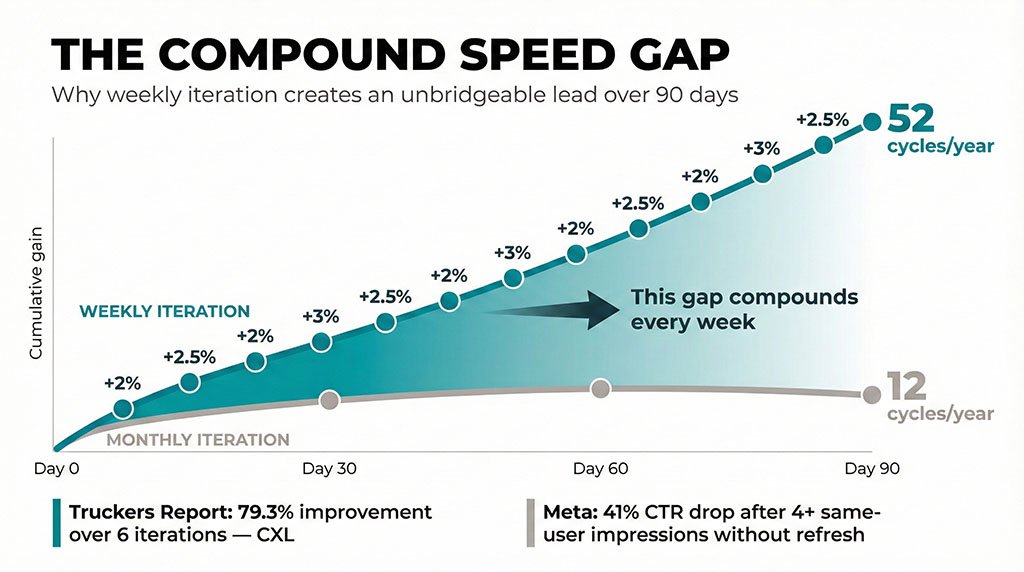
Consider the mechanics. A team that iterates weekly runs through 52 optimisation cycles per year. A team locked into monthly review cadences runs through 12. But the difference isn’t 40 extra attempts—it’s exponential. A 10% improvement compounded across three funnel stages doesn’t produce a 30% gain. It produces 33.1% (1.1 × 1.1 × 1.1). Stack modest gains across 52 cycles instead of 12, and the gap between the fast operator and the slow agency becomes a chasm that widens every single week.
This isn’t theory. The case study evidence is consistent. Truckers Report ran six rounds of iterative A/B testing and achieved a 79.3% conversion improvement over the original (CXL). Crazy Egg’s sequential homepage redesign delivered 30% improvement; layering in video produced an additional 64% boost—compound gains through rapid iteration (Linear Design, 2025). ArchiveSocial ran three sequential A/B tests and saw a 101.68% increase in click-through rate (VWO). Flos USA’s multi-stage funnel optimisation achieved a 125% checkout conversion increase and 18X ROI (VWO).
AI amplifies this effect by increasing the iteration frequency itself. Optimizely’s 2025 benchmark data shows AI users run 78.7% more experiments, launch 24.1% more personalisation campaigns, and lift win rates by 9.3%. Fully Agile marketing teams—the kind built for rapid iteration—are three times more likely to report being “extremely successful” compared to non-Agile teams (AgileSherpas, 2025).
And the cost of not iterating is equally measurable. Meta’s 2024 data shows campaigns experience a 41% drop in click-through rate after four or more same-user impressions. Creatives refreshed every 10–14 days maintained 30% higher engagement compared to monthly refresh. Delay your creative refresh by even two weeks and you’re looking at a 22% CPC increase and a 17% conversion rate decrease (Socialinsider, 2024).
McKinsey’s research on marketing “Integrators”—companies that merge data and creativity through agile operating models—found they grew revenues at twice the average rate of their peers.
"But speed without governance is a liability"
This is where the reasonable objection lands. And it’s a serious one.
US consumer trust in AI has fallen from 50% to 35% over five years (Edelman Trust Barometer). A third of consumers say AI negatively impacts brand perception, while only 16% see it positively (Clutch.co, 2025). Nearly two-thirds of US adults say they’re uncomfortable with AI-generated advertising (Basis Technologies, 2025). Offensive content in ad environments grew 72% year-over-year (IAS 2025). The FTC issued more than $785 million in fines in 2024 for deceptive AI-generated advertising. The EU AI Act reaches full application by August 2026 with fines up to €35 million or 7% of worldwide turnover.
So yes—moving fast without guardrails is dangerous. Every one of those numbers is real. The question isn’t whether governance matters. It does.
The question is whether your current process actually provides governance—or just the feeling of governance.
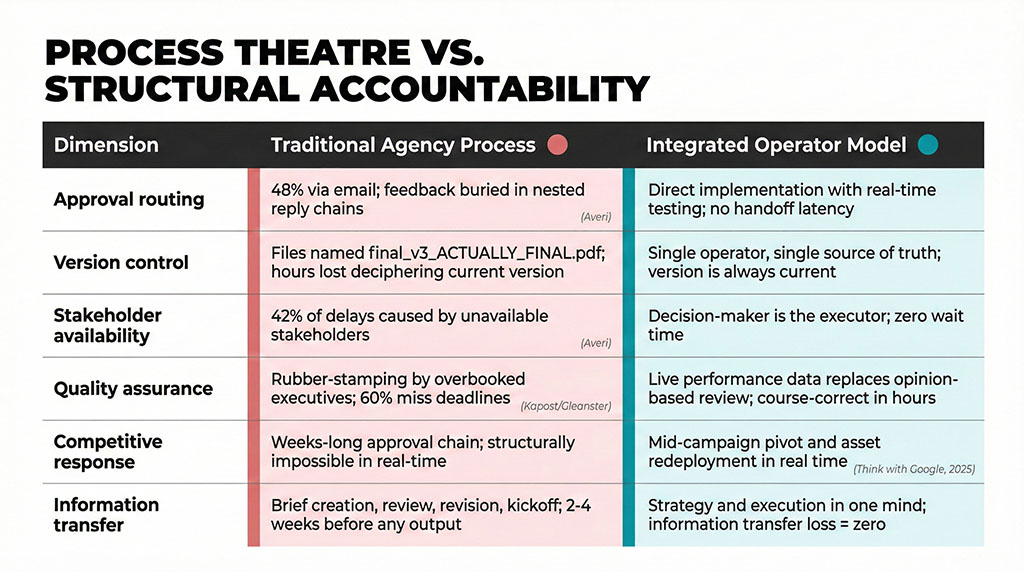
Because here’s what the 47-step approval chain actually produces: 48% of approvals routed through email, where feedback gets buried in nested reply chains (Averi). Files named “final_v3_ACTUALLY_FINAL.pdf.” Stakeholders rubber-stamping work they haven’t read because they’re already late for their next meeting. Sixty per cent of companies missing deadlines due to approval bottlenecks (Kapost/Gleanster). That’s not governance. That’s theatre.
The integrated operator model doesn’t eliminate oversight. It eliminates the latency of oversight. When the person devising the strategy also executes it, information transfer loss drops to zero. There’s no brief to misinterpret, no creative direction lost in translation across four departments. Decisions that required a committee are made by someone who can implement, test, and read results before a traditional team could schedule the meeting to discuss them.
The Verizon/WPP case is instructive. When WPP rebuilt Verizon’s promotional pipeline using its WPP Open platform, the team delivered 15 videos in 70% less time (Think with Google/WPP, December 2025). Then something happened that would have been structurally impossible under the old model: a competitor launched a similar offer mid-campaign, and the team pivoted and redeployed assets in real time. No approval chain. No emergency meeting. No two-week delay while the window closed.
That’s not recklessness. That’s responsiveness with accountability built into the structure rather than bolted on top of it.
What this actually looks like when everything goes sideways
The Verizon story is clean. Big brand, big platform, successful pivot. Here’s a messier one — because messy is what business actually looks like.
We were launching Sunday Drive — an event with a fixed date, zero flexibility, and the kind of public visibility that punishes mistakes. The campaign plan was solid. The timeline was mapped. And then the reality of live business did what it always does: it ignored the plan completely.
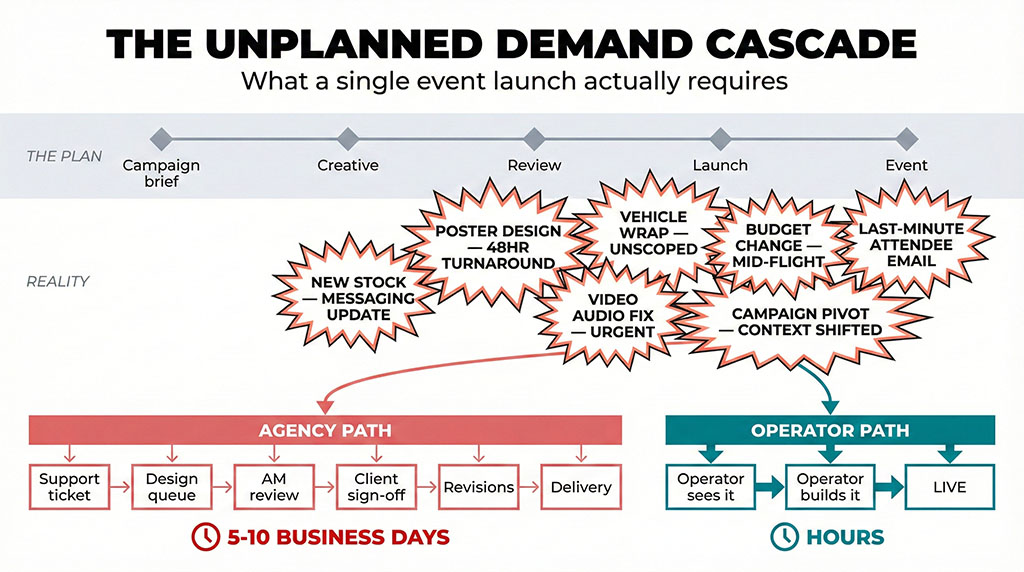
Within days of launch, requirements started surfacing that nobody had anticipated. Posters needed designing. A full vehicle wrap for a car trailer materialised out of nowhere — not a line item anyone had scoped. Campaign ideas that made sense on Monday needed rethinking by Wednesday because the context had shifted. Last-minute emails to attendees. New cars arriving in stock that needed integrating into the messaging. Budget changes mid-flight. Video audio that needed fixing before it could go out.
None of this was in the brief. None of it could have been.
Now imagine routing each of those through a traditional agency process. The poster goes into the design queue — estimated turnaround, five business days. The vehicle wrap needs a separate brief, a separate team, a separate approval chain. The email copy goes to the copywriter, then to the account manager for review, then to the client for sign-off, then back for revisions. The video audio fix becomes a support ticket. Every unplanned need enters the back of a line behind someone else’s planned work.
By the time the agency process catches up, the event is over.
This is the part the data doesn’t capture — the sheer volume of unplanned, urgent, overlapping demands that define real marketing work. Strict campaign plans, support tickets, and project management tools are built for predictable conditions. They perform beautifully when everything goes according to schedule. They collapse the moment business gets stressful, which is to say, constantly.
An independent operator with multiple skills doesn’t file a ticket for the poster. They make the poster. They don’t brief a separate team on the vehicle wrap. They design it. The email, the video fix, the new stock integration — it all happens in hours because there’s no structural friction between recognising the need and meeting it. The person who sees the problem is the person who solves it.
That’s not a theoretical advantage. It’s the difference between a campaign that adapts to reality and a campaign that was perfect on paper and irrelevant by launch day.
The operator model: one person, AI, and the numbers to prove it
The shift isn’t speculative. It’s already happening at scale.
LinkedIn users self-identifying as “fractional” leaders grew from 2,000 in 2022 to 110,000 in early 2024—a 5,400% increase. The US now counts 120,000 fractional leaders, doubled from 60,000 in just two years (Frak Conference, 2024). Fractional CMO adoption specifically grew 245% over 2023–2025. And 30.4% of all fractional executives work in marketing and communications—the single largest functional category.
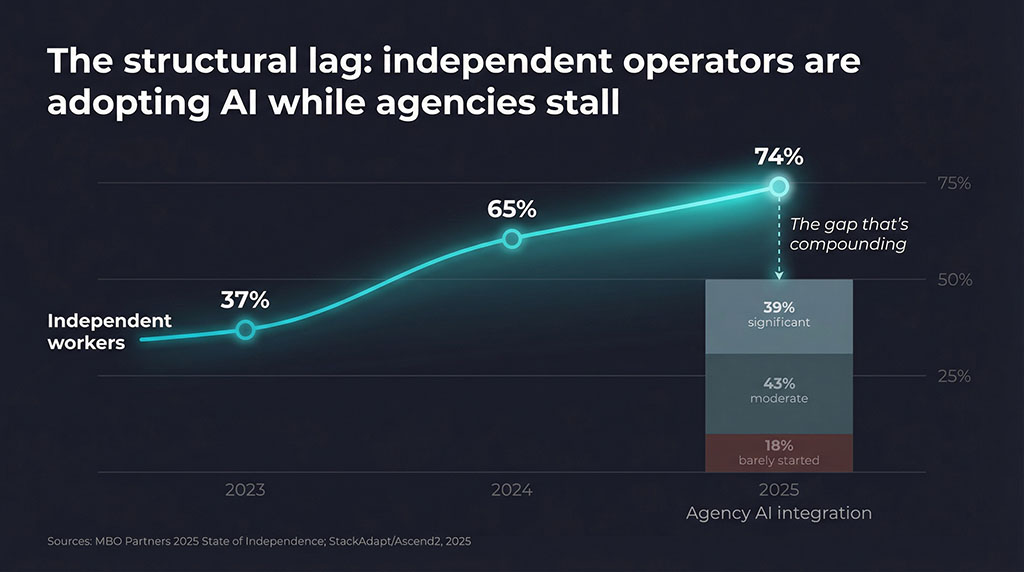
AI is the force multiplier that makes this model viable. 74% of independent workers used generative AI in 2025, up from 37% just two years earlier (MBO Partners 2025). Freelancers using AI save roughly eight hours per week (Fiverr). Solo founders using AI complete tasks 55% faster with 22% lower capital requirements (Nucamp, 2025). Early AI adopters report 70–80% automation of operations and productivity gains between 150% and 300% (AgentiveAIQ, 2025).
The timeline compression is staggering. Companies using AI report campaigns that launch 75% faster than manual builds (Averi). AI content generation reduces production timelines by 70–95% across most formats (Storyteq). Creating 100 content variations with AI takes only 10–20% longer than creating a single version (Storyteq). AI agents can conceptualise, create, and launch campaigns within 2–4 hours—a 90% time reduction against traditional workflows (Lyzr AI).
And yet—only 39% of agencies have significantly integrated AI. Eighteen per cent have barely started (StackAdapt/Ascend2, 2025).
Superside used custom AI image models to achieve 10x faster image creation, 75% less time per image, and 85% lower cost per image (Superside, 2026). McKinsey reports that some Fortune 250 brands have already sped up campaign execution by 15x. This isn’t the future arriving. It’s the present widening the gap.
What this means for 2027
Gartner predicts 80% of enterprise marketers will use generative AI daily by 2027. AI tools will account for nearly 30% of marketing technology budgets. By 2028, 90% of B2B buying will be AI agent intermediated, pushing $15 trillion through AI agent exchanges.
Forrester is blunter: 15% of agency jobs will be eliminated in 2026, after 8% in 2025. One global holding company CEO told researchers: “By 2028, we’ll double profits and halve the people.” And 85% of US B2C marketing executives plan to review media agency contracts in 2026.
The split is already forming. McKinsey’s State of Marketing Europe 2026 report—surveying 500 CMOs—found that generative AI ranks only 17th out of 20 in stated CMO priorities. But the 6% of marketing executives at “mature” AI deployment already see 22% efficiency gains. McKinsey calls this an “AI reckoning” risk: the gap between leaders and laggards is compounding while most leaders aren’t even watching.
Dentsu projects global ad spend will surpass $1 trillion for the first time in 2026, with 71.6% of that spend algorithm-driven—rising to 76% by 2028. In an algorithmic marketplace, speed isn’t a nice-to-have. It’s the operating system.
The relay race is over
Picture that relay race again. Four runners, four handoffs, two seconds lost at every exchange. Except now the runner in the other lane isn’t just fast—they’re running a different race entirely. They’ve got real-time data feeding their stride. They adjust course mid-step. And every lap they run makes the next one faster, because every cycle compounds on the last.
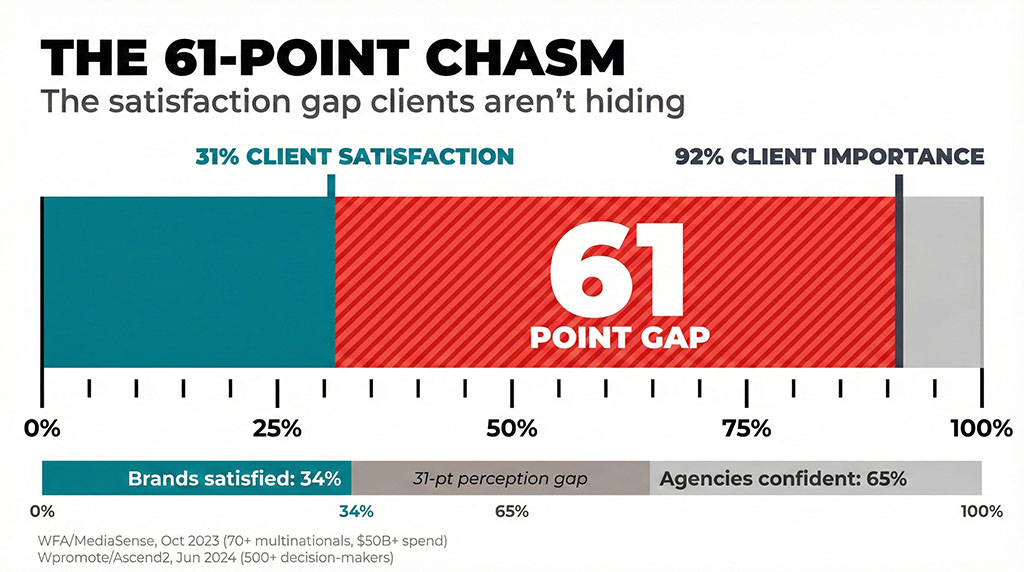
The 47-step odyssey, the 17 meetings per week, the 61-point satisfaction gap—these aren’t bugs in the agency model. They’re features of a system designed for a market that no longer exists. The question facing every marketing leader isn’t whether to move faster. The data already answered that.
The question is whether you’ll keep handing off the baton—or start running the race yourself.
See what one brain would change.
Map your current setup against the integrated model — find the gaps, the overlaps, and the spend that’s going nowhere. Takes 30 minutes.
Most clients find 2–3 channels working against each other that nobody spotted — because nobody could see both at once.