
Doug D’Anna tells a story about his first jujitsu lesson. He spent twenty minutes trying to wrench his opponent’s arm into a submission hold. Couldn’t get it. Kept muscling. Kept failing.
The instructor stopped him. “Doug, you’re never going to get the arm bar like that.” He paused. “You always go for the choke first. Go for the choke—he gives you the arm.”
D’Anna is a copywriter who’s generated over $100 million in direct sales. Gary Bencivenga—widely considered the greatest living copywriter—put D’Anna on his short list of six writers in the entire country he’d recommend without hesitation. And D’Anna says that jujitsu lesson taught him more about selling than most marketing books.
The translation: go for what your prospect wants first (the choke), and the sale (the arm) follows. Most people learn technique but miss strategy.
I think about that story constantly. Because every week, I watch small business owners try to wrench the arm. Pushing product features, credentials, and clever positioning at people who haven’t been given a reason to care yet. Muscling harder. Converting less.
The problem isn’t the arm bar. It’s the sequence.
The river between you and the sale
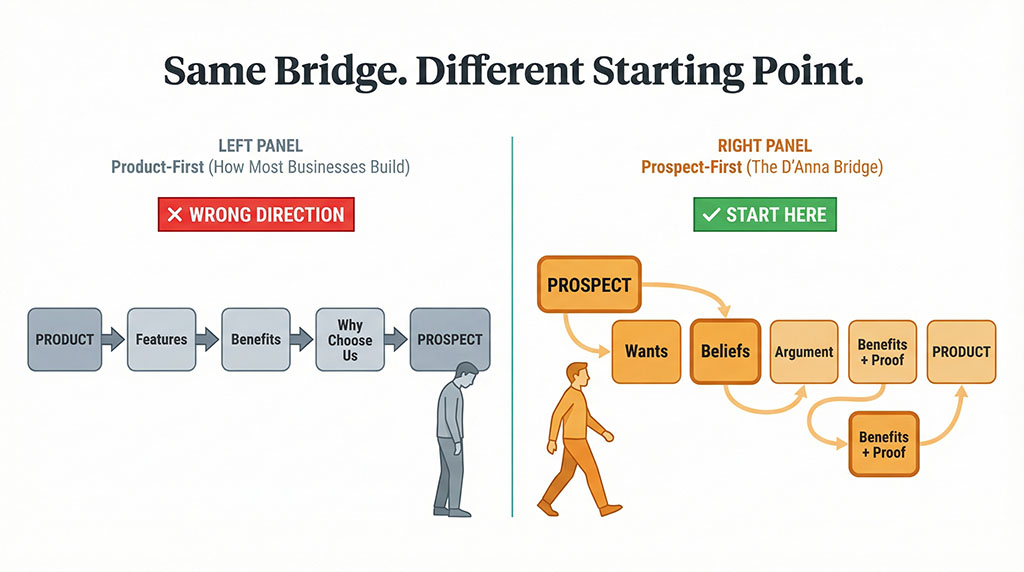
D’Anna’s central idea is deceptively simple. He describes it as a river: your prospect stands on one bank, your product sits on the other. Your marketing is the bridge.
Here’s where most small business owners get it backwards. They start building from the product side.
They stand next to their offer—the thing they built, the service they perfected—and try to construct a bridge outward toward the customer. Features. Benefits. Pricing tiers. Testimonials. All shouted across the water at someone who can barely hear them.
D’Anna’s framework flips the direction entirely. His copyrighted formulation: “The bridge to your next breakthrough begins on your customers’ side of the river, founded on their wants and beliefs, supported by your argument, your benefits, and your proof.”
The bridge starts on their side. Wants first. Beliefs second. Argument third. Benefits and proof last.
Most businesses run that sequence in reverse and wonder why their conversion rates are anaemic.
The cookie and the dog
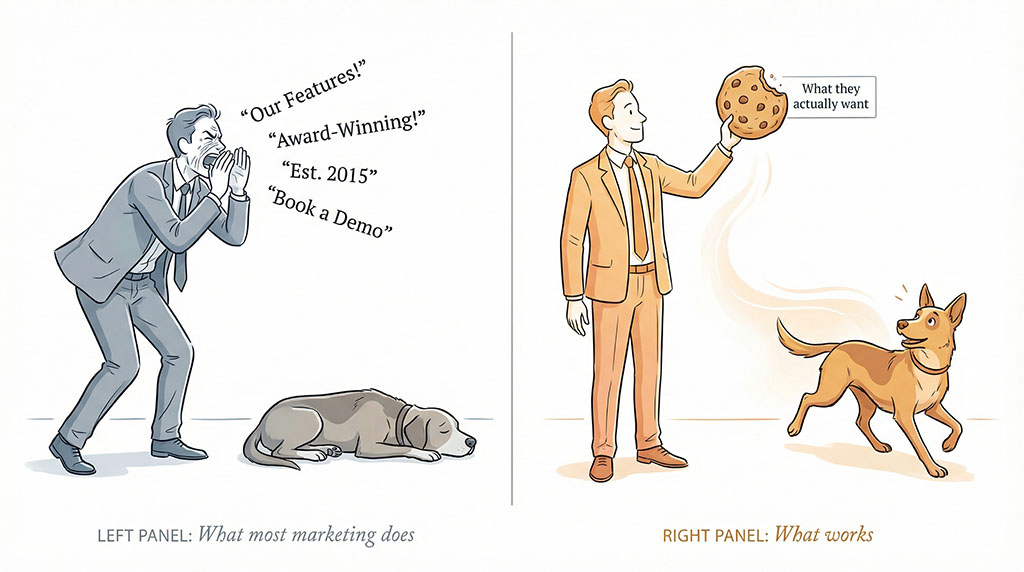
D’Anna has a way of making this visceral. He asks: do you have a dog?
Picture this. You’re at a mate’s house. Their dog is across the room. Your mate calls the dog. Calls again. The dog ignores them. Now imagine you hold up a cookie. That dog crosses the room in two seconds flat.
Most marketing is calling the dog. Product announcements. Feature updates. “We’re excited to launch…” Company news dressed up as customer value.
The cookie is what your customer already wants. Not what you wish they wanted. Not what they should want. What they actually lie awake thinking about.
D’Anna spent 40 hours on prospect research before writing a single word of copy. Not product research. Not competitor research. Prospect research. He’d go to bookstores and study magazine covers—”a trillion dollars’ worth of research,” he called it—because those covers represent what editors have tested and proven that people actually care about.
His master question, borrowed from Eugene Schwartz’s Breakthrough Advertising: What do they want?
Not “what do we sell?” Not “what makes us different?” What. Do. They. Want.
Four bridges, four psychologies
Here’s where D’Anna’s thinking goes deeper than the standard “know your customer” advice you’ve heard a thousand times.
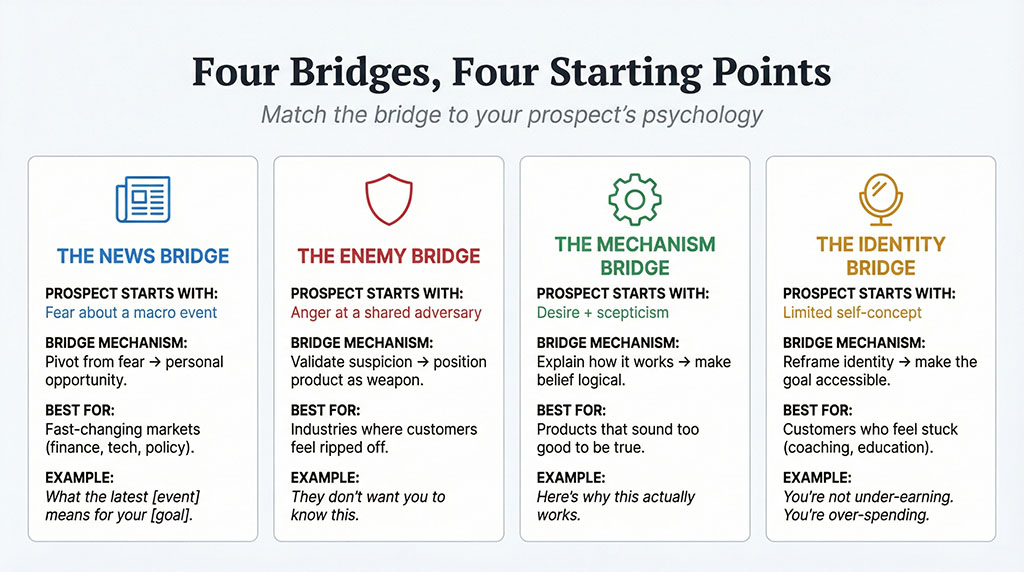
Through decades of split-testing—real money, real results, millions of pieces mailed—he discovered that the bridge isn’t one thing. It’s at least four distinct structures, each calibrated to a different prospect psychology.
The News Bridge starts with a macro fear or event your prospect is already anxious about, then pivots to the micro personal opportunity hidden inside it. A financial adviser doesn’t lead with portfolio services. They lead with “what the latest rate announcement means for your retirement”—then bridge to the specific action only their service enables.
The Enemy Bridge aligns you and your reader against a shared adversary. D’Anna’s most famous piece—The Great Retirement Betrayal—didn’t sell a newsletter by talking about the newsletter. It validated the reader’s suspicion that banks, government, and brokers were working against them. The newsletter became the weapon. That piece beat the existing control by 100%, mailed to over 25 million people, and ran for three years before anyone could beat it.
The Mechanism Bridge works when your prospect wants the result but doesn’t believe it’s possible. Instead of making bigger promises, you explain how it works in a way that makes belief logical rather than emotional. The mechanism itself becomes the proof. This is the bridge for any business selling something that sounds too good—you answer the “but how?” before they even ask it.
The Identity Bridge is the subtlest and often the most powerful for small businesses. It shifts the reader from a limited self-concept to an aspirational one. D’Anna used this for a financial publication by reframing the problem from “how to earn more” (hard, overwhelming) to “how to keep more of what you already earn” (accessible, within control). The reader’s identity shifted from “struggling earner” to “smart money manager.” That piece earned roughly $100,000 in about three weeks.
The bridge you choose depends entirely on where your prospect is standing. Are they scared? Angry? Sceptical? Stuck? Each starting emotion demands a different structure. This is not a template. It’s a diagnostic.
What this looks like for a real business
Theory is lovely. Here’s what happens when you actually flip the direction.
I worked with Swimming Pool Kits Direct—a company that sells pool kits homeowners install by coordinating their own tradies, cutting out the pool builder middleman. Their previous agency had them running ads with the headline: “Looking for a pool that fits your space and budget?”
Product-first. Calling the dog. Describing the offer instead of speaking to what the prospect actually wants.
We rebuilt the bridge from the prospect’s side. The new headline: “Your Neighbours Aren’t Richer. They’re Smarter.”
Then the subtext: They stopped collecting quotes and started coordinating tradies directly.
Same product. Same audience. Completely different starting point. The old message began with the pool (product side of the river). The new message began with a feeling every homeowner recognises—watching the neighbours get the pool you want and assuming they must earn more (prospect’s side of the river). Then it reframed that assumption into something the reader could act on.
That’s an Identity Bridge. It shifts the reader from “I can’t afford a pool” to “I’m smart enough to get one differently.”
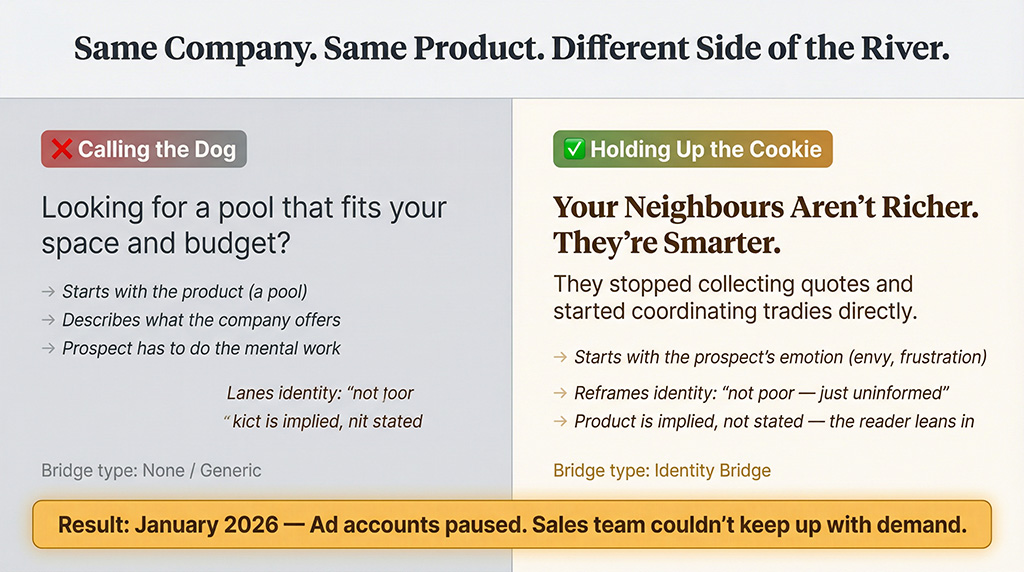
The results? In January 2026, they had so many leads they had to pause their ad accounts while the sales team caught up.
Not because the product changed. Because the bridge started on the other side of the river.
"But I already know my customer"
I can hear it. You’ve done the persona exercise. You’ve mapped the journey. You’ve filled in the empathy canvas at some workshop. You know your customer.
And you might be right. The problem isn’t knowledge. It’s orientation.
Knowing your customer and starting from your customer are two completely different things. You can have a detailed persona document pinned to your wall and still build every piece of marketing from the product outward. The persona sits in a folder. The homepage still leads with “Our Solution” and “Why Choose Us.”
D’Anna puts it bluntly: “Even in the direct marketing associations, people are product pushers. They think that they need to push what they think off on people and not what they want.”
He’s describing billion-dollar companies. But I see the same pattern in every small business I work with. The “About” page is three times longer than the page explaining what the customer gets. The email sequence opens with company backstory instead of the reader’s problem. The sales page leads with the founder’s credentials instead of the prospect’s frustration.
It’s not a knowledge gap. It’s a direction gap. You built the map facing the wrong way.
And here’s what makes this uncomfortable: turning it around means rewriting things that feel finished. That homepage you spent two months on? The pitch deck you’re proud of? The email sequence that “sounds professional”? If they start with your product, they start in the wrong place—regardless of how polished they are.
D’Anna never considered himself the best writer in his field. His own words: “I’ve never been the best writer. I’ve been the best salesman because I’ve been able to focus on what exactly they want.” When he went head-to-head in split-run tests against other top copywriters, the best writer didn’t win. The best strategist did.
That’s the gap I want to close for you. Not better words. Better direction.
The diagnostic you can run right now
D’Anna’s method is immersive—40 hours spent getting “in tune” with a prospect before writing a single word. That’s not realistic for most small business owners.
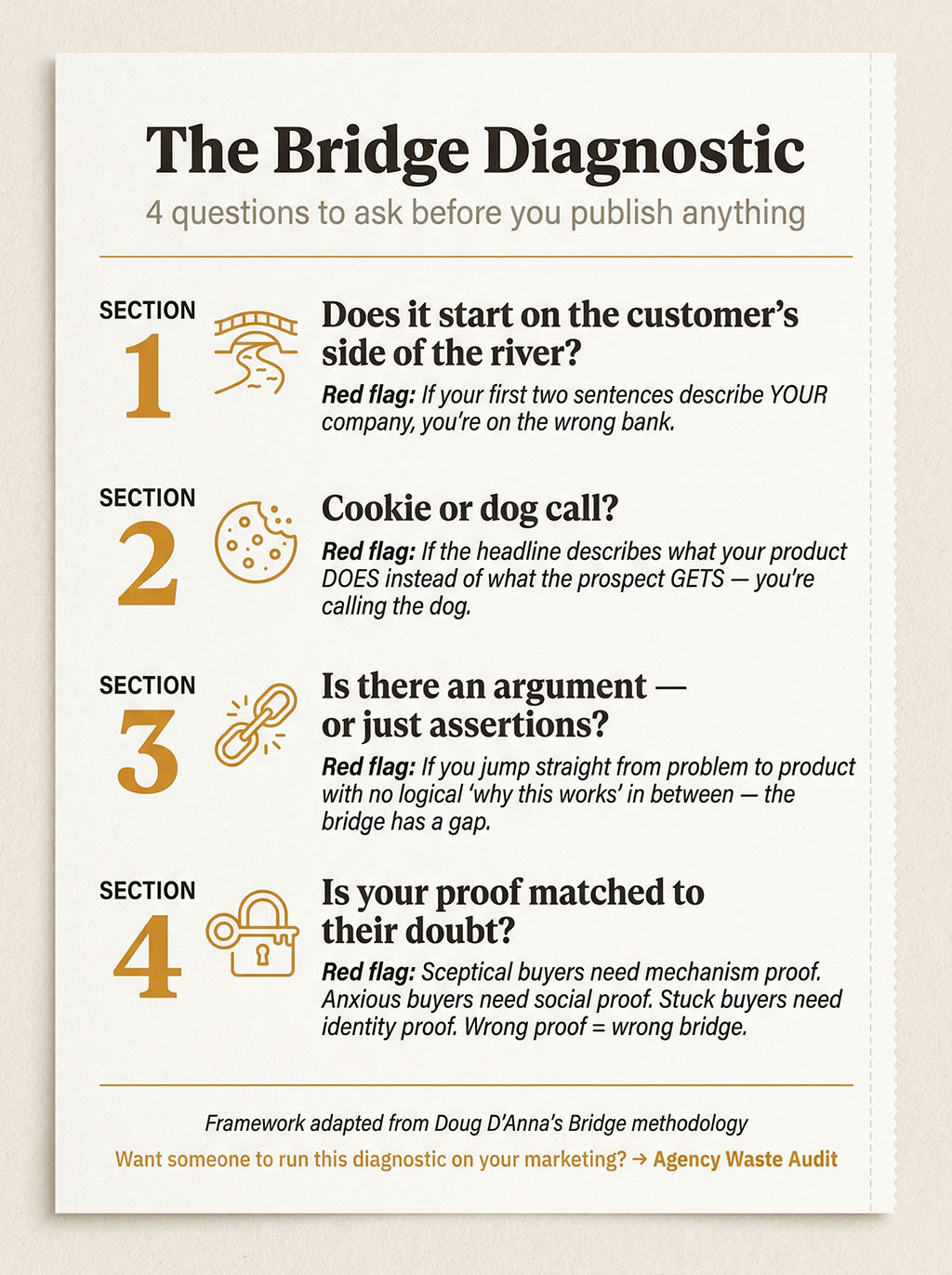
But his diagnostic questions are. Pull up your homepage, your best-performing email, or your main sales page, and ask:
Does it start on the customer’s side of the river? Read the first two sentences. Do they describe the customer’s world—their problem, their frustration, their desire? Or do they describe your company, your product, your process?
Are you holding up the cookie or calling the dog? Is the headline about what the prospect gets (the cookie), or what your product does (calling the dog)? “We offer comprehensive financial planning” is calling the dog. “Retire five years earlier without earning a cent more” is the cookie.
Is there an argument—or just assertions? D’Anna’s bridge formula isn’t just wants and benefits. There’s a logical argument in the middle. A reason why your solution connects to what they want. Most small business copy jumps straight from problem to product. The argument—the “here’s why this specific approach works for someone in your situation”—is usually missing entirely.
Is your proof matched to their doubt? Proof isn’t just testimonials. It’s data, demonstrations, mechanisms, and evidence chosen specifically because they address what this prospect doubts. A sceptical buyer needs mechanism proof. An anxious buyer needs social proof. A stuck buyer needs identity proof. Using the wrong type for the wrong psychology is like prescribing medicine without a diagnosis.
D’Anna once made a distinction that stuck with me. He said he absolutely does critiques of marketing—but they’re marketing critiques, not copywriting critiques. You can’t evaluate copy without understanding the specific market, the specific prospect psychology, and the competitive landscape. Copy doesn’t exist in isolation. Neither does your marketing.
Go for the choke
Back to that jujitsu mat. What D’Anna’s instructor understood is that the choke and the arm bar aren’t unrelated moves. They’re sequential. When you threaten the choke—something your opponent desperately wants to avoid—they instinctively protect their neck. And in doing so, they expose the arm.
Your prospect’s desire is the choke. It’s the thing they can’t ignore, the want they’ll instinctively reach toward. When you lead with that—when you start on their side of the river and build toward your product instead of the other way around—you don’t have to force the sale.
They walk across the bridge because the bridge started where they were already standing.
Swimming Pool Kits Direct didn’t change their product. They didn’t slash prices or redesign their website from scratch. They walked around to the other side of the river and started building from there. The leads came to them.
Most small business owners don’t need better copy. They don’t need a new funnel, a fancier website, or a bigger ad budget. They need to stop reaching for the arm bar.
Go for the choke first. He gives you the arm.
Doug D’Anna’s Bridge framework is taught in his Million-Dollar Copywriting Formula coaching program. The intellectual foundation behind it—and required reading for anyone serious about persuasion—is Chapter One of Eugene Schwartz’s Breakthrough Advertising.
See Which Side of the River Your Marketing Starts On
We’ll map your current messaging — ads, landing pages, emails — against the prospect bridge framework and show you exactly where you’re pushing product instead of pulling prospects.
Book Your Agency Waste Audit →
Most businesses find 2–3 assets that are calling the dog when they should be holding up the cookie. Takes 15 minutes.
You don’t need better copy. You need to start building from the other side.