
“New Hot Golf Ball Banned From Pro Tour — Flies Too Far.”
That headline ran in the sports section of a newspaper. Not the advertising section. The sports section. Readers saw it next to box scores and game recaps, picked it up the way you’d pick up any interesting sports story, and read the whole thing before they realised someone was selling them a golf ball.
It ran for years. Years. Same headline, same placement, same result. Because the ad didn’t act like an ad. It acted like content — and people engaged with it the way they engage with content. They read it. They believed it. They bought.
That was print. The principle hasn’t changed. What’s changed is the scale of money proving it right.
$148 billion says your agency isn't paying attention
Native advertising — the digital descendant of that golf ball ad — is projected to hit $147.98 billion in US spending this year. That’s a 13.1% jump from 2025. The format delivers click-through rates four to eight times higher than standard display. Branded content achieves 81% aided recall versus 63% for conventional ads.
You’ve probably seen native ads without knowing it. Sponsored articles on news sites. In-feed content on social platforms that reads like a post, not a pitch. Advertorials that educate before they sell. The format works because it earns attention instead of demanding it.
The CTR gap alone should get your attention. But it’s not even the main advantage.
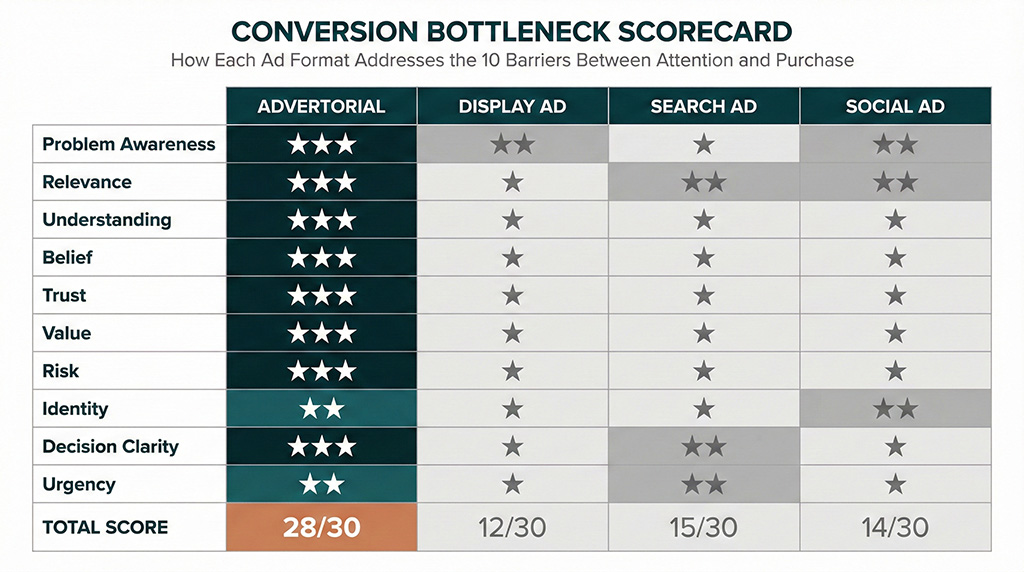
Every conversion funnel has bottlenecks — places where prospects stall. They don’t feel the problem. They don’t trust you. They don’t believe the solution works. They can’t see the value. They’re scared of the risk. Most ad formats address one or two of those bottlenecks well. Advertorials score highest on almost all of them: problem awareness, relevance, understanding, belief, perceived value, identity, urgency. No other format comes close to that range. A display ad can drive a click. An advertorial can move someone from “never heard of you” to “take my money” in a single piece of content — because it has the space and the editorial trust to do the full job.
So here’s the question worth asking: if this is where the money is going, if the performance data is this lopsided, and if the format solves more conversion problems than anything else in your toolkit — why has your agency never brought it up?
The ad format that doesn't fit the assembly line
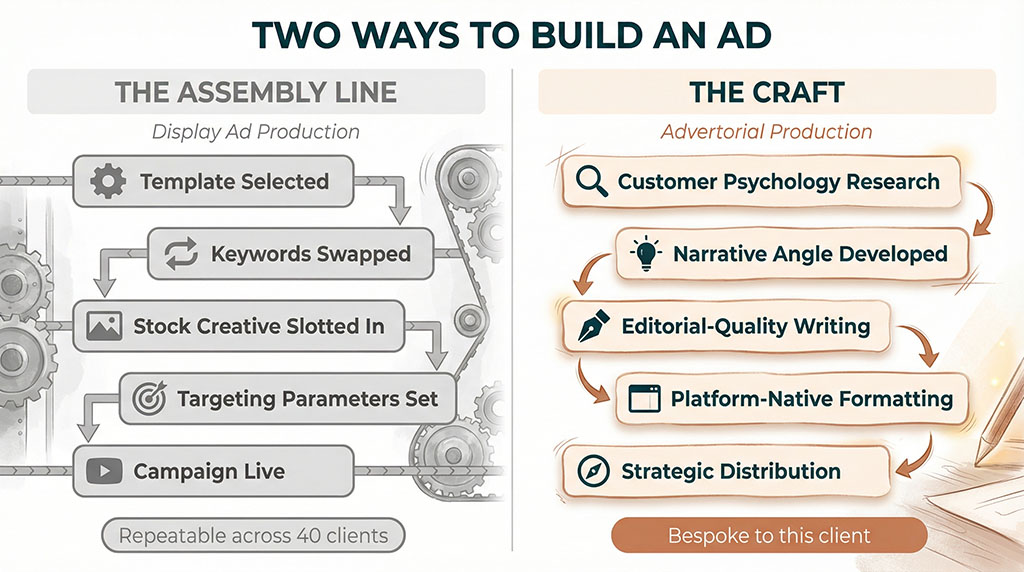
Your agency runs display ads. Search campaigns. Maybe some social. These formats share one trait that has nothing to do with performance and everything to do with operational convenience: they’re templatable.
A Google Ads campaign follows a structure. Keyword research, ad group setup, bid strategy, creative variations that slot into predefined character limits. A Facebook campaign has its own assembly line — audience targeting, creative sizing, A/B test protocols. An agency can hire a junior media buyer, hand them a checklist, and have campaigns live by Thursday.
Advertorials don’t work that way.
An advertorial requires someone to understand your customer — not your demographic, your customer. The person sitting across the table who’s worried about a specific problem and skeptical of anyone claiming to fix it. It requires writing that reads like editorial, not copy. It requires a headline that belongs in a news feed, not a banner. It requires a narrative arc: problem, tension, resolution — with your product woven in so naturally that the reader arrives at the sale feeling like they got there themselves.
You can’t hand that to a junior buyer with a template. You can’t batch-produce it across 40 clients on a Tuesday afternoon. You can’t automate it the way you automate bid adjustments.
Which is precisely why agencies don’t recommend it.
It's not that they can't. It's that they won't.
Think about how your agency makes money. They charge a management fee — usually a percentage of ad spend or a flat monthly retainer — to run campaigns across one or more channels. The more campaigns they can manage with the same team, the wider their margins. Efficiency is the business model.
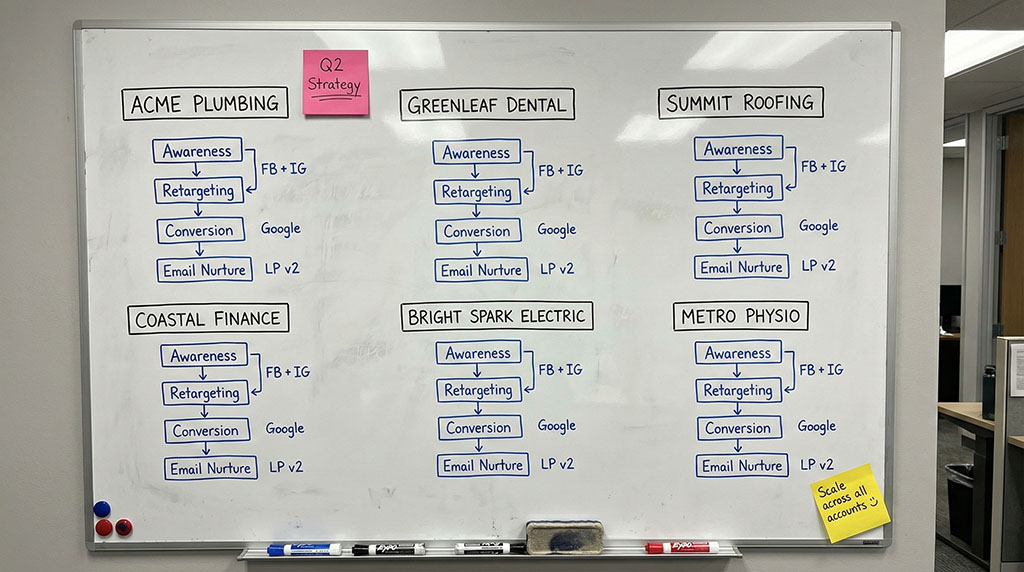
Display ads are efficient. You write a handful of headlines, pair them with stock-adjacent creative, set targeting parameters, and monitor performance dashboards. The cycle repeats monthly. The agency can service a dozen accounts with the same playbook, swapping out keywords and audiences like interchangeable parts.
An advertorial blows that model apart. Each one is bespoke. Each one needs strategic thinking about this specific client — their market position, their customer’s psychology, the competitive angle that makes the story worth reading. That thinking takes hours, not minutes. And it doesn’t transfer to the next client on the roster.
So when your agency sits down to recommend your media mix, the advertorial doesn’t make the slide deck. Not because it wouldn’t work for you. Because it wouldn’t work for them.
They’ll never say this, of course. What they’ll say is: “We focus on proven, scalable channels.” What they mean is: “We focus on channels we can run without thinking too hard about your business specifically.”
"But I can't afford to produce that kind of content"
Right about now you’re doing the maths. Advertorials sound expensive. You’d need a strategist who understands your customer. A writer who can produce editorial-quality work. Someone to handle distribution. That’s a bigger investment than another month of Google Ads — which at least feels familiar, even if the results have plateaued.
Here’s what that calculation misses.
You’re already spending the money. Every month, you pay for display campaigns that the average internet user has been trained to ignore. Banner blindness isn’t a theory — it’s the default state. Your agency reports impressions and clicks, and those numbers look respectable in a spreadsheet, but the gap between a click and a customer keeps widening because the person who clicked wasn’t reading. They were scrolling. Their thumb grazed a banner. That counts as engagement in your monthly report.
Now compare. One well-built advertorial, placed where your customers already read, written in a voice they trust, structured to educate before it sells. The data says that piece will be viewed 53% more often than a banner. It will be shared — actually shared, by real people — 32% more frequently. And the people who read it will spend minutes with your message, not the 1.7 seconds the average display ad gets before the eye slides past.
The cost of one advertorial versus the cost of one month of underperforming display isn’t even close when you measure what matters: attention that converts.
The real expense isn’t doing advertorials. It’s paying for the ad format that doesn’t work because nobody told you the one that does exist.
Why the difficulty is the advantage
Here’s where the agencies accidentally revealed something useful: advertorials are hard.
They’re right. And that’s the entire point.
If advertorials were easy to templatise, every agency would run them. Performance would normalise. The advantage would vanish. The reason native content still outperforms display by multiples — after more than a decade of digital advertising evolution — is that the barrier to entry keeps lazy execution out.
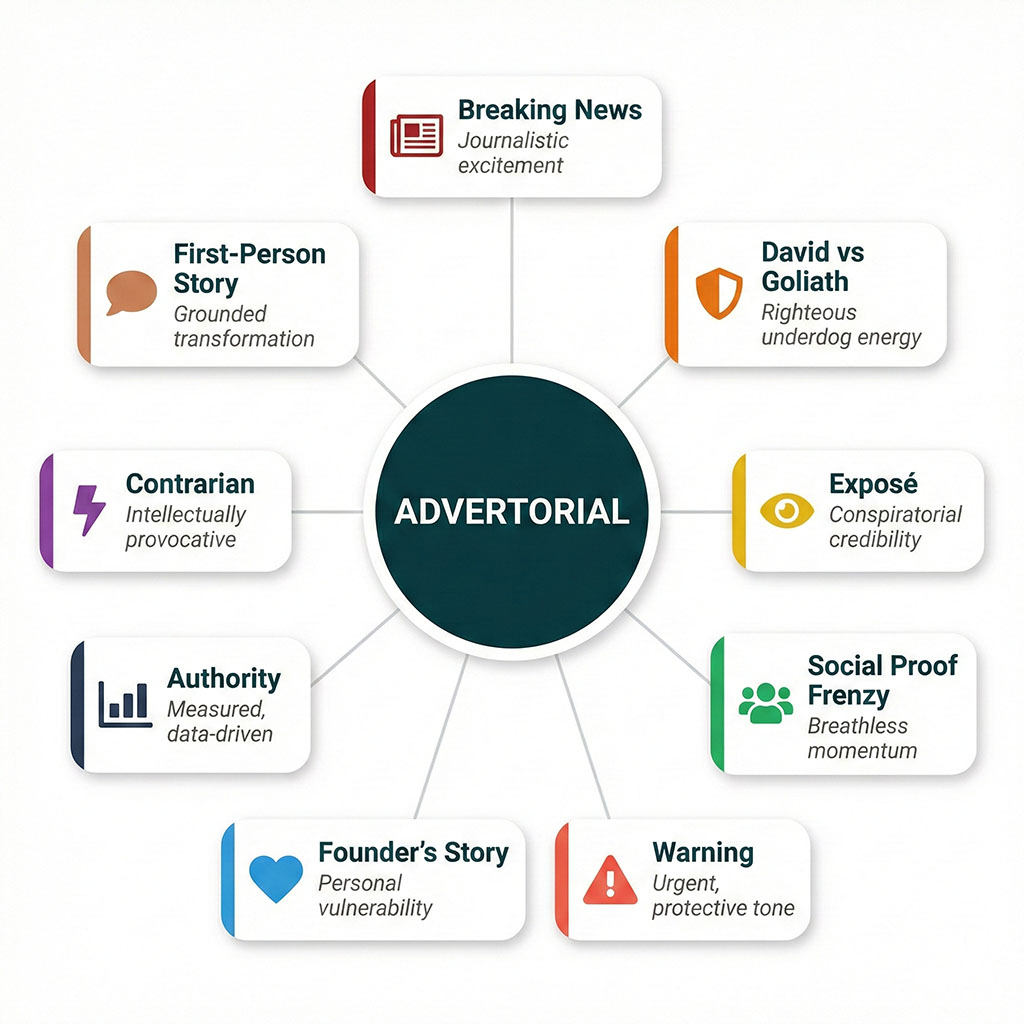
Consider what “doing it right” actually involves. There are at least nine distinct advertorial subtypes, each with a different voice, emotional arc, and structure: Breaking News, David vs Goliath, Exposé, Social Proof Frenzy, Warning, Founder’s Story, Authority, Contrarian, First-Person Story. A Breaking News advertorial sounds nothing like a Founder’s Story. An Exposé follows a completely different emotional arc than a Social Proof Frenzy. Choosing the wrong subtype for your customer’s situation doesn’t just underperform — it wastes the traffic entirely. Getting this right means diagnosing which conversion bottleneck is killing your funnel, then matching the subtype that structurally solves it. That’s strategic work. That’s the work agencies skip.
The golf ball ad worked because someone sat down and thought: what would make a golfer stop and read? Not “what fits our campaign template.” Not “what can we produce at scale.” They asked the only question that matters in advertising — what does the reader actually want to know? — and then they delivered it in a format the reader was already paying attention to.
That’s not a hack. It’s not a trend. It’s the foundational principle of effective advertising dressed up in different clothes for different eras. Claude Hopkins wrote about it in the 1920s. Your agency ignores it in the 2020s. The principle outlasts the platform every single time.
The real cost of taking your agency's word for it
Your agency’s recommendation isn’t neutral. It never was.
When they tell you to increase Google Ads spend by 20%, they’re recommending more of the thing they already know how to do. When they suggest adding another social channel, they’re expanding the assembly line they’ve already built. The advice isn’t bad, exactly — it’s just limited to the menu of things that are convenient to serve.
What they’ll never recommend is the thing that requires them to fundamentally change how they work for you. And advertorials sit squarely in that category. They require more strategic involvement, more creative investment, and more client-specific thinking than the standard agency model supports.
This is the same pattern behind most of the waste in fragmented marketing setups. It’s not that your specialists are incompetent. It’s that their business model rewards doing more of what’s easy rather than exploring what’s effective. The media buyer optimises media buys. The social manager manages social. Nobody’s job description includes: “find the format that would actually work best for this particular client, even if it’s harder for us to deliver.”
What happens when one brain runs the whole thing
The golf ball ad worked because one person understood both the product and the reader. They didn’t hand the strategy to one team and the copy to another and the placement to a third. One mind held the whole picture: who’s reading, what they care about, how to earn their attention, and where the product fits into the story.
That’s not nostalgia. That’s architecture.
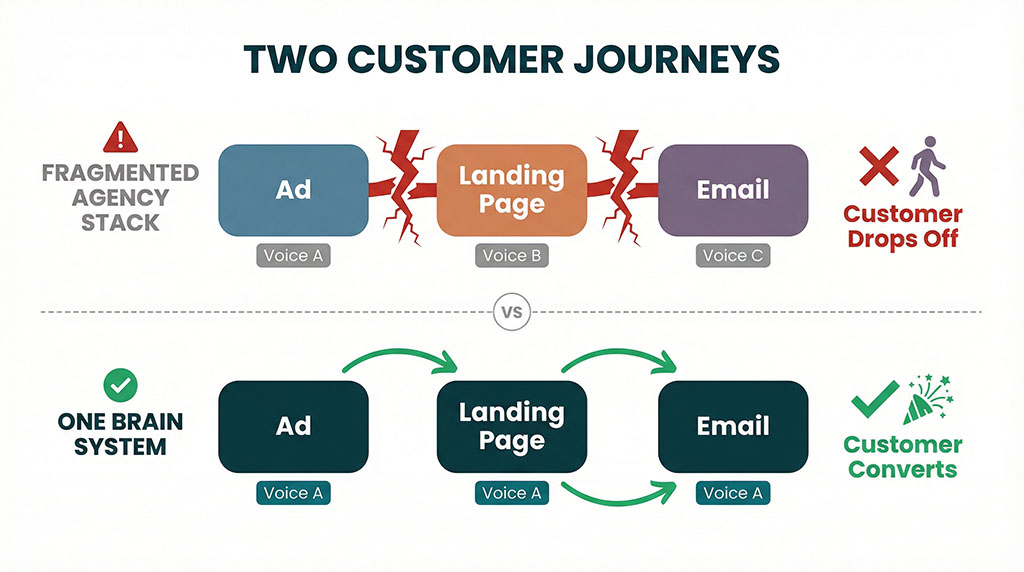
When a single strategist controls the message across every touchpoint — from the advertorial that earns the first click, to the landing page that continues the conversation, to the email sequence that closes the sale — the whole system compounds. The advertorial’s voice matches the landing page. The landing page delivers on the headline’s promise. The follow-up feels like a continuation, not a cold restart.
Contrast that with the current setup: your Google person writes ads that say one thing. Your Facebook person runs creative that says another. Your landing page was designed by someone who hasn’t seen either ad. The customer clicks through and feels the disconnect before they can name it. They just… leave.
An advertorial amplifies that problem or solves it entirely, depending on what’s behind it. Run it through a fragmented agency stack, and the landing page won’t match the editorial tone that earned the click. Run it through a unified system, and every step feels like the same trusted voice leading the reader forward.
The $148 billion question
The money is moving toward native. Fast. The businesses capturing that value aren’t the ones with the biggest ad budgets — they’re the ones who’ve figured out that earning attention outperforms interrupting it. That the ad which doesn’t look like an ad is the ad that works.
Your agency knows this. The data is impossible to miss. But recommending it would mean telling you: “We need to work differently for you. It’ll take more thinking. More craft. More involvement with your specific business. And honestly, it doesn’t fit the way we work for our other 39 clients.”
So they don’t say it. They run another display campaign. They send another report showing impressions and clicks. And somewhere in a feed your customer scrolls through every morning, the spot where an advertorial could have earned their trust sits empty — filled instead by another banner they’ve already learned not to see.
That golfer in the sports section? He didn’t know he was reading an ad until he wanted what it was selling. By then, it didn’t matter. The story had done its work. The trust was built. The sale was made.
The ad format that works best in 2026 is the one that worked in 1986. Your agency just hopes you never ask about it.
See What Your Agency Isn’t Showing You
We’ll map your current ad mix against the formats that actually move conversion needles — including the ones your agency has no incentive to recommend.
Most clients discover at least one high-performing format that was never proposed because it didn’t fit their agency’s production model. Takes 30 minutes.
You don’t need more ad spend. You need someone whose recommendations aren’t limited by what’s easy to deliver.