
The Toyota dealership in Brookvale had its first lot-quiet Tuesday in eleven years. Not a single walk-in. The salespeople refreshed their CRMs and watched the inventory dashboard. Cars were still selling – just not through them. Buyers had asked their agents for “a reliable hybrid hatchback under forty grand, available within two weeks.” The agents had compared, negotiated, and committed. The dealership got the order. Nobody arrived to be sold to.
This isn’t a funnel-is-dying story. It’s the opposite.
The funnel-is-dying speech, again
Every five years, someone announces the funnel is dying. In 2010 it was social media. In 2015 it was content saturation. In 2020 it was iOS privacy changes. In 2023 it was generative search. Each time, marketers panicked, conferences ran the same keynote, and businesses adapted – usually by bolting another channel onto the same fundamental shape. The buyer browsed, the seller persuaded, the transaction happened on the seller’s surface. Different attire, same skeleton.
So when Stripe announced its agentic commerce stack at Sessions and the same panic-keynote-circuit cranked back up, the cynical response was earned. I’ve been through this. I adapted to social. I adapted to mobile. I adapted to AI search. My business is fine.
The other half of the consensus is the quiet exemption: this is an e-commerce problem. Cars and coffee and consumer goods. Service businesses are protected because relationships can’t be automated. Consultants, advisors, agencies, professional services – we sell judgment, not products. Agents can’t replace what we do.
That logic has kept a lot of businesses calm. It’s also wrong about the part that matters most.
This time the substrate moves
Past funnel-death cycles were channel shifts. The substrate stayed intact: a buyer with unformed intent showed up somewhere, and a seller’s interface – site, ad, post, listing – did the work of shaping that intent into a decision. You changed where you advertised and how you ranked. The funnel itself, the institutional arrangement for making intent visible, didn’t move. Like rearranging furniture in the same room.
This shift moves the room.
When a buyer’s agent arrives at your business, intent has already been formed somewhere else. The agent has translated “authentic coffee” into a fourteen-variable purchasing brief. It has compared you against alternatives. It has read your terms, your delivery windows, your return policy, your reviews. By the time it touches your surface, the persuasion phase is over. You’re not being shopped. You’re being checked against a decision.
If this still feels speculative, Google’s I/O 2026 keynote put a timestamp on it. AI Mode has crossed one billion monthly users with queries doubling every quarter, and Google announced that for home repair, beauty, and pet care, buyers can now ask Google to call businesses directly on their behalf. The phone that rings won’t be the buyer’s. It will be the buyer’s agent, working from the buyer’s specifications, with the buyer’s payment authority, and zero patience for friction.
That changes what your funnel was actually doing. For two decades, “funnel” meant the staged interface where ambiguous human intent got narrowed into a transaction – which is to say, the funnel was where most of the value was created. Not the product. Not the delivery. The resolution of ambiguity. You’ve felt this every time you bought something complicated and ended up grateful to the salesperson who simplified it.
Buyer agents resolve that ambiguity outside your walls. Whatever your funnel was doing to earn its keep, it has to keep doing – somewhere visible to the agent, in machine-readable form, before the agent ever reaches the part of you that used to do the work.
Buyer agents audit your funnel
Here’s the reframe.
Buyer agents don’t compress the funnel. They audit it.
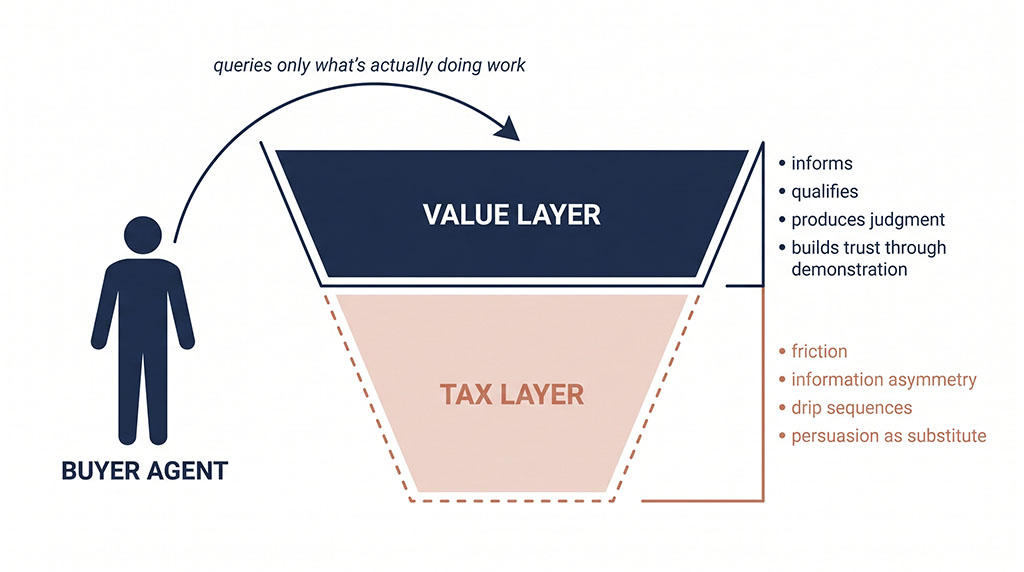
Every funnel has two layers stacked on top of each other. The first layer creates value: it informs, it qualifies, it educates, it builds trust through demonstration, it produces judgment the buyer couldn’t produce alone. The second layer collects tax: it adds friction the buyer has to push through, generates leads the seller can chase, creates information asymmetry the seller can exploit, and substitutes persuasion for substance.
For decades these layers have been fused. You couldn’t tell which was which because buyers had to pass through both to transact. The dealership had real value (a place to test-drive, a person who knew financing) tangled up with real tax (information asymmetry on price, friction designed to make leaving feel costly). The buyer paid for both because they couldn’t separate them.
Buyer agents separate them. Cleanly. Surgically. Without sentiment.
When an agent walks into your business, it queries only the value layer. It ignores the tax layer because it doesn’t experience friction – friction is just data it processes. It doesn’t get persuaded by aesthetics, get worn down by drip campaigns, or feel a sunk-cost obligation halfway through your sales sequence. Whatever portion of your funnel was tax disguised as value gets stripped away in milliseconds.
What survives is the part that was actually doing work.
Why the dealership lost. Why the advisor won.
This is why the Brookvale dealership lost its Tuesday. The dealership’s funnel was eighty percent tax – information asymmetry on pricing, friction-driven negotiation, sunk-cost commitment from showing up in person. The twenty percent that was real value (the test drive, the financing expertise) couldn’t justify the lot, the staff, the showroom, the markup. Once the agent could resolve the comparison externally, there was no reason to walk in. Same reason nobody buys film cameras at the chemist anymore.
Now run the same audit on a health advisor. Her funnel runs through an intake form, a twenty-minute discovery call, a customised plan, and an ongoing relationship. Strip it. The intake form was tax – agents fill those out perfectly. The discovery call structure could be partly automated. But the consultation itself? The judgment in the room, the personalised adjustment, the relational continuity? That’s pure value layer. The agent doesn’t replace it. It routes buyers to it faster, having pre-screened them for fit.
Same mechanism. Opposite outcome.
The compression spectrum
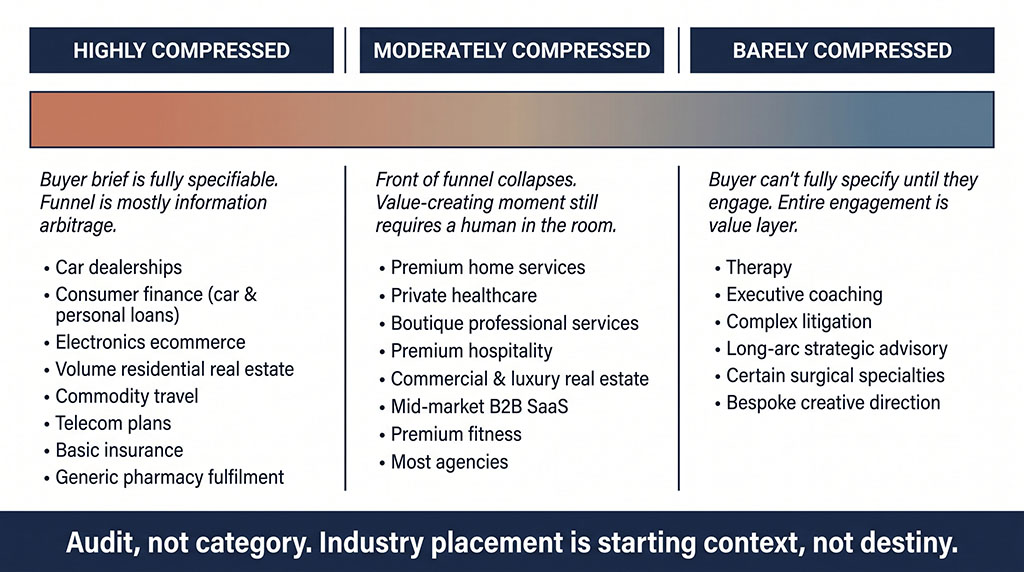
The dealership and the health advisor are the two poles. Most businesses sit between them, on a spectrum that determines how much of the existing funnel survives the agent era.
Highly compressed. Industries where the buyer’s brief – make, model, price, delivery – is already specifiable, and the seller’s funnel is mostly information arbitrage. Car dealerships. Consumer finance: car loans, personal loans, basic insurance comparison. Standardised electronics: TVs, fridges, appliances. Volume residential real estate. Commodity travel. Mainstream telecom plans. Generic pharmacy fulfilment. Anything where a competent buyer agent could handle the entire pre-transaction process with no human judgment lost. The value-layer remnant is small enough that the business has to be redesigned around what’s post-transaction – service quality, relationship retention, fulfilment excellence – rather than acquisition theatre.
Moderately compressed. Industries where the buyer can specify some of the decision but real human judgment is still required somewhere in the work. Premium home services. Private healthcare. Boutique professional services. Premium hospitality. Commercial and luxury real estate. Mid-market B2B SaaS where implementation requires custom work. Most agencies. The funnel collapses at the front – qualification, comparison, scheduling, intake – but the value-creating moment (the consultation, the on-site assessment, the strategic call, the bespoke design) still requires a human in the room. The compression hits the wrapper, not the core. Most local SMBs sit here.
Barely compressed. Irreducibly relational work where the buyer can’t fully specify what they need until they’ve engaged with someone who can interpret it. Therapy. Executive coaching. Complex litigation. Long-arc strategic advisory. Certain surgical specialties. Bespoke creative direction. The funnel collapses at the very top (discovery and matching) but the entire engagement – including the framing of the problem – is value layer. Buyer agents act as routers here, not replacers, and the businesses get easier to run.
The diagnostic question doesn’t change. Where you sit on this spectrum is less important than which steps inside your specific funnel are which. A boutique professional service can still have a 70% tax-layer funnel if it’s been padded with theatre. A car dealership can still defend a real value layer if it’s quietly built service excellence and event-tier brand pull. The audit decides, not the industry label.
The service business trap
You’re reading this thinking your business is closer to the health advisor than the dealership. Most service businesses do. I sell expertise. I sell relationships. My funnel is mostly value layer.
Stop. Run the audit honestly.
You’ve been adapting to channel shifts for years and you’ve been right to trust that pattern. Your business survived 2010, 2015, 2020. You probably will survive this too. But the survival math is different now, because the question isn’t whether you can adapt your channels – it’s whether the work you’ve been calling “funnel” was always doing what you assumed it was.
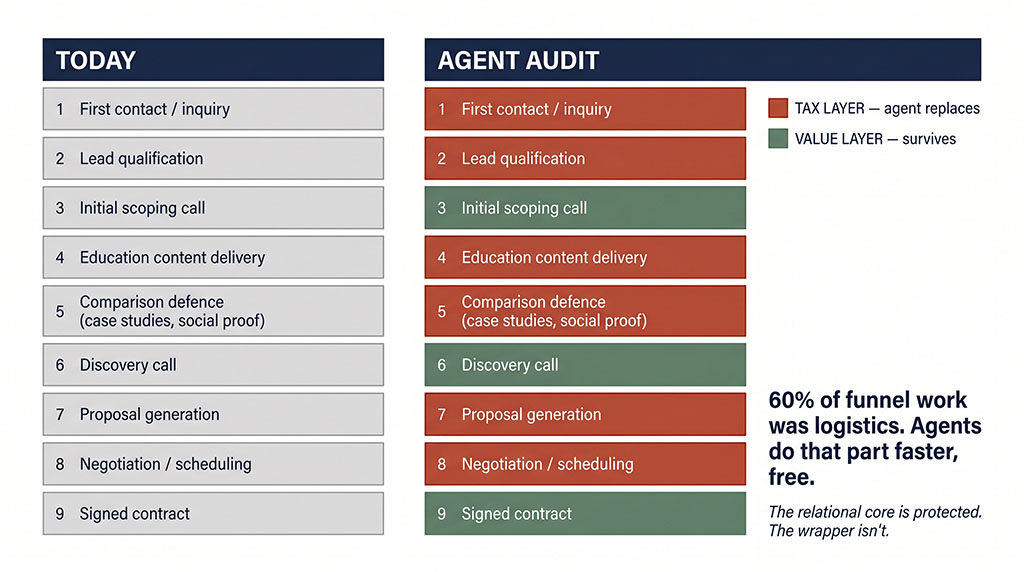
Most service businesses we work with discover, when they actually map it, that fifty to seventy percent of their funnel is logistics work agents replace cheaply. Lead qualification. Initial scoping. Proposal generation. Comparison-shopping defence. Booking and rescheduling. Intake. Education content that exists to demonstrate competence rather than to teach. Drip sequences that exist because someone read a book in 2017.
The relational core is real and protected. The sixty percent wrapped around it isn’t. And the sixty percent is where most of your team’s billable hours go.
Brand splits in two. So does the budget.
When a buyer instructs their agent – find me a Toyota hybrid hatchback under forty grand – they’ve named exactly one brand. Toyota. The agent then commoditises everything below that level: every Toyota dealer within range gets compared on price, inventory, delivery, and service ratings. The single word “Toyota” is the entire return on Toyota’s brand spend in an agent world. It earned the right to be named.
The Brookvale dealership earns no such return. No buyer says find me a Toyota at the Brookvale dealership. The dealership’s name isn’t an instruction; it’s an option in a comparison. Manufacturer brand wins. Channel brand mostly doesn’t.
Which means a thirty-second emotional spot featuring the dealership owner shaking hands with happy families builds familiarity in human heads that will never instruct an agent to specify the dealership. The funnel that used to convert that familiarity into showroom visits has gone. What’s left is a memory the agent can’t read.
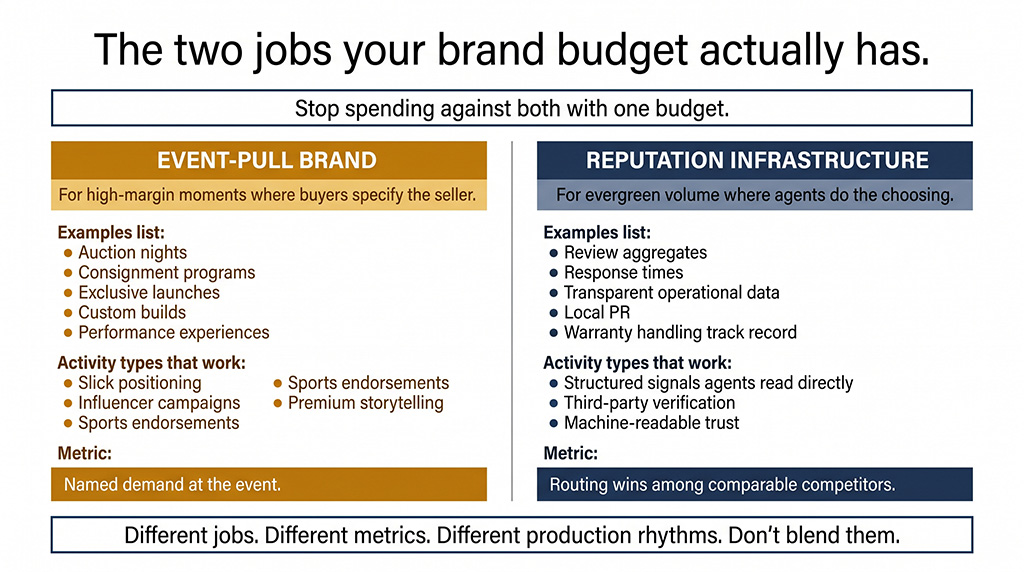
There’s one exception worth naming. Brand-building at the channel level does work when the dealership creates moments the buyer actively seeks out – auction nights, consignment programs, exclusive launches, custom builds, performance experiences. These are pull events. The buyer specifies the dealer because the event is the destination, not the car. Slick high-end positioning, sports star endorsements, and influencer-led campaigns earn their keep here. They don’t earn it on day-to-day inventory sales, where the buyer is buying the car, not the dealership, and the agent treats every Toyota dealer as interchangeable.
So most local dealership brand budgets are misallocated. The cure is to split spend between two distinct jobs: building agent-readable trust signals for evergreen volume – review systems, response times, transparent operational data, local PR – and building event-pull brand for the high-margin moments where buyers want a destination, not a delivery. Mixing these strategies blunts both.
The same split applies to almost every local SMB. The era of paying for more people knowing about us ends when the people stop being the ones doing the deciding.
Where the consensus is right
The consensus isn’t entirely wrong. There are businesses where buyer agents will mostly drive demand without disrupting how value is created.
If your work is irreducibly relational – therapy, executive coaching, complex litigation, certain medical specialties, long-arc strategic advisory – agents will route buyers to you having pre-qualified the fit, and your job will get easier, not threatened. And if your funnel was already lean – substance-only, no theatre, no friction-by-design – you’ll feel the agent era as a tailwind, because you’ll finally stop competing against businesses whose funnel was a magic trick.
The businesses that should be uneasy aren’t service businesses or product businesses. They’re persuasion businesses.
Run the audit
Run the diagnostic now, while you have time.
Take your last ten clients. For each, list what your funnel actually did between first contact and signed contract. Then ask: which of those steps would a competent buyer agent have done faster, without you, given access to the same information?
Whatever’s left is your real business. That’s what you’re selling. Everything else is what you were charging for while pretending it was something else.
The Brookvale dealership won’t reopen. The lot is being subdivided. Across the highway, the health advisor’s calendar is full eight weeks out – agents have been routing pre-qualified buyers to her since June. Same town. Same shift. Two completely different audits.
Which lot is yours?
Your marketing, looked at properly
Thirty minutes on your current setup — what’s working, what’s quietly leaking budget, and what I’d fix first. You’ll leave with a clearer picture whether we work together or not.
Got something specific bugging you? Flag it when you book and I’ll have it looked at before we talk.

AboutBruce Marjoribanks
Bruce Marjoribanks has spent 27 years in marketing, including building, running and selling his own agency before going independent. He now runs every channel - paid, organic, social, email, creative and automation - as one integrated system, with AI ehancing production and the judgment staying human.