
Your marketing can now be made in an afternoon and still take a week to go out. Ads, emails, landing pages and posts that once took days to produce arrive in hours, then sit exactly where they always sat, in the owner’s inbox, behind a red number that keeps climbing.
AI marketing now breaks at the approval layer, not at production. Owners who won’t sack themselves from approving every piece of work become the ceiling on everything the system can produce.
I learned the original version of this lesson in 2012. The first thing the business consultant I’d hired at Digital Organics did was hand me a card and have me write on it, in my own handwriting, the date I would sack myself from the business. I carried that card around with me. In 2013 I sold the agency.
Sacking yourself was always about the bottleneck
Most owners have been through this once already. If the business can’t run without you in the room every day, you don’t own a business, you own a job. The owners who get through that transition don’t stop caring about quality. They stop being the only place it can happen.
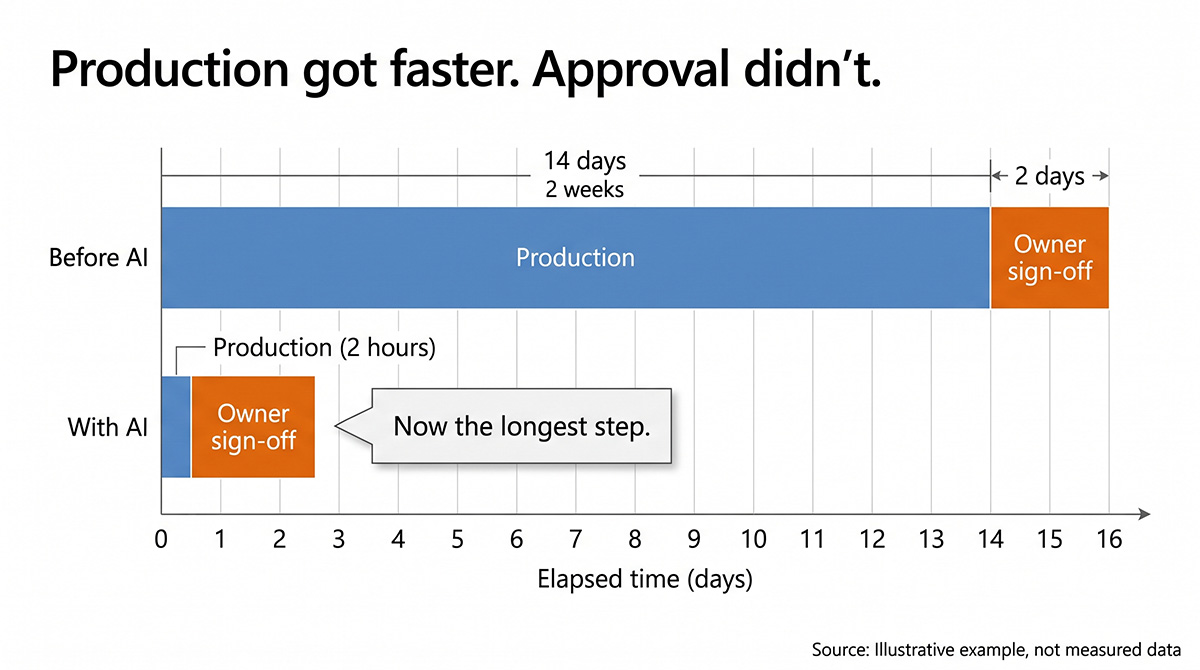
Marketing let owners skip that lesson for years, because production was slow anyway. When an agency took two weeks to turn around an ad, a two-day wait for the owner’s sign-off disappeared inside it. Nobody noticed the owner was a queue. The one in front was longer.
AI moved the queue to the owner's desk
That cover is gone. Production now runs in hours, and the volume the channels ask for went up at the same moment. The ad platforms reward creative diversity, distribution needs feeding, and every landing page wants a second version to test against the first. All of it passes through the same point, so more output means more approvals, more edits and more back-and-forth. A two-day wait inside a two-week job is now a two-day wait on a two-hour job, and it is the only step that didn’t get faster.
Anyone who has taken a business through a growth spurt has seen this before. The quotes pile up on the desk, the owner works later to keep up, and growth stalls anyway because everything still goes through one person.
Three habits keep owners in the approval seat
The first habit is finding reasons not to do something. The reasons are familiar: it isn’t quite on brand, it should wait until after the sale, it needs a proper look on Sunday night with the laptop open. Each one sounds sensible on its own, and together they mean nothing ships. Most wouldn’t survive a second question. The real reason is usually that saying yes means letting go.
The second habit is the belief that only you can do it properly. For years that was often true, because the owner knew the customer best. It frequently isn’t any more. With a clear brief and a system built around it, plenty of owner edits change the wording without changing the result, and every one of them costs a day.
The third habit is avoiding accountability, and it has changed the most. In an AI workflow, everything is a ledger. What was briefed, what was produced, what was sent back, how long it sat and who it sat with are all on the record. When marketing ran through a handful of agencies, an owner could hold work for a week and the delay would blur into everyone else’s. That no longer works. The owner who avoids accountability for the queue is the one whose name keeps appearing on it.
Someone still has to check the work
The objection to all of this is a fair one. Your name is on every ad, every email and every page. One careless claim can cost you a customer, a complaint or worse, and nobody else carries that risk the way you do. Wanting to see the work before it goes out is not vanity. It is responsibility.
Where it goes wrong is the assumption that checking has to mean looking at every asset after it has been made. Approving a hundred pieces one at a time is an expensive way to enforce a standard you could write down once. The sack-yourself move is to approve the standard instead of the asset.
That standard lives in the brief. It says who the work is for, what it promises, what proof it is allowed to use, how it should sound and what it must never say. A system working from that brief produces work that has already been checked against it before it reaches anyone. The ledger then lets you check the checker. You pull a sample, see what went out and why, and when something drifts you fix the brief rather than the asset, so the same mistake doesn’t come back next week.
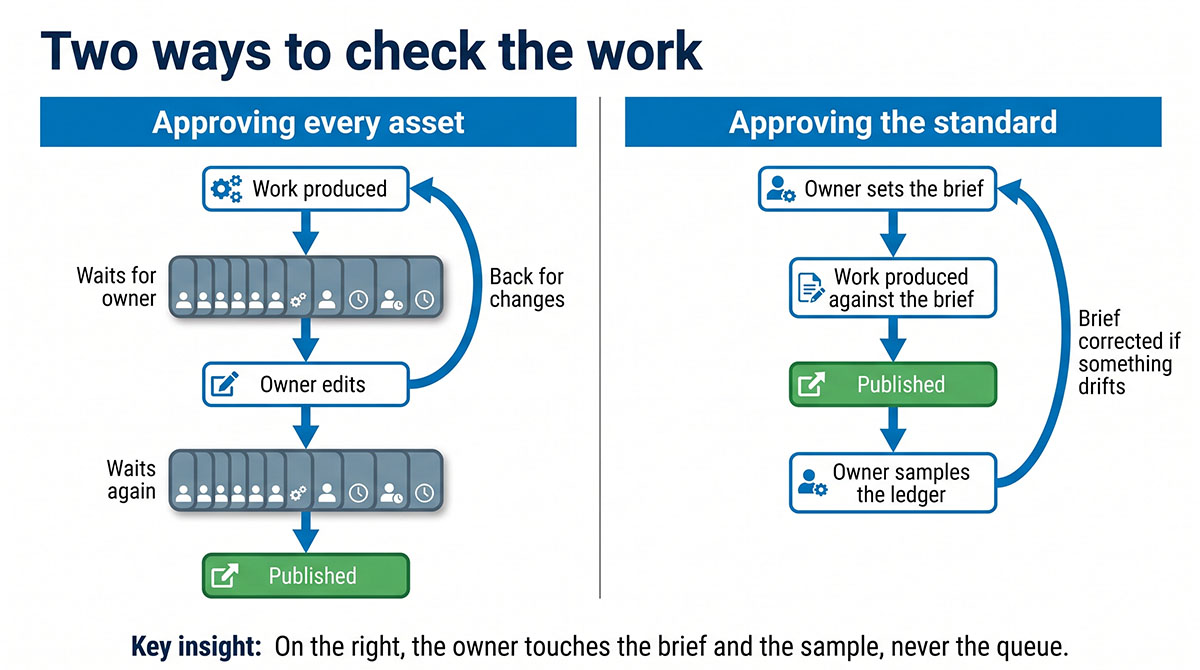
None of this means stepping out of the work. The owner still owns the judgement: what the business stands for, what it will and won’t say, and whether the strategy is right. What changes is that the owner stops being the person every individual piece of work has to queue for. That’s quality control that scales with the volume. Approval by inbox doesn’t.
The time you get back belongs to the decisions only you can make
Sacking yourself from the approval queue doesn’t free up an empty afternoon. It frees up the hours that should have been going to the questions nobody else in the business can answer. Which customers are worth more than the rest, and are you spending to reach them? Which offer is carrying the business, and which one is only there out of habit? Is there a market you keep meaning to test and never get to?
Those questions sit untouched in most small businesses, because the owner’s week fills up with reviewing ad variations and nobody notices what didn’t get decided. That was always the owner’s job. The queue was simply in the way.
When the owner should stay in the queue
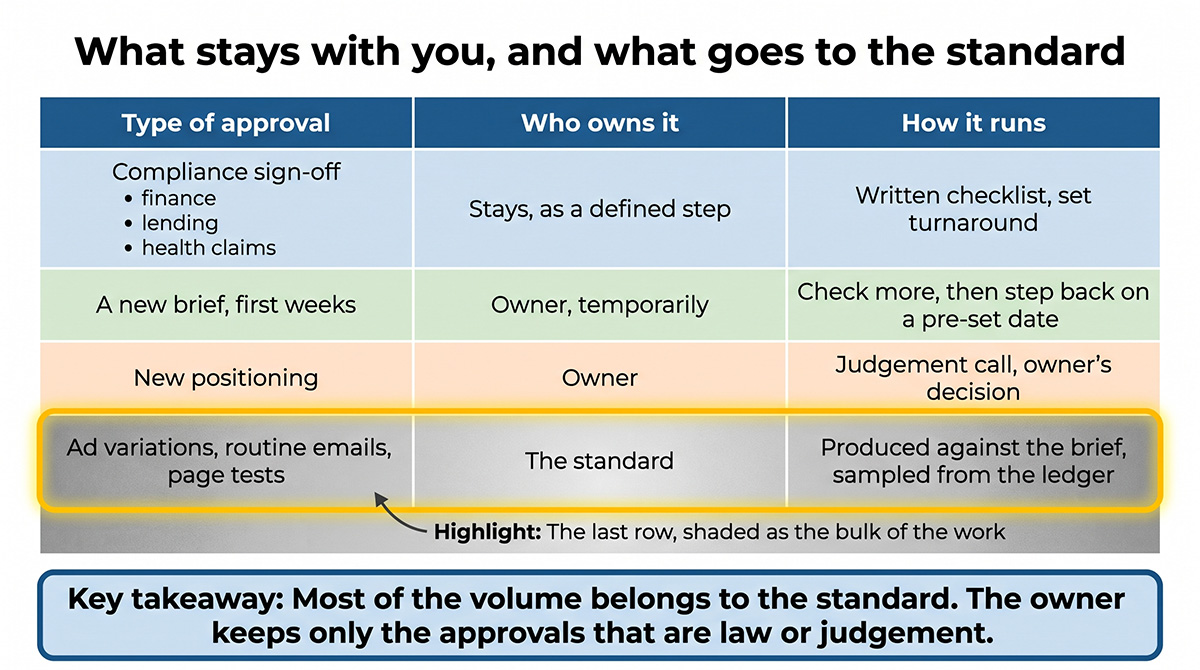
Some approvals are not habits. In finance, lending and anything that makes health claims, compliance sign-off is a requirement, and it stays. The difference is that it becomes a defined step with a defined turnaround, done against a written checklist, rather than an open-ended wait for whenever the owner gets to it.
The early weeks of a new brief are another exception. Until you have seen the system produce work you trust, check more. Then step back on a date you have set in advance, rather than drifting into permanent review because nothing ever felt quite ready.
New positioning is the third. Deciding what the business should say about itself for the next two years is judgement, and it belongs with the owner. Deciding whether the fourth variation of an ad should say “today” or “now” does not.
Write the date down
The card I carried in 2012 had one thing on it, a date. Make your own. Write down the date you will stop approving individual pieces of marketing, and underneath it write the three things you are actually checking for when you look at the work. The date is when you step out of the queue, and those three things are the start of your first brief.
Your marketing, looked at properly
Thirty minutes on your current setup — what’s working, what’s quietly leaking budget, and what I’d fix first. You’ll leave with a clearer picture whether we work together or not.
Got something specific bugging you? Flag it when you book and I’ll have it looked at before we talk.

AboutBruce Marjoribanks
Bruce Marjoribanks has spent 27 years in marketing, including building, running and selling his own agency before going independent. He now runs every channel - paid, organic, social, email, creative and automation - as one integrated system, with AI ehancing production and the judgment staying human.