
She had done everything right.
Twelve months building her brand. Real money in ads, not “let’s see what happens” money, a proper budget with a strategy behind it. The creative looked good. Her product was better than the competition’s. She had hired someone to sort the targeting.
June this year. She is sitting at her kitchen table at 7am, coffee going cold, scrolling through the results. Impressions: strong. Click-through: decent. Sales: almost nothing.
She refreshed the page. Same numbers.
I keep thinking I’m missing something. Like there’s a switch I haven’t found yet.
There was no switch. The ads were not broken. Her product was not broken. What had changed, quietly, without anyone sending a memo, was the person on the other side of the screen.
The buyer your ads were written for
Here is what most businesses running ads in Australia have not absorbed yet.
In November 2025, economist Janine Dixon set the wage index against prices and found that Australian wages bought roughly what they bought in 2011.
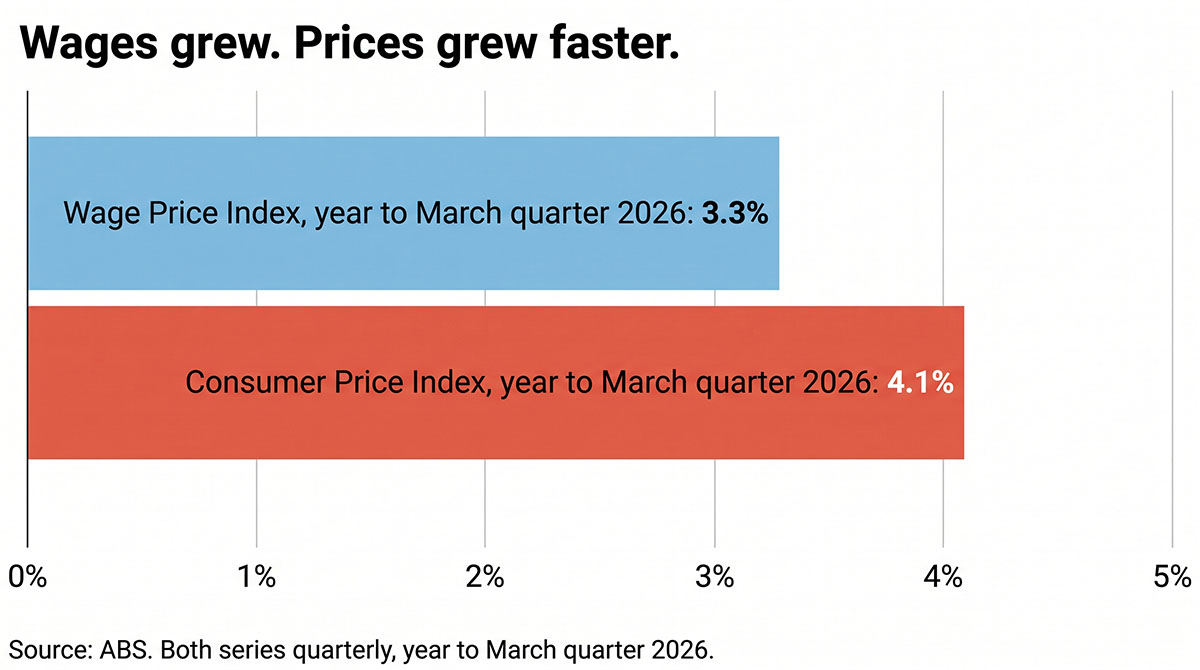
It has not turned around since. Wages grew 3.3% in the year to the March quarter 2026. Prices grew 4.1% over the same quarter. John Buchanan at the University of Sydney read this year’s annual wage review decision and put the real pay cut at 5.9% since June 2021. The Commission’s own language is more cautious and lands in the same place. Award rates remain lower in real terms than they were in July 2021, and closing that gap would take a wage rise of well over 5%.
Australians can feel it. In August 2025, Compare the Market surveyed 3,006 people about their cost of living. Seven per cent said it had improved on the year before.
They have already changed what they buy. MYOB surveyed 1,000 working Australians aged 18 to 54 in April 2024. Sixty-five per cent had cut back on dining out. Sixty-two per cent had moved to cheaper groceries. Sixty-two per cent had cut entertainment. Fifty-one per cent had cut clothing. The first things to go were not luxuries. They were things people used to treat as normal.
Your customers have not stopped wanting things. They have stopped shopping like people who expect next year to be easier.
That distinction matters more than almost anything else in your marketing right now.
What money worry does to attention
In 2013, four researchers published a paper in Science about what money worry does to attention. Anandi Mani, Sendhil Mullainathan, Eldar Shafir and Jiaying Zhao ran experiments with shoppers in a New Jersey mall and with sugarcane farmers in India. People scored worse on reasoning and attention tasks when a money problem was sitting in their mind. The authors called it tunneling. Attention narrows onto the immediate problem and pushes everything else to the edge.
Two caveats, because someone will check. The study measured how people performed on tasks, not what was happening inside their heads, so nobody has shown that money stress physically reduces anything. And it has not replicated cleanly. Carvalho, Meier and Wang found no such effect around payday in a 2016 American Economic Review study, and a 2022 replication in Colombia with 417 participants failed to reproduce it.
So treat tunneling as a useful description of something you can already see in the spending data, not as settled science. The description holds up on its own.
You have felt it yourself. Think about the last time you were properly stressed about money. Not background worry. The staring-at-the-balance kind. Were you thinking about next year? Browsing for inspiration? Or were you locked onto one number and how to change it before it mattered?
That is the state a large part of your customer base is in right now.
Here is what it does to your advertising.
Grow your business. Scale faster. Unlock your potential. These are futures. They ask the reader to picture a better version of their life and to feel stable enough to fund the trip. That works on someone with room to think. It does not land on someone counting down to an invoice. Not because they stopped wanting those things. Because you are asking a question they cannot answer today.
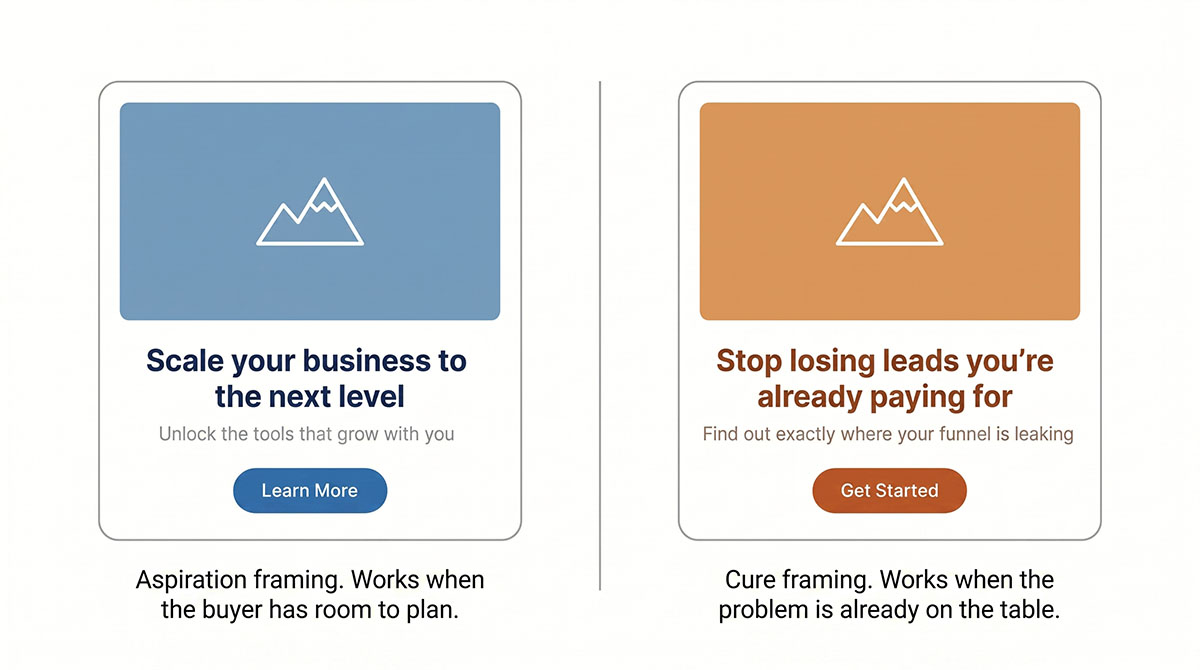
The ads have not changed. The person reading them has.
What ALDI and Hyundai did differently
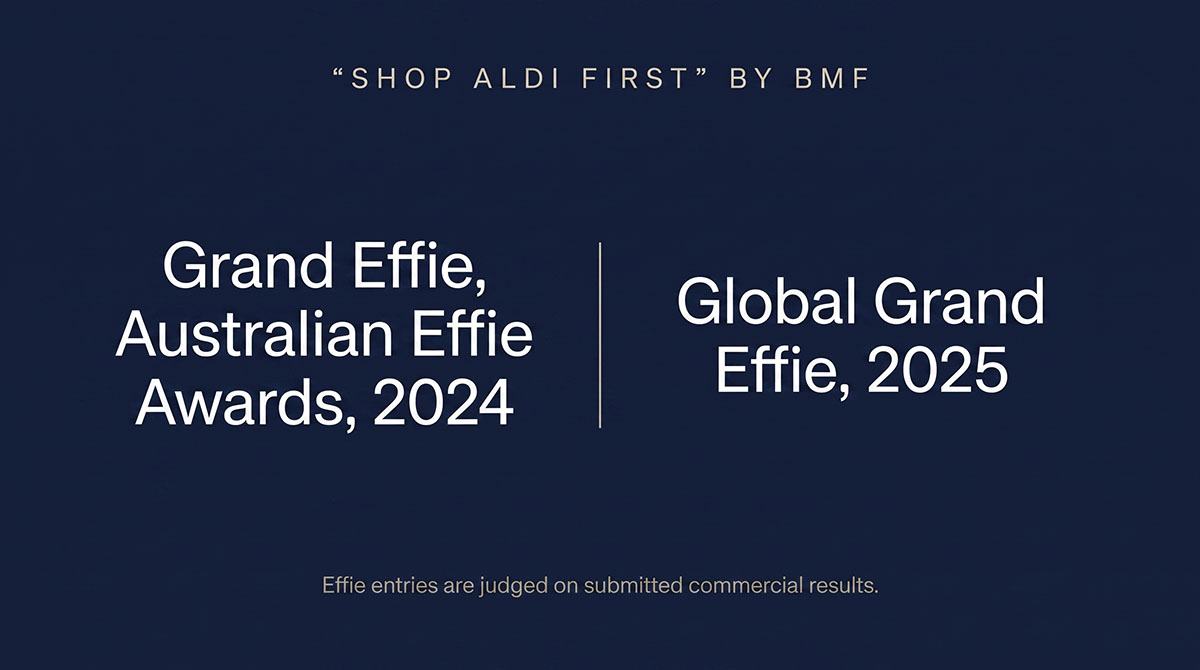
In February 2023, as the cost-of-living squeeze set in, ALDI launched a campaign called “Shop ALDI First” through its agency BMF. The premise was not “discover our great range” or “Australia’s freshest produce.” It was blunter. We will save you real money, and you should let us. The campaign named the financial situation Australians were living in instead of selling around it.
It won the Grand Effie at the 2024 Australian Effie Awards, then the Global Grand Effie in 2025. Effie entrants have to submit their commercial results, and results carry 40% of the score in the Australian awards. Strategy, insight and execution of the idea carry the rest. The creative is judged, so this is not a pure business award. But no campaign wins one on looks alone.
I cannot show you ALDI’s own sales numbers. The Effie case study is paywalled and the trade press published no hard metrics. What is public is YouGov BrandIndex, which tracks brand consideration. ALDI’s score moved from 44.7 in September 2023 to 53.6 in December 2025, a rise of 8.9 points over 27 months. That series begins seven months after the campaign launched, so it is not a before and after. It is the direction of travel while the campaign ran. ALDI was selling the same groceries it had always sold. The product did not change. The question the advertising asked did.
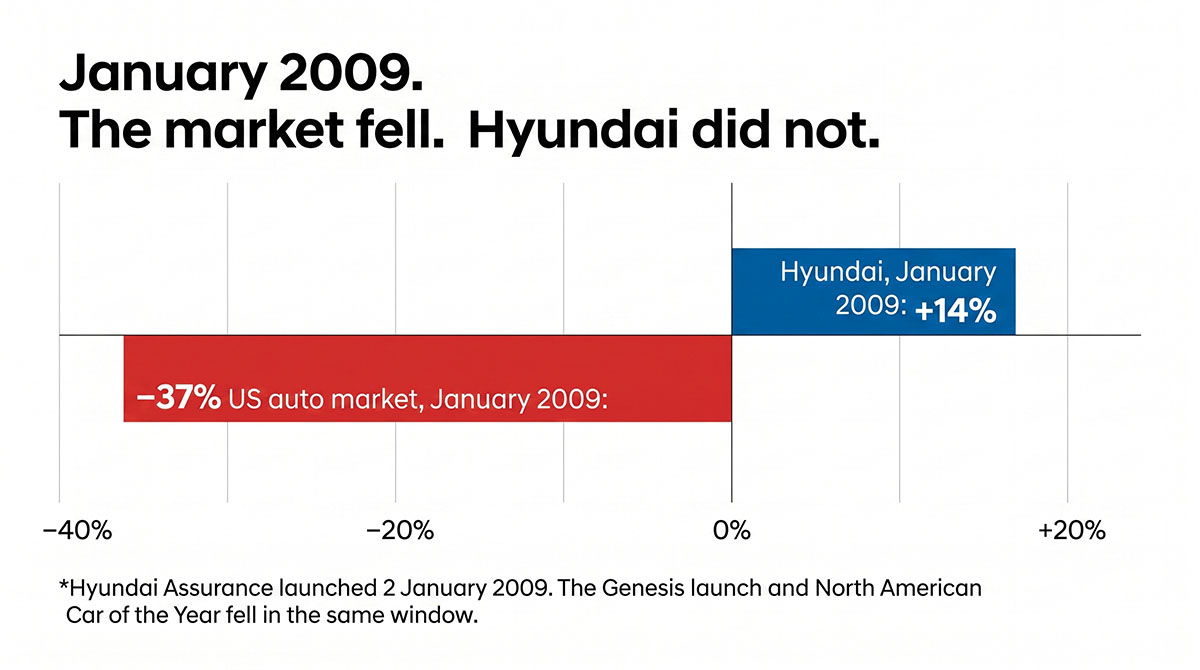
The same pattern showed up in a harder market. On 2 January 2009, with American car sales collapsing, Hyundai launched Hyundai Assurance. Buy the car. If you lose your job within a year, hand it back. No penalty. No questions.
That month the US auto market fell 37%. Hyundai’s sales rose 14%. By mid-2009 Hyundai held its highest ever US market share at 4.3%.
Be honest about what caused what. Assurance launched on the second day of the month, so it cannot claim all of January on its own. Hyundai launched the Genesis and won North American Car of the Year in the same few weeks. What Assurance did was answer the fear people actually had. Not the dream of driving something beautiful. The car payment that might stop being affordable.
Why this is not about going cheap
If I lead with savings, I train my customers to see me as the cheap option. I erode the brand I have spent years building. I win a few sales now and lose my position later.
The concern is legitimate. The conclusion is wrong.
Neither ALDI nor Hyundai abandoned its positioning. Neither rebranded as the discount alternative. Both added a second message aimed at a different state of mind and ran it alongside everything they were already doing.
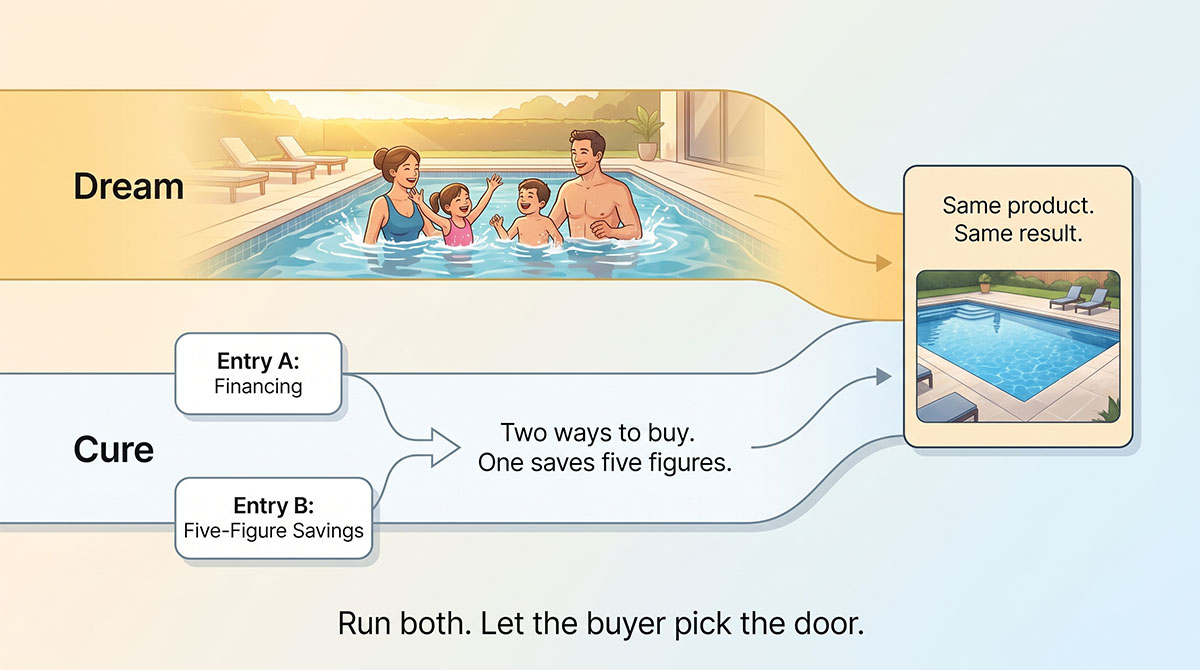
The mistake is treating this as a choice. Sell the dream or sell the cure. The better play is both at once, for different people in different states.
A pool company did this recently. They kept the dream ads running. Golden light, beautiful water, happy families. Alongside them they added a second track, a guide showing two paths to a pool, one of which cuts $20,000 to $40,000 off the cost of going through a builder. Same product. Same result at the end. Two ways into the same conversation. One for the buyer with room to dream, one for the buyer doing sums. Their competitors are still running the first track only.
The audit question
Look at your current ads and your landing pages. Honestly. How many speak to a problem your customer has today, and how many sell a result they might want someday?
Futures need optimism. Cures need pain. Pain is not in short supply.
This is not about becoming a discount brand or cutting price until it hurts. It is about noticing that the customer who responded to “grow your revenue” twelve months ago now reads that phrase differently. They are not stupid. They know their situation. A message that sells them the future while ignoring the present reads as out of touch at best, dishonest at worst.
The cure does not always mean cheaper. Sometimes it is risk removal. If it does not work, you do not pay. Sometimes it is an inefficiency you can point at. You are spending $X more than you need to, and here is the proof. Sometimes it is time. Stop losing three hours a week to this. The common thread is that the problem already exists in your customer’s life. You are not asking them to imagine a benefit. You are offering relief from something they already feel.
That is a different ask, and in this economy it is one people can say yes to.
There is a switch after all. Just not the one most people look for.
It is not in the targeting, the creative refresh or the landing page. It is in the question you ask your customer to answer. Do you want this future? That needs optimism. Do you have this problem? That needs only honesty, and honesty is one thing Australians are not short of right now.
The customers are still there. They are in a different state than they were. Ask them the question they can answer, and the numbers start to move.
Your marketing, looked at properly
Thirty minutes on your current setup — what’s working, what’s quietly leaking budget, and what I’d fix first. You’ll leave with a clearer picture whether we work together or not.
Got something specific bugging you? Flag it when you book and I’ll have it looked at before we talk.
Sources
Wage purchasing power against 2011: Janine Dixon, The Conversation, 19 November 2025.
Wage Price Index 3.3% and Consumer Price Index 4.1%, both quarterly, year to the March quarter 2026: Australian Bureau of Statistics.
Real pay cut of 5.9% since June 2021: John Buchanan, University of Sydney, The Conversation, 3 June 2026. The Fair Work Commission’s own wording, that award rates remain lower in real terms than July 2021 and closing the gap would take a rise of well over 5%, is from its June 2026 Annual Wage Review announcement.
Cost-of-living sentiment: Compare the Market, August 2025, n=3,006, fielded by PureProfile.
Spending cutbacks: MYOB Consumer Snapshot, fielded by Pollfish 25 to 26 April 2024, n=1,000 employed and self-employed Australians aged 18 to 54.
Tunneling: Mani, Mullainathan, Shafir and Zhao, “Poverty Impedes Cognitive Function,” Science, 2013. Contested by Carvalho, Meier and Wang, American Economic Review, 2016, and by a 2022 Colombian replication.
“Shop ALDI First”: launched by BMF, 20 February 2023. Grand Effie, Australian Effie Awards, 10 October 2024. Global Grand Effie, 2025.
ALDI consideration, 44.7 to 53.6: YouGov BrandIndex, September 2023 to December 2025.
Hyundai Assurance: launched 2 January 2009. January 2009 US market and Hyundai sales figures, and mid-2009 US market share of 4.3%.

AboutBruce Marjoribanks
Bruce Marjoribanks has spent 27 years in marketing, including building, running and selling his own agency before going independent. He now runs every channel - paid, organic, social, email, creative and automation - as one integrated system, with AI ehancing production and the judgment staying human.