
“We know what it takes to be a Tiger.”
“In business people are good together.”
“Hello.”
Walk through any international airport terminal and you are surrounded by millions of dollars of advertising that says nothing at all. Enormous backlit panels. Immaculate photography. Slogans that could belong to any company, in any industry, in any decade.
Vodafone ran “Make the most of now” for years in exactly these places. Translated into plain English it says: please use your phone for a lot of things that are pointless to you and profitable to us, and please do them now, because we make nothing on your old voice calls.
Somebody approved that. Somebody signed a purchase order. Somebody looked at the creative, felt a swell of pride, and said yes, that represents us.
That is the real problem. Not that bad advertising exists. The problem is that almost nobody involved in making it can tell whether it will sell anything.
The vanity trap has two doors
It is tempting to blame the agencies. They deserve some of it, and we will get to that. But the business owner opens the first door.
You have seen it happen. A business owner commissions advertising, and what they actually want, underneath the brief about awareness and conversions, is to feel a certain way about their company. They want the glossy spread. The cinematic brand film. The clever tagline that makes them sound like Apple. The work that impresses their peers at the industry dinner. Advertising that makes them feel good about their business. The customer never enters the equation.
Drayton Bird has spent sixty-odd years in direct response. He sold his own direct marketing agency to Ogilvy, became vice chairman and worldwide creative director of Ogilvy & Mather Direct, and sat on the Ogilvy Group board. He has spent most of those decades making one argument over and over: companies write about themselves.
Look at almost any business website and the centre of gravity is the About Us page, stuffed with inward-looking boasts. We are the leading. Our innovative approach. We are committed to excellence. Language built to make the company feel impressive, not to answer the only question the customer is actually asking. What is in it for me?
This is not a formatting problem. It is a misunderstanding of who the advertising is for.
Fairfax Cone co-founded Foote, Cone & Belding in December 1942. The line most often recalled about him is a question he put to writers who brought him bad copy. Would you say that to someone you know?
If you would not look a friend in the eye and say “we are committed to delivering best-in-class solutions,” do not inflict it on a stranger.
The pig that went to market
The second door into the vanity trap is held open by the agency. Sometimes the scale of it is remarkable.
In 2002 Barclays launched a television campaign fronted by Samuel L. Jackson, made by Bartle Bogle Hegarty and directed by Jonathan Glazer. Campaign reported the account at around £15 million. The films were beautiful. Jackson walked through deserted landscapes delivering cryptic monologues about money. One was a fable about a pig going to market, meeting a matador, and running from bears. The strapline was “Money speaks in many languages. Barclays understands them all.”
Barclays’ group marketing director, Simon Gulliford, said the approach was “deliberately thought provoking, not hand holding.”
Another execution, titled “drama,” has Jackson reciting about a dozen lines from The Comedy of Errors. Learning on Screen, the academic moving image archive, catalogues it and notes: “The choice of text for the selling point is unclear.”
A national bank put millions into advertising whose selling point a professional archivist could not identify.
Then it got stranger. BBH’s executive creative director, John O’Keeffe, told the trade press that Samuel had never been the idea, only ever the vehicle for the idea. Two weeks later Barclays publicly rebuked the agency and said Jackson had not been dropped and would appear in two more ads the following year.
Meanwhile the account’s own alumni could not agree who the work was for. Gordon Rankin, a former Barclays marketing director writing in Campaign’s Private View column, described the campaign as aimed at affluent opinion formers rather than the mass market. Gulliford, separately, credited it with landing on 20 to 35 year olds. One is a wealth segment. The other is an age segment. They are not the same people.
So on the public record: the agency and the client disagreed about whether the star was the idea, two insiders described two different audiences, and the archivist could not find the selling point.
None of that is a creative failure in the craft sense. The films were well made. It is an evaluation failure. Somewhere in the process, the question of whether any of this would move one person to switch their bank account stopped being the question that mattered.
Bird has a phrase for work made to please the person making it. He called one car ad the gentle swish of creative masturbation. The point underneath the joke is the one that costs money: you cannot send the creative team round to every prospect to explain the brilliance of the idea. The ad has to do that on its own, in about three seconds, with no help.
The proof is worse than you think
Here is where it gets alarming.
You might assume the industry’s award ceremonies work as a filter. That the campaigns recognised as the world’s best creative are the campaigns that sell best. For a long time the data supported that. The IPA Effectiveness Databank showed creatively awarded campaigns growing market share far more efficiently than non-awarded work, with the advantage reaching roughly eleven times more share growth for every point of excess share of voice.
That is an efficiency multiple, not a return on investment. It matters, because it is the number the industry has spent fifteen years quoting incorrectly.
And it has since collapsed.
Peter Field’s 2019 analysis for the IPA, The Crisis in Creative Effectiveness, examined almost 600 case studies covering 1996 to 2018. It found that creatively awarded campaigns had become no more effective than non-awarded campaigns. The advantage had gone.
Two things about that finding usually get left out, and both matter more than the headline.
Field names the cause. It is short-termism, combined with a misunderstanding of how brands grow. The proportion of campaigns evaluated over less than six months rose sharply after 2006, which cuts off the mechanism that made creativity pay in the first place. Creativity did not stop working. The industry stopped running it long enough to work.
Field also says it is reversible. He describes the collapse as entirely avoidable if the lessons of creative best practice are learned, and calls his own report a wake-up call rather than an obituary.
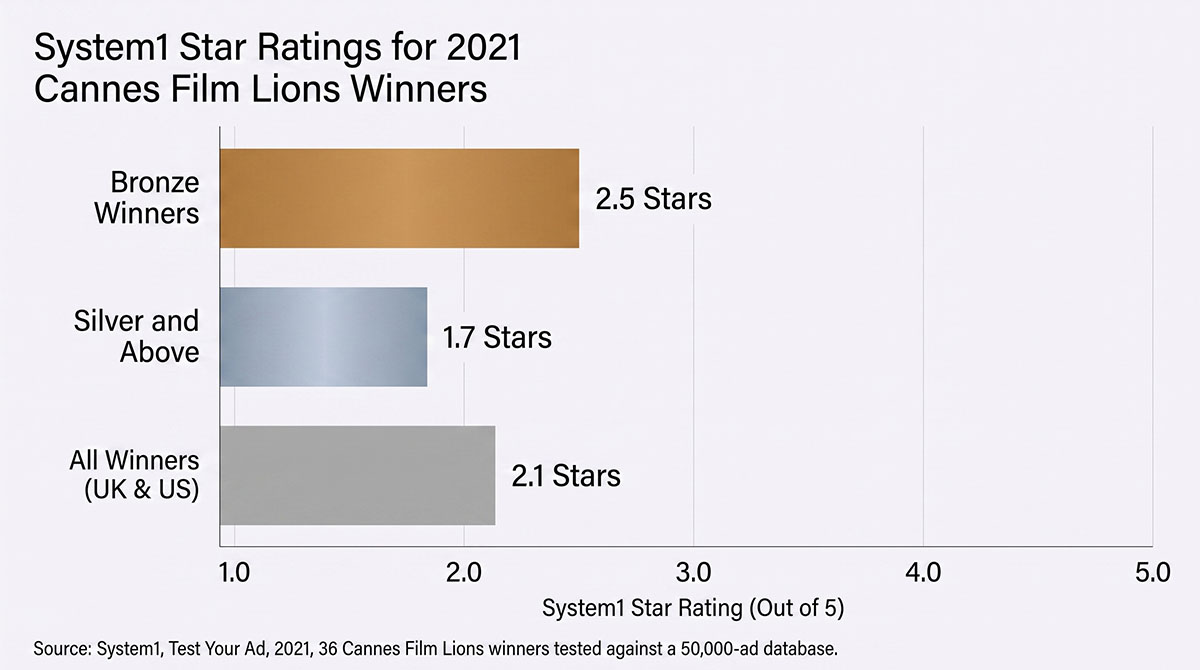
The independent testing points the same way. System1 measures ordinary consumers’ emotional response to ads and scores them for long-term brand-building potential. In 2021 it tested all 36 Cannes Film Lions winners from the UK and US against a database of 50,000 ads. The winners averaged 2.1 Stars out of 5, which System1 described as slightly less effective than the average TV ad, and no better than a random selection from its database.
The detail inside that number is worse. Bronze winners averaged 2.5 Stars. Work that took Silver or higher averaged 1.7. The more decorated the work, the less it moved anyone. That split divides 36 ads into two groups, so read it as a signal rather than a settled finding.
It was not a bad year, either. System1 reports the average holding flat at 2.1 from 2021 to 2023, rising to 2.3 in 2024 as jurors rewarded more humour, with 75% of winners using it against 52% the year before, then 2.2 for the 2026 Film winners.
One caveat on that run of numbers. The 2021 study reports scores out of 5. Later System1 posts describe a scale running from 1.0 to 5.9, and the company has never documented when or why it moved. Treat the series as System1’s own reporting rather than four points on one line.
The reason is a gap between the jury and the customer. Award juries are made up of sophisticated, media-saturated professionals who have been desensitised to the emotional appeals that move ordinary people. They reward technique, provocation, and purpose-led campaigns about rainforests and social injustice. Noble causes. Terrible selling.
Both Mark Ritson and Byron Sharp have made this argument publicly for years. Sharp puts it simply: nobody standing in front of a shelf is asking which brand saves the dolphins.
Try it yourself. Open your fridge and count the items you bought because of the manufacturer’s social purpose. For almost everyone the answer is zero.
"But what about Apple?"
You are probably thinking: this is all very well, but Apple’s advertising is creative and it sells. Nike’s advertising is creative and it sells. Is this just an argument for ugly, low-rent direct response?
Fair objection, and worth sitting with, because this is where most people get the distinction wrong.
The argument is not creativity against selling. It is creativity for the creator against creativity for the customer.
Raymond Rubicam founded Young & Rubicam, and Ogilvy named him among the people who shaped him. His instruction to copywriters was to mirror the reader to himself, and then show him how the product fits his needs.
Mirror the reader. Not the writer. Not the client. Not the jury.
The trouble starts when that order flips. When the work becomes about the writer’s cleverness, the director’s reel, the client’s ego, or the jury’s appetite for novelty, and the customer becomes an afterthought.
Apple’s “Shot on iPhone” took the Creative Effectiveness Grand Prix at Cannes in June 2025, with TBWA\Media Arts Lab Los Angeles, after ten years in market. It did not win for being edgy or provocative or purpose-driven. It won because it contributed to the iPhone becoming the best-selling smartphone in the world. Creativity in service of a commercial outcome, sustained for a decade.
That is the distinction. And the conditions that make creativity pay are now reasonably well mapped.
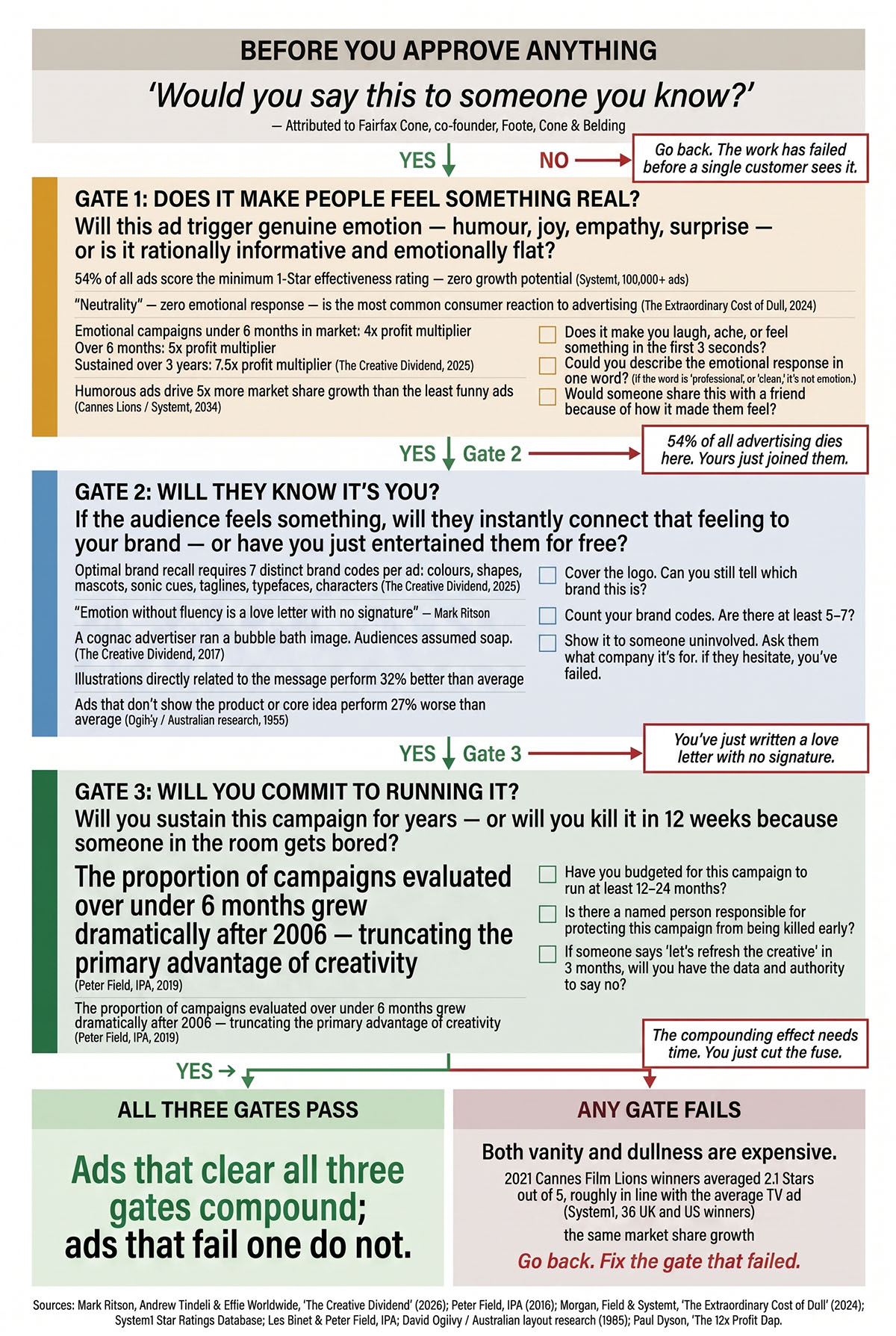
The 2025 Creative Dividend research identified three conditions that have to be present at the same time. Miss one and the multiplier dies.
First, the work has to generate genuine emotion. Not the kind that impresses a jury. Real human feeling, humour, joy, empathy or surprise, that gets past the brain’s filters. Without it the ad joins the large majority of advertising that scores the minimum effectiveness rating and becomes invisible.
Second, the audience has to know instantly that it is you. Emotion without brand recognition is a love letter with no signature. Ritson calls the assets that do this brand codes. Byron Sharp calls them distinctive brand assets. Same idea: colours, shapes, mascots, sonic cues, typefaces, characters. If you make someone laugh and they cannot remember who made them laugh, you have entertained them for free.
Third, you have to leave it running. Campaigns sustained past three years deliver several times the incremental profit of campaigns pulled before six months. The industry’s addiction to novelty, killing campaigns that are working but boring the people who made them, is the same short-termism Field identified. It truncates the compounding before it starts.
Meet all three and the compounding effect is worth many multiples of the initial investment. Miss one and you are burning money, whether the ad is glossy or ugly.
The expensive alternative to vanity
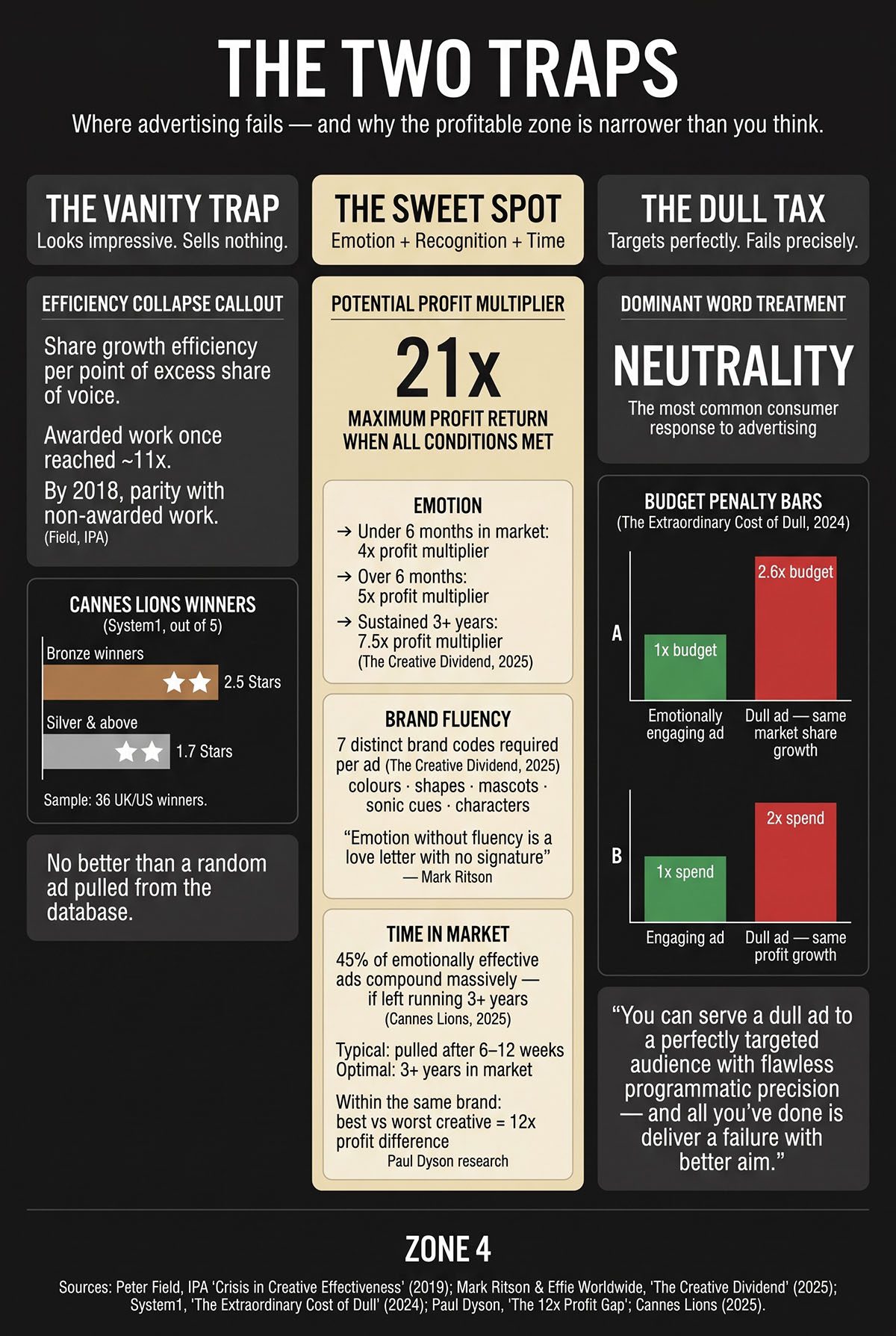
If vanity advertising is a trap, there is an equally expensive trap on the other side. Boring advertising.
The 2024 study The Extraordinary Cost of Dull put a price on it. Neutrality, the complete absence of any emotional response, has become the most common consumer reaction to advertising. And dull ads do not merely underperform. They cost significantly more to achieve the same result.
To match the market share growth of emotionally engaging advertising, dull ads need roughly two and a half times the media budget. To match the same profit growth they need about double the spend. Boring advertising is a tax on every dollar you put into marketing.
You can serve a dull ad to a perfectly targeted audience with flawless programmatic precision. All you have done is deliver a failure with better aim.
The escape route is not more creative in the award-jury sense. It is not safer in the corporate risk-avoidance sense. It is asking the right question before anything gets made.
One question that changes everything
Here is the diagnostic. Before you approve any piece of advertising, a TV spot, a social campaign, a landing page, a poster, ask Fairfax Cone’s question.
Would you say that to someone you know?
Not “does this represent our brand values.” Not “is this on strategy.” Not “will this win an award.” Not even “do I like it.”
Would you walk up to a friend, a real person with real problems who is genuinely busy, and say these words to their face?
If the answer is no, the work has failed before a single customer sees it. It does not matter how beautiful the photography is. It does not matter how much the production cost. It does not matter that the CEO thinks it makes the company look prestigious.
There is old layout research David Ogilvy used to share that most designers still have not encountered. When people were shown ads and asked what was being advertised, they assumed the picture related to the subject. Show a woman in a bubble bath and people think soap, even when you are selling cognac. Show an abstract geometric pattern and nobody thinks about processors. Illustrations directly related to the message performed meaningfully better than average. Ads that showed neither the product nor the core idea performed meaningfully worse.
Relevance beats ingenuity. Every time. In every test. Across every decade of data.
Back to the airport
Next time you walk through a terminal, look at those enormous glossy panels differently. Count how many answer the question “what is in it for me?” Count how many would still make sense if you covered the logo. Count how many you could attribute to the correct company without the branding.
Most of them could be selling anything. Or nothing.
That is not a creative failure. It is an evaluation failure. Somebody in the room, the agency, the client, the marketing director, the CEO, should have asked Cone’s question and did not. Somebody was so busy feeling proud of the advertising that they forgot to check whether it would sell.
The airport ads will keep running. The question is whether yours will look like them.
Your marketing, looked at properly
Thirty minutes on your current setup — what’s working, what’s quietly leaking budget, and what I’d fix first. You’ll leave with a clearer picture whether we work together or not.
Got something specific bugging you? Flag it when you book and I’ll have it looked at before we talk.

AboutBruce Marjoribanks
Bruce Marjoribanks has spent 27 years in marketing, including building, running and selling his own agency before going independent. He now runs every channel - paid, organic, social, email, creative and automation - as one integrated system, with AI ehancing production and the judgment staying human.