
Three browser tabs. Three green arrows. Flat revenue.
Monday morning. The SEO dashboard shows organic traffic up 18%. The ad platform shows cost-per-click down. The email tool shows open rates at a six-month high. Three people will tell you, in three separate Friday reports, that everything is working.
Nothing is working. The line that matters, the one that pays for everything else, hasn’t moved in four months. And nobody can tell you why.
The usual read is that somebody underperformed. It’s almost never that. Everyone hit their number. The problem is which numbers were theirs to hit.
That arrangement was never a philosophy. One owner per channel, each accountable for their own metric. It was arithmetic. AI just changed the arithmetic.
The split was never about depth. It was about cost.
Nobody divided marketing into five channels because five brains beat one. They divided it because production was slow, expensive and skilled, and work like that has to be split up to get done at all.
Look at what a single channel used to demand. A technical SEO audit: days of crawling, log analysis, schema work, then a written set of recommendations. Ad creative: a senior copywriter, a designer, three rounds of revision, two weeks gone. A nurture sequence: a week of writing, then QA. Each of those was a full-time job because each of those took a full week.
Depth followed cost. If you’re buying a week of somebody’s attention anyway, you want the week spent by the person who has done it four hundred times. The specialist was the efficient answer to an expensive question.
Then the question got cheap.
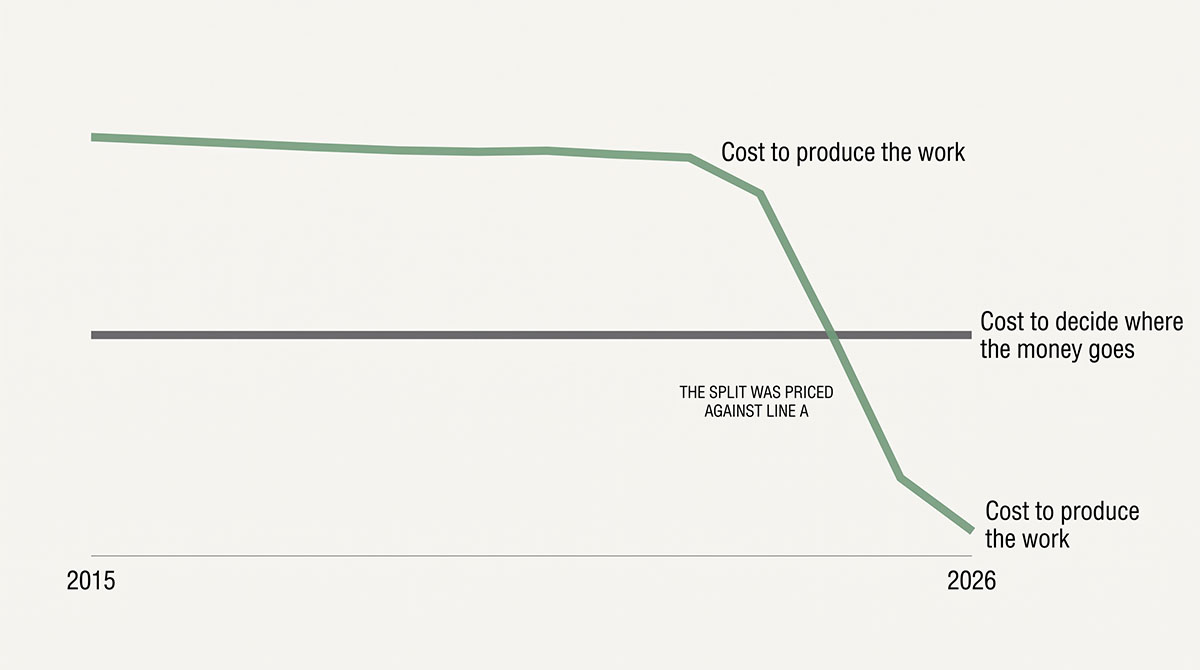
What AI actually collapsed
Not judgment. Not strategy. Not taste. Production.
An audit that used to take me the better part of a day now takes about ninety minutes, because the crawl, the log parsing and the first-draft recommendations run while I’m looking at something else. Ad variants that were a two-week sprint are an afternoon. A nurture sequence gets drafted in the time it used to take to brief one.
That’s my own setup, not an industry benchmark. Your numbers will differ. The direction won’t.
Here’s the part that matters. The depth advantage didn’t disappear. A specialist still knows things I don’t. But depth was only ever worth buying because it was the cheapest route to competent output, and it isn’t the cheapest route any more. Competent output is now the cheap part of the job.
When the expensive thing becomes cheap, everything priced against it gets repriced. Specialisation was priced against expensive production. Production stopped being expensive. The bill is still arriving.
Worth saying plainly: I run the integrated version of this. That’s a reason to check my reasoning, not a reason to skip it.
What didn't collapse
One item on that Monday morning list is exactly as hard as it was five years ago.
Which channel deserves the next dollar this week.
No tool answers that. It isn’t a production question, so cheap production doesn’t touch it. It means holding customers, constraints, history, budget and every live channel in one head at once, and then deciding what to starve. That work got more valuable the moment everything around it got cheaper. Not because it improved, but because it’s now the only scarce part.
It’s also the one thing a channel-divided structure cannot do. Not won’t. Cannot. Everyone in it is looking at one square of the board.
The split doesn't just fail to help. It removes context.
Michael Wesch used the phrase context collapse in 2008 for what a webcam does to an audience: flatten every distinct group into one, so you end up addressing nobody in particular. Alice Marwick and danah boyd’s 2011 Twitter paper made the term standard. Your boss, your mum and your university friends all read the same post, so the post can’t assume what any of them know.
Divided marketing manufactures the same flattening, one layer down. The SEO owner doesn’t see what the paid owner saw in last week’s auction data. The email owner doesn’t know organic just started ranking for the query their nurture flow targets. Each one produces competent work for a version of the business they only partially see.
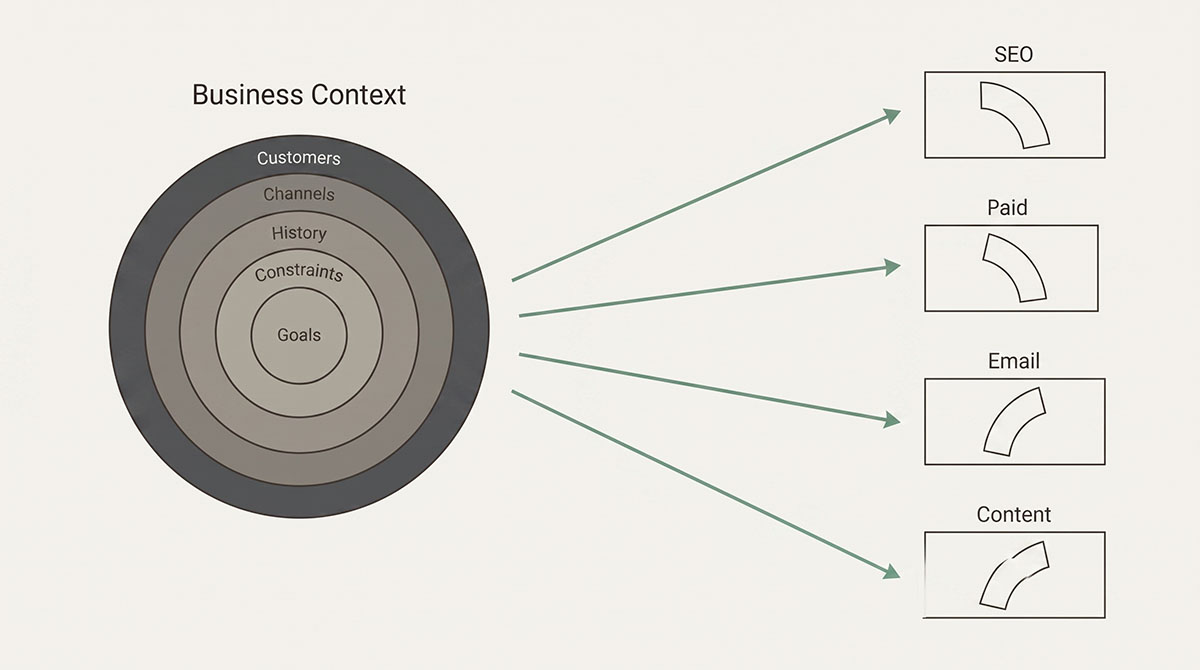
This isn’t a communication failure, and a Monday standup doesn’t fix it. Context isn’t a document you can circulate. It’s the running sense of what this business is currently blocked on, and it only exists inside whoever is watching all of it. Buying all five partitions from one supplier doesn’t merge them. It just puts one invoice on them.
AI tools amplify the problem, hard. Hand an AI a narrow brief. “Rewrite this subject line, here’s the open rate history.” It will do exactly that, expertly, in isolation. It cannot tell you the email is competing with the company’s own paid campaign for the same audience that week. It can’t, because nobody fed it that context. Narrow brief in, narrow brilliance out, faster than before.
Which is the trap sitting inside “AI-enabled” as a selling point. Better tools inside a divided structure produce more output per partition. The partitions don’t move.
What to ask before you hire
If you’re buying marketing help in 2026, “are you using AI?” is a dead question. Everyone says yes. It costs nothing to say.
Ask this instead: who is holding the whole map, and how often do they move budget because of something they saw on it?
Then ask for the last three times it happened. Dates, channels, what moved where, what it did to revenue. Anyone actually doing the work answers in a minute. Anyone selling you five partitions with better software answers with process. The rest of what to look for is in 12 reasons to hire an AI-powered generalist instead of an agency of specialists.
None of this is about headcount or job titles. Contractors, an agency, an in-house team, one person. Any of them can hold the whole map, and any of them can be arranged so nobody does. What matters is whether the map exists and who is looking at it.
Monday morning, a year from now. One screen. One person reading it. Organic, paid, email, revenue, all in a single view. A decision made before the coffee goes cold, and budget moved off the channel that’s saturated onto the one that’s blocked.
That’s not a tool. It’s not really a service either, in the old sense.
It’s just what’s left once production stops being the expensive part.
Your marketing, looked at properly
Thirty minutes on your current setup — what’s working, what’s quietly leaking budget, and what I’d fix first. You’ll leave with a clearer picture whether we work together or not.
Got something specific bugging you? Flag it when you book and I’ll have it looked at before we talk.

AboutBruce Marjoribanks
Bruce Marjoribanks has spent 27 years in marketing, including building, running and selling his own agency before going independent. He now runs every channel - paid, organic, social, email, creative and automation - as one integrated system, with AI ehancing production and the judgment staying human.