
Your customer has ordered the pie. The waiter now has two ways to sell the ice cream.
The first is to ask whether they want any. That question has a one word answer, and most of the time the answer is no. Not because the diner dislikes ice cream. Because no is the cheapest thing to say when you are full and the bill is coming.
The second is to ask whether they want vanilla or chocolate on it.
Now there is no cheap no. There is a small, easy choice between two things the diner would probably enjoy either way. That second sentence belongs to Elmer Wheeler, and he was selling it to hotel restaurants in the 1930s.
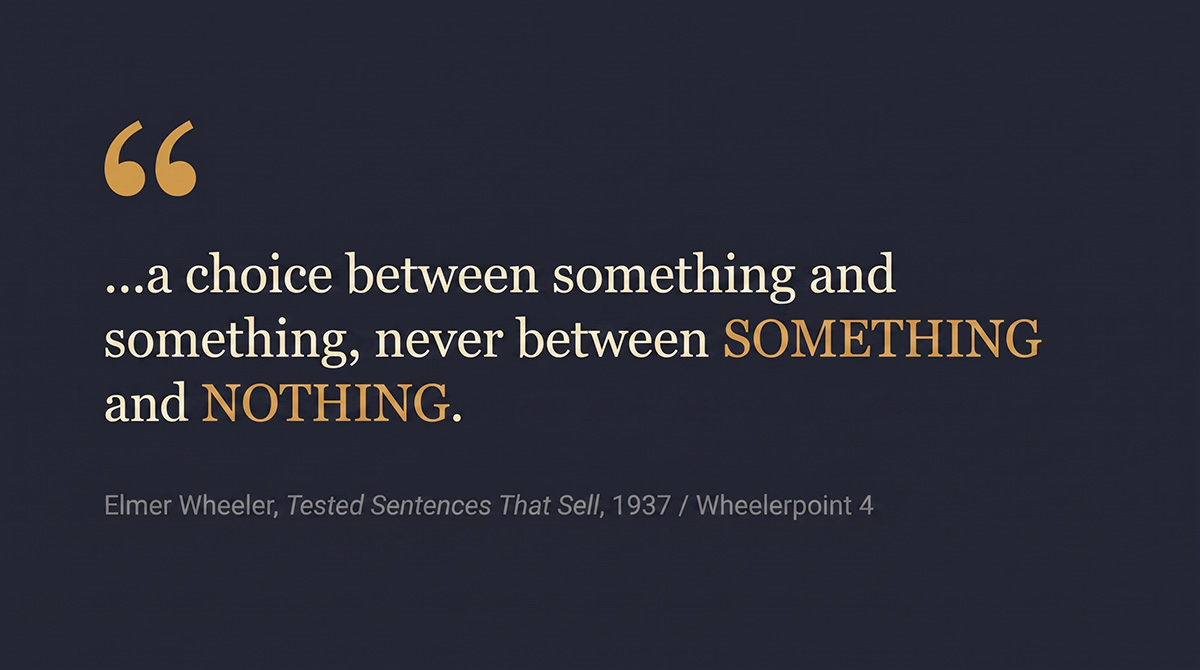
Wheeler ran the Tested Selling Institute. He published Tested Sentences That Sell in 1937, on the back of ten years of work testing 105,000 words and word combinations. He gave the principle a name that has never needed improving: don’t ask if, ask which. Frame the close, he taught, so the customer picks between two things rather than between one thing and nothing at all.
Now the part most retellings skip. That 105,000 figure travels with a second number, 19 million people tested, and it is worth knowing where both come from before you repeat either.
They appear twice in the book, and neither appearance is an audit. The first is in the foreword, written by a client of Wheeler’s, who introduces the figures with the hedge “I understand that.” A paying customer, recalling second hand, in a promotional preface. The second is Wheeler himself, in the body, stating that he analysed 105,000 sales words and techniques and noted the results of testing them on 19,000,000 people. That is the man whose consultancy the number was selling, citing his own count.
No methodology. No third party. No definition of what counted as a test. I am telling you this because a reader who opens the 1937 PDF finds both sentences in about four minutes, and because the number is not the reason to use the rule. Four tells of manufactured authority covers why that distinction matters more than it used to.
Everything I can prove about the gas station
Wheeler grew up around a gasoline station. His father ran one on South Avenue in Rochester, New York, and Standard Oil bought him out.
That is the whole of the origin story I can verify from Wheeler’s own writing, so that is the whole of the origin story you are getting. No coached sentence at the pump. No fifteen gallon miracle. Just a boy in a business where a single question at the driver’s window decided the size of the sale.
Why it probably works
“If” asks for a verdict. “Which” asks for a preference.
A verdict is expensive. The customer has to decide whether they want the thing, then decide whether to say so out loud, then live with having committed. A preference is cheap. They point at one of two things.
That is my explanation, not Wheeler’s evidence. Worth being clear about: Wheeler prescribed the rule, he taught it as an instruction to salespeople, and he did not publish a controlled comparison showing which beats if. Nobody since has published one I can stand behind either. What the rule has going for it is eighty-nine years of practitioners finding it useful, which is real but is not the same as a number.
It is also not manipulation. The diner who chooses chocolate was never talked into eating. They were spared the work of deciding whether to eat at all.
The part where I have no proof
Your buyers are not 1930s diners. They research. They read reviews. They compare three vendors, loop in a decision maker, and still take another fortnight. A grammar tweak will not move someone with a spreadsheet open.
That objection is half right, and the honest answer is uncomfortable.
I went looking for the modern proof. A split test, an attach rate study, anything with a sample size, a date and a control. There isn’t one I would put my name to. What exists is a 1937 book that prescribes the rule, and every retelling since, each arriving with a slightly better statistic bolted on. If someone shows you a percentage for this, ask them where it came from. I did, and the trail ended.
So do not take the rule on Wheeler’s authority. His authority is a foreword. Take it on one week of your own data instead, which is the only evidence that should have moved you in the first place and is cheaper to get than you think.
The five places "if" is costing you right now
| Touchpoint | "If" phrasing | "Which" phrasing |
|---|---|---|
| Website CTA | "Get in touch if you'd like to talk" | "Book a 20-min call or send us a brief" |
| Proposal close | "Let me know if you'd like to proceed" | "Should we start on the 1st or the 15th?" |
| Upsell conversation | "Would you be interested in the add-on?" | "Which channels do you want, social only, or social plus email?" |
| Referral ask | "If you know anyone who might benefit…" | "Who's one person this would help, someone new, or an established business?" |
| Follow-up email | "Just checking in to see where things stand" | "Are you closer to ready, or still gathering information?" |
Every “if” phrasing builds a yes or no exit. Every “which” phrasing builds a path forward.
Treat this as an audit rather than a mindset. Run it across the five.
Your website CTA. “Get in touch” and “Book a call” are both if questions wearing a disguise. They ask whether the visitor wants to take a step at all. “Book a 20 minute call or send us a brief” is a which. Two options, both pointing the same way.
Your proposal close. “Let me know if you’d like to proceed” hands the entire decision back to the client. “Should we kick off on the 1st or the 15th?” assumes the sale. In my experience the assumed close beats the permission ask, and not because it pressures anybody. It is simply easier to answer.
Your upsell conversation. “Would you be interested in the social media add on?” gives the client a clean exit and usually an argument about price. “Which channels do you want included, social only, or social plus email?” does neither. Same service. Different load on the other end of the call.
Your referral ask. “If you know anyone who might benefit” is a polite exit and nobody acts on it. “Who is one person in your network this would be useful for, someone building a new business, or someone running an established one?” forces a mental scan. Mental scans produce names.
Your follow-up email. “Just checking in” is barely a question. “Are you closer to ready to move, or still gathering information?” gives the prospect an answer that isn’t yes or no. Either reply tells you something. Either reply keeps it alive.
How to test it in a week
Pick one touchpoint. Just one. Find where you are asking if in disguise. Rewrite it as a which. Run it across the next ten conversations, emails or calls and count the replies.
One condition, and this one is mine rather than Wheeler’s. The options have to be genuinely available. Offering the gold plan or the platinum plan when you actually sell five plans is a fake choice, and customers can feel a fake choice even when they cannot name it. Both paths have to lead somewhere you can honour.
Wheeler’s institute spent ten years on this. You can get a usable signal in five days.
The waiter never talked anyone into dessert. He just made yes cheaper than no. The diner still chose. They just chose without having to think about it.
Your business has a dessert course too. Probably five of them. The only question is whether you are asking if, or asking which.
Your marketing, looked at properly
Thirty minutes on your current setup — what’s working, what’s quietly leaking budget, and what I’d fix first. You’ll leave with a clearer picture whether we work together or not.
Got something specific bugging you? Flag it when you book and I’ll have it looked at before we talk.

AboutBruce Marjoribanks
Bruce Marjoribanks has spent 27 years in marketing, including building, running and selling his own agency before going independent. He now runs every channel - paid, organic, social, email, creative and automation - as one integrated system, with AI ehancing production and the judgment staying human.