
Swimming Pool Kits Direct came to me paying one agency. Not five. One. A full-service agency — the kind you hire specifically so you never have to juggle specialists again.
Inside that one agency: an account manager, a Facebook specialist, a Google Ads specialist, an SEO specialist. Four people, four remits, four separate reports landing in four different formats — and the client still the one connecting the dots between them. The only thing that had genuinely consolidated was the invoice.
Moving everything to one full-service agency fixes the invoice count, not the structure. Departments under one roof are still departments — and until one brain holds your complete picture, you haven’t consolidated anything. You’ve hidden the fragmentation under a logo.
The most reasonable wrong decision in marketing
I want to be fair to this decision, because it’s the smartest wrong move available.
You’ve already worked out that fragmentation is killing you. Five agencies, five strategies, five versions of what success means, and you in the middle relaying messages like an unpaid switchboard operator. You’ve diagnosed it correctly. So you do the obvious thing: collapse it all into one agency that does everything. One contract. One point of contact. One monthly call instead of five.
The logic is clean. If the problem is too many companies, hire fewer companies. If coordination between agencies is where the money leaks, put everything inside a single company where the coordination happens internally, done by professionals, on their payroll instead of your calendar.
Every full-service agency’s pitch deck is built on exactly that logic. And the diagnosis half of it is right. That’s what makes the trap work — it sells you a real problem and a solution shaped like the answer.
Departments under one roof are still departments
Walk into the full-service agency you just hired and look at how the work actually gets done.
The Facebook specialist runs Facebook. The Google Ads specialist runs Google Ads. The SEO specialist runs SEO. Each one plans their own channel, optimises their own numbers, and reports their own wins. They sit in different meetings, work from different briefs, and answer to different metrics. The thing you were promised — everything working as one system — has no owner. It has a coordinator.
That’s what the account manager is. Not a strategist who sees across channels and makes decisions. A relay. They collect what the Facebook specialist did, what the Google specialist did, what the SEO specialist did, and assemble it into a deck. The channels get summarised side by side. They don’t get connected, because connecting them isn’t anyone’s job. Summary is not strategy.
At Swimming Pool Kits Direct, that structure meant the client’s experience was identical to managing four separate agencies. Same silos, same handoffs, same dots left for the client to connect. The four invoices had merged. The four remits hadn’t.
And every one of those departments carries salaries. Those salaries are fixed whether or not your account needs them this month, and every department head is measured on keeping their people billable. That is not a scandal. It is arithmetic. But it is arithmetic that runs quietly underneath every recommendation that reaches you, and we will come back to what it produces.
What the org chart promises
vs. what reaches the client
| Dimension | On the org chart | In your week |
|---|---|---|
| Strategy | One integrated team | Four channel plans, never reconciled |
| Reporting | Unified view | Four reports, four formats, four definitions of a win |
| Decisions | Made by the agency | Made by you, between their meetings |
| Point of contact | One | One relay, four decision-makers behind it |
| Invoice | One | One |
Consolidation happened on exactly one line of the comparison
"But a real full-service agency coordinates internally - that's the whole point"
This is where the smart buyer pushes back, and the pushback deserves a straight answer.
Isn’t internal coordination exactly what you’re paying for? There’s a weekly WIP. There’s a shared strategy document. The account manager’s entire job is making sure the left hand knows what the right hand is doing. Even if it’s imperfect, professionals coordinating inside one company must beat you doing it yourself across five.
Partly true. Your Mondays genuinely improve. One call instead of five, one contact chasing answers instead of you chasing them. If the only problem were your workload, full-service would solve it.
But your workload was never the real problem. The real problem is that nobody makes decisions across channels — and coordination doesn’t fix that, because coordination is not integration. A weekly WIP tells each department what the others did last week. It doesn’t decide that this month the budget should move out of Google and into Facebook. That call depends on knowing the SEO content is feeding cheaper retargeting audiences than either channel can buy cold. That decision needs someone who understands all three channels deeply enough to trade them off against each other. In a departmental structure, that person doesn’t exist. The account manager doesn’t have the depth. The specialists don’t have the width.
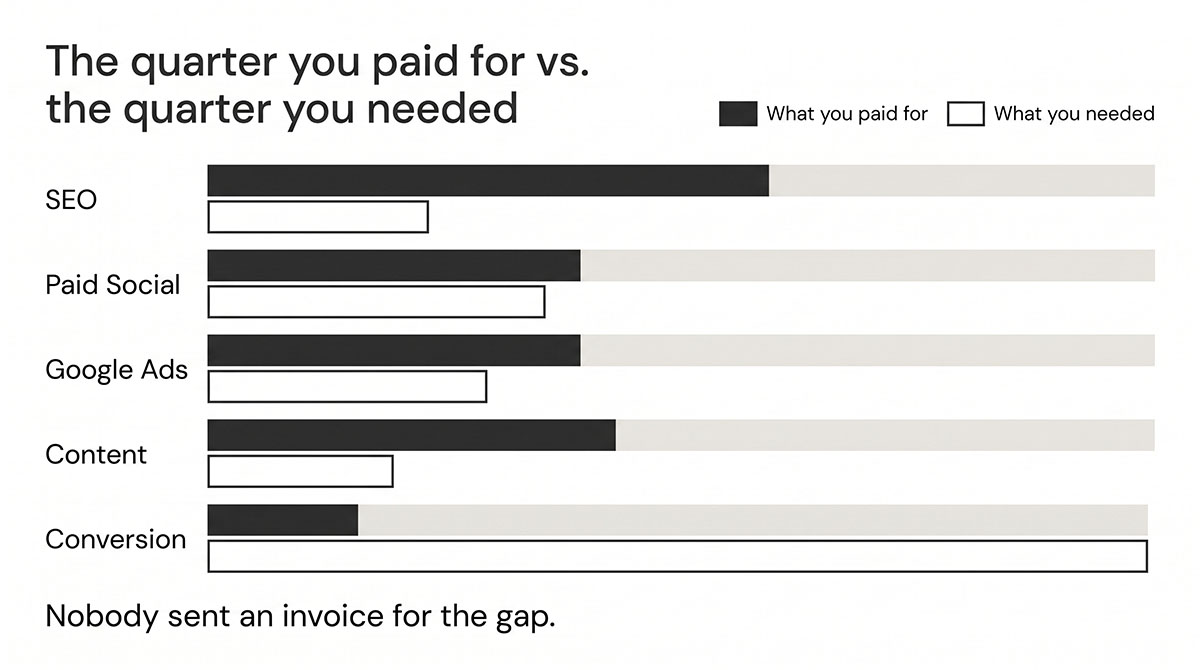
The recommendation you get depends on who has spare hours
Here is what that arithmetic produces, seen from your side of the invoice. Think about the last quarterly deck that landed in your inbox — forty slides, everyone’s channel in its own colour. Your problem that quarter was conversion. The traffic was fine, the landing page was the leak, and somehow the plan that came back was twelve blog posts. Or the quarter where three of five recommendations happened to come from whichever team had gone quiet. Nobody in that meeting was being dishonest. The SEO lead genuinely believes more content helps. They always believe it — that belief is their job description. What you experience as strategic advice is partly a capacity report wearing a strategy deck’s clothes.
Now put that next to how you’d make the same call yourself. You’d look at the whole account, find the binding constraint, and put money and effort there — even if that meant three departments did nothing for a quarter. No department inside a full-service agency can propose its own idleness. Nobody writes a plan that says: pause SEO entirely until the landing page converts.
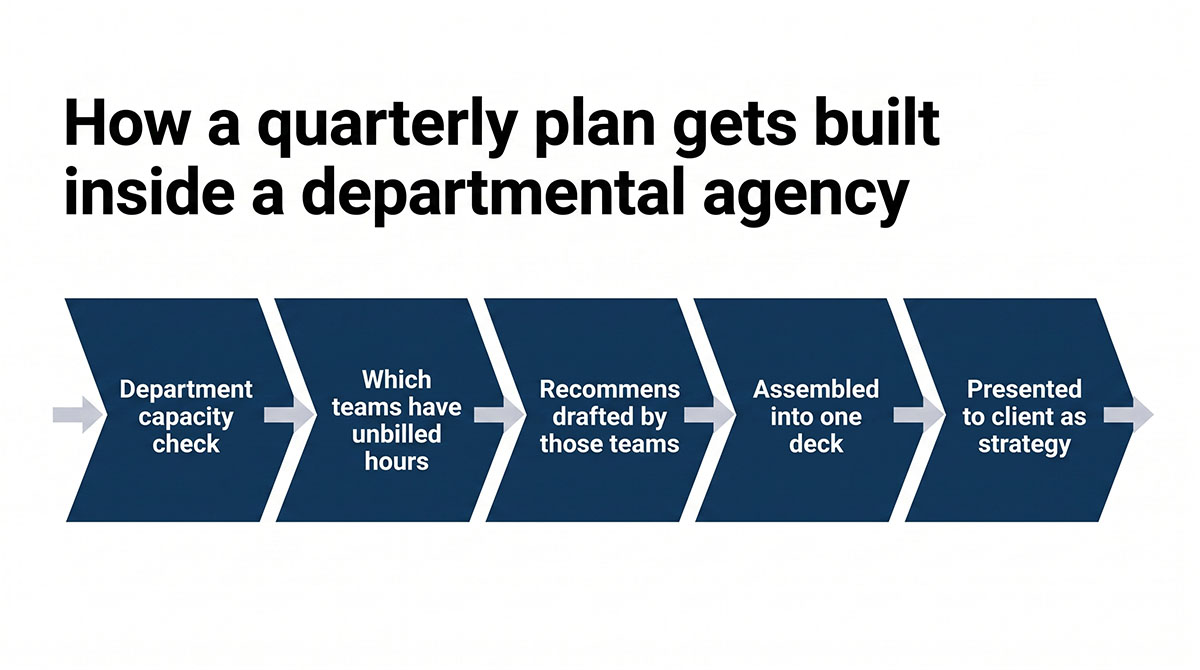
That is the structural distortion. Work flows toward available capacity rather than toward your bottleneck, and the more disciplined the agency is about utilisation, the stronger the pull. Honest people, professional process, and a plan that’s still tilted away from what your business actually needs. The distortion is built into the floor plan, which is exactly why hiring a better full-service agency doesn’t remove it.
If you've already signed, don't fire anyone yet
Most people reading this signed months ago. You recognised the capacity section because you’ve lived it. Firing the agency and starting again is expensive, slow, and not obviously better. So here is something you can do inside the relationship you already have.
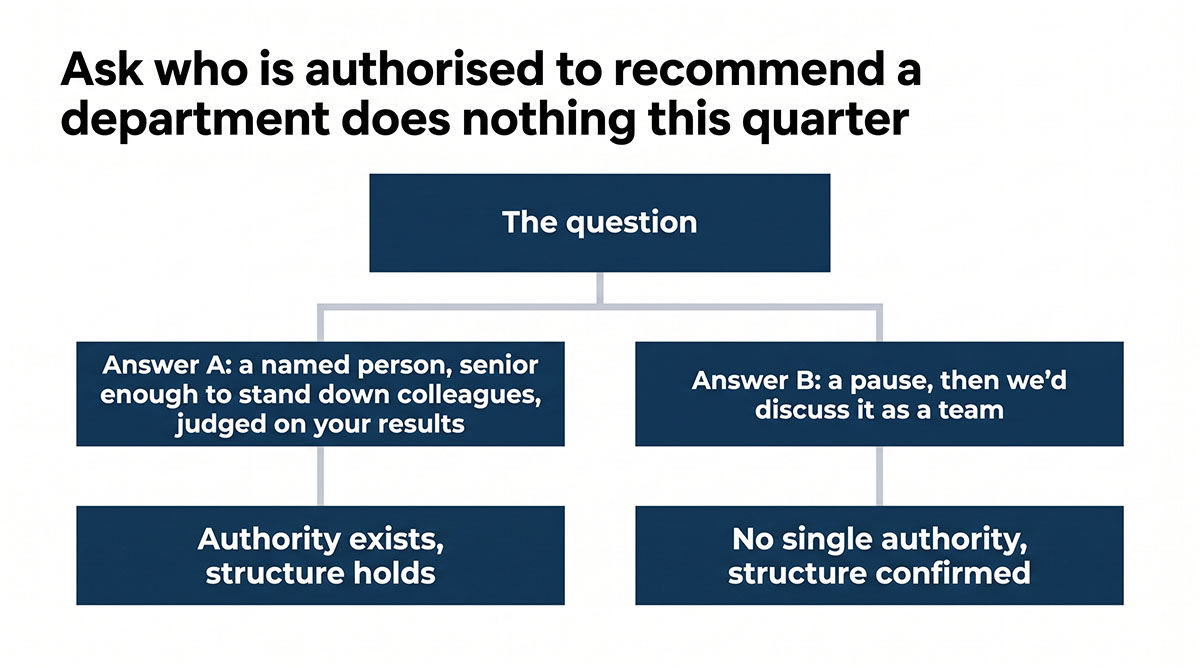
Ask who is authorised to recommend that a department does nothing this quarter.
Ask it plainly, of the person who owns your account. Then watch what happens. You get one of two answers. Either a name — someone senior enough to stand down their own colleagues, and judged on your results rather than their utilisation — or you get a pause. Then a version of “well, we’d discuss it as a team.” A pause is an answer. It means nobody holds that authority. You have confirmed the structure from the inside, and you haven’t fired a soul.
What you do next matters more than the answer. You now know that what arrives each quarter is partly a capacity plan. So stop receiving the constraint. Set it. Name your binding problem before the deck gets built — conversion this quarter, retention next — and ask for a plan that solves that one thing, naming the departments that should be quiet while it happens. You won’t get everything you asked for. You will find out fast which parts of the agency can hear you.
What consolidation is actually for
Here’s the concession, because it’s real: full-service beats five separate agencies. Fewer contracts, fewer calls, one number to ring when something breaks. If your choice is five fragmented specialists or one agency holding everything, take the one agency. Your admin shrinks and your Mondays get quieter.
Just be clear about what you bought. You bought fewer invoices. You did not buy integration, because integration was never a headcount problem or a contract problem. It’s a structure problem, and it has one solution: one brain across every channel, holding the complete picture and executing on it.
That’s what changed at Swimming Pool Kits Direct. The four-person account team came out. The coordination work didn’t get reassigned — it disappeared, because there were no longer any silos to route information between. Every decision factored in every channel, since every channel lived in the same head.
And if you haven’t signed yet, ask it from the other end: who — one named human — holds my complete picture and makes cross-channel decisions every day? If the answer is a department per channel and an account manager stitching the seams, you already know how this goes. You’ve seen the four remits behind the one invoice.
Two questions this post has deliberately left alone. What does that fragmented structure actually cost you, in dollars and in your own hours? The maths is in Five Agencies. Five Wins. One Losing Business. And why can’t you see any of this in your reports, when every agency is reporting honestly? That one has its own answer — individually true numbers that add up to a fiction — and it’s told in Your Marketing Partners Aren’t Hiding Anything. That’s the Problem.
Both start where this one ends. The invoice count was never the problem. The structure was.
Your marketing, looked at properly
Thirty minutes on your current setup — what’s working, what’s quietly leaking budget, and what I’d fix first. You’ll leave with a clearer picture whether we work together or not.
Got something specific bugging you? Flag it when you book and I’ll have it looked at before we talk.

AboutBruce Marjoribanks
Bruce Marjoribanks has spent 27 years in marketing, including building, running and selling his own agency before going independent. He now runs every channel - paid, organic, social, email, creative and automation - as one integrated system, with AI ehancing production and the judgment staying human.