
The campaign cost $47,000 to produce and six weeks to build. The creative brief was tight, the concept was strong, the video looked genuinely cinematic. The agency presented it on a Friday afternoon with slides that used words like “brand story” and “emotional resonance.” Everyone in the room felt good about it.
It went live on a Tuesday. By day eleven, the CTR was 0.4%. Cost per click: $18.40. The algorithm had decided it wasn’t worth showing. There was nothing left to test. One execution, one bet, $47,000 locked in. Three weeks remained in the quarter.
This is not a story about a bad agency. It’s a story about a structural problem that most business owners don’t see until it’s too late. The creative wasn’t the problem. The model was. Brief to concept to approval to launch is a process built for a media environment that no longer exists.
The Doctrine That Made Sense (And Still Has Its Champions)
The advertising industry was built around a single organizing principle: the Big Idea wins. Find the one concept that captures your brand’s truth, execute it with precision, spend heavily behind it, and let time do the rest.
This doctrine made sense for fifty years. When you were buying television airtime or magazine spreads, you had one shot. Distribution was expensive, production was expensive, your window was fixed. Under those conditions, the right answer really was to slow down, get the idea right before launch, and commit.
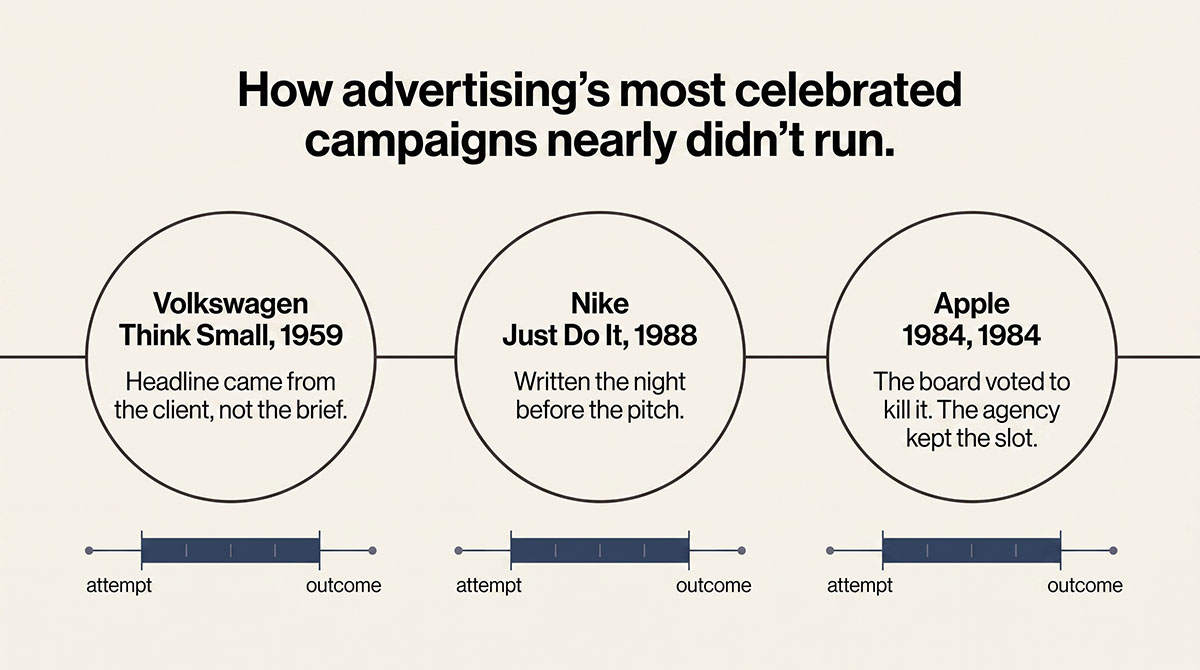
Volkswagen’s “Think Small” is the case people reach for, and it is a genuine iteration story. The famous headline was not in the first layout. Helmut Krone and Julian Koenig led with “Wilkommen,” and the line that became the headline was sitting at the bottom of the body copy. What is usually left out is that the push to promote it came from the client, not from the agency. The credit is also contested, because George Lois has claimed the work for decades.
Either way, the iteration happened before the ad ran. It did not happen in the live market. The winners were the agencies that got the idea right before the work went out.
The logic cascaded through the entire industry. Agency structures, approval processes, brand guidelines and six-week production cycles were all designed to protect the Big Idea from the market until it was ready.
The problem is that the market changed while the doctrine didn’t.
What Actually Drives Performance
Before getting to what changed, it’s worth establishing what we’re actually trying to get right. Most business owners are optimizing for the wrong variable.
Ask ten business owners what drives campaign performance and you’ll hear: targeting, audience selection, spend, the algorithm. The research says something different.
NCSolutions modelled around 450 campaigns and found that creative accounted for 49% of the change in short-term sales. Brand contributed 21%, reach 14%, targeting 11%, and recency 5%. Two things worth knowing about that number. It measures short-term sales lift in US consumer packaged goods, so read it as directional for other categories rather than universal. And it is a modelled decomposition of NCS’s own studies, not an independent meta-analysis.
You will also see a claim that Google’s own research puts creative at 70% of campaign success. It doesn’t. Google’s Think with Google page says effective creative accounts for almost 50% of ROI, and footnotes that figure straight back to NCSolutions. It is the same finding, not a second one. The 70% traces to a trade-press interview quote with no methodology behind it.
So the honest version is narrower than the one usually quoted, and still decisive. Creative is roughly half of the outcome. Targeting is roughly a tenth.
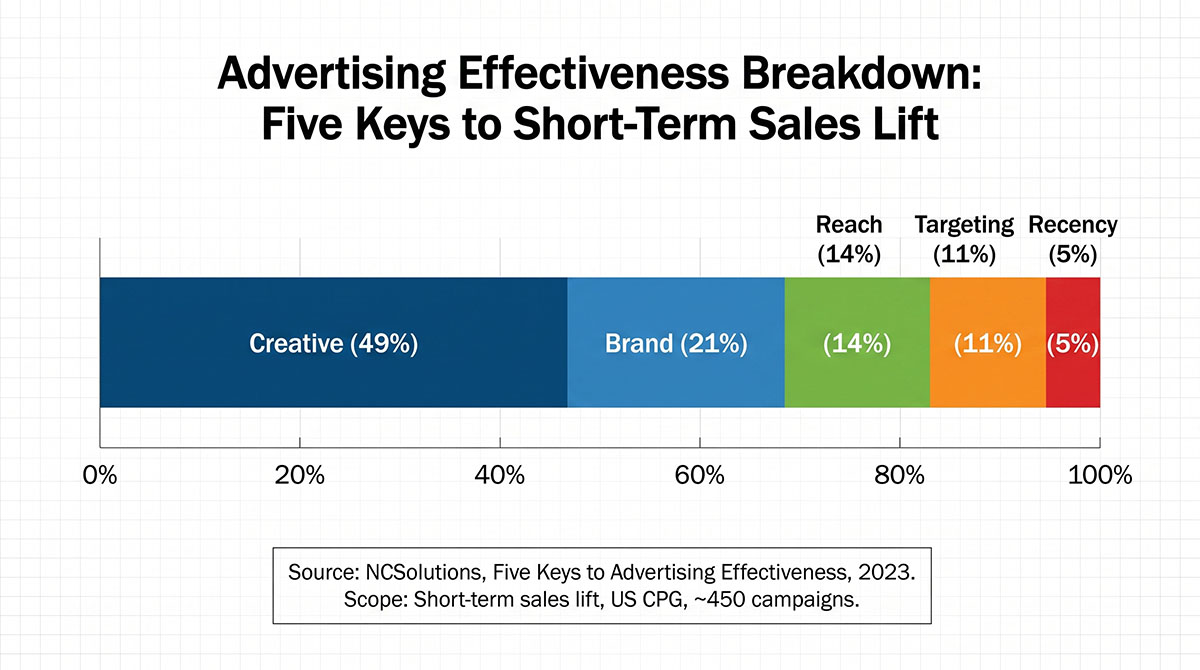
Here’s the implication. If creative is roughly half your result, the question becomes whether anyone can pick the good creative in advance.
Hartnett, Kennedy, Sharp and Greenacre put that question to about 700 marketers at the Ehrenberg-Bass Institute. They showed them 16 pairs of television ads and asked which one in each pair performed better. The marketers were right 51% of the time. The task was binary, so 51% genuinely is coin-flip territory.
Half your outcome rides on creative, and trained professionals cannot pick the winner ahead of time. That leaves one strategy. Test enough variants to let the market tell you.
Motion’s Creative Benchmarks report, built on roughly $1.3 billion of Meta spend, puts the winner rate at 5 to 8%. Their volume data is measured per week and sorted by spend tier. Micro-spend accounts ship about 2.8 new creatives a week. Enterprise accounts ship closer to 19.
Do the math on that. Run five genuinely new variants a month at a 6% hit rate and you find a winner roughly once a quarter. Run twenty five and you find one or two every month. Same hit rate. Completely different learning speed.
The Model Is Broken, and the Numbers Prove It
The Big Idea doctrine was built on the premise that getting the idea right before launch was worth more than the cost of being wrong after. That calculus made sense when production cost $15,000 and the campaign was locked into print placements for six months.
It doesn’t make sense anymore.
Meta’s average price per ad rose 10% across 2024, and 14% in the fourth quarter alone. That is Meta’s own reported price per ad, not CPM. Over a slightly earlier window, April 2023 to March 2024, LocalIQ found search cost per click climbing across 86% of industries in a sample of nearly 18,000 accounts. Different periods, same direction.
Meanwhile, Gartner surveyed 418 senior marketing decision makers between July and September 2024. 87% reported campaign performance issues. Nearly half of them terminated a campaign early, and in my experience that is rarely because the idea was wrong. It’s because the budget went to a handful of untested assets before anyone had performance data.
The agency production cycle runs four to eight weeks. Video stretches to ten or more. By the time you know whether your creative works, the quarter is half over and the budget is committed.
You’re flying the plane after the destination has already been locked in.
The Economics That Changed the Rules
The reason the old model survived this long is that high-velocity testing wasn’t affordable for most businesses. One professionally produced video runs $1,000 to $5,000 for a basic execution. Published ranges for agency-led work run from roughly $4,500 to $20,000 depending on scope. A senior in-house designer costs the same salary whether they turn out ten assets a month or forty, and their hours are the ceiling either way.
At those prices, testing 100 creative variants wasn’t a strategy. It was a budget conversation.
AI creative platforms broke that math. Static variants now run a few dollars each. Published pricing for AI-generated video sits somewhere between $1 and $11 per execution, against thousands for a traditional shoot. Depending on what you’re comparing, that’s a difference of two to three orders of magnitude.
The practical effect is that the financial risk of a creative test has essentially disappeared. You can now afford to test specific messaging angles, niche audience appeals and unconventional visual approaches that were unviable at $3,000 a variant and are rational experiments at $5.
The bottleneck has shifted from “can we afford to test this” to “do we have the judgment to know what to test.” That is a different problem, and one that business owners who know their customers are better positioned to solve than they’ve been given credit for.
The Algorithm Is Already Rewarding the Brands That Figured This Out
Meta’s analytics team has published on creative fatigue, and it’s worth separating two findings that usually get welded together.
Their logistic regression found that conversion likelihood drops around 45% by the fourth repeated exposure to the same creative. Separately, an experiment across roughly 26,000 cases tested whether introducing fresh creative repairs fatigue once it has set in. It does, by around 8% on conversion rate. The 45% comes from the regression, not from the 26,000-case experiment. Both come from a post by the team on Medium rather than a peer-reviewed paper, so treat them as strong internal signal rather than settled science.
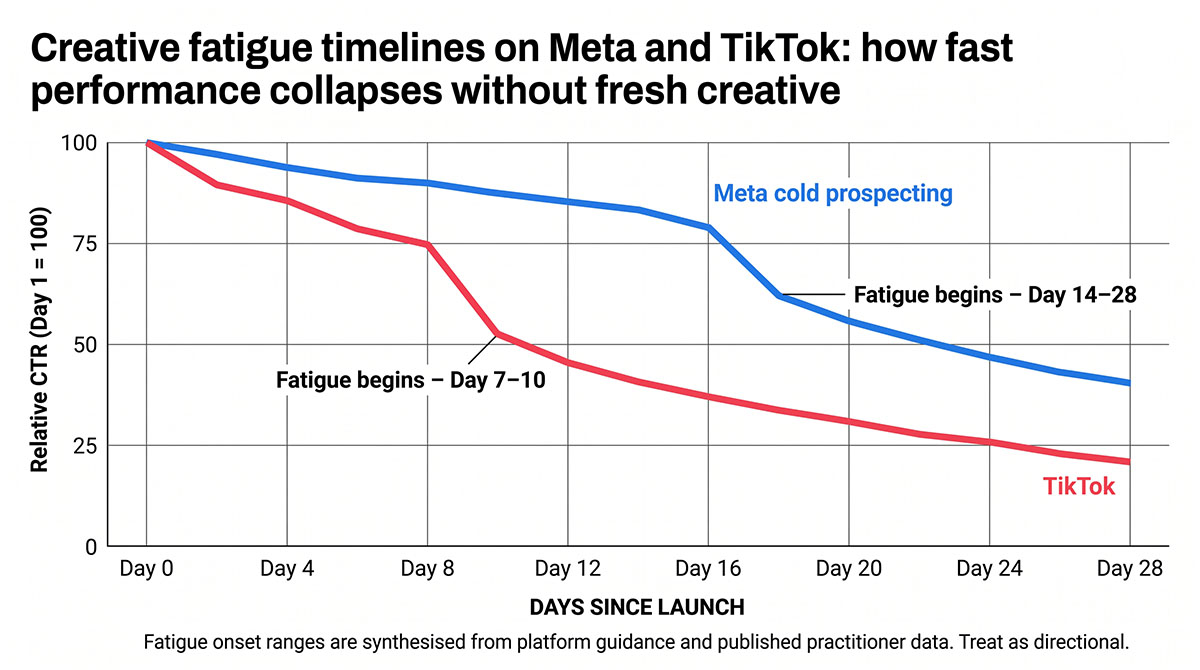
On timing, the picture is slower than most agencies tell you. Creative fatigue on Meta shows up over roughly two to four weeks for cold prospecting audiences. On TikTok it moves faster, in the range of seven to ten days. You will often see “three to five days” quoted for TikTok. That’s the Smart Creative auto-pause window, which is a platform setting, not the point at which the creative stops working.
The platforms are still not patient. They want fresh creative continuously, and near-identical assets don’t give them much to work with.
On how much new creative you actually need, the honest answer is that there’s no rigorous public benchmark. Admetrics, an analytics vendor, puts the minimum at 1.0 new creatives per $10,000 of weekly ad spend, with a working range of 1.5 to 3.0, and treats 0.8 as the floor below which acquisition cost starts climbing. They publish no methodology and they sell creative-velocity tracking, so use it as a rule of thumb rather than a finding.
Run the numbers on it anyway, because the shape is useful. A business spending $20,000 a month is spending about $4,600 a week. At the working range that’s roughly three to six genuinely new creative variants a month. Not per quarter. Per month. And genuinely new is the operative phrase.
For context, an agency retainer delivering 30 to 40 creatives a month is usually cycling minor variations on one approved concept. Meta’s retrieval engine, Andromeda, narrows millions of ad candidates before ranking, and individual creatives sit in that pool as indexed candidates. Meta does not describe creative as the primary targeting mechanism, whatever you read on agency blogs. What is clear is that swapping a headline or changing a background colour gives the system very little to tell apart.
The brands operating this way are posting real numbers, with one caveat attached. A published A/B test compared 25 creative variants against 5 at the same budget and the same audience. The 25-variant set produced 171 more purchases at a 15% lower cost per conversion, while reaching 59,000 fewer people. The caveat is where it comes from: a paid promotional feature by an agency that sells creative volume, with no methodology published. Directionally useful. Not proof.
Why the Gap Compounds, and Why You Can't Close It With Budget Later
This is the part that matters most strategically.
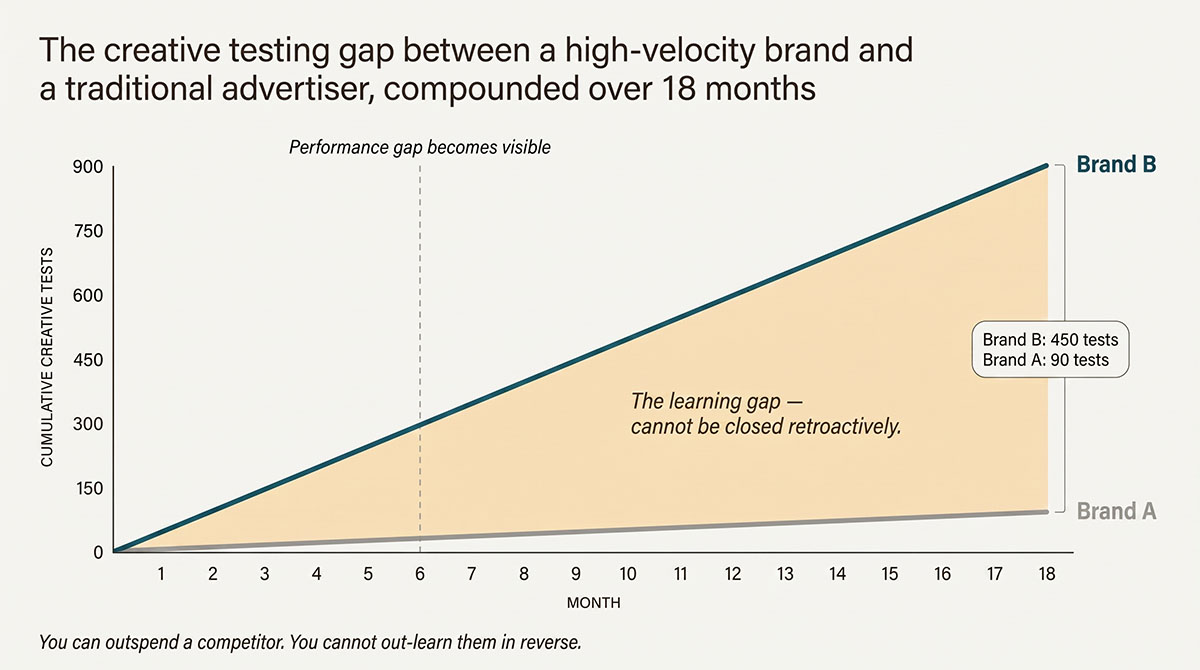
Think about two businesses in the same category. Brand A runs its campaigns the traditional way, five creative variants a month, most of them variations on one approved concept. Brand B builds a testing habit that produces twenty five variants a month, using AI for production and internal customer knowledge for strategy. In month one their performance looks similar. The gap isn’t dramatic yet.
By month six, Brand B has run 150 tests. They know which visual hooks stop the scroll for their specific audience. They know whether their customer responds to problem-first or solution-first framing. They may know that a phone-shot testimonial outperforms a polished lifestyle video for their product, because they tested it rather than assumed it. Their data is specific enough that it no longer generalizes to anyone else.
Brand A has run 30 tests. They know roughly as much as they did in month one.
There is a well-known pattern behind this, though it’s worth stating carefully. BCG’s experience curve work found that unit production costs fall typically 20 to 30% in real terms every time cumulative output doubles. Their examples are semiconductors, hard disk drives and laser diodes. It describes production cost, not error rate, and it is not a law of advertising.
The analogy still holds up, as an analogy. Brand B’s hit rate improves because each test is built on the last one. Brand A’s hit rate stays flat because there’s nothing underneath it.
By month eighteen, Brand B has run 450 tests and Brand A has run 90. The only way to close a 360-test learning gap is to run 360 tests, and you can’t run them retroactively. The platforms need time to serve them, measure them, and feed the signals back into your decisions.
This is what separates a structural advantage from a tactical one. You can outspend a competitor. You cannot out-learn them in reverse.
What This Actually Looks Like
This is not an argument for firing your agency or abandoning creative judgment. It’s an argument for restructuring where your production budget goes.
The shift has two components.
First, collapse the per-unit production cost. AI tools handle static and video variation at a fraction of traditional cost, which means your existing production budget, redirected, funds many times the number of tests.
Second, invest the human creative energy where it can’t be automated, which is hypothesis generation. What messaging angles haven’t you tested? What emotional triggers have you assumed rather than verified? What does your customer believe about their problem that’s actually wrong, and what would happen if an ad said so directly?
The businesses winning right now are treating advertising the way software companies treat product development. Run the test. Read the data. Apply the learning. Build the next test on top of the last one. The bottleneck is no longer whether you can build it. It’s what you should build next. That second question is a founder question. It requires understanding your customer, your category and your competitive position in a way no agency has by default, and you do.
Back to that campaign. $47,000. Six weeks. One execution. CTR at 0.4%.
Now run the same scenario with a different architecture. Same $47,000, same quarter. But week one is fifteen variants, different hooks, different emotional angles, different formats. Some polished, some raw. Total production cost, including the time to build them, under $3,000. By day ten, three are outperforming. By week three you’ve doubled down on what works, cut what doesn’t, and you’re still generating data with three weeks left in the quarter.
The creative isn’t beautiful. But it’s working.
And in six months, when a competitor tries to enter your market with a $50,000 agency budget and one beautifully produced campaign, they’ll find you’ve already mapped this territory. You’ve already run the tests they’re about to run. You already know what their customers respond to, because they’re your customers now.
That’s not luck. That’s what a learning machine looks like from the outside.
A note on where these numbers come from
Worth saying plainly, because it cuts against my own argument. A number of the figures above come from companies that sell creative-volume tooling. Motion sells creative analytics. Admetrics sells velocity tracking. The 25-versus-5 test is a paid promotional feature by an agency selling creative volume.
I’ve kept them because they’re the only public numbers that exist on these questions, and I’ve flagged each one where it appears. But the article argues that testing volume beats single-bet creative, and several of the companies supplying the evidence sell testing volume. Read them accordingly.
The two figures that don’t have that problem are NCSolutions on creative’s share of sales lift and Ehrenberg-Bass on marketers’ ability to predict winners. Those are the load-bearing ones, and they’re the two that hold.
Your marketing, looked at properly
Thirty minutes on your current setup — what’s working, what’s quietly leaking budget, and what I’d fix first. You’ll leave with a clearer picture whether we work together or not.
Got something specific bugging you? Flag it when you book and I’ll have it looked at before we talk.

AboutBruce Marjoribanks
Bruce Marjoribanks has spent 27 years in marketing, including building, running and selling his own agency before going independent. He now runs every channel - paid, organic, social, email, creative and automation - as one integrated system, with AI ehancing production and the judgment staying human.