
“Sources say NBC suspects the ad was deliberately created to be rejected.”
That line ran in a 2009 Hollywood Reporter piece about PETA’s Super Bowl submission — a lingerie-clad ad featuring models doing things to vegetables that you can probably imagine. NBC rejected it with a detailed list of objections. PETA held a press conference about the rejection. The story ran everywhere. The ad reached millions of people who would never have seen it during a commercial break, and PETA paid nothing for the airtime.
The NBC insider who figured it out wasn’t angry. He sounded almost impressed.
The ad wasn’t designed to air. It was designed to be banned. The ban was the campaign.
PETA calls this their playbook. Lush Cosmetics used a version of it when they announced they were leaving Facebook, Instagram, TikTok and Snapchat — on Black Friday, the single highest-traffic day in retail, guaranteeing every journalist covering commerce would write about their departure. A Melbourne restaurateur named Joost Bakker built an entire media career on it by announcing he would build the world’s first restaurant without a rubbish bin before he’d opened any restaurant at all.
None of them waited to be discovered. They engineered the moment that made discovery inevitable.
Every one of these tactics — stripped of celebrity budgets and international PR teams — is available to a small business owner who understands one thing about how the news actually works.
The Thing Journalists Can't Say Out Loud
Press coverage is not a reward for excellence. A superior coffee, a reliable trade service, a well-run clinic — none of these are stories. They’re the baseline. The news doesn’t cover the baseline.
What the news covers — what it structurally needs to cover — is events. Specifically, events that check what journalists call news values: timeliness, impact, conflict, unusualness. The daily reality of running a small business checks almost none of these boxes on its own.
What a pseudo-event does is check them deliberately. The event is real. The commitment is genuine. The policy is in effect. The milestone number is accurate. What’s manufactured is not the substance — it’s the frame that makes the substance press-worthy.
Fringe + Ginge, a café in Canterbury, Kent, actually banned laptops. Owners Alfie Edwards and Olivia Walsh didn’t just post a sign. They framed the ban as a cultural position — restoring “real hospitality” in the remote-work era — gave polished, quotable soundbites, and made their 5/5 TripAdvisor rating a validation metric that appeared in every headline. The story ran in KentOnline, then the Daily Mail, then The Telegraph, then globally via Bored Panda. One café. One policy. One frame. Local to global in a single news cycle.
The coverage didn’t happen because the ban was controversial. It happened because the ban repositioned a small café as a character in a much larger cultural debate about remote work, community, and what hospitality is for. That’s the structural insight running through every case study in this piece: the pseudo-event works when it moves a business from “commercial operation seeking attention” to “protagonist in a story the culture is already having.”
A café that bans laptops is not a story. A café that takes a stand on what community means after COVID — and happens to ban laptops as a result — is.
Three Types. One Playbook.
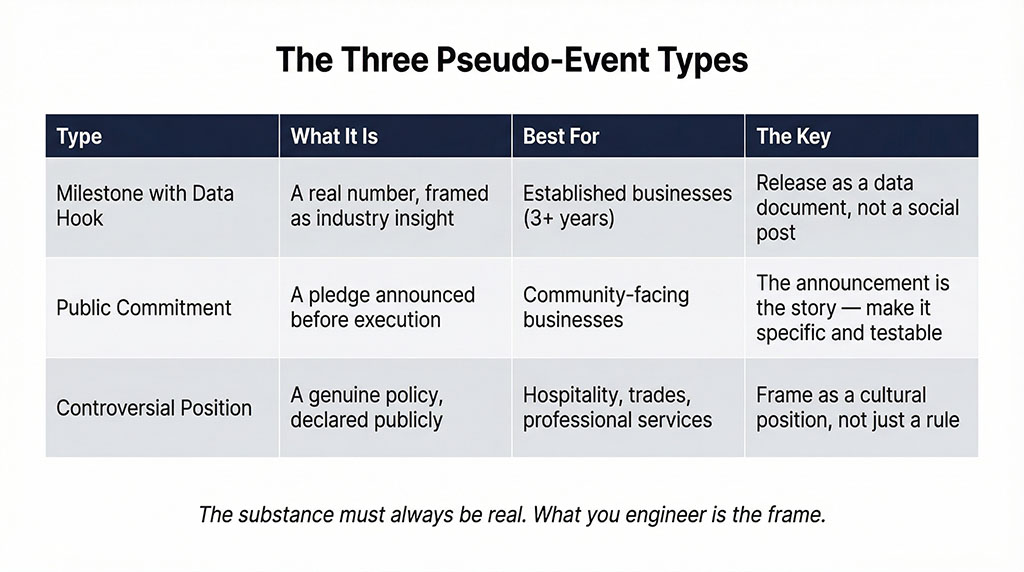
One objection worth naming before the examples: if you’re running a genuinely good business, engineering press moments might feel like a distraction from the work — or worse, a kind of dishonesty. Hold that thought. There’s a section below that addresses it directly. For now, just notice that every business you’ve ever seen generate coverage did exactly this, whether they knew it or not.
The Milestone with a Data Hook
Lune Croissanterie in Fitzroy didn’t celebrate their 10th anniversary. They engineered a month.
Each weekend they released one iconic item from the past decade as a limited run — scarcity mechanics, nostalgia angle, a fresh hook every seven days — coordinated with founder Kate Reid’s cookbook launch. The result: four consecutive weekends of coverage across Secret Melbourne, Broadsheet, Good Food and ABC News.
A birthday is not news. A structured drip-feed of limited releases, each giving a journalist a different angle rather than a rehash, is news four times over.
You’ve seen the equivalent in every industry: a company turns an internal number into a headline. It works because a data milestone doesn’t just announce the business — it situates the business inside a larger story readers already care about.
For a Brisbane physio practice turning five years old, the engineered version looks like this: a data release noting 2,400 patients treated, 340 referred by existing patients, during a period when the national average wait for public physiotherapy blew out to 14 weeks. Frame your milestone as a microcosm of an industry story and you’ve given a journalist something publishable. Not a birthday announcement. A small business as evidence of a national trend.
The Public Commitment
Joost Bakker announced he would build the world’s first zero-waste restaurant before he had built any restaurant at all. The commitment was the story. The proof came later — the dehydrator, the steel milk vats, the flour mill on-site. By the time Silo opened in Melbourne, Bakker had already appeared in CNN, the New York Times and at TEDxSydney, because the pledge was what made news, not the execution.
T Australia later described him as “a master of the media stunt.” What that description misses is that the stunt and the principle are the same thing. Bakker genuinely believes in zero waste. What he understands — that most business owners don’t — is that a quiet conviction changes nothing, while a declared commitment generates coverage before a single thing has been built.
For a local plumber, this could be a Winter Emergency Pledge: a public commitment to prioritise call-outs for elderly residents during a cold snap, announced through a community Facebook group and a local paper before the first frost. The pledge is real. The announcement is designed. The coverage, if it comes, is earned.
The Controversial Position
The least subtle of the three. Also the easiest to get wrong.
Fringe + Ginge got it right because the controversy served a coherent position, not the other way around. The laptop ban wasn’t random provocation — it articulated a specific philosophy about what a café should be. Customers who disagreed were not the target market. The controversy acted as a filter: it repelled the wrong customers and made the right ones acutely aware the place existed.
The Type 3 pseudo-event fails when the controversial position has no real conviction behind it. A ban that exists only for press will collapse under the first hard question from a journalist. The ones that work — the laptop ban, the no-rubbish-bin rule, the no-split-bills policy — are positions the owner actually holds and can defend at length. The engineering is in the announcement. The substance has to be real.
The Question You've Been Sitting With
Is this manipulative?
Here’s the direct answer.
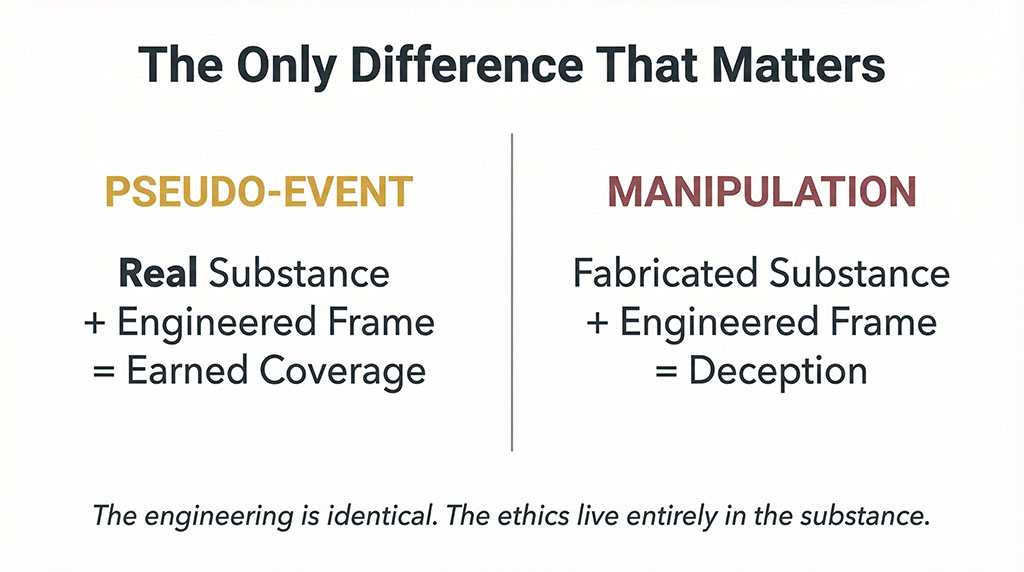
What Ryan Holiday documented — and eventually regretted — was pseudo-events built on fabricated substance. Fake tips. Manufactured outrage. Events that didn’t happen. That’s manipulation.
What Lune, Bakker and Fringe + Ginge did is different in one critical way: the substance is real. The croissants existed. The restaurant had no rubbish bin. The café actually banned laptops. What was engineered was the frame — the decision to announce the thing in a way that made it press-worthy, rather than letting it sit quietly as an operational detail.
Consider what you’re already doing. Every product launch, every grand opening, every award nomination, every charity partnership a business announces publicly — these are all pseudo-events in the original definition. Designed moments, intended to generate coverage. The question isn’t whether to engineer press moments. You already are. The question is whether you’re doing it deliberately enough to work.
Four Worth Designing This Year
Most businesses can find at least one entry point.
The data release. What numbers does your business hold that would be interesting set against a larger industry trend? Client outcomes, wait times beaten, local supply chain volume, staff who’ve gone on to start their own businesses. Package them against national benchmarks and release them as a document — not a social post. Give a journalist a data hook and you’ve done half their job.
The milestone reframe. What anniversary or threshold is coming in the next twelve months? Design the external narrative first: what larger story does your number sit inside? Build the release around that frame, not around the business itself. “We’ve been open 10 years” is not a hook. “Here’s what a decade of this business reveals about how [your suburb/sector/industry] has changed” is.
The public pledge. What commitment could you make — before you’ve fully made it — that would genuinely matter to your community? It needs to be specific, testable, and something you’d be embarrassed to walk back publicly. The more concrete the pledge, the more credible the coverage. The more you’d regret breaking it, the more journalists will trust it.
The declared position. What do you actually believe about your industry that most businesses in your category won’t say out loud? A position you hold strongly enough to defend, implemented as a visible policy, is a story. A position you hold quietly is just an opinion.
Four events across a year is one per quarter. Each one gives a journalist something to write about. Each piece of coverage becomes the pitch asset for the next — and if you’ve read our piece on trading up the chain, you already know what that compounds into. You’re not just generating press. You’re building a documented public record of a business with something to say.
The NBC insider who figured out PETA’s strategy was right. The ad was designed to be rejected. But he was wrong about what that meant.
It didn’t mean the ad was fake. The footage was real. The position was genuine. What PETA engineered was the delivery mechanism — a format that guaranteed more people would see the message than $8 million in airtime could buy.
That’s not manipulation. That’s understanding how attention actually works.
Your business has a position worth knowing about. The only question is whether you design the moment that makes it impossible to ignore — or wait to be discovered.
Most businesses wait.
Your marketing, looked at properly
Thirty minutes on your current setup — what’s working, what’s quietly leaking budget, and what I’d fix first. You’ll leave with a clearer picture whether we work together or not.
Got something specific bugging you? Flag it when you book and I’ll have it looked at before we talk.

AboutBruce Marjoribanks
Bruce Marjoribanks has spent 27 years in marketing, including building, running and selling his own agency before going independent. He now runs every channel - paid, organic, social, email, creative and automation - as one integrated system, with AI ehancing production and the judgment staying human.