
Dave had done everything right.
Google Ads running for four months. A click-through rate of 6.2%, which any agency would call solid. Landing page professionally built. Offer clear: Licensed plumber, same-day service, upfront pricing, 100% satisfaction guarantee. He’d even sprung for a video testimonial from a grateful customer whose burst pipe he’d saved on a Sunday afternoon. The phone rang maybe twice a week from ads. His competitor down the road — worse website, no video, a logo that looked like it was made in 2003 — was turning away work.
Dave’s problem wasn’t his ads. His problem was 1966, and a copywriter named Eugene Schwartz who figured out something that most marketers still haven’t told him.
The Market Has a Memory
Schwartz spent his career measuring something most business owners never think about: the collective memory of a buying market. Every ad your prospect has ever seen in your category — every claim, every promise, every “we’re the best,” every “trusted and experienced” — settles somewhere in their head. And the longer your category has been advertising, the more cluttered that space gets.
Walk past a newsagent and glance at the magazine rack. Your eyes land on the red cover, skip the green, register the face but not the headline. That’s not random. It’s a trained response to repetition — your brain filtering out noise it has already processed. (New.) Your prospect does exactly the same thing with ads in categories they’ve browsed before. The words arrive. Nothing happens. (Knew.)
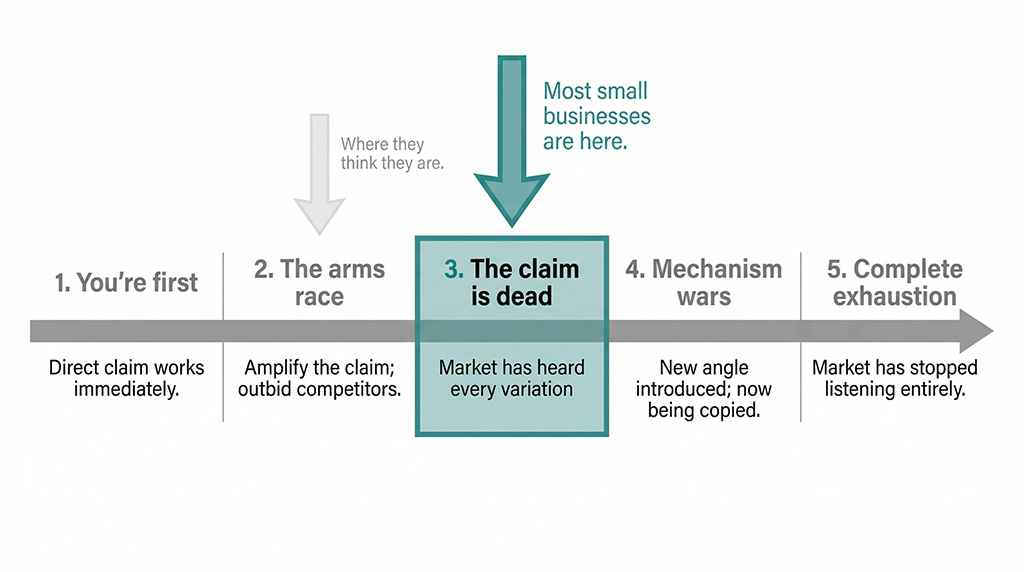
Schwartz called this Market Sophistication. Every market moves through predictable stages depending on how much it has already been told. Most small business owners are stuck in Stage 3 without knowing it — and they keep trying Stage 2 solutions.
The Five Stages (Applied to Your Market)
Stage 1 — You’re first. Nobody in your category is advertising yet, or you’ve created something genuinely new. Your job is simple: state the benefit directly. “Same-day plumbing, guaranteed.” Works immediately. For about five minutes — until competitors appear.
Stage 2 — The arms race. Others have made your claim. So you amplify it. “Same-day plumbing, or it’s free.” Then someone goes to “Same-day, in under 60 minutes, or it’s free.” Then “45 minutes.” The market pushes the claim to its absolute limit of believability. Most small businesses are here — competing on who can make the biggest version of the same promise.
Stage 3 — The claim is dead. Your market has heard every variation. They’ve been disappointed before. They don’t disbelieve you exactly — they just don’t react. The old headline that used to convert produces nothing. Worse, you have no idea why, because the ad still looks right. This is where Dave lives.
Stage 4 — Mechanism wars. Someone in your market figured out Stage 3 and introduced a new angle. Now competitors are copying that angle and pushing it to its limits, exactly as they did with the original claim. Another temporary window closing fast.
Stage 5 — Complete exhaustion. The market doesn’t want to hear from you at all. The only path back in is through identity — making the prospect see themselves in your advertising, not just your product. This takes time, money, and patience you may not have. You don’t want to be here.
How to Know Which Stage You're In
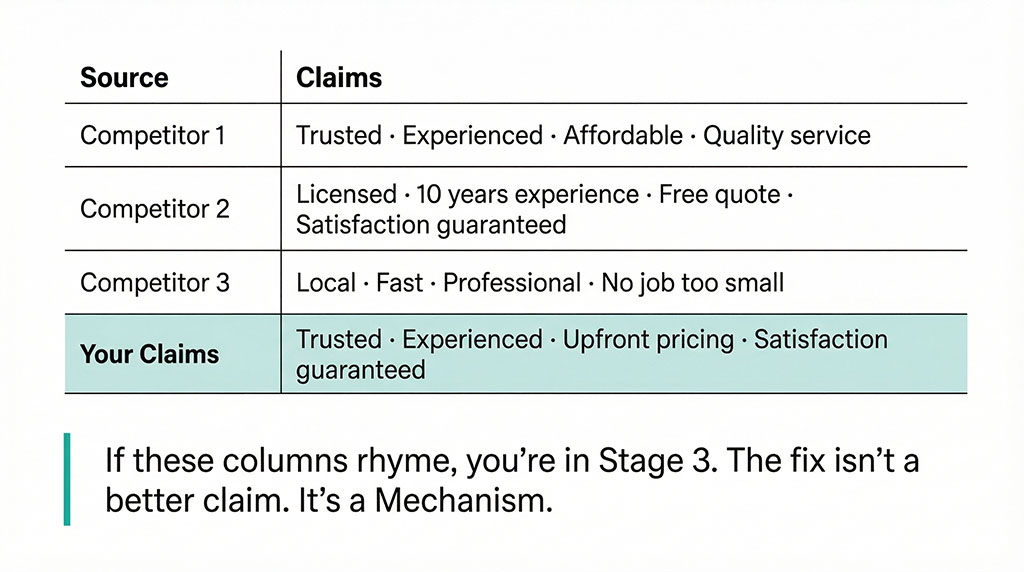
Here’s the diagnostic. Pull up your three closest competitors’ websites and ads. Write down every claim they make.
Now look at your own. How much overlap is there?
If your competitors are all saying “experienced,” “trusted,” “affordable,” and “quality service” — and so are you — you’re in Stage 3. The claims are identical. Nobody believes any of them fully, because they’ve appeared too many times from too many businesses that turned out to be ordinary.
If your market has been around for more than a decade and has more than four or five active competitors advertising regularly, you’re almost certainly in Stage 3. This includes accounting, law, real estate, plumbing, electrical, physiotherapy, personal training, financial planning, mortgage broking, landscaping, and cleaning — and, yes, digital marketing agencies too.
Being in Stage 3 isn’t a death sentence. It just means the old strategy won’t work. You need a different one.
"But I'm Local — My Market Can't Be That Saturated"
This is the objection most business owners reach for. It makes intuitive sense: you’re not competing with every plumber in the country, just the twelve within twenty kilometres of your postcode.
But sophistication isn’t about the number of competitors. It’s about the number of claims your prospect has already processed.
Your customer has seen local plumbing ads for years. On Google. In the letterbox. On the magnet stuck to the fridge from the last tradie they called who quoted high and never followed up. They’ve been promised “upfront pricing” by someone who then added a call-out fee, a materials surcharge, and a weekend rate. The claim has been made — and broken — enough times that their brain has quietly stopped registering it as meaningful information.
Twelve local competitors advertising the same thing for five years will exhaust a market just as thoroughly as fifty national ones. Possibly faster, because the pool of buyers is smaller and more concentrated.
The question isn’t how many competitors you have. It’s how many times your customer has heard a promise like yours — and how many times that promise disappointed them.
The Way Out: Your Mechanism
Schwartz watched the weight-loss market hit Stage 3 in the 1950s. Every headline was screaming about how many pounds you’d lose. Readers had stopped believing. Then someone changed the game — not by making a bigger claim, but by shifting the entire focus from what the product did to how it did it.
The old Stage 2 headline: “I AM 61 POUNDS LIGHTER — NEVER A HUNGRY MINUTE.”
The Stage 3 breakthrough: “FLOATS FAT RIGHT OUT OF YOUR BODY.”
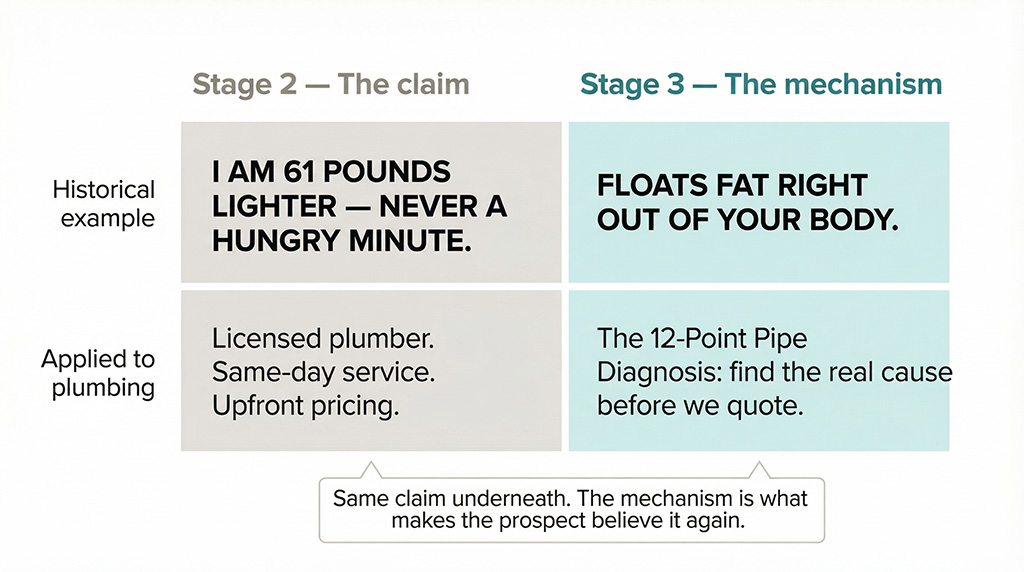
Same underlying claim — you’ll lose weight. But the mechanism transformed it. Suddenly the prospect had a reason to engage again. There was something new to consider. The “how” gave the “what” credibility it couldn’t achieve alone.
This is what a Mechanism does. It names and describes the specific process by which you deliver your result. Not a feature list. Not a tagline. The answer to the question your sceptical Stage 3 prospect is actually asking: “Yeah, but why would yours be any different from the last one I tried?”
How to Build Your Mechanism
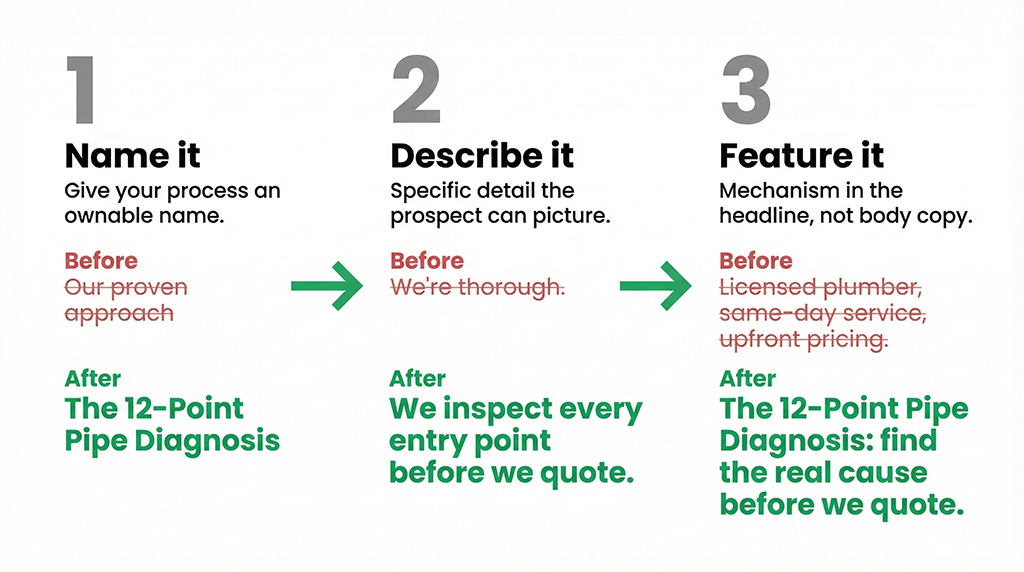
A Mechanism has three parts. Schwartz laid them out plainly: Name it, Describe it, Feature it.
Name it. Give your process an actual name — one that couldn’t belong to anyone else. Not “our proven system.” Not “our approach.” A real name. The 12-Point Pipe Diagnosis. The Profit Leak Review. The 47-Point Home Audit. When you name a process, you implicitly claim ownership of it. Even if the underlying steps aren’t unique, the named, packaged version is.
Describe it. Explain what happens at each step in enough specific detail that the prospect can picture it working. “We inspect every electrical entry point before we quote” is a description. “We’re thorough” is not. Specificity does the persuasive work that claims cannot.
Feature it. Put the mechanism in your headline — not as a supplement to the claim, but instead of it. The claim lives in your body copy. Your headline’s job in a Stage 3 market is to give prospects something new to evaluate before they’ve decided whether to trust you.
For Dave, that shift looked like this. Out: “Licensed plumber, same-day service, upfront pricing” — indistinguishable from every other plumbing ad in the city. In: “The 12-Point Pipe Diagnosis: we find the real cause before we quote, so you’re never hit with a second callout.” Same underlying service. Entirely different frame. A mechanism that implies a process no competitor has bothered to articulate.
The phone started ringing more. That’s what a Stage 3 shift looks like in practice.
What Stage Are You In?
The five stages aren’t arbitrary. They’re a map — and maps only help if you can find yourself on one.
Run the diagnostic. Pull your competitors’ claims, then pull yours. If they rhyme, you’re in Stage 3 or beyond. And if you are, no amount of better photography, tighter copy, or higher ad spend will fix what’s actually broken. You’re not spending your way out of this. You’re thinking your way out.
Your market’s memory is the problem. Your Mechanism is the answer.
Dave already figured that out. You don’t have to take four months to get there.
Your marketing, looked at properly
Thirty minutes on your current setup — what’s working, what’s quietly leaking budget, and what I’d fix first. You’ll leave with a clearer picture whether we work together or not.
Got something specific bugging you? Flag it when you book and I’ll have it looked at before we talk.

AboutBruce Marjoribanks
Bruce Marjoribanks has spent 27 years in marketing, including building, running and selling his own agency before going independent. He now runs every channel - paid, organic, social, email, creative and automation - as one integrated system, with AI ehancing production and the judgment staying human.