
You sent the proposal on Tuesday. It’s Thursday afternoon and you’ve checked your email eleven times since lunch. Nothing.
So you do what every sales trainer, business coach, and motivational poster has told you to do. You follow up. “Hey, just checking in to see if you’d had a chance to review the proposal?” You hit send. You feel productive. You wait.
Three days later: silence.
Here’s the problem. And it’s not what you think.
You Already Know the Advice. That's the Issue.
“The fortune is in the follow-up.” “The three rules of business: follow up, follow up, follow up.” You’ve heard all of it. At the networking breakfast, from the business coach, in the book you bought at the airport. You are not failing to follow up because you don’t know you should.
You’re failing because nobody told you that “just checking in” is structurally broken — regardless of how politely you phrase it.
Every “just checking in” email does the same thing: it asks your prospect to do your work. It hands them the burden of generating a response, a reason to reply, a next step. It creates no forward momentum. No obligation. No reason to act right now rather than next week, or never.
You’re not being annoying when you send it. You’re just being invisible.
The good news: the fix isn’t about sending more emails. It’s about changing one thing, and changing it before you even leave the first conversation.
The 3 Follow-Up Moves That Actually Move Things
Move 1: The Social Contract (Do This Before You Leave the Room)
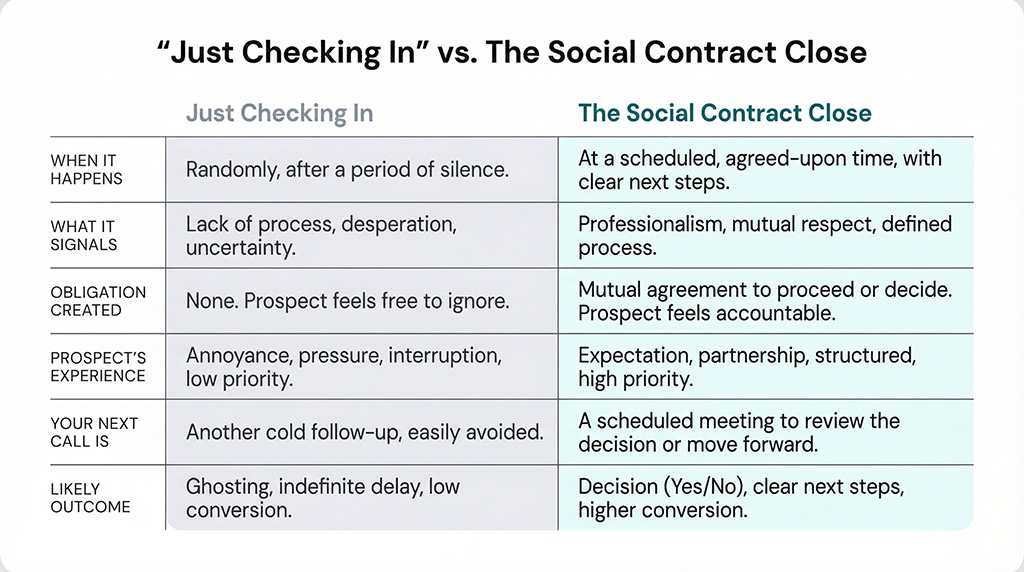
This is the highest-impact change you can make — and it costs nothing.
Before a prospect meeting ends, before a proposal goes out, before a phone call wraps up, you ask one question: “What’s the best way to follow up, and when should I reach out?”
They say: “Give me a couple of weeks.” You say: “Perfect — I’ll drop you a note on the 15th.”
That’s it. That exchange just transformed your next follow-up from an interruption into an expectation.
Keith Ferrazzi — who built a career studying how relationships actually form — calls this the social contract. It doesn’t need to be formal or written. A casual agreement about what happens next creates a quiet obligation on both sides. When you follow up on the date you named, you’re not pestering them. You’re keeping a promise. The psychological difference for your prospect is enormous.
The version most small business owners skip: confirming next steps after the conversation in writing. A short email — “Great talking through the project today. I’ll send the proposal by Friday and follow up the week of the 20th to get your thoughts” — does two things. It documents a mutual expectation. And it gives you a natural opener when you do follow up: “As I mentioned I would…”
You’re no longer checking in. You’re showing up.
Move 2: The Value-First Follow-Up (Within 24 Hours of Any Meeting)
Most business owners wait. Three days. A week. “I don’t want to seem too eager.”
Ferrazzi tracked what happened when he distributed his contact details to over a hundred people at a single event. One person emailed before he’d reached his hotel room that night. He still remembers that person. Everyone else blurred into a single, indistinct crowd.
Speed signals seriousness. But speed alone isn’t what made that email memorable — it was that the person referenced something specific from their conversation. Not “great to meet you.” Something real. Something that told Ferrazzi: this person was actually listening.
The follow-up within 24 hours of a meeting, proposal, or call should do three things:
- Reference one specific thing from your conversation (not generic gratitude — a detail)
- Add something of value (an article relevant to their problem, an idea you thought of on the drive home, a connection that might help them)
- Confirm the next step you agreed to
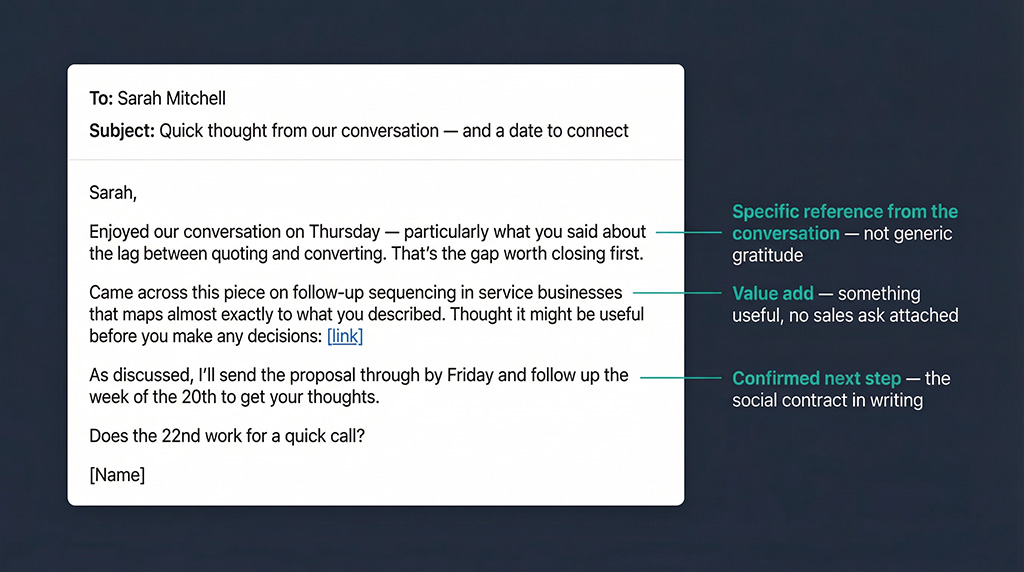
What it should not contain: a sales ask, a pitch recap, or anything that requires them to work to respond.
The bar for “value” is lower than you think. Forwarding a relevant piece of news in their industry, mentioning a tool that solves a problem they raised, or simply writing something that tells them you were paying attention — all of it counts. The goal is to leave them thinking: this person is useful to know, not this person wants something from me.
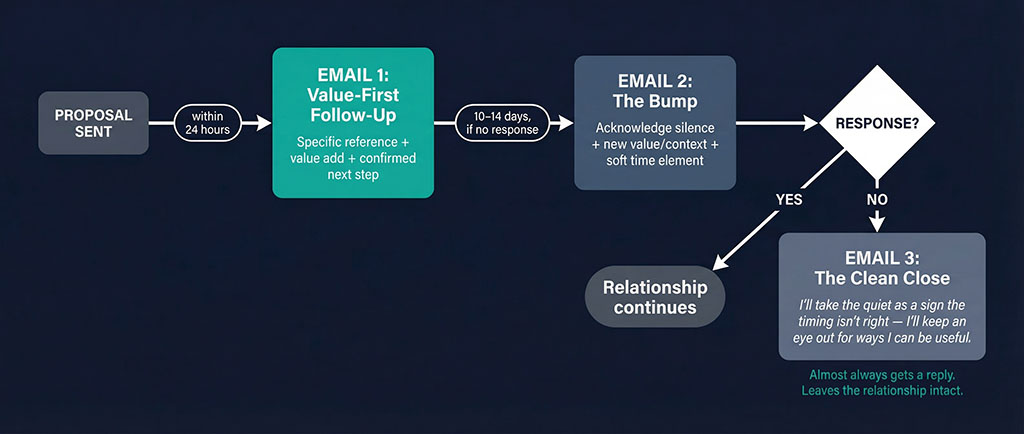
Move 3: The Bump With Stakes (When They’ve Gone Quiet)
Here’s what every small business owner thinks at this point: “I don’t want to be annoying. If they’re interested, they’ll call.”
This belief has a body count. Proposals buried in inboxes, deals that died not because the prospect chose someone else but because no one made it easy for them to say yes. Silence is not rejection — it’s usually just noise. Life happens. Priorities shift. Your email fell below the fold on a busy Tuesday.
The bump email is not “just checking in.” It creates a reason to act.
The structure: acknowledge the silence without apology, add one new piece of value or context, and introduce a light time element.
It looks like this:
“I know you’ve had a lot on — wanted to resurface this before the end of the month in case the timing works. Since we spoke, I came across [specific thing relevant to their situation] that made me think of your project. Happy to jump on a quick call this week if it’d help move things forward.”
Three things just happened. You acknowledged reality without grovelling. You delivered something useful. And you introduced a soft reason to act now rather than later — without a hard deadline that feels like a pressure tactic.
One bump. If there’s still no response after that, send one final email that closes the loop cleanly: “I’ll take the quiet as a sign the timing isn’t right — but I’d love to reconnect whenever it is. I’ll keep an eye out for ways I can be useful in the meantime.”
That email almost always gets a reply. And it leaves the relationship intact.
The Part Nobody Does: Using AI to Make All of This Actually Happen
The reason most small business owners don’t follow up consistently isn’t laziness. It’s that drafting personalised follow-ups for ten prospects while running a business feels like homework nobody assigned.
Here’s where AI earns its place in your process — not to replace the relationship, but to remove the friction that makes you avoid it.
Drafting: Feed a tool like Claude or ChatGPT the notes from your conversation — what they said, what they’re trying to solve, what you proposed — and ask it to draft a value-first follow-up that references those specifics. Edit it so it sounds like you. Takes four minutes instead of twenty.
Tracking the social contract: Tools like HubSpot’s free CRM, Notion, or even a simple Google Sheet can hold the follow-up dates you agreed to. Set a reminder on the day you named. The system holds the promise so your memory doesn’t have to.
The bump sequence: AI can draft a three-email sequence — initial follow-up, value-add bump, clean close — based on a brief description of the prospect and the proposal. You personalise the details, review the tone, and have a ready-to-go sequence sitting in your drafts before you even send the proposal.
The goal is not automation for its own sake. A follow-up that sounds like a robot sent it is worse than no follow-up at all. The goal is removing the reason you keep putting it off: the blank page, the awkward tone, the “I don’t know what to say.”
The proposal you sent Tuesday is still sitting in someone’s inbox. It’s not dead. But it is waiting — for you to give it a reason to move.
Send the email. Reference something real. Name the next step. The phone call you’ve been waiting for doesn’t come from patience.
It comes from showing up.
Your marketing, looked at properly
Thirty minutes on your current setup — what’s working, what’s quietly leaking budget, and what I’d fix first. You’ll leave with a clearer picture whether we work together or not.
Got something specific bugging you? Flag it when you book and I’ll have it looked at before we talk.

AboutBruce Marjoribanks
Bruce Marjoribanks has spent 27 years in marketing, including building, running and selling his own agency before going independent. He now runs every channel - paid, organic, social, email, creative and automation - as one integrated system, with AI ehancing production and the judgment staying human.