
Somewhere around 1455, a monk sat in a scriptorium in Mainz, hand-copying a psalm onto vellum. He’d done this for twenty years. His father had done it before him. The work was slow, sacred, and—as far as he knew—permanent. Forty kilometres away, Johannes Gutenberg was pulling the first sheets off a mechanical press. The monk’s profession had about a decade left. He had no idea.
He wouldn’t have called what was happening a “revolution.” He would have called it a nuisance. A cheap trick. A shortcut that lacked the devotion of real craftsmanship.
You’re that monk.
Not because your job is disappearing tomorrow—maybe it is, maybe it isn’t—but because you’re standing inside a civilisational shift and doing what humans always do at the start of one: underestimating it.
The pattern you're not seeing
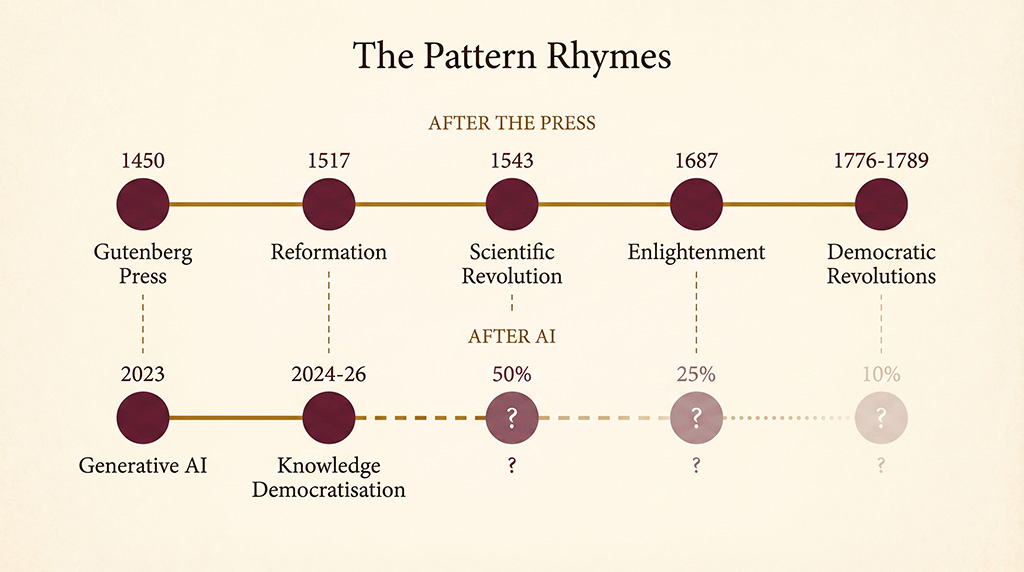
The printing press didn’t just make books cheaper. That’s the version you learned in school, and it’s roughly 5% of what actually happened.
What the press really did was collapse a monopoly. For a thousand years, the Catholic Church controlled the flow of information across Europe. Knowledge lived in monasteries, locked behind Latin, guarded by institutions that decided what people were allowed to read, think, and believe. The press broke that gate off its hinges.
Within decades, a German monk named Martin Luther could print pamphlets that reached millions. People read the Bible in their own language for the first time. They formed their own interpretations. The Reformation followed. Then the Enlightenment. Then democratic revolutions. The entire political architecture of the Western world restructured itself—because ordinary people suddenly had access to information that had been hoarded by elites.
That’s not a story about a machine. That’s a story about power shifting from institutions to individuals.
Now read that paragraph again and replace “printing press” with “AI.”
The gatekeepers are already falling
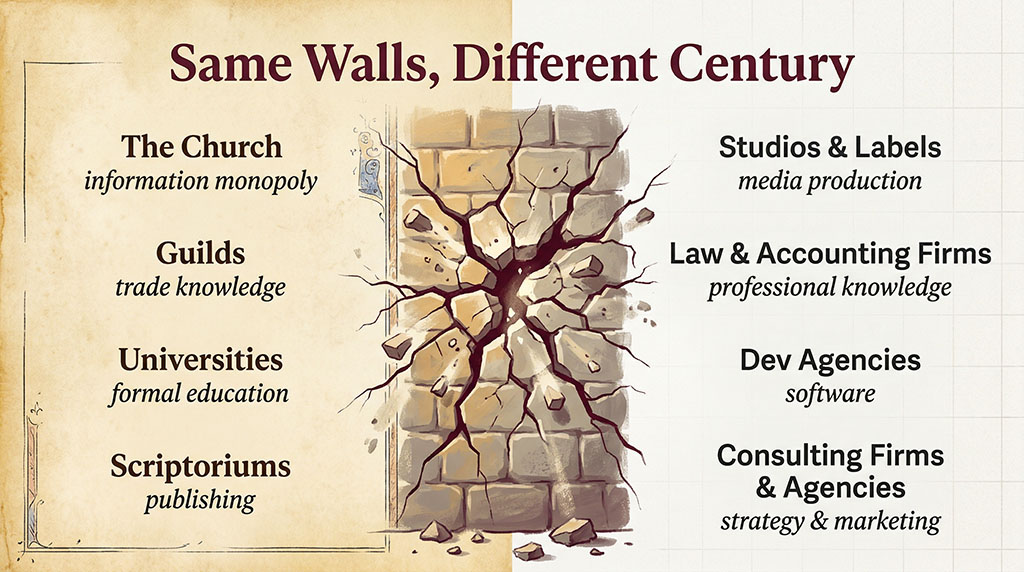
A 16th-century merchant could suddenly read a navigation manual without begging a scholar for help. A 2026 entrepreneur can build software without hiring a dev team.
That’s not a metaphor. It’s a direct structural parallel.
You no longer need a law degree to understand a contract—AI can parse it in seconds and flag the clauses that will cost you. You don’t need a finance background to model a business—you can build projections through conversation. You don’t need a film crew to produce a short film, a label to distribute music, or an agency to run a marketing campaign.
Every industry that relied on “you need us because this is complicated” is hearing the same sound. It’s the sound of a press warming up in Mainz.
The solo operator is the new Renaissance figure. Da Vinci painted, engineered, anatomised, and designed weapons—not because he was superhuman, but because he lived in an era where a single mind could suddenly access knowledge across disciplines. The printing press made the polymath possible.
AI is doing it again. One person with the right tools can now operate as a media company, a consultancy, a software studio, and a design agency. Not because the work got easier. Because the barriers got thinner.
New forms, not just faster old ones
Here’s where most “AI is like the printing press” comparisons stop—at distribution. Books got cheaper. Information spread faster. End of analogy.
But the press didn’t just distribute existing knowledge faster. It invented entirely new forms of knowledge. The novel didn’t exist before print. Neither did the pamphlet, the newspaper, the scientific journal, or the encyclopaedia. These weren’t old ideas made portable. They were new ways of thinking made possible by a new medium.
AI is already doing this. Generative art isn’t painting made faster—it’s a form that couldn’t exist without the technology. Interactive storytelling, personalised music, conversational interfaces, AI-assisted filmmaking—these aren’t upgrades to old categories. They’re new categories.
And here’s the part that should genuinely excite you: we’re probably in the parchment-and-woodblock phase. The truly novel forms—the ones equivalent to the novel or the newspaper—haven’t been invented yet. Nobody in 1460 could have predicted the newspaper. Nobody in 2026 can predict what’s coming.
"But isn't this just hype?"
Let’s stop here. Because if you’ve been reading with one eyebrow raised, thinking every generation says they’re living through a revolution—you’re not wrong to be sceptical.
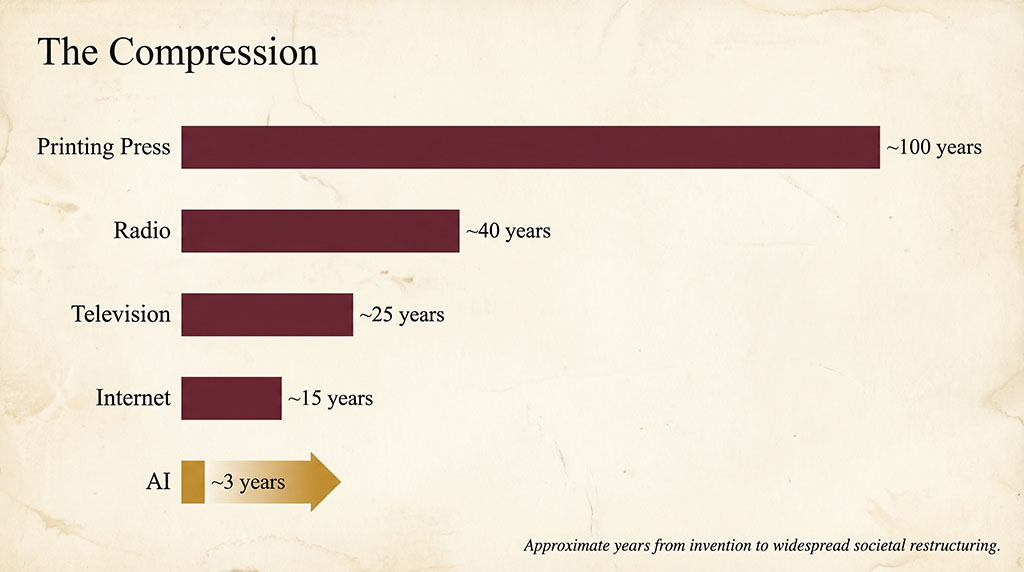
The printing press took decades to reshape society. AI has been mainstream for roughly three years. Comparing a weekend with ChatGPT to a 300-year transformation of Western civilisation feels like the kind of breathless overstatement that tech culture specialises in. Silicon Valley calls everything a paradigm shift. Most of it isn’t.
That’s a fair objection. Here’s why it doesn’t hold.
The printing press was slow because physical infrastructure was slow. Presses had to be built. Paper had to be manufactured. Books had to be transported by horse. Distribution was bottlenecked by atoms. AI has no such constraint. It distributes at the speed of an internet connection. The feedback loop between idea and execution—which compressed from decades to years after Gutenberg—is now compressing from years to hours.
The pattern is the same. The clock speed is different.
Luther’s 95 Theses took weeks to circulate across Europe, and that was considered astonishingly fast for 1517. A single AI-generated deepfake can reach a billion people before lunch. The dynamics are identical. The velocity is not.
Which brings up the part nobody wants to talk about.
The shadow Renaissance
The printing press enabled the Reformation, the scientific method, and the Enlightenment. It also enabled propaganda, religious wars, and one of the bloodiest centuries in European history.
That’s not a footnote. That’s the pattern.
Every tool that democratises creation also democratises destruction. The same press that printed Luther’s Bible printed witch-hunting manuals. The same AI that helps a solo entrepreneur build a business helps a bad actor generate deepfakes, misinformation, and manipulation at a scale no propagandist in history could have dreamed of.
People love the Renaissance narrative—the art, the genius, the explosion of human potential. They forget that the century after Gutenberg was defined as much by the Wars of Religion as by Michelangelo. The Thirty Years’ War killed roughly eight million people. The printing press didn’t cause it directly, but it supercharged the ideological conflicts that did.
AI carries the same dual edge. The question isn’t whether it will be used for harm—it already is. The question is whether the creative explosion will outweigh the destructive one. History suggests it will, eventually. But “eventually” can take a very ugly century.
The Ottoman warning
In 1485, the Ottoman Empire banned the printing press. Sultan Bayezid II issued a decree prohibiting printed books in Arabic script. The ban, in various forms, lasted nearly 300 years.
The official reasons sounded noble. Protect the scribes. Preserve the sanctity of religious texts. But strip away the rhetoric and the motive was naked: prevent the spread of ideas that could threaten their own power and control. An informed population is an ungovernable one. The institutions sitting at the top of the hierarchy had one incentive—keep the gates closed.
By the time the Ottomans finally embraced printing in the 18th century, Europe had undergone the Scientific Revolution, the Enlightenment, and the Industrial Revolution. The gap was insurmountable.
Now look at the current conversation around AI regulation. Some of it is thoughtful and necessary—nobody sensible argues against guardrails on weapons systems or deepfakes. But some of it sounds exactly like Bayezid’s decree: protect existing industries, preserve current power structures, slow things down until we’re comfortable.
The societies that embraced the press—even with all its chaos—built the modern world. The ones that resisted it watched from the margins.
That choice is being made right now. By countries. By industries. By you.
The monk's question
The Renaissance didn’t announce itself. There was no press conference, no launch event, no moment where someone said this is the start of a new era. It was visible only in retrospect—after the monasteries had emptied, after the new institutions had formed, after the world was unrecognisable from what came before.
The people living through it didn’t feel like pioneers. They felt uncertain. Disrupted. Some felt excited; many felt afraid. The monk in the scriptorium didn’t see a Renaissance. He saw his livelihood disappearing and a machine producing inferior copies of sacred work.
He was right about the disruption. He was wrong about the trajectory.
You’re standing in the same scriptorium. The press is warming up. The old rules are breaking down, and the new ones haven’t formed yet.
The only question that matters is the one the monk never thought to ask: What do I want to build with this?
Find out if your marketing is built for the old world or the new one
Most audits we run surface the same problem: strategies designed for a world that’s already shifted, budgets protecting old gatekeepers, and nobody asking whether any of it is actually reaching people who’ve moved on.
Takes 30 minutes.