
She’s on her phone. Thursday night, probably the couch, half-watching something on TV. She sees your ad — actually sees it, stops scrolling for a second — reads the headline, maybe glances at the offer.
Then she puts her phone down.
Not because she went to a competitor. Not because she found someone cheaper. She just… stopped. Came back to the show. Made a cup of tea. By morning she’d forgotten you existed.
That woman is where your revenue went. And no amount of competitor research is going to get it back.
The Way Most Businesses Think About This Problem
Ask any small business owner who their competition is and they’ll give you names. The other plumber in the suburb. The café two doors down. The agency that keeps undercutting them on Google.
It makes sense. Competition is visible. You can see their ads, visit their website, check their reviews. So that’s what gets the attention — matching offers, monitoring pricing, trying to out-feature or out-cheap whoever’s eating into your market share.
And in a normal economy, that’s a reasonable place to direct energy. If customers are actively buying and you’re losing them to someone else, the gap between you and that someone else is worth closing.
The problem is that this isn’t that economy anymore.
What Actually Changes When Uncertainty Goes Up
Over the past year, most Australian households have run a quiet audit. Mortgage repayments up. Groceries up. Power bills. Insurance. The weekly budget that used to have some give in it doesn’t anymore. And when that happens, consumer behaviour doesn’t just shift toward cheaper options — it shifts toward no option.
Not your competitor. Nothing.
This is what the American marketing strategist Jay Abraham calls “ambivalent uncertainty” — and it’s the most expensive phenomenon most small businesses have never heard of. It’s not a customer who chose someone else. It’s a customer who stood at the edge of a decision and walked away from the whole category.
Think about the last time you went to a cinema complex with no movie in mind. You stood in front of the listings. Nothing grabbed you. Everything looked fine but nothing looked worth $22 and two hours of your night. So you left. The cinema didn’t lose you to Netflix that evening — it lost you to your own inability to commit.
That’s what’s happening to your potential customers right now. At scale.
Uncertain buyers are not comparing your offer to a competitor’s offer. They’re arguing with themselves about whether to spend at all. And if that’s the real decision happening in their heads, your current marketing — built almost entirely to win a comparison — is speaking to a conversation that isn’t taking place.
The Uncomfortable Implication for Your Marketing
Most small business marketing is built around a specific assumption: that the buyer has already decided to buy, and is now choosing between options.
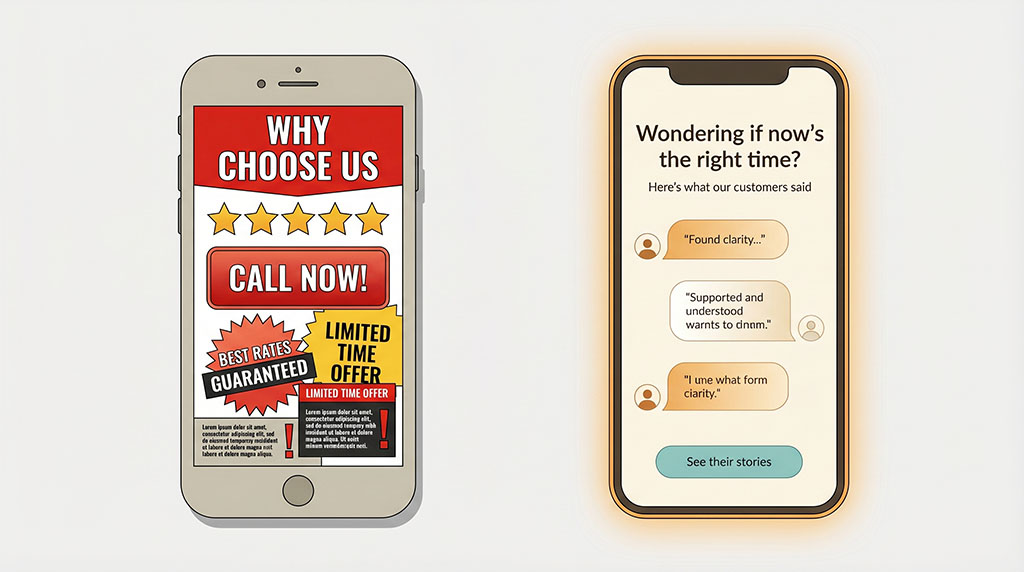
Your USP, your “why choose us” page, your comparison table, your awards and accreditations — all of it is designed for a buyer who’s in evaluation mode. Ready to spend, just deciding where.
That buyer still exists. But right now they’re outnumbered by a different buyer: someone who’s interested, maybe even keen, but hasn’t fully committed to parting with money. They’re in a holding pattern. Watching. Waiting to feel like the timing is right.
Standard competitive marketing bounces right off an uncertain buyer because it’s answering a question they haven’t asked yet. You’re saying “here’s why we’re better” when they’re thinking “I’m not sure I should be doing this at all.”
And the harder you push competitive messaging at someone in that state — the bigger discount, the louder ad, the more urgent countdown timer — the more it can feel like pressure on a bruise. They retreat further.
Here’s the objection sitting in the back of your mind right now: you can’t manufacture urgency. You can’t argue someone into spending money they’ve decided to hold onto. If an uncertain customer has made up their mind to wait, no headline is going to change that.
That’s true. It’s also exactly the wrong way to think about what’s possible here. Inertia isn’t a locked door. It’s a stalled one — and stalled doors respond to a different kind of push.
This Doesn't Mean Marketing Less. It Means Marketing Differently.
Here’s where a lot of businesses go wrong with this insight: they read “customers are hesitant” and conclude “we should pull back and wait it out.” That’s the exact wrong response — and it’s what most of your competitors are doing right now, which is actually the opportunity.
The goal isn’t to manufacture fake urgency or manipulate someone into a decision they’re not ready to make. It’s to change what your marketing is talking about.
Make the cost of doing nothing visible. Inertia feels safe. It feels like preserving the status quo. Your marketing’s job is to gently correct that perception — to show what staying put actually costs. Not in a fear-based way, but specifically. A solar company doesn’t tell uncertain buyers how great solar is; it shows them what the next twelve months of power bills will cost if they don’t act. The decision to wait has a price. Most marketing ignores that price entirely.
Shrink the first step. A primary driver of uncertainty is the perceived size of the commitment. When someone is in a belt-tightening mindset, even a reasonable purchase can feel larger than it is. Your marketing should be removing barriers, not adding calls to action. Free assessment. No-obligation quote. A conversation, not a contract. The buyer who won’t commit to $3,000 will often commit to a free 20-minute call — and that call changes the dynamic completely.
Use social proof to show movement, not just quality. Most businesses use testimonials to answer “are you good at what you do?” That’s fine for a competitive environment. In an uncertainty environment, the more powerful proof is that people in the same position made the decision and came out better for it. Not “we’re excellent” — “here’s someone who was exactly where you are, who decided to move forward, and here’s what changed.” This addresses the hesitation directly.
Shift from “why us” to “why now.” Audit your homepage, your ads, your email subject lines. Count how many answer “why should I choose this business?” versus “why should I act on this now?” The ratio is almost always skewed heavily toward the first question. Right now, the second question matters more.
Where Competitor Focus Still Matters
None of this means ignoring the competition entirely. If you’re in a market where buyers are still active and comparing options, your positioning against rivals remains critical. There are categories and price points where people are spending without much hesitation, and in those markets, differentiation is your primary lever.
The shift in thinking isn’t “competitors don’t matter.” It’s this: competitors are not the primary obstacle right now. Treating them as if they are will cost you.
Most businesses will spend the next twelve months watching their metrics, running more of the same ads louder and cheaper, and concluding the market is just slow. A smaller group will recognise that the market isn’t slow — it’s uncertain — and that uncertainty responds to a completely different kind of message.
Same Phone. Different Ad.
She’s back on the couch Thursday night. Same woman, same feed, same moment.
This time the ad doesn’t tell her why this business is better than the others. It tells her what the next six months look like if she keeps putting this off. It offers her something small — a call, a quote, a starting point that doesn’t feel like a commitment. It shows her someone who sat exactly where she’s sitting, decided to move, and doesn’t regret it.
Her thumb stops.
She reads the whole thing.
That’s not a better ad. It’s an ad built for the right enemy.
Find out how much of your marketing is answering the wrong question
Most accounts we audit are weighted almost entirely toward “why choose us.” The ads, the homepage, the email sequences — all built for a buyer in evaluation mode. Right now, that’s not most of your buyers. We’ll show you what to shift and where.
Takes 30 minutes.