
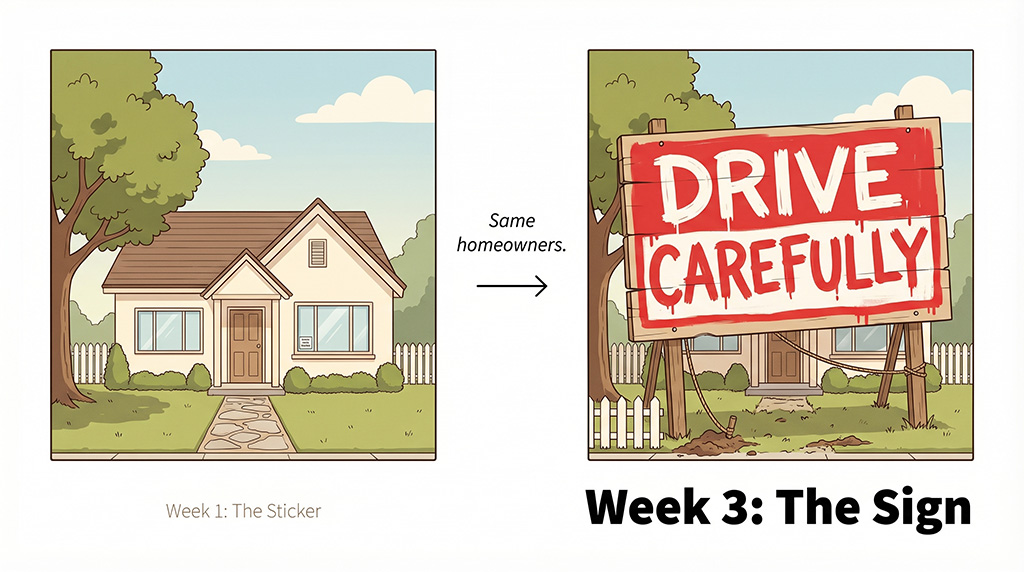
Picture a house in a quiet California suburb. Trimmed hedges, clean driveway, the kind of lawn a person spends Saturday mornings protecting from dandelions. Now picture a billboard — massive, crudely painted, blocking nearly the entire front view — screaming DRIVE CAREFULLY in letters a child might have drawn.
76% of homeowners said yes to that billboard.
Not under duress. Not for money. Not because they were unusual people. They agreed to let complete strangers destroy their home’s curb appeal for one reason: two weeks earlier, a different stranger had asked them to put a tiny sticker in their window. Three inches. “Be a Safe Driver.” A nothing request. Nearly everyone said yes to the sticker without thinking about it.
That nothing request changed everything.
The experiment nobody believes until they see the numbers
In 1966, psychologists Jonathan Freedman and Scott Fraser knocked on doors across a residential neighborhood with a request so unreasonable it bordered on comedy. Would you allow us to install a large, ugly public-service sign on your front lawn? Here’s a photo of what it looks like. Yes, it’s as bad as you think.
When they asked cold — no prior contact — only 17% agreed. Which makes sense. You’d say no. I’d say no. Almost everyone said no.
But one group had been softened up. Not with a sales pitch. Not with a bribe. Two weeks before the billboard request, a different researcher (someone they’d never connect to the sign people) had visited and asked them to display a small window sticker supporting driver safety. It was effortless. It was meaningless. And it quadrupled their compliance with the absurd request that followed.
You’ve seen this pattern before, even if you didn’t have a name for it. The restaurant that asks you to “just try a bite” before presenting the full menu. The SaaS product that gets you to set up a free profile before pitching the annual plan. The car salesperson who says “let’s just take it for a spin — no commitment.”
The academic name is the foot-in-the-door technique. But the mechanism underneath it is far more interesting than the label suggests — and far more useful for anyone trying to grow a small business.
What actually happens between the sticker and the sign
Here’s what Freedman and Fraser’s study didn’t explain on the surface, but Robert Cialdini’s analysis in Influence: Science and Practice makes visible: the sticker didn’t just create familiarity or goodwill. It altered how people saw themselves.
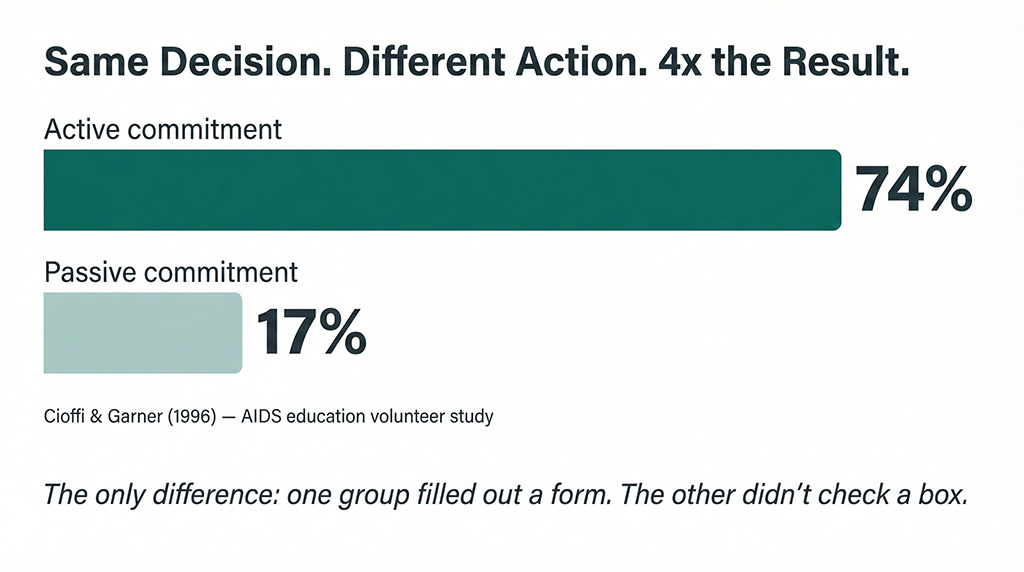
The moment a homeowner placed that tiny sticker in their window, they made an active choice. And active choices — this is the part most marketing advice gets wrong — fundamentally change identity. A follow-up study on AIDS education volunteers proved the point with uncomfortable clarity. Researchers arranged for college students to volunteer for an education project in local schools. Half volunteered actively — filling out a form saying they wanted to participate. The other half volunteered passively — they simply didn’t fill out a form saying they didn’t want to participate. Same outcome on paper. Radically different outcome in practice.
When it came time to actually show up? 74% of active volunteers appeared. Only 17% of passive ones did.
Same commitment. Same project. But the people who had physically written down their choice – who had done something – were four times more likely to follow through. And when asked why they’d volunteered, the active group pointed to their personal values. They’d absorbed the commitment into their identity. “I’m the kind of person who cares about education.”
This is the engine that powered the billboard experiment. The sticker wasn’t a warm-up. It was an identity assignment. Every homeowner who placed it in their window became, in their own mind, “the kind of person who supports driver safety.” And when someone who supports driver safety is asked to put a sign in their yard? Consistency pressure does the rest.
Cialdini calls this “growing legs.” The commitment generates its own supporting reasons. The homeowner doesn’t think “I said yes to a sticker, so I guess I should say yes to the sign.” They think “I care about driver safety, and this sign will help.” They’ve invented new reasons that have nothing to do with the original request.
Your customer does the same thing — when you let them.
"I don't have time for a commitment ladder. I need the phone to ring."
I hear you. You’re not a behavioral psychologist with a research grant and three semesters to study compliance rates. You’re a business owner, possibly the entire marketing department, and the idea of engineering a careful sequence of micro-commitments sounds like a luxury reserved for companies with a funnel strategist on payroll.
You need the sale. You need it this week. The person is on your website right now and you want them to fill out the contact form, not some intermediate “tiny yes” that delays revenue.
Here’s the problem with skipping straight to the big ask: it’s the reason clients ghost you.
Cialdini spent time undercover at a car dealership and documented a tactic called the low-ball. The dealer offers an unreal price — $400 below any competitor. The customer says yes. They fill out paperwork, arrange financing, drive the car home, show the neighbours. Then the dealer “discovers an error.” The price goes up $400. And the customer still buys the car.
Why? Because during that period of test-driving and form-filling and neighbour-showing, the commitment grew legs. The customer generated their own reasons to want the car. “The interior is perfect for the kids.” “It handles well in rain.” “My wife loved the colour.” None of those reasons existed when the price was the deciding factor. They were invented after the commitment was made.
Now flip it. When a small business owner puts a quote in front of someone on the first interaction — no prior commitment, no identity shift, no legs — what happens when the prospect goes home to “think about it”? There are no legs. No invented reasons. No self-image as “the kind of person who works with this company.” Just a price on a page, competing with every other price on every other page.
The micro-commitment isn’t a delay. It’s the scaffolding that makes the final yes actually hold.
What this looks like when you're not a psychologist
The application is simpler than the theory.
You need one small, active ask before the real ask. Active is the key word. Not a checkbox. Not an auto-opt-in. Something the person does — types, chooses, builds, answers.
A contractor asks the homeowner to walk the property together and point out what bothers them most, before presenting any estimate. The act of describing the problem out loud — actively, in their own words — creates ownership of the project. They’ve committed to the idea that “this needs fixing.”
A consultant sends a three-question intake form before the discovery call. Not to gather information (you’ll get that on the call). To create an active commitment. The prospect who writes “we’re struggling with inconsistent lead quality” has now stated a problem they need solved. They’ve placed the sticker in their window.
A service business offers a free, genuinely useful diagnostic — a website audit, a financial health check, a kitchen design sketch — but requires the client to fill out specific details first. Not a name-and-email gate. Real questions that force real thought. The effort itself becomes the commitment.
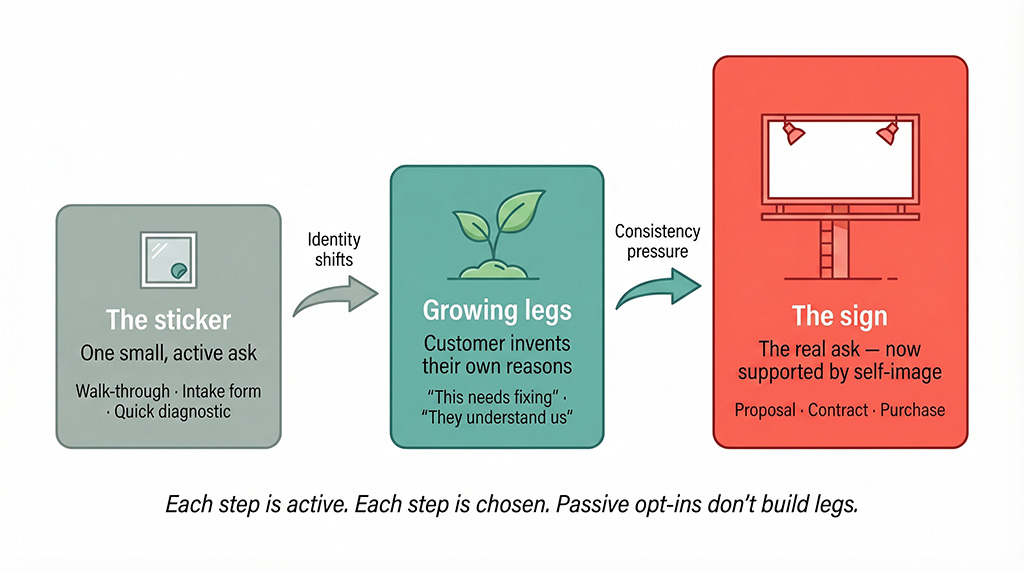
Notice what all of these have in common: they trade a small amount of friction for a large amount of commitment. This runs counter to the dominant marketing advice of 2026, which tells you to remove every possible obstacle between the visitor and the conversion. Fewer form fields. One-click signups. Frictionless everything.
But frictionless produces passive commitments. And passive commitments follow through 17% of the time.
The lawn, revisited
Somewhere in a California suburb, a homeowner stood in their yard looking at a sign that would have made any reasonable person cringe. They’d agreed to it freely, even eagerly. Not because they were pushovers. Because weeks earlier, someone had been smart enough to ask for something small — something active, something effortless — and that tiny act had quietly rewritten the story the homeowner told themselves about who they were.
Your customers are standing on that same lawn every day. They’re deciding who they are and what kind of person buys what you sell.
The question isn’t whether you can get them to say yes to the billboard. It’s whether you’ve given them the sticker first.
Find out where your sales process is leaking commitment
Most businesses we audit have the same gap: plenty of first conversations, a decent close rate on the day — and a ghost trail of prospects who said “let me think about it” and never came back. The sticker is missing.
Takes 30 minutes.