
A hundred calls out. Ten returned.
The man on the other end of that silence was a marketing consultant—sharp, credentialed, decades of experience with major tech brands including a household-name printer manufacturer. After a layoff, he and two partners launched a consulting practice and did what every business development playbook tells you to do: they picked up the phone and started calling CEOs.
Their pitch was reasonable. Set a meeting. Ask about the company’s biggest challenges. If they could isolate a problem, they’d propose a solution. A clean value exchange. Textbook outbound.
The phone didn’t care. Ninety of those CEOs never called back.

This wasn’t a cold-calling rookie fumbling through a script. This was an experienced operator with a legitimate offer, reaching out to the exact right people, with a reasonable ask. And 90% of them treated his voicemail like a piece of junk mail.
You’ve felt this. Maybe not with CEOs—maybe it’s the local business owner who ghosted your follow-up email, the prospect who said “send me some info” and then vanished, the referral who agreed to a call and then cancelled twice. The silence of outreach that doesn’t land has a specific texture to it. It makes you question whether the problem is your offer, your timing, or you.
It wasn’t any of those things. The problem was the frame.
What changed: one word in the ask
The consultant learned a method from Darrell Gurney, a career strategist who’d spent 25 years in recruiting and career coaching. Gurney documents the case in his book Never Apply for a Job Again!—written for job seekers, but built on a principle that applies to anyone trying to get a meeting with someone who doesn’t know them yet. His advice was disarmingly simple: stop calling to sell. Start calling to learn.
The consultant and his partners began writing articles for trade publications in the electronics industry—the same sector those CEOs operated in. Real articles, not thinly veiled sales collateral. They picked topics they genuinely understood, angles they were curious about, questions they actually wanted answered.
Then they picked up the same phone and called the same caliber of CEO. But this time, the ask was different. Instead of “I’d love 20 minutes to discuss your company’s challenges,” it became “I’m writing a piece on [specific industry trend] for [publication]. Could I interview you for the article?”
The callback rate went from 10% to 90%.
Same person dialing. Same type of executive on the other end. The only thing that changed was what the call was about. One frame said, “I need something from you.” The other said, “I want to learn from you.”
Why 90% of people dodge your outreach (and it's not because they're busy)
Here’s the part most sales and marketing advice gets wrong. We assume prospects ignore us because they’re overwhelmed, distracted, or don’t see the value yet. So we follow up harder. Add more value to the pitch. Lead with a case study. Try a different subject line.
But the reason is simpler, and more human, than any of that.
People avoid situations where they might have to say no.
Think about your own life for a second. A friend asks you for a favour you can’t deliver—maybe a job referral you don’t feel right making, or an introduction to someone you barely know yourself. How does that feel? Awkward. Pressured. You don’t dislike your friend. You just don’t want to be put in the position of disappointing them. So what do you do? You delay. You dodge. You let the text sit unanswered for three days and then pretend you forgot.
That’s exactly what’s happening when a CEO sees a voicemail from someone who wants to “discuss their business challenges.” They hear the subtext instantly: this person wants to sell me something, and I’ll have to find a way to say no. The path of least resistance is to not return the call at all.
But when that same CEO hears “I’m writing an article and I’d like to interview you”? There’s no rejection risk. There’s nothing to say no to. You’re not asking for money, time commitments, or a decision. You’re asking for their expertise. You’re telling them they’re worth learning from.
What people forget: being asked for your opinion feels good. Being asked for your money does not.
"That's nice, but I need revenue this month."
Let’s stop here. Because if you’re a small business owner reading this—a tradie, a bookkeeper, a café owner, someone running a small agency with actual payroll due on the 15th—you’re probably thinking something along these lines:
I don’t have time to write articles. I don’t have a publication to write for. I can’t spend three months “building relationships” while my pipeline dries up. I need the phone to ring this week.
That’s fair. And I’m not going to pretend this is a magic trick that replaces your entire marketing operation overnight.
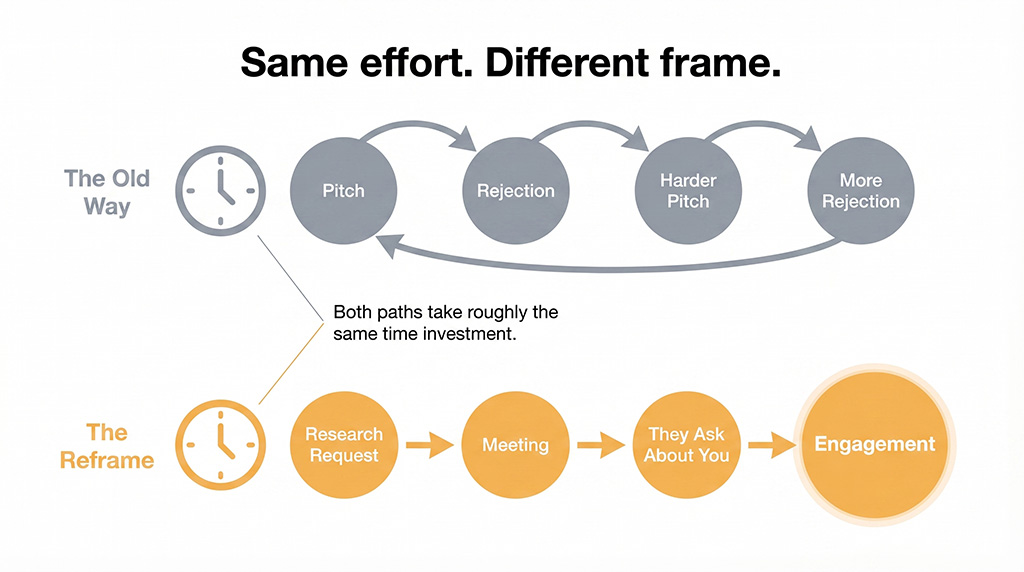
But consider this: the consultant didn’t add a second job. He replaced the activity that was already failing. Those 100 cold calls weren’t free—they cost time, energy, and morale. He redirected that same effort into a different frame. The input was roughly the same. The output went from 10 to 90.
And the timeline wasn’t as leisurely as “relationship-building” implies. Something happened in those research interviews that the consultant didn’t plan for. Picture the scene: a corner office, the faint hum of an air conditioner, two coffee cups on a desk that’s too tidy to belong to someone who actually does the work. The consultant is forty minutes in, notebook open, asking about supply chain shifts in the Asia-Pacific region. He hasn’t mentioned his own company once. And then the CEO leans back, crosses his arms—not defensively, but curiously—and says, “So, tell me about what you do.” The door that was barricaded during the cold call swung open on its own during the interview—because the CEO had been heard first, and now they were curious.
The consulting gigs didn’t come from a six-month nurture sequence. They came from the meetings themselves. The research was the sales call. The CEOs just didn’t know it yet—and neither, at first, did the consultant.
The hidden math your marketing is ignoring
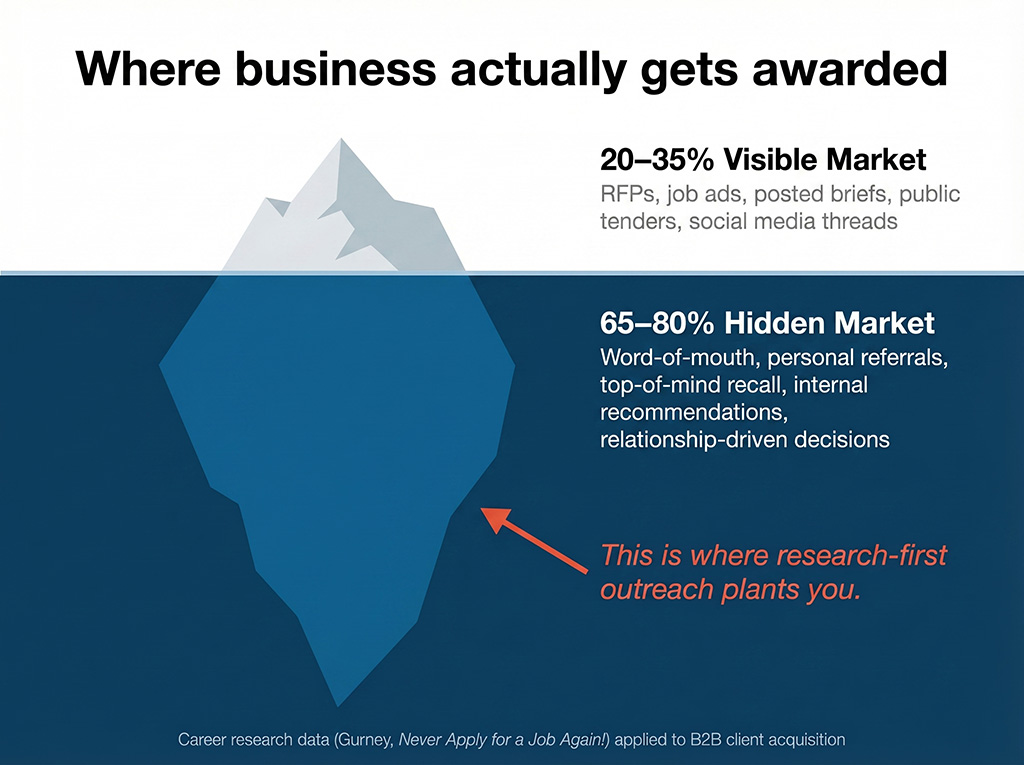
Here’s a number that should rearrange how you think about client acquisition: somewhere between 65% and 80% of business opportunities never hit the open market.
Career researchers have tracked this for decades in the job market—the so-called “hidden job market” where positions are filled through word-of-mouth, internal referrals, and personal connections before a listing is ever posted. The same dynamic applies to how businesses choose vendors, contractors, and service providers.
Think about how you’ve hired people in your own business. Did you post on a job board and sift through 200 applicants? Or did you ask someone you trust, “Know anyone good?” Think about the last time you needed a new accountant, a web designer, a signage company. Did you Google it? Or did you ask around first?
Most business gets awarded the same way: someone has a need, and the first name that surfaces in their mind—or the first name someone they trust mentions—gets the call. By the time an RFP goes out, a brief gets posted, or a “looking for recommendations” thread appears on social media, there’s usually already a frontrunner. Often, there’s already a done deal wearing the costume of an open process.
So when you spend all your marketing energy competing for the 20-35% of visible demand—running ads, responding to posted briefs, bidding against four other providers—you’re fighting over the scraps. The real game is being the name that surfaces before the search begins.
The research-first approach builds exactly that. Every conversation you have—every genuine interview, every question you ask about someone’s business, every article or post you create from what you learn—plants a seed in someone’s mind. Not “this person wants my money.” But “this person understands my world.”
When the need arises, that’s the person who gets the call.
What this looks like if you're not writing for Forbes
You don’t need a magazine column. You don’t need to be a consultant. The underlying principle adapts to any business size or type.
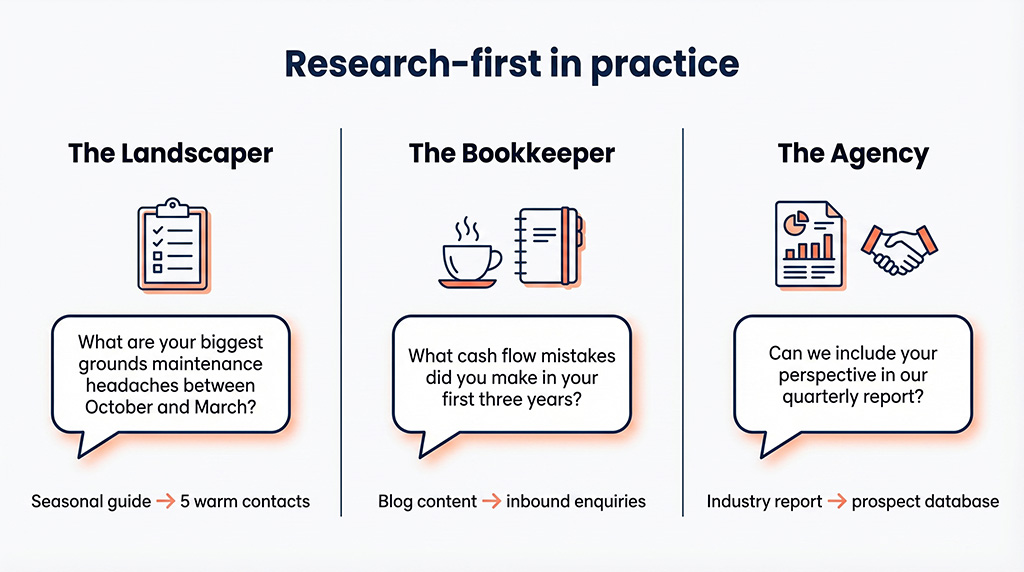
The landscaper who calls five property managers, not to pitch maintenance contracts, but to ask: “I’m putting together a seasonal guide for commercial properties in our area—what are the biggest grounds maintenance headaches you deal with between October and March?” That guide becomes a blog post, a PDF handout, a reason to follow up. And those five property managers now know a landscaper who understands their problems.
The bookkeeper who reaches out to ten local business owners to ask: “I’m researching the most common cash flow mistakes small businesses make in their first three years. Would you be open to a 15-minute chat about your experience?” Half of those conversations will surface someone who needs a bookkeeper. But you didn’t ask for the gig—they brought it to you.
The marketing agency that interviews its own prospects for a quarterly industry report. “We’re tracking how small retail businesses in [city] are adapting their marketing post-COVID. Can we include your perspective?” Now you’ve got content, relationships, and a database of warm contacts who associate your name with expertise, not sales pressure.
The pattern is the same every time: lead with curiosity, create something from what you learn, and let the business follow the relationship.
The principle underneath the tactic
Strip away the specifics—the CEOs, the articles, the callback rates—and one principle sits at the centre of all of it:
Being interested attracts. Being needy repels.
It works in dating. It works in friendships. And it works in business development for the exact same reason: human beings are wired to move toward people who are curious about them and away from people who want something from them. Not because they’re selfish. Because they’re human.
Every piece of marketing you put out either says “I need your business” or “I understand your world.” Every cold email, every ad, every social post, every networking conversation—it carries one of those two frequencies. And your prospects can hear the difference before they’ve finished reading the subject line.
The consultant learned this with a telephone and a hundred CEOs. But the principle was there long before the phone calls, and it’ll be there long after your current marketing strategy runs its course.
There’s a phone sitting on a desk somewhere right now. Yours, probably. It’s the same phone it was yesterday—same contacts, same area code, same reach.
The question isn’t whether to pick it up. It’s what you say when someone answers.
“I’d love to tell you about what we do” gets you a 10% world. “I’d love to learn about what you do” gets you a 90% one.
Same phone. Same you. Different frame.
Find out how much of your spend is delivering vs penetrating
Most audits we run surface the same problem: budgets built for delivery, campaigns measured on reach, and nobody asking whether any of it is actually getting off the page.
Takes 30 minutes.