
Why the race to "more" produces faster mediocrity in every category where judgment decides the result
On page 11 of a sales letter that has nothing to do with you, a copywriter with 65 years behind him admits something most technology companies would never put in writing.
He’s describing his competition – AI tools trained on vast libraries of marketing copy. He concedes they work. They produce competent material. Then he says this: a library of copy will tell you what the form looks like, but it “will not tell you when to break the rules, why a particular approach works for a particular market or what the underlying human truth is that makes any of it work at all.”
Read it twice. He’s given away more than he meant to.
He thinks he’s making an argument about his software. He’s actually describing the mechanism that decides who wins in your category — and it has nothing to do with how much data anyone has. It has to do with a kind of work that gets worse, not better, the more you scale it.
The belief that built every big company you admire
More is better. More data trains a better model. More specialists build a better agency. More reach sells more product. More reviews, more case studies, more locations, more headcount. Scale is the thing every business is supposed to want, because scale is leverage – the force that turns small things into large ones.
This belief is correct often enough to feel like a law of nature. Amazon got better as it got bigger. The cloud got cheaper as it got larger. A factory making a million units has advantages a workshop making a hundred never will. Whole business school curricula exist to teach people how to capture economies of scale, and the people who capture them do tend to win.
So when a new tool arrives – say, AI – the instinct is automatic. The bigger model, trained on more of the internet, must be the better one. The tool that has read everything must know the most. More input, more capability, more value.
That instinct is about to cost a lot of people a great deal of money.
What "more" actually does to judgment
When you train a system on enormous quantities of material, you don’t get the best of that material. You get the average of it.
This is not a flaw in the technology. It’s the entire point of it. A model trained on a billion pieces of writing learns what writing typically looks like – the statistical centre of everything it has seen. Ask it for a sales email and it gives you the sales email that sits at the dead middle of every sales email ever written. Competent. Recognisable. Utterly without a point of view, because a point of view is by definition a departure from the average, and the average is the one thing the system is built to reproduce.
Drayton Bird – the copywriter, who spent those 65 years selling everything from insurance to holidays across 52 countries – calls this “averaged-out mush from the internet.” He’s not wrong, and the same physics applies far beyond AI.
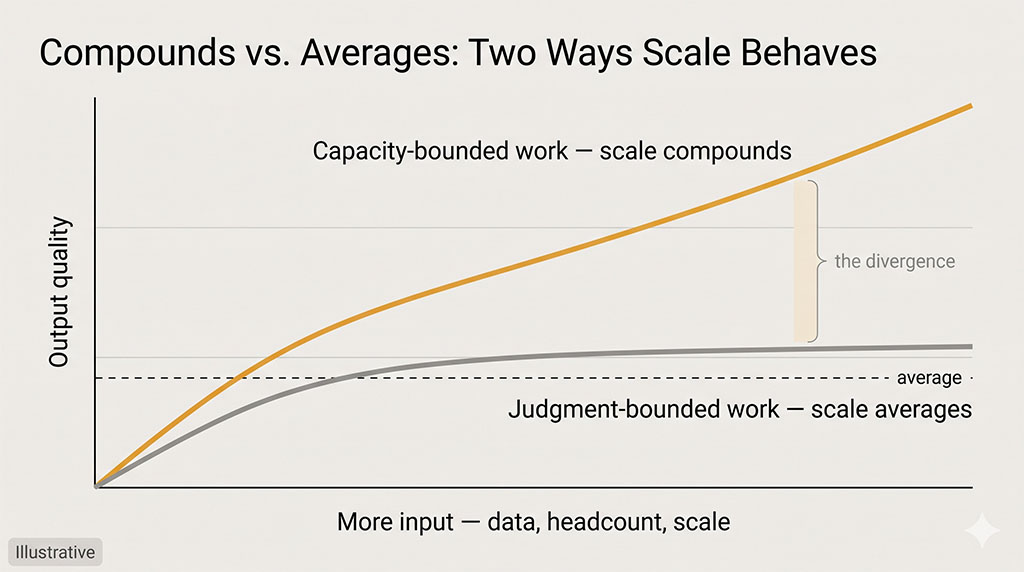
Think about what happens when an agency scales. It started as one or two people with a strong sense of what worked. They added a specialist. Then another. Then a head of paid, a head of content, a head of social, an account layer to coordinate the heads. Each hire was defensible. Each one added a real capability. And somewhere in the addition, the thing that made the early work good – a single coherent view of what this particular client needed – got distributed across eleven people who each own a slice and none of whom own the whole.
The output didn’t get worse because the people got worse. It got worse because it got averaged. I have sat in the meeting where eleven capable people produce, between them, a campaign not one of them would have signed off alone – each slice sanded down to fit the others until the whole thing was smooth, agreeable, and dead. Eleven competent slices, coordinated by meetings, produce the statistical centre of what a marketing campaign looks like. Which is exactly what the giant model produces, for exactly the same reason.
You’ve sat through the result without naming it. The campaign deck where every slide is defensible, the room nods along, and nobody in it feels a single thing. The website that could swap logos with three competitors and no one would notice. The brand that sounds like all its rivals because it was built the way they were — by scaling a team until the point of view dissolved into politeness.
The objection you're building right now
You’re reading this thinking: hold on. Scale genuinely is an advantage. The biggest AI models really do outperform the small ones on almost every test. The biggest agencies really do win the biggest accounts. The biggest companies really do have advantages I’ll never have. There’s a reason “enterprise scale” is a phrase that means something, and telling small operators that being small is secretly better sounds exactly like the kind of comfort small operators love to hear.
You’re right. About some categories.
And the difference between the categories where you’re right and the categories where you’re catastrophically wrong is the most useful distinction in this entire argument. So here it is.
Ask one question about any kind of work: is the quality of the output bounded by the tool’s raw capacity, or by the operator’s judgment?
Where it’s bounded by raw capacity, scale compounds. Storage, distribution, computation, reach, manufacturing – pour more in and you get proportionally more out, every time, reliably. A bigger warehouse genuinely holds more. A larger ad budget genuinely reaches more people. In these categories, the instinct to scale is not just correct, it’s the whole game, and the small operator really is at a structural disadvantage.
But where the output is bounded by judgment – by taste, by knowing which rule to break and when – scale does something different. It doesn’t compound. It averages. Because judgment doesn’t aggregate. You cannot produce one excellent decision by combining a thousand mediocre ones, and you cannot produce one sharp point of view by averaging ten thousand. Pour more into a judgment-bounded process and you get more average, faster. More wrong, at scale.
Copy is judgment-bounded. Strategy is judgment-bounded. Positioning, design, advisory work, the decision about what a business should actually do next – all judgment-bounded. And every one of them is being attacked right now by people applying scale-economy thinking to a category that punishes it.
The narrow thing that beats the big thing
Bird’s pitch, stripped of the selling, is this: his tool is trained on less. One person’s thinking, accumulated over a lifetime, instead of the entire internet. He frames the narrowness as the feature, not the apology. And in a judgment-bounded category, he’s correct to.
A system trained on one coherent point of view will tell you when to break the rules, because it has a view about which rules matter. A system trained on everything cannot, because it has averaged away every view that might have told it. The narrow thing knows something. The broad thing knows everything, which is a different way of saying it knows nothing in particular.
This is why the small operator with a real point of view beats the scaled-up competitor in judgment work, consistently, and why the same operator would lose instantly in a category bounded by raw capacity. Put a single sharp strategist against a thirty-person full-service agency on a question of what a business should do, and the strategist wins – not despite being narrow, but because of it. The strategist holds the whole picture in one head with one view. The agency holds it in thirty heads with thirty slices and a coordination layer that exists only to paper over the fact that nobody holds it at all.
The narrowness isn’t a limitation the small operator is bravely overcoming. It’s the source of the advantage. The judgment lives in the refusal to scale past the point where one coherent view can hold the work together.
The test you can run on your own category this afternoon
So before you chase more – more tools, more headcount, more specialists, more data — run the question on whatever you’re about to scale.
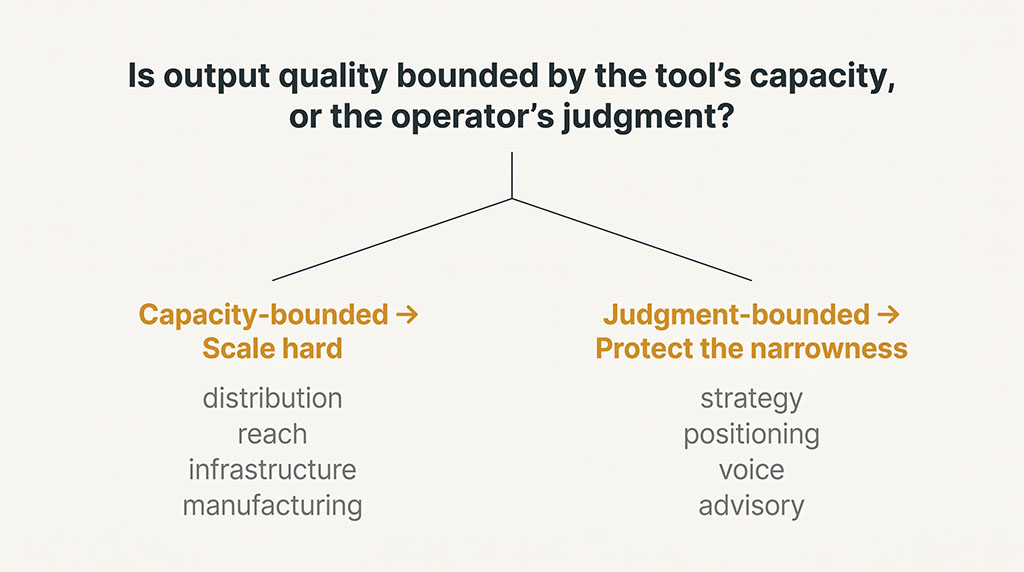
Is this work bounded by capacity or by judgment? If you doubled the inputs, would you get proportionally better output, or just more of the same average produced faster? Is the value here in the volume, or in a point of view that volume would dilute?
For the parts of your business that are genuinely capacity-bounded – your distribution, your reach, your infrastructure – scale hard, with no guilt. That’s where bigger wins.
For the parts bounded by judgment – your positioning, your strategy, your voice, the actual thinking about what your business should do – protect the narrowness like it’s the asset it is. Resist the instinct to spread it across more people, more tools, more average. The moment you scale a point of view, you lose it. That’s not a risk. It’s arithmetic.
Most businesses get this exactly backwards. They scale the judgment work, hiring and adding and averaging until their strategy sounds like everyone else’s, and they under-invest in the capacity work where scale would actually have paid off. They end up large where they should be sharp, and thin where they should be vast.
Back to page 11
Which returns us to Drayton Bird and his confession.
He wrote that a library will tell you what the form looks like but not when to break the rules – and he meant it as a line of sales copy, a way to make his narrow tool look better than the broad ones. He undersold it. That sentence isn’t a sales argument. It’s the test for which categories reward scale and which ones it quietly destroys.
A library tells you the rules. Only a point of view tells you when they don’t apply. And in your business – in the strategy, the positioning, the actual judgment that decides whether any of it works — knowing when the rules don’t apply is not part of the value.
It’s all of it.
So the next time someone tells you the answer is more – more data, more specialists, more reach, more scale – ask them the only question that matters. More of what, exactly? Because if the work is bounded by judgment, they’ve just described, in the language of progress, the fastest route to sounding like everybody else.
Your marketing, looked at properly
Thirty minutes on your current setup — what’s working, what’s quietly leaking budget, and what I’d fix first. You’ll leave with a clearer picture whether we work together or not.
Got something specific bugging you? Flag it when you book and I’ll have it looked at before we talk.

AboutBruce Marjoribanks
Bruce Marjoribanks has spent 27 years in marketing, including building, running and selling his own agency before going independent. He now runs every channel - paid, organic, social, email, creative and automation - as one integrated system, with AI ehancing production and the judgment staying human.