
The line ran across the bottom of every Lennen & Mitchell ad in 1928: An Advertising Agency in Which the Principals Do the Work. That single sentence sold the agency for the better part of half a century.
In 1972 the agency filed the biggest bankruptcy in advertising history. Eighteen years of lawsuits followed. The line on the door was still true – somebody, somewhere, was still doing the work of an advertising agency in which the principals did the work. It just wasn’t Lennen & Mitchell anymore.
That’s the part of the story most people miss when they read this old ad and admire it as a relic. The ad didn’t fail. The agency stopped being it.
And reading the ad in 2026 – with AI now drafting most of the copy in the world – the disciplines it lays out aren’t quaint. They’re the only thing your clients can’t get cheaper somewhere else.
What the 1928 ad actually said
The ad runs nearly a thousand words. Three sentences are doing all the work.
First: “They will not delegate the responsibility for producing good advertising. That responsibility belongs to the principals and they assume it.”
Second: “In the final showdown, ‘conference copy’ seldom holds a candle to the job done by the solitary worker who shuts himself up with his problem — and lives with it until he licks it.”
Third: “They are ready to cheerfully delegate that detail to their ample routine facilities. But they will not delegate the responsibility for producing good advertising.”
These look like three lessons. They’re not. They’re one standard said three ways: the senior thinker stays close to the problem. Principals do the thinking. Group meetings produce average thinking; solitary work produces real thinking. Delegate the admin, never the thinking. Same point. Three angles.
Lennen & Mitchell built the agency on that standard. They stopped keeping it. The bankruptcy was the receipt. And every one of the three disciplines, forty years later, has been made existential by what AI does to the alternative.
Discipline (1928)
What scales it away
What AI does to it
Principals do the work
“Responsibility belongs to the principals and they assume it.”
Senior time gets expensive. Delegating the thinking looks like efficiency.
Average junior work is now free. Senior judgment is what’s left to pay for.
Solitary worker beats conference copy
“‘Conference copy’ seldom holds a candle to the solitary worker.”
Agencies bill hours; hours come from teams. Solitary work is hard to invoice.
AI averages everything it touches. Group + AI reads like everyone else’s.
Delegate detail, never thinking
“Cheerfully delegate that detail. Will not delegate responsibility for good advertising.”
Most agencies have it reversed — they delegate thinking and keep admin.
AI absorbs infinite detail. Thinking is the only thing left to charge for.
The senior thinker stays close to the problem.
Discipline one: principals do the work
In 1928 this line was unusual enough to be worth running an ad about. Most agencies of any size had already moved to a model where the founder pitched the client and a junior wrote the copy. Lennen & Mitchell were going on the record: not us.
The reason the discipline is hard to keep is the same now as it was then. Success scales the firm beyond what one principal can hold. The senior thinker who personally wrote copy in year one is, by year ten, running a business with overhead and managers and a sales pipeline. The principal becomes a manager of managers. Senior time gets expensive. Delegating the thinking looks like efficiency. Clients can’t immediately tell the difference, so the gap between the pitch and the operation goes unpunished for a while.
This is the structural drift. Nothing about it is corrupt. Every growing service business meets it.
The corruption sits one floor up – at the moment the standard becomes uncomfortable, you either revise it publicly or hide the breach. Most leaders hide it. They keep telling clients “you’ll work directly with our senior strategist” while routing the work to whoever the senior strategist hires. The 1928 promise stays in the deck. The 1972 operation runs underneath.
What AI changes is the cost of the gap. Until 2023, a junior writing competent copy was still a product the client couldn’t replicate at home. Now they can. Average work – the kind produced by a junior with a brief and a deadline – is free. A client with ChatGPT and twenty minutes can generate something defensible. The only thing left to pay an agency for is the senior thinker who has lived with the problem long enough to see what ChatGPT can’t see.
If your senior thinker isn’t actually doing the work, you’re charging for what your client can already do for free.
Discipline two: conference copy versus the solitary worker
The 1928 ad makes a specific argument about how thinking happens. Group effort produces decent process and average output. Solitary effort, with one person living inside the problem, produces work that conference copy can’t match.
Most modern agencies are built the other way. The pitch has a creative director, a strategist, an account director, a planner, and a junior team. The work is developed through workshops, syndicated through reviews, watered down through stakeholder rounds. The bill reflects the headcount.
The structural reason this discipline is hard to keep: agencies bill hours, and hours come from teams. The solitary worker – one senior thinker locked in with the problem – is hard to bill at full rate, because the client looks at the invoice and sees one person and a week. Five people and a week feels like more value, even when the output is worse.
What AI does to this is brutal. Conference copy was already average. AI is now the most efficient producer of average copy in the world. Put group thinking through a system designed to produce defensible-but-average outputs, pipe that through AI tools that average everything they touch, and you get content that reads exactly like every other agency’s content. Because that’s what averaging does. It produces the average.
The solitary worker is the only differentiator left. Not because the lone genius myth is true – it isn’t. But because deep context is the one thing AI can’t fake. Someone who has spent two months inside your business knows things no brief can transfer. That’s the work worth paying for. Anyone selling you “our team will collaborate to develop your messaging” is selling you something a $20 ChatGPT subscription will produce by Tuesday.
But the model didn't work
There’s an obvious objection at this point.
You can’t run a modern service business on one principal staying close to every problem. Scale demands process. Scale demands teams. Scale demands handoffs and deliverables and a way for senior people to stop personally writing every email. Lennen & Mitchell is a museum piece. The 1928 ad reads beautifully and ran an agency into the biggest bankruptcy in advertising history.
The model didn’t work.
That’s the wrong reading. The model worked. It built the agency for forty-four years. The model stopped working when the agency stopped running it – and then refused to admit it. The bankruptcy wasn’t caused by the standard being too hard to keep. It was caused by the standard being abandoned in private while the marketing department kept selling it in public. Adolph Toigo, the CEO who took the firm into the wall, didn’t just run up debts. He hid his decisions from his own people. The agency that sold find the man had a man at the top his own staff couldn’t find.
Every service business that grows hits the moment when its founding promise gets uncomfortable. The honest move is to say so out loud. We used to be a one-strategist shop; now we have a team. Here’s what’s different about working with us today. The dishonest move is to keep the old pitch on the website while the operation runs on something else entirely. The dishonest move kills you slowly. Lennen & Mitchell took forty-four years to die. Most agencies running this play today will not get forty-four years.
Discipline three: delegate detail, never thinking
The 1928 ad makes the cleanest version of this argument anyone has made since.
The principals are ready, the ad says, to cheerfully delegate that detail to their ample routine facilities. What they will not delegate is the thinking. The judgment. The “responsibility for producing good advertising.” That stays at the top, with the people whose names are over the door.
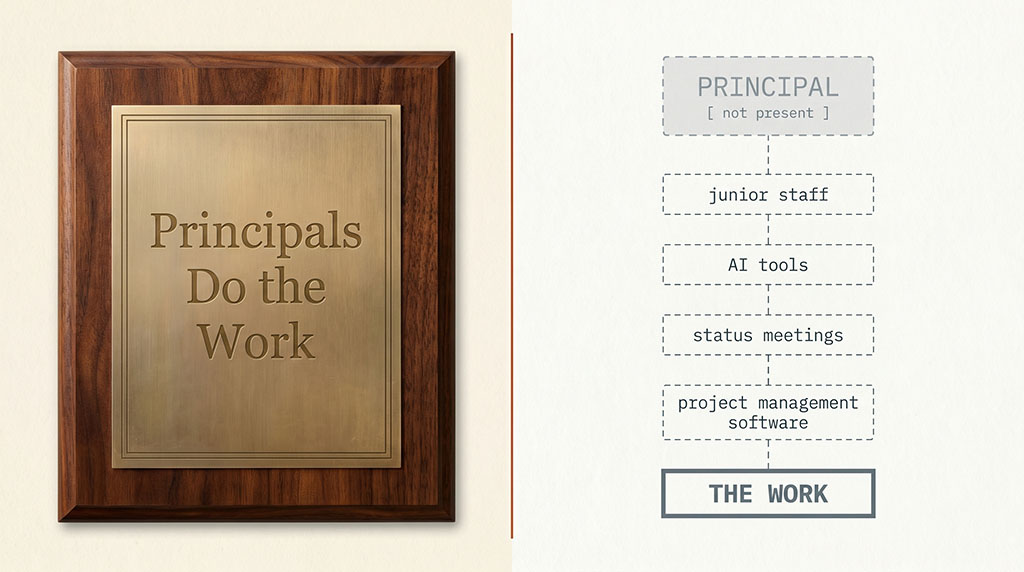
Most agencies — then and now — have it backwards. They delegate the thinking and keep the admin. The senior partners run the business. Junior staff produce the work. Whatever judgment was sold to the client at the pitch stage gets handed to whoever has bandwidth on Tuesday. The senior partners spend the rest of their week in status meetings about projects they’re no longer thinking about.
What AI has done to this is final.
AI is the ultimate ample routine facility. It can absorb infinite detail. It produces drafts, schedules, documentation, summaries, decks, copy, briefs — anything that sits in the detail half of the 1928 distinction. Every agency that has spent the last forty years selling thinking-as-deliverable, while routing the actual thinking to junior staff and the actual deliverables to senior staff, is now exposed. The deliverables can be made for free. The thinking is the only thing left.
The 1928 ad anticipated the decision an agency principal now has to make every Monday morning. What will I cheerfully delegate today, and what will I refuse to delegate? If the answer to the second question is nothing, you don’t have an agency anymore. You have a billing system attached to ChatGPT.
The receipt
Lennen & Mitchell had eighteen years of lawsuits ahead of them when the bankruptcy was filed in 1972. The standard the ad set in 1928 had stopped being kept long before the paperwork caught up. By the late 1960s anyone who looked closely could see what the agency was actually selling – and how far it had drifted from the line at the bottom of the ad. The signs were there. The principal had become a stranger inside his own building. The work had moved to people whose names weren’t on the door. The lawsuits, when they came, weren’t really about the bankruptcy. They were about the gap between what the agency had told clients and partners for years and what was actually happening inside.
That gap is the part of the story that travels. Every business has a founding pitch. Most of them outgrow some version of that pitch. The ones that survive long-term are the ones honest enough to say so when it happens.
Read your agency's pitch deck again
An Advertising Agency in Which the Principals Do the Work.
That sentence ran across the bottom of every Lennen & Mitchell ad in 1928. It set a standard. The standard was clear, and the agency held it for half a century, and then forgot it, and then died.
Pull out your agency’s pitch deck this week. Find the line at the bottom – the one you assumed described how they actually operate. Then look at how your work has been running for the last six months. Are the principals you were sold at the pitch still doing the work? Is the senior thinker still close to your problem? Is anyone over there cheerfully delegating the detail and refusing to delegate the thinking – or is it the other way around?
If the line on their door doesn’t match what’s happening inside the building, you don’t have an agency problem. You have an honesty problem. They could revise the line. They could change the operation. What they’re doing instead is keeping the old promise on the website while routing your work to whoever has bandwidth on Tuesday.
Lennen & Mitchell are an extreme case. Forty-four years of drift, eighteen years of lawsuits, a bankruptcy that owed its existence to a CEO who’d stopped being findable to his own people. Most agencies running this play today won’t get forty-four years.
You don’t have to wait that long either. The line on your agency’s door – does it still describe what happens when you walk inside?
Your marketing, looked at properly
Thirty minutes on your current setup — what’s working, what’s quietly leaking budget, and what I’d fix first. You’ll leave with a clearer picture whether we work together or not.
Got something specific bugging you? Flag it when you book and I’ll have it looked at before we talk.

AboutBruce Marjoribanks
Bruce Marjoribanks has spent 27 years in marketing, including building, running and selling his own agency before going independent. He now runs every channel - paid, organic, social, email, creative and automation - as one integrated system, with AI ehancing production and the judgment staying human.