
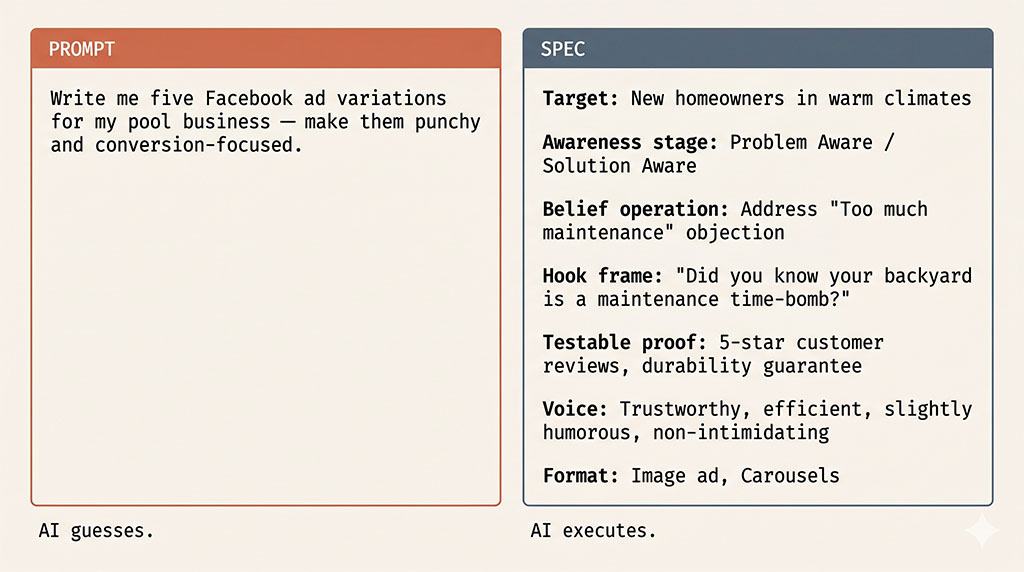
A marketer types a sentence into ChatGPT. Write me five Facebook ad variations for my pool business – make them punchy and conversion-focused.
Six seconds later, five ads appear. They are grammatically perfect. They use power words. One has an emoji. The marketer scans them, copies the second-best one into Meta Ads Manager, and feels a small dull thud they can’t quite name.
The thud has a name. It’s the sound of average.
The ads weren’t bad. They were the precise statistical centre of every pool ad ChatGPT has ever seen. Which means they were the same ads three other pool businesses generated that morning, with the same emoji, the same urgency cliché, the same “transform your backyard into a private oasis” closing line. Five variations of one idea, and the idea wasn’t the marketer’s. It was the model’s best guess at what a pool ad should sound like, averaged across the internet.
This is the new failure mode in advertising. It doesn’t look like failure. It looks like productivity.
The ceiling moved while nobody was watching
Last week the AI strategist Nate B Jones published a piece on the latest generation of image models. His core argument wasn’t about pixels or rendering quality. It was about where the constraint sits now. Reasoning has joined the visual stack. Models can think, search, and self-verify before they generate. The bottleneck on visual work, he said, has moved from model skill to specification quality. Teams that already think in briefs are about to pull very far ahead.
He’s right, and he’s pointing at something that’s true beyond images. The same shift is happening across every output category – copy, strategy, creative concepts, ad variations, landing pages. The execution layer collapsed. What you can prompt your way to is now a commodity. The ceiling moved up to the spec.
You’ve seen this before. When digital cameras got good enough that everyone could take a sharp, well-exposed photo, photography didn’t die – it just stopped being valuable for sharpness and exposure. The work moved up the stack to composition, direction, taste. The cameras commoditised the bottom rung. Whoever could direct the shot inherited the value.
That’s the move happening now in advertising. Whoever can write the spec inherits the agency.
A prompt is a request. A spec is a decision tree.
Most marketers don’t see the distinction yet, so they keep losing without knowing why. Here’s the difference, in concrete terms.
Sitting on my desk right now is a 40-page advertising strategy document for a real client – a pool kit business that sells direct to consumers and bypasses traditional pool companies. I’ll call them SPKD. The document doesn’t contain ads. It contains the operating system that produces ads.
In it: forty-nine specific false beliefs the target market holds, sorted into three categories – beliefs about the problem, beliefs about the solution, beliefs about the vendor. Each false belief has a word-for-word mini-script attached, and each script is tagged with one of four operations – Uninstall, Install, Reframe, Accommodate. There are four buyer personas, each with their own emotional triggers, awareness-level distribution (what percentage are problem-aware versus solution-aware versus product-aware), and a bespoke ABCDE persuasion framework – Attention, Beliefs, Constraints, Desires, Excuses. There’s a ten-level Scale of Believability that calibrates which claims sit in the Goldilocks zone — surprising enough to compel, credible enough to land. There’s a list of fifteen testable real-world experiments the buyer can run themselves, designed to produce the belief shift the brand needs without the buyer feeling sold to.
That’s not a creative brief. It’s a persuasion architecture. And here is the point most marketers miss: every single ad ChatGPT writes for SPKD against that document is sharper than every ad ChatGPT writes for a competitor against a one-line prompt – not because the AI is different, but because the AI is being told what to do by something that knows more than the AI does.
A prompt asks the AI to think. A spec already did the thinking and tells the AI what to produce.
You can feel the difference in your hands. Write five Facebook ads for my pool business hands the AI a blank wall and asks it to build something. Write a Facebook ad targeting Persona 2 (Premium DIY Professionals) at solution-aware stage, installing the belief that pool company markups are mechanical not value-based, using the Pattern Interrupt frame from the hook bank, anchored to the testable proof of calling a local excavator for a direct quote – that hands the AI a track to run on. The AI doesn’t have to guess. The guessing already happened, by the human, before the prompt was written.
"But I don't have time to write a 40-page strategy"
Here’s where you push back. This is a fantasy for anyone except big-budget brands. Writing a 40-page strategy document takes weeks. The whole reason I’m using AI is to skip that work – that’s the entire point. If I had time to build a “persuasion architecture” I wouldn’t need the AI in the first place.
That objection is doing two jobs. It’s defending your time, which is fair. And it’s protecting a belief about what you were paying for in the first place, which isn’t.
The strategy work was the value. It always was. Agencies bundled it with execution and let you assume you were paying for the ads – the deliverables, the volume, the monthly content calendar. The execution was the visible product because it was easy to invoice. The thinking was the invisible product because nobody knew how to bill for it. So agencies hid the thinking inside the price of the deliverables and presented you with a stack of posts at the end of the month.
AI didn’t kill the thinking. It killed the execution arbitrage. The deliverables that used to take a designer a week now take a competent operator an afternoon. The asset cost has collapsed toward zero. What’s left worth paying for is the layer that was always doing the actual work – the layer that tells the AI what to make, in which voice, against which objection, for which awareness bucket, with which proof.
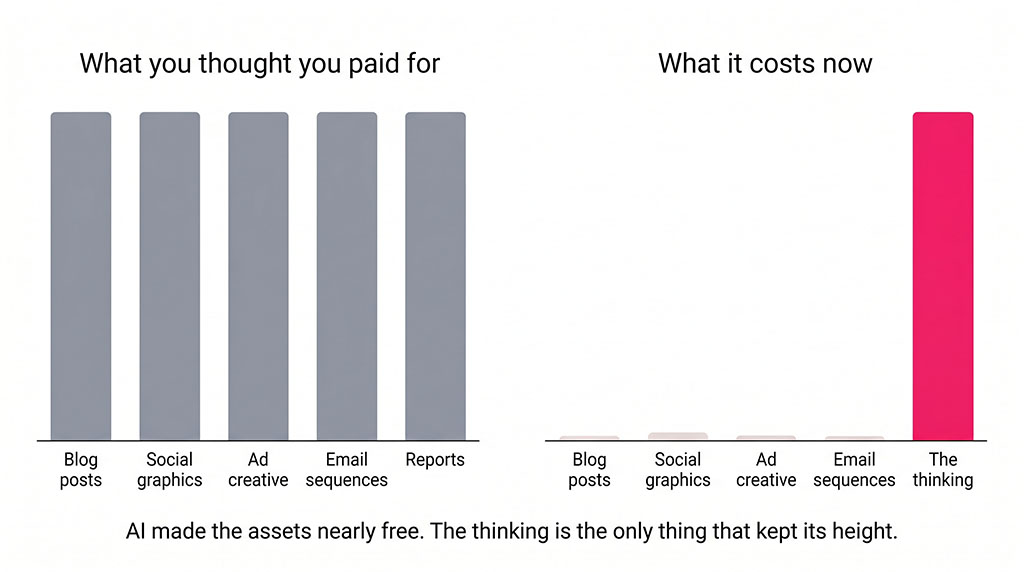
If you skip that layer because you don’t have time, you don’t get to skip it. You just hand the decision to the AI’s average. Which means you and your three competitors are now running ads written by the same model, against the same generic prompt, hitting the same fatigued audience, with the same diminishing return. The “savings” you got from skipping the strategy work are paid back, with interest, in click-through rates that decay faster than your spend.
The lazy middle – AI will make my ads for me – produces output that looks identical to everyone else using the same lazy middle. Which is most marketers. Which is the opportunity.
What a real spec contains (and where to start)
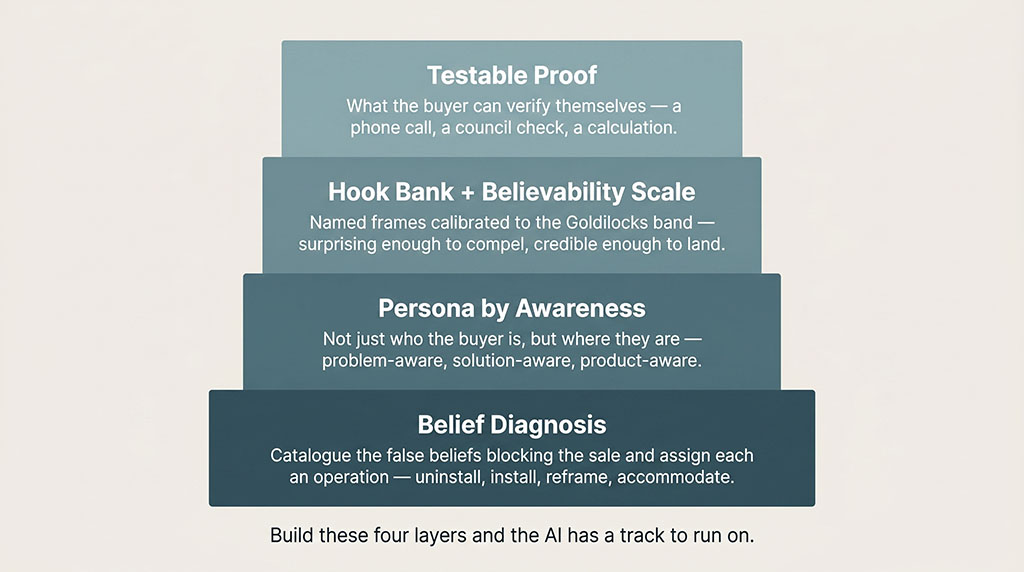
You don’t need a 40-page document to start. SPKD’s strategy is the comprehensive end of the scale; most businesses can run on a fraction of it, as long as the fraction contains the right layers. Here are the four that matter most.
The first is belief diagnosis. Not “what does my audience want” – that’s a wishlist question. The diagnostic question is: what does my audience currently believe that’s blocking the sale? List the false beliefs by category – about the problem they’re trying to solve, about the type of solution they think they need, about you and your competitors. For each belief, decide the operation: uninstall it, install a new one, reframe it, or accommodate it inside your offer.
The second is persona-by-awareness. Not just who the buyer is, but where they are. A problem-aware buyer who doesn’t yet know solutions exist needs a different ad than a product-aware buyer comparing you to a competitor. Most generic AI prompts produce content for an imaginary mid-funnel buyer who doesn’t actually exist. A good spec maps the message to the awareness stage explicitly.
The third is a hook bank tied to a believability scale. Not “make it punchy” – that’s an instruction the AI cannot honour because punchiness depends on what’s surrounding it. Instead: a list of named frames – Pattern Interrupt, Insider Confession, Solution Gap, Invisible Difference, Ticking Clock – with the rule that any claim must sit in the Goldilocks band. Surprising enough to compel. Credible enough to land. The AI can apply named frames to a believability budget. It cannot invent the frames or the budget.
The fourth is testable proof. This is the layer almost no AI-generated ad has, because the AI doesn’t know what’s real in your business. What can the buyer go and verify themselves – a phone call they can make, a council website they can check, a calculation they can run? Spec’d proofs are the antidote to the generic claim, and they’re the layer that makes an AI-generated ad feel like it was written by someone who knows the business – because it was, by you, before the AI started typing.
Build those four layers and you have a spec the AI can execute against cleanly. The output is no longer generic, because the input no longer is. You haven’t replaced the AI. You’ve replaced the prompt – with something it can actually use.
The marketer at the keyboard, again
Picture the marketer from the opening. The keyboard is the same. The pool business is the same. The AI on the other side of the screen is the same.
What’s different is the document open in the other window — twelve pages instead of forty, but built right. Beliefs catalogued. Personas mapped to awareness. Five hook frames named and budgeted. Three testable proofs sitting in a list, ready to be dropped into copy.
The prompt window is almost empty. There’s no clever wording, no list of adjectives, no plea for “punchy and conversion-focused.” Just a few lines pointing the AI at one cell of the spec and asking it to produce the ad that lives there.
The output isn’t five variations of one idea. It’s five executions of a decision that was already made.
That’s the work. The spec was always the work. AI didn’t change what the work was – it just removed every excuse to skip it.
Your marketing, looked at properly
Thirty minutes on your current setup — what’s working, what’s quietly leaking budget, and what I’d fix first. You’ll leave with a clearer picture whether we work together or not.
Got something specific bugging you? Flag it when you book and I’ll have it looked at before we talk.

AboutBruce Marjoribanks
Bruce Marjoribanks has spent 27 years in marketing, including building, running and selling his own agency before going independent. He now runs every channel - paid, organic, social, email, creative and automation - as one integrated system, with AI ehancing production and the judgment staying human.