
She’s at the kitchen table at 9:40 on a Tuesday night. Laptop open, a cup of tea going cold beside it. Self-employed, three years of messy tax returns, a deposit she’s scraped together one quarter at a time, and a bank that’s already said no twice. She doesn’t open Google. She opens a chat window and types something close to: “best mortgage broker for self-employed people who’ve been knocked back by the banks.”
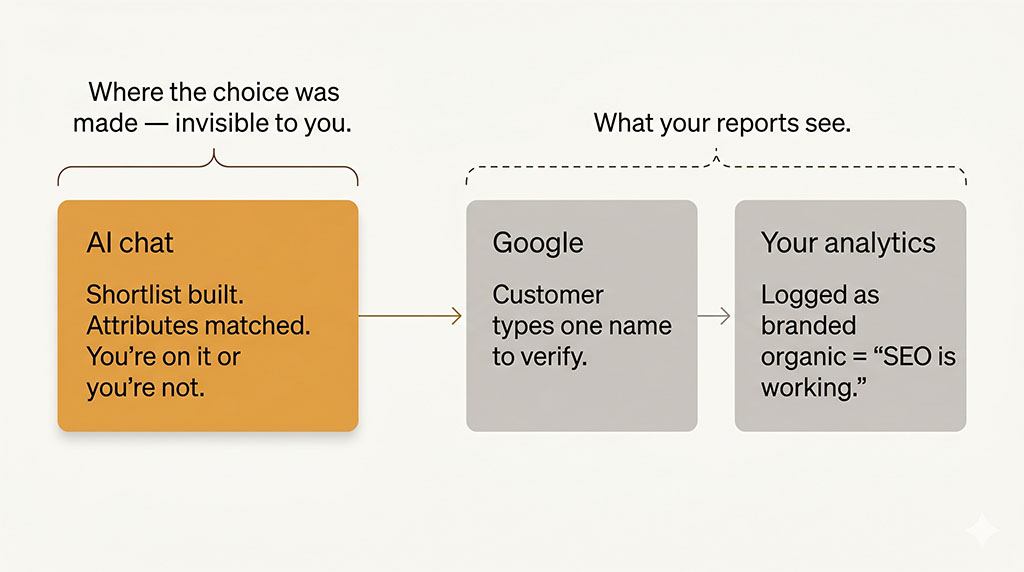
Three names come back. A sentence on each – why this one’s good with non-standard income, why that one knows the second-tier lenders. She reads it the way she’d read a tip from a friend who happens to know everything. Then she does the only thing you’ll ever see in a report: she types one of those three names into Google to check they’re real.
That Google search is the one your agency points at. And it’s the least important thing that happened that night.
The demand you think you own
Here’s the story every owner has been told and mostly believes. Branded search going up means the brand is working. People type your name because they know you, trust you, were referred to you. Direct and branded traffic is the good stuff — high intent, cheap, yours. The demand you built, finally showing up in the dashboard.
For a long time that was true. A billboard, a happy client telling a mate, a name remembered from a sponsorship – all of it eventually funnelled into someone typing your name. The name-search was the finish line of trust you’d earned out in the world.
The decision moved somewhere you can't see
That finish line moved. Not to a different keyword or a new channel. It moved into a conversation between your prospect and a machine – one that ends before your name is ever typed.
The branded search you celebrate isn’t independent proof your brand is strong. It’s the visible echo of an invisible decision. The chat now sits upstream of the search. It chooses who gets Googled. And if you weren’t on the shortlist, that person is typing a competitor’s name into Google right now, and you will never see the search that didn’t include you. Your analytics can’t report an absence.
Which, by the way, is why “branded traffic is up, SEO’s working” is such a comfortable line for an agency to deliver. They’re claiming a verdict reached somewhere they had no hand in.
Five prompts, zero overlap
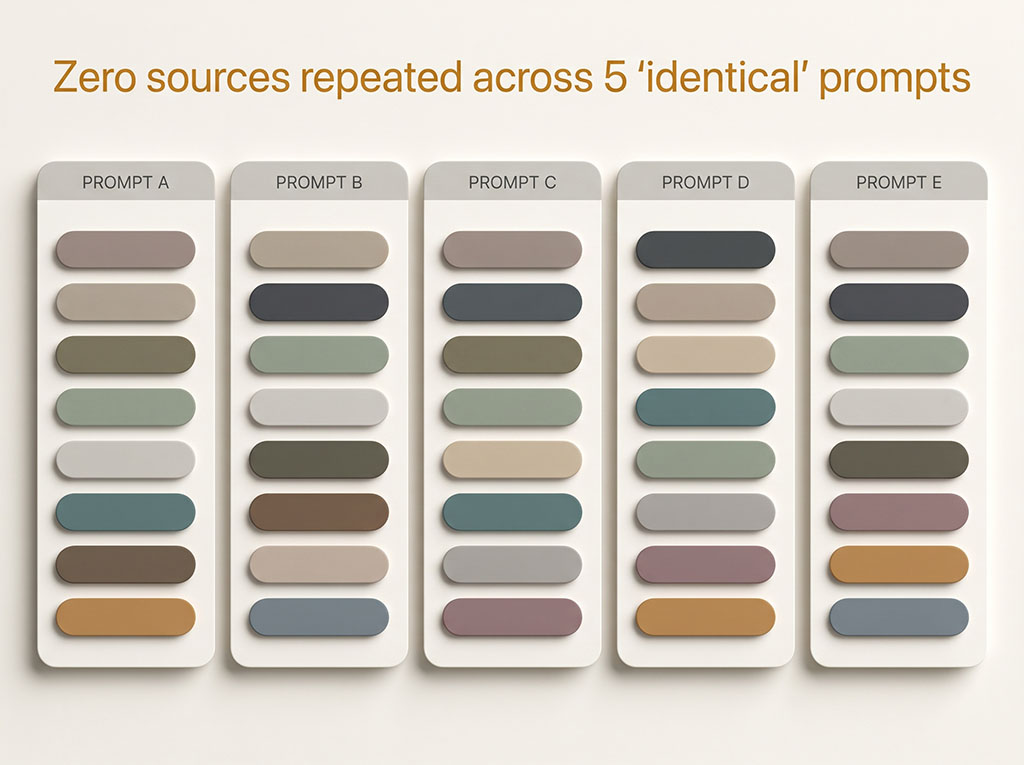
Run the experiment yourself tonight. Take five prompts that sound like the same question – “best broker for self-employed,” “mortgage broker for contractors knocked back by banks,” “who finances self-employed home loans” – the kind of variations a keyword tool would file under “same intent.” Paste them into a chat, one at a time.
You won’t get the same three names. You’ll often get zero overlap – not one source repeated across five answers that looked identical to you. It’s like asking five people the same question and watching each reach for a completely different little black book. The intent was the same. The shortlist wasn’t.
Because the chat isn’t matching keywords. It’s matching attributes. “Self-employed.” “Knocked back.” “First home.” Each one is a filter, and any single filter can flip the entire list. Your prospect never asks for “the best broker.” She asks for the best broker for someone exactly like her, with her specific mess – and the machine assembles a list tuned to that mess, in seconds, in private, before a human visits a single page of yours.
Volume was never the point
The number of people landing on your site straight from a chat is still small. For most growth-stage businesses it’s a trickle, not a flood. Anyone waving a “10% of our revenue is AI now” stat at you is usually quoting enterprise brands that already own those answers – not a $5M operator in your town.
But volume was never the point. The point is sequence. The chat happens first, and it decides who gets searched second. So you’re not trying to capture AI referral traffic. You’re trying to be the name the machine offers before the search ever happens.
But these are people who already know me
You might not be buying this. You’re thinking: those are real people typing my real name. That’s my reputation. Twenty-seven years of word of mouth, the clients who refer me, the work that speaks for itself. A robot didn’t conjure those people out of nothing.
You’re right. Some of that demand always was pure brand, and still is. The referral from a happy client. The name remembered from a junior netball sponsorship. That’s real and it’s yours.
But watch the edges of it. The borrower who got your name from a friend checks you against the chat before she calls – and the chat either confirms you or quietly adds two names “you might also consider.” The prospect who half-remembers you asks the machine “is [your business] any good for self-employed lending?” and gets an answer stitched together from your reviews, your site, and the silence where your missing information should be. The brand strength you’re crediting has quietly become a verification step on a choice the machine is making first. You didn’t lose the demand. You lost the ability to see where it’s actually decided.
The line isn't industry — it's research
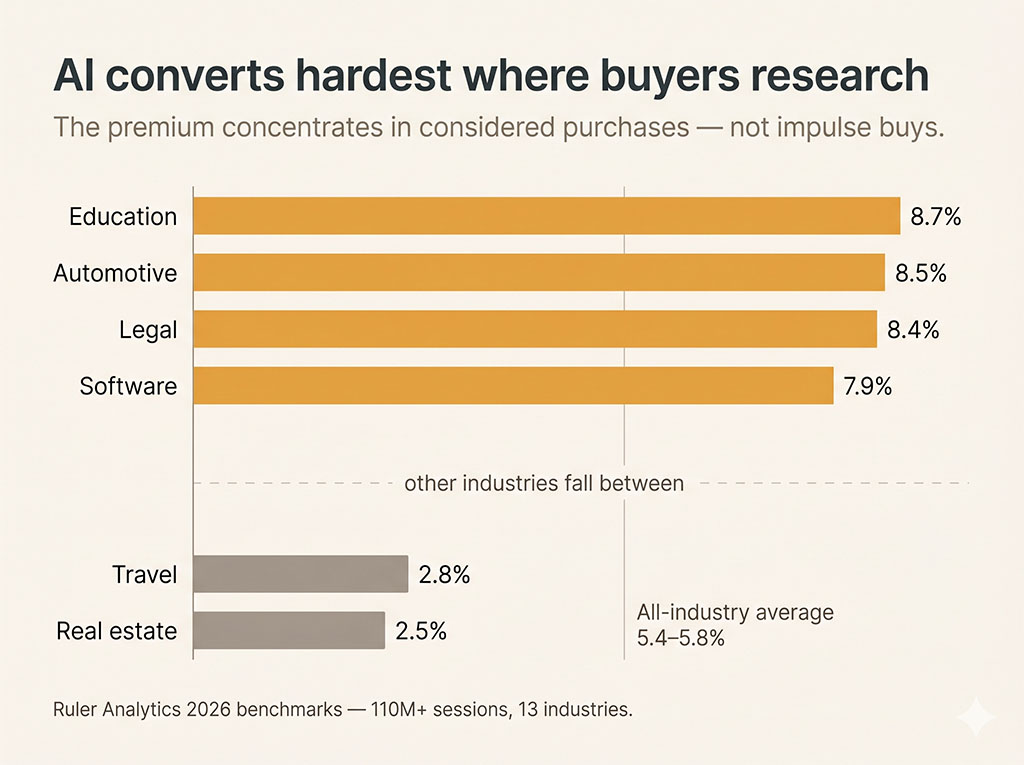
This bites hardest wherever a purchase makes someone stop and look into it before they choose. The more vetting, comparing, and “let me research this properly” a decision involves, the more of that work now happens inside a chat – and the more the shortlist it spits out decides the outcome.
You already know the other end of it. The toilet’s overflowing at 10pm and nobody opens a chat – they tap the first plumber with decent reviews who’s still awake and call. Too fast, too disposable for research to matter, so the machine never gets a say.
It isn’t about your industry. It’s about the moment your customer is in. Finance makes the point precisely because it holds both extremes. A self-employed family choosing who to trust with a mortgage spends weeks quietly researching – the chat is the room that decision gets made in. But “my car died, I need finance approved by Friday”? Urgent, stressful, decided fast – the machine barely gets a look. Same sector, opposite ends.
So the question for your business isn’t whether you sit in some high-stakes vertical. It’s whether buying you involves research at all. A $40k kitchen renovation, not a blocked drain. A managed IT provider you’ll live with for years. An accountant. A wedding venue. A B2B supplier going onto a shortlist. Anything a buyer compares, vets, and sleeps on is now being compared, vetted, and slept on with an AI in the room. The slower and more considered the choice, the more the machine decides it. The faster and more disposable, the less it matters.
And the data backs it, in an unhyped way that’s worth trusting precisely because it isn’t dramatic. Ruler Analytics’ 2026 benchmarks – 110 million-plus sessions across 13 industries – show AI-referred traffic converting at or above organic search, and clustering highest in the categories people research hardest: education at 8.7%, automotive 8.5%, legal 8.4%, software 7.9%. The most rigorous independent study, from Amsive, found no meaningful overall gap between AI and organic conversion at all – the edge shows up specifically where a purchase is complex enough to deliberate over. Which is the point. AI traffic isn’t magic. It converts when the buyer was already deliberating – and deliberating is exactly the moment the chat gets to build the shortlist.
Find your shortlist tonight
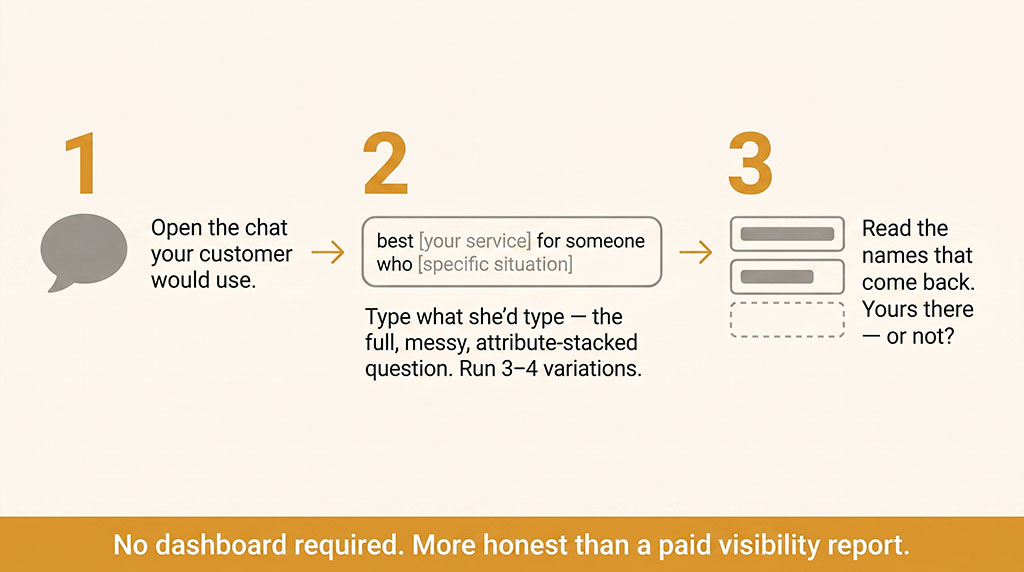
You can see where you stand right now, for free, before you pay anyone a cent for an “AI visibility” report. Open the same chat your customer would. Type what she’d actually type – not “best broker,” but the full, messy, attribute-stacked question, with three or four variations. Watch the names that come back. If yours isn’t among them, you’ve just seen the shortlist your prospects are seeing – the one no paid dashboard was ever going to show you straight.
Stop reading the shadow
None of this means branded search is worthless, or that building a brand stopped mattering. If most of your name-searches still come from genuine word of mouth in a tight local market, the old story holds for now. And the urgent, low-trust, grab-the-first-option purchases will keep ignoring the machine for years. The reframe isn’t “branded search is fake.” It’s that branded search is a lagging shadow – so stop reading the shadow as if it were the thing casting it.
The job was never to chase the 1% of direct AI traffic. It’s to be worth including when the shortlist gets built, which is a harder and quieter job than ranking for a keyword. It’s whether your site states the exact attributes the machine filters on. Whether your reviews describe outcomes a machine can quote, instead of “great service, thanks.” Whether the thing you’re known for is said clearly and consistently everywhere a machine can read it. That’s whole-picture work – and a row of specialists each shipping a disconnected piece is structurally the worst possible way to do it. The shortlist is decided by the whole picture. It has to be built by something that can see the whole picture.
So go back to the kitchen table. The cold tea, the third “no” from the bank, the three names on the screen. By the time she types one of them into Google, she isn’t searching anymore. She’s confirming. The decision was made a paragraph earlier, in a sentence she read like advice from a friend – a sentence with three names in it. The only question that matters for your business is the one your reports will never answer: was one of them yours?
Your marketing, looked at properly
Thirty minutes on your current setup — what’s working, what’s quietly leaking budget, and what I’d fix first. You’ll leave with a clearer picture whether we work together or not.
Got something specific bugging you? Flag it when you book and I’ll have it looked at before we talk.

AboutBruce Marjoribanks
Bruce Marjoribanks has spent 27 years in marketing, including building, running and selling his own agency before going independent. He now runs every channel - paid, organic, social, email, creative and automation - as one integrated system, with AI ehancing production and the judgment staying human.