
In November 2024, an Australian direct-response agency called King Kong launched an AI. By the agency’s own description, Kong was trained on the best-performing ad copy and creative from more than $200 million in ad spend. Ads in seconds. Better than 99% of copywriters, so the pitch goes.
Read that number again. $200 million in ad spend. The agency didn’t spend that money. An agency’s spend figures are, by definition, run on campaigns its clients paid for. So that number is a record of other businesses buying their own media, month after month, generating their own results. The agency watched what worked across all of them, kept the learning, says it trained a product on that learning, and now sells access to the product back to the market.
Nobody did anything wrong. Not really. The contracts almost certainly allowed it, because agency agreements routinely grant rights over aggregated performance data, and nobody reads that clause because nobody thought it would ever matter. The learning had to live somewhere, and the clients had nowhere to keep it. No client ever asked for it back, because no client had a shelf to put it on.
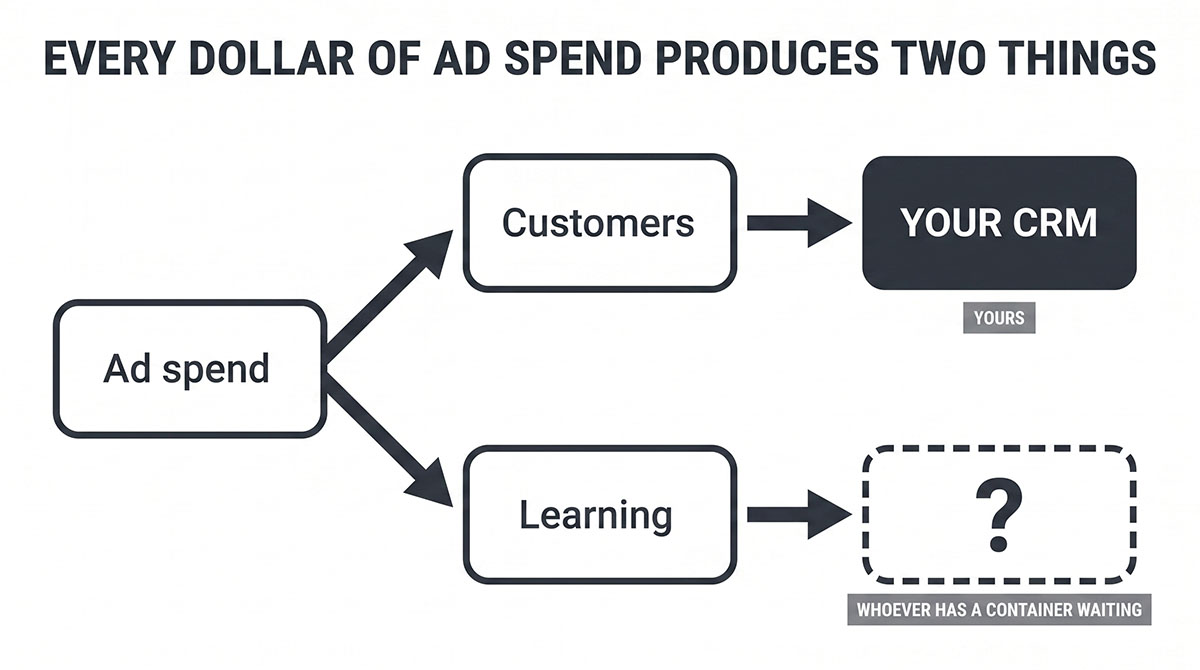
That’s the part worth sitting with. Every dollar of ad spend produces two things: this month’s customers, and the knowledge of how those customers were bought. The customers land in your CRM. The knowledge lands wherever there’s a container waiting for it – and for the last decade, the only container in the room belonged to someone else.
Whether your agency uses AI tells you nothing
Everywhere you look right now, the advice is the same. Use AI. Hire people who use AI. If your marketing doesn’t have AI in it somewhere, you’re falling behind the businesses whose marketing does.
The advice is right, as far as it goes. The cost of output has collapsed. Ad variations that took an agency a week now take an afternoon. Testing that needed a dedicated budget line now runs continuously. A business that ignores this is genuinely choosing to pay more for less.
So owners tick the box. The agency uses AI. The consultant uses AI. Someone in the office has a ChatGPT subscription. Job done.
Except “does anyone use AI” was never the question. That’s like asking whether your accountant uses a calculator. Of course they do. Everyone does. It tells you nothing.
The question that matters is the one nobody asks: when your marketing learns something, where does the learning go – and whose name is on the door where it lives?
The difference between a feature and an asset
AI as a feature sits inside someone else’s workflow. Your agency’s copywriting model, your consultant’s prompt library, the automation stack your freelancer swears by. The output flows to you. The accumulation flows to them. When the relationship ends – and every marketing relationship ends – the feature leaves in the same car as the person who operated it.
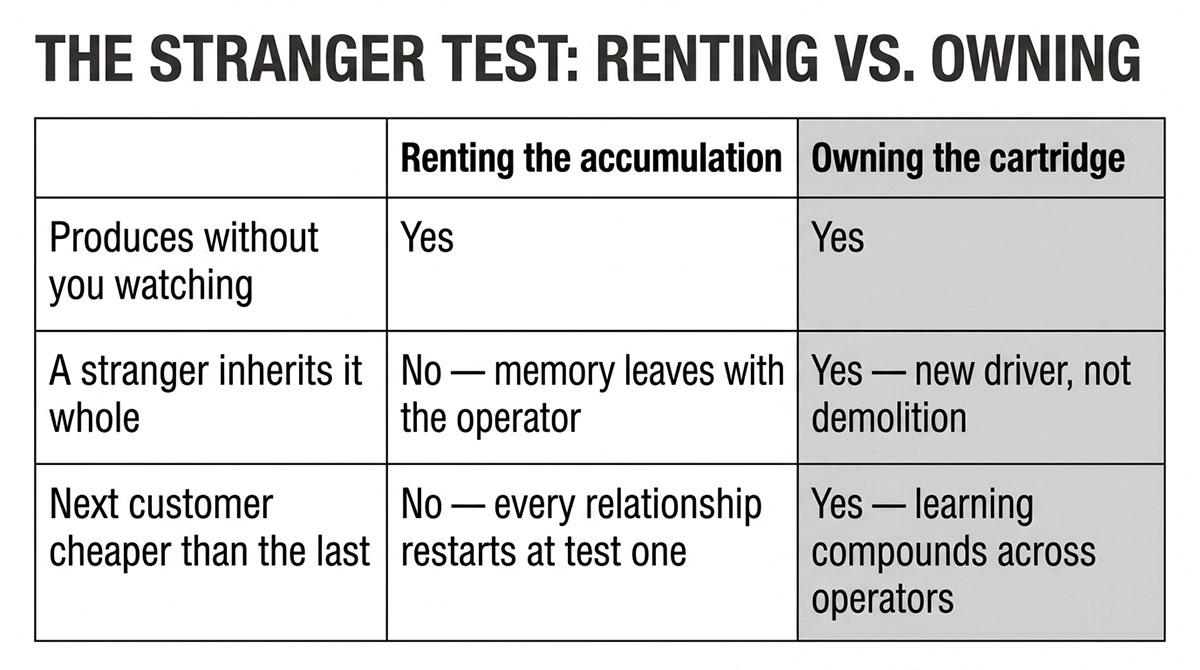
An asset is different, and the test for it hasn’t changed. An asset produces without you standing over it. A stranger could take it over and it would keep producing. And it makes the next customer cheaper to buy than the last one.
I wrote recently that most marketing budgets fail all three legs of that test – twelve months of spend, and nothing on the shelf a buyer, a successor, or you yourself could put a price on. This is the sequel to that argument, because the most valuable thing your spend produces isn’t the leads. It’s the interpretation. Which audience actually closed, not which one looked cheap in the platform. Which angle died, and the specific reason it died. Which headline won on a real difference and which won on noise.
Here’s the uncomfortable audit. Pull up your last three years of ad account history and your GA4 property. Scroll it. Every number is there. Every campaign, every result, every dollar. Now try to answer one question from it: what did we learn?
You can’t. Nobody can. Platform data records what was spent and what happened. It does not record what was understood. The understanding lived in a media buyer’s head, and that media buyer has changed twice since 2023.
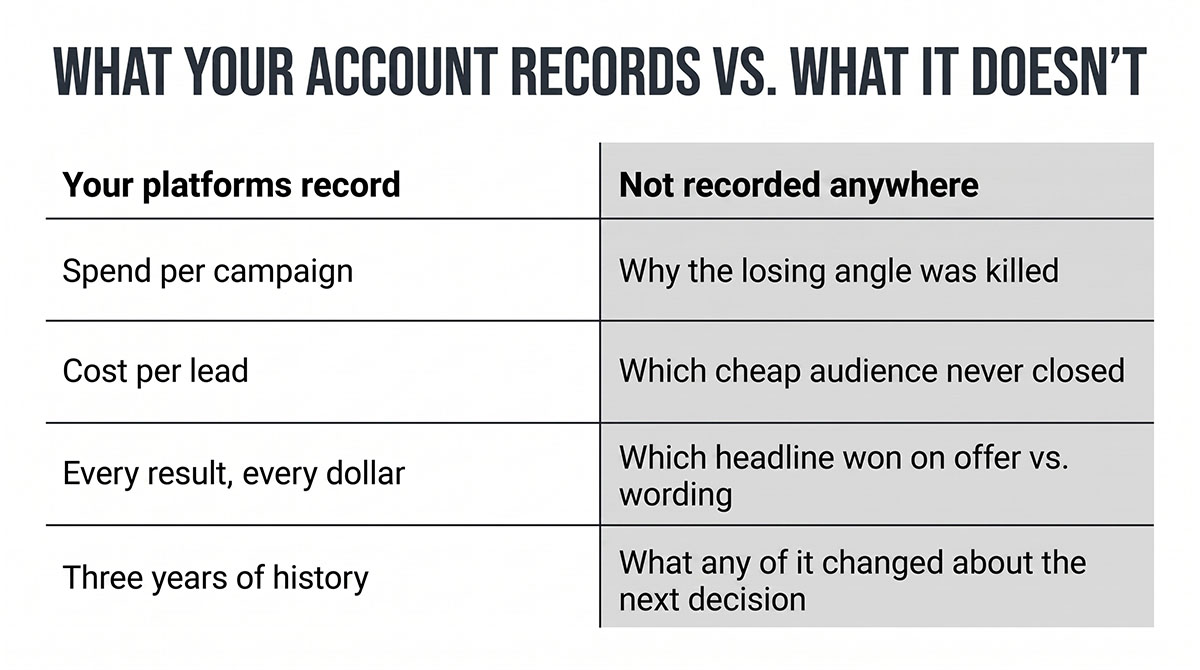
Ask yourself how many businesses sit down and annotate their own marketing data – a plain-English note next to each test saying what it meant, why it was killed, what it changed about the next decision. I’ve been doing this for 27 years, 20 of them in digital, and the honest answer is none. Not lazy ones. Not cheap ones. None, full stop. It was never anyone’s job, it was never a line on any contract, and until about two years ago there was no practical container to put it in even if someone had tried.
But my cost per lead is fine
Here’s the objection, and it deserves a straight answer.
The output is identical. My agency’s AI writes my ads, tests my angles, and my cost per lead is fine. Installing my own system sounds like friction I’m currently paying someone to make disappear. This whole ownership argument smells like a way to sell me a platform.
Everything in that objection is true. The output really is identical. Outsourcing the whole apparatus really is easier. And you should be suspicious of ownership arguments, because most of them are lock-in wearing a costume.
But run it against the opening of this article. The businesses behind that $200 million got excellent ads too. Their cost per lead was fine. The output was never the problem – the output was the feature, and the feature worked exactly as advertised. What their spend also produced was a record of what worked, and that record ended up inside somebody else’s product.
That’s not a scandal. That’s just what happens to learning when only one party in the room has somewhere to keep it.
So the question isn’t whether your current setup produces good ads. It’s the stranger test: hand over every login tomorrow. Your ad account, your GA4, your CRM. Does the new person inherit three years of understanding – or three years of uninterpretable numbers and a rebuild that starts at test one?
If it’s the second, you don’t own an asset. You rent proximity to one.
The cartridge, not the console
Here’s what the owned version actually looks like, and the shape of it matters more than any tool name.
Think of a games console and a cartridge. The console is the machine – the intelligence, the processing, the thing that runs the game. The cartridge is the game itself. Swap the console for a newer one and nothing is lost, because everything that makes the game yours travels in the cartridge.
Your marketing needs a cartridge. A single installed container, in your stack, under your accounts, that holds the strategy – the plan, the customer avatars, the brand voice, the claims that convert each cut of your market – and that is wired directly into your data. Your GA4. Your ad platforms. Your CRM. Your CMS.
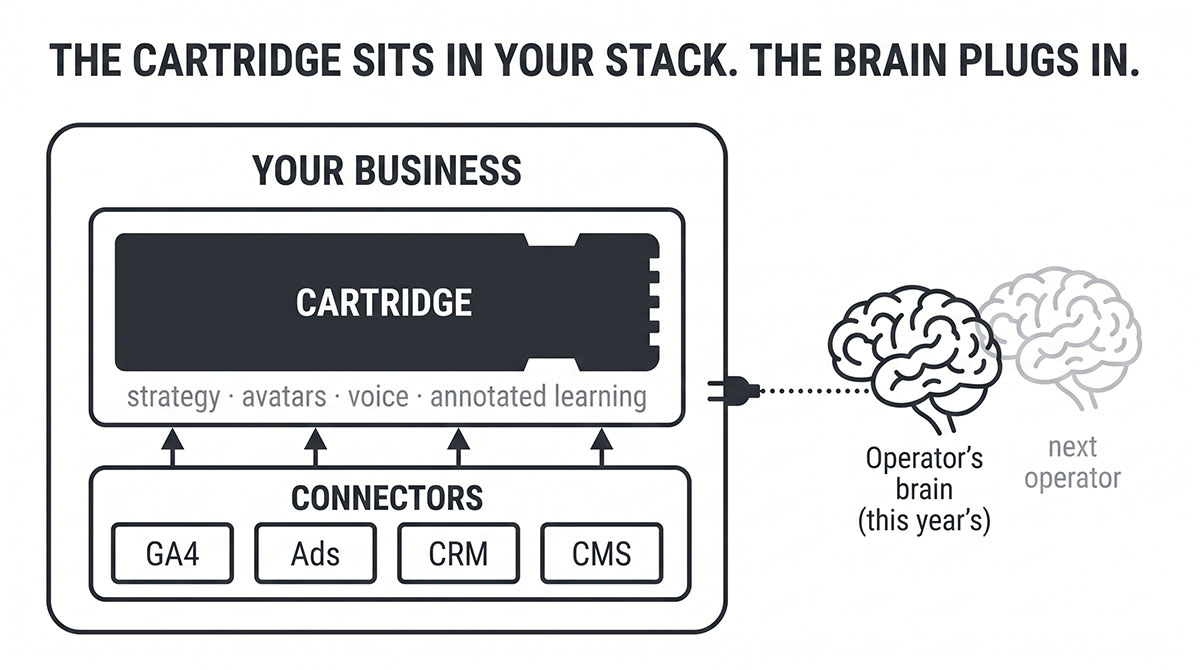
And then the part that changes everything: it accumulates. Every test that runs gets written against the data, in plain language, at the moment the result lands. This audience looked cheap and never closed – here’s the CRM join that proved it. This angle died in week three, and here’s why. This headline won, and it won on the offer, not the wording. The interpretation that used to evaporate into a departing media buyer’s memory becomes a permanent, readable layer sitting on top of your numbers.
The AI brain that operates on all this – the strategist’s engine, the rules, the skills – that can belong to whoever runs your marketing this year. It should be replaceable. That’s the point. A new operator plugs into your cartridge and opens at test forty, not test one. New driver, not demolition.
That’s the design that passes the asset test. It produces without you watching it. A stranger inherits it whole. And it’s the only mechanism by which next year’s customer costs less than this year’s – because the learning compounds instead of resetting with every handover.
This has never existed before in marketing. Not because nobody wanted it – because the container didn’t exist, annotating cost more than any client would ever pay for, and connecting the platforms took an engineering team. All three of those barriers fell in the last two years. The businesses building cartridges right now are simply the first who could.
Where the rented version is genuinely fine
Fair’s fair. Not everything needs to live in your cartridge.
One-off creative production, a campaign in a channel you’ll never touch again, an experiment you’re running to kill an idea cheaply – rent all of it. The accumulation on a dead end is worth nothing, so who keeps it doesn’t matter.
And the ownership test cuts every direction, including at whoever runs your marketing – me included. If the system only works while one particular person operates it, it isn’t an asset either. It’s key-person risk with a subscription fee. The test isn’t “is the operator good.” It’s “does the operator’s departure delete the memory.” Any operator, any arrangement, any brand of brain: if the answer is yes, you’re renting.
Where are your test results written down?
You don’t need to build anything to start. You need to ask one question of whoever currently runs your marketing:
“When a test finishes, where is the result written down, what account is it stored under, and what happens to it if we part ways?”
There are only two honest answers. Either there’s a place, it’s yours, and they can show it to you — or there isn’t, and everything your spend is teaching is accumulating somewhere you’ll never see, the way $200 million in ad spend went into training one agency’s product and left the businesses who funded it with nothing they could take anywhere else.
Your next twelve months of marketing spend is going to train a brain. That part isn’t optional anymore – the learning happens whether anyone captures it or not, and somewhere, someone’s container is catching it.
The only open question is whose name is on it.
Your marketing, looked at properly
Thirty minutes on your current setup — what’s working, what’s quietly leaking budget, and what I’d fix first. You’ll leave with a clearer picture whether we work together or not.
Got something specific bugging you? Flag it when you book and I’ll have it looked at before we talk.

AboutBruce Marjoribanks
Bruce Marjoribanks has spent 27 years in marketing, including building, running and selling his own agency before going independent. He now runs every channel - paid, organic, social, email, creative and automation - as one integrated system, with AI ehancing production and the judgment staying human.