
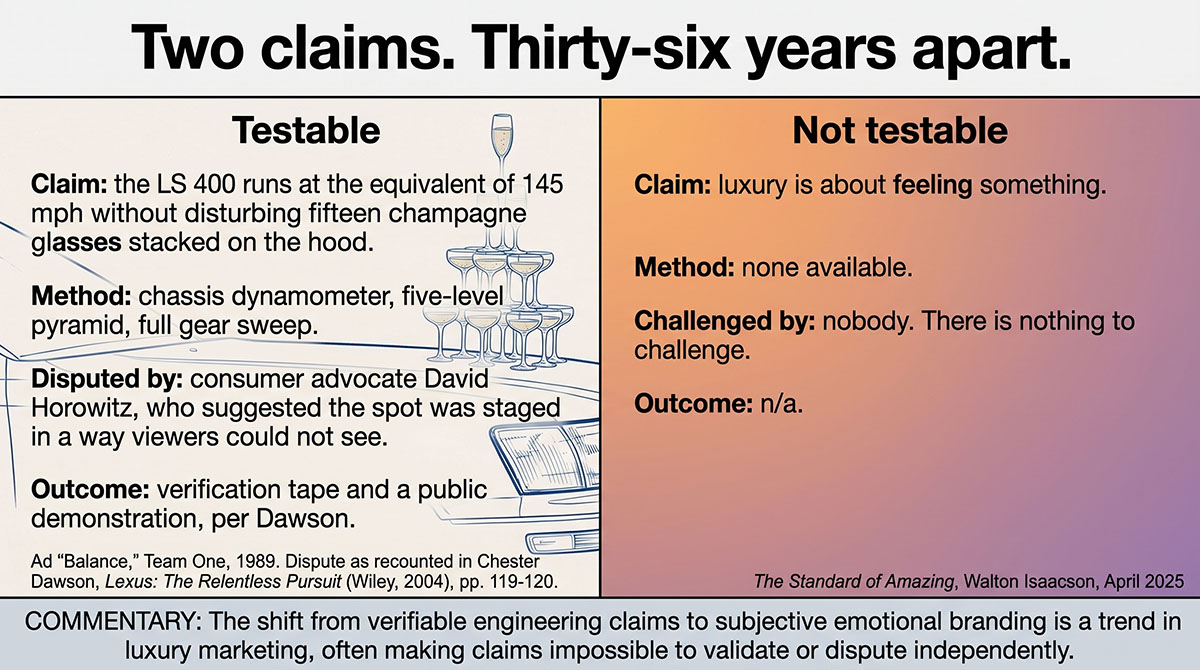
In 1989, Lexus put an LS 400 on a chassis dynamometer, stacked fifteen champagne glasses in a five-level pyramid on the hood, and ran the car through every gear to the equivalent of 145 miles per hour. Nothing moved. The voiceover said the car was built to “stir the soul… and not much else.”
The claim was specific enough to argue with, and somebody argued with it.
Chester Dawson’s history of the brand, Lexus: The Relentless Pursuit, records that consumer advocate David Horowitz suggested the spot had been staged in some way viewers could not see. By Dawson’s account Lexus responded with a verification tape and a demonstration of the same feat in front of a studio audience. Dawson does not date the exchange. A Fight Back! episode taped in December 1991 is listed as covering what happened with the Lexus champagne glasses, which puts it two years after the ad first ran.
Read that at its weakest and the point still holds. There was a claim on the table, and it was the kind of claim a person could dispute, test and settle.
The claim nobody can challenge
In April 2025, Lexus launched a new brand platform through agency Walton Isaacson: The Standard of Amazing. At launch, Lindsay Smelser, General Manager of Lexus Product and Consumer Marketing, framed it this way: “Luxury is more than craftsmanship and refined performance; it’s about feeling something.”
Nobody will ever accuse that line of being staged. There is nothing in it to stage.
Run the swap test. Move that sentence onto Genesis. Onto Cadillac. Onto a watch brand, a boutique hotel group, a business-class cabin. Nothing breaks. No engineer signs off. No lab verifies anything. The line survives every transplant because it never belonged to the product in the first place.
The tagline it replaced drew the same objection years earlier. In a 2017 blog post, brand consultant Bruce Turkel wrote that Experience Amazing would sit just as comfortably on Cirque du Soleil, Disney World, a new IPA, or Dr. Scholl’s newest shoe liners. He called it generic pabulum.
Lexus can afford this. A brand spending at that level is buying recognition across years, and a feeling is a legitimate thing to buy when your name is already on eight million driveways.
You cannot afford it. When your entire budget is what Lexus spends on catering, every line has to do work. A line that survives being transplanted onto a competitor is a line that did no work at all.
The part I got wrong
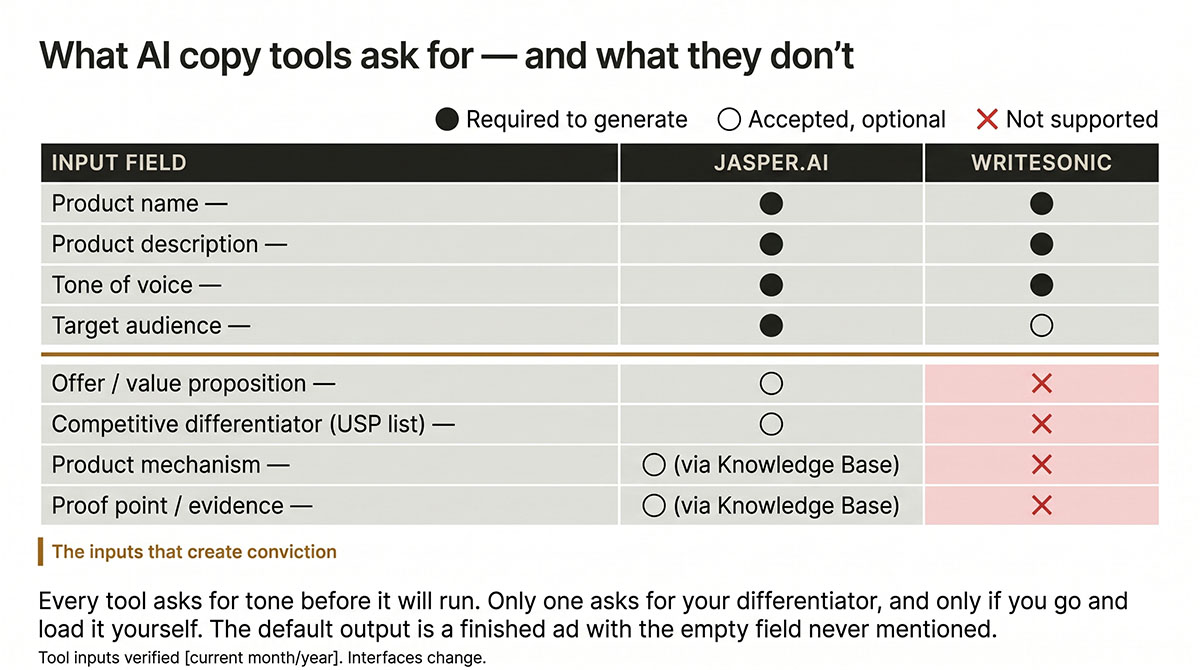
There is a popular version of this argument that says the AI tools caused the problem. That they ask for tone, audience and format, and never ask what makes the product different. I ran that argument in the first version of this post. It is out of date, and it is worth correcting in public.
Jasper’s Ad Campaign Agent asks for the core campaign message, the primary audience, the offer or value proposition, and the call to action. Behind it sits a Knowledge Base built to hold a campaign brief, a messaging hierarchy, a USP list, ICP definitions, competitive context and landing page copy. The field for your differentiator exists. It has existed for a while.
Here is the part that matters. It is not required. Leave the Knowledge Base empty, give the agent a product name and a tone, and it will still generate fluent, well-formatted, on-brand copy. The output looks finished. Nothing in the interface tells you that the one input that separates you from your competitors was the one you skipped.
Some tools never ask at all. Writesonic’s Facebook ad generator takes three inputs: ad topic, ad language, tone of voice. That is the whole form.
The vendors are candid about this when they write it down rather than build it. Shopify’s own guide to ad copy generators tells readers: “Don’t rely on the ad copy generator to determine your value proposition.” Jasper’s guidance on long-form ads asks writers to bring evidence and proof points, specific numbers and outcomes, and names the two phrases that weaken a message: industry-leading and best-in-class.
So the gap is real. It just isn’t in the software. It’s in what gets loaded into it, and loading it is slow, unglamorous work that nothing in the workflow forces you to do.
What the evidence actually shows
The claim you see everywhere is that AI copy performs worse. The largest study anyone has run does not say that, and it is worth reading past the press release to find out what it does say.
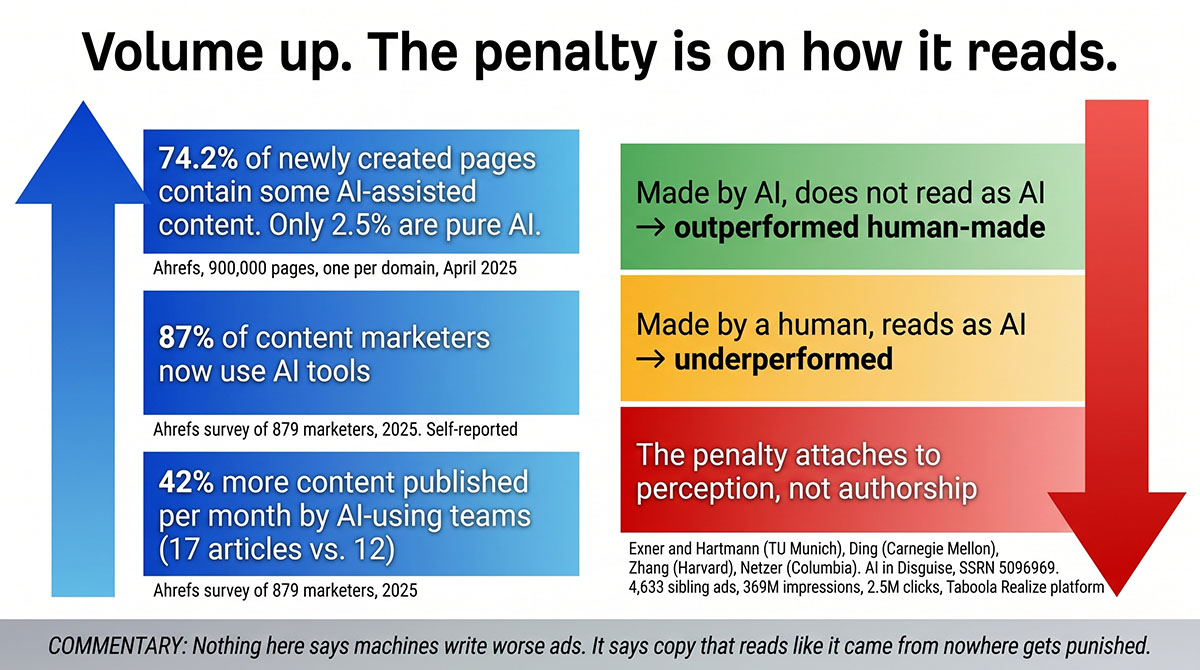
The paper is AI in Disguise: Quasi-Experimental Analysis of a Large-Scale Deployment of AI-Generated Ads, by Exner and Hartmann at the Technical University of Munich, Ding at Carnegie Mellon, Zhang at Harvard and Netzer at Columbia. It studies 4,633 sibling ads on Taboola’s Realize platform: AI-generated and human-made creative launched by the same advertiser, in the same campaign, at the same time. 369 million impressions. 2.5 million clicks.
The finding is not that the two drew level. AI-generated images beat human-made ones on click-through, with one condition attached. They had to not look like AI.
Then comes the result that should reset the whole argument. Ads readers perceived as AI-generated underperformed whether or not AI had made them. The penalty attached to how the ad read, not to who produced it. A human wrote it, a human shot it, and it still lost, because it landed like something nobody had thought about.
Three caveats belong on this, and they belong here whether or not they suit the argument. The study ran on Taboola’s platform, using Taboola’s generative ad tool. It measured native display creative, not search text or long-form copy. And the figures you will see quoted around it, 300,000 ads and 500 million impressions and a 0.76 percent click-through rate, come from Taboola’s press material rather than the paper. The paper’s own numbers are the ones above.
Nobody has found that machines write worse ads. What the evidence shows is a penalty on copy that reads like it came from nowhere in particular.
The volume numbers point the same way. Ahrefs ran its AI detector across 900,000 newly created web pages in April 2025, one page per domain. Around 74 percent contained some AI-generated content. Only 2.5 percent were pure AI with no human involvement, and 71.7 percent were a blend of the two. In a separate survey of 879 marketers, Ahrefs found 87 percent using AI to create or assist with content, and teams using AI publishing 17 articles a month against 12 for teams that don’t. Both figures are self-reported, and Ahrefs sells the detector, so treat them as directional.
One more, because the version circulating in marketing blogs has it backwards. Siege Media’s research is widely quoted as showing a 21.5 percent success rate for AI-using marketers against 36.2 percent for everyone else. That is a failure rate. Just 21.5 percent of AI-using content marketers say their strategy is falling short, against 36.2 percent of those not using AI. The number favours the AI users.
More content. The same results. That is a harder problem than the one everybody is writing about.
Fluency stopped being a differentiator
Every argument about AI copy assumes the author is the variable. The evidence says otherwise. Across 369 million impressions, what predicted failure was not who made the ad. It was whether the ad read as though nobody had.
The tools made competent, on-tone, correctly structured copy free. Anything free stops being an advantage the moment everyone has it. Your competitor can match your tone this afternoon. They can match your structure, your framework, your hooks, your call to action, your rhythm.
What they cannot do is copy a claim that only your product can support.
That is the whole game now, and it is a briefing problem rather than a writing problem. Benefits are still the right destination. They were never the whole trip. A benefit tells the reader where they end up. A product point tells them why the promise holds. Strip the second one out and you have written a wish.
Four questions before you open the tool
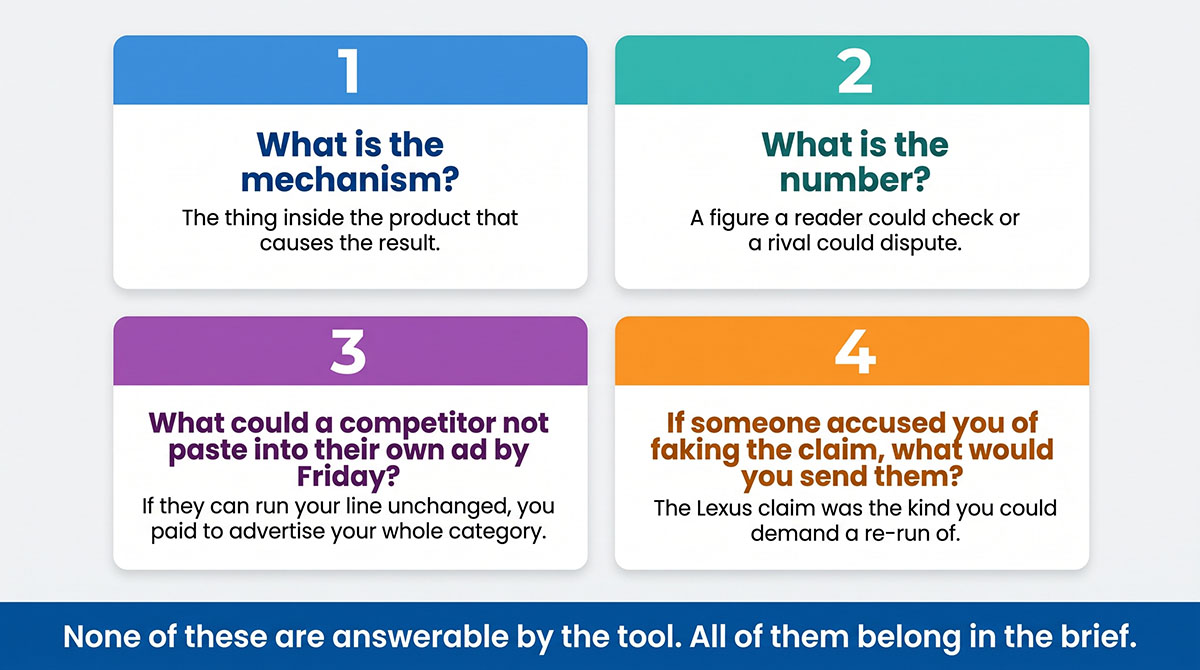
None of these are answerable by the software. All of them belong in the Knowledge Base, the brief, or the prompt before a single headline gets generated.
What is the mechanism? Name the thing inside the product that produces the result. Not the result. The thing that causes it.
What is the number? A figure, a timeframe, a tolerance, a measurement. Something a reader could check or a rival could dispute.
What could a competitor not paste into their own ad by Friday? If they could run your line without changing a word, you have written category copy and paid to promote your whole industry.
If someone accused you of faking the claim, what would you send them? The Lexus claim was the kind you could demand a re-run of, and somebody did.
If you can answer all four, the tools will turn that into ad copy in about four seconds, and the copy will be good.
If you can’t, the tools will still produce something in about four seconds. It will read well. It will match your tone. It will slide onto a competitor’s account without a single edit.
Your tone was never the scarce thing. The proof was.
Your marketing, looked at properly
Thirty minutes on your current setup — what’s working, what’s quietly leaking budget, and what I’d fix first. You’ll leave with a clearer picture whether we work together or not.
Got something specific bugging you? Flag it when you book and I’ll have it looked at before we talk.

AboutBruce Marjoribanks
Bruce Marjoribanks has spent 27 years in marketing, including building, running and selling his own agency before going independent. He now runs every channel - paid, organic, social, email, creative and automation - as one integrated system, with AI ehancing production and the judgment staying human.