
It was a slow January. The kind where you check your email more than usual, not because you’re busy but because you’re hoping something will land. A new enquiry. A referral. Anything.
And then a difficult client called.
They wanted more work done faster, at a rate that barely covered costs. They’d been a headache for months. Slow to approve, quick to complain, the type who sends a one-line email on Friday afternoon that ruins your weekend. Any sane version of this conversation ends with you holding your ground. But this wasn’t a sane conversation. This was a slow January.
So you said yes.
Not because you lacked confidence. Not because you didn’t know your worth. Because at that moment, with an empty pipeline and a rent payment due, they were the only game in town. And somewhere in the back of your mind, you both knew it.
This isn't a mindset problem
Every piece of advice about handling difficult negotiations tells you the same thing. Be more confident. Know your worth. Have a script ready. Stand firm. That advice isn’t wrong, exactly. It’s just aimed at the wrong problem.
Confidence is a lagging indicator. It’s the result of having options, not the cause of them.
Roger Fisher and William Ury ran the Harvard Negotiation Project, and their book Getting to Yes grew out of the practical work of training mediators and diplomats. Their argument is not that the strongest negotiator is the most confident or the best scripted. It’s that your power in the room comes from what happens if you walk away. They call it your BATNA, your Best Alternative to a Negotiated Agreement.
Their own phrasing is that negotiating power depends primarily on “how attractive to each is the option of not reaching agreement.” Not how well you argue. What you have waiting if the deal dies.
Why your alternative matters more than your argument
Here’s a story that stayed with me. It comes from Mary Parker Follett, the management theorist, who was telling it back in the 1920s. Fisher and Ury retell it in Getting to Yes, which is where most people meet it.
Two sisters both want an orange. A sensible parent splits it in half. Fair enough. But one sister eats the fruit and throws away the peel. The other throws away the fruit and uses the peel for a cake. A perfectly fair compromise produced two half-outcomes, when either sister could have had everything she actually needed. Nobody asked why they each wanted the orange.
Small business negotiations follow the same pattern. A customer pushes back on your price. You both dig into positions, your number versus their number, and eventually somebody blinks. But the real question, the one almost never asked, is this. What happens if this deal doesn’t happen?
If your answer is “I’ll be fine, I have other enquiries on the go,” you negotiate completely differently than if your answer is “I don’t know.” Your customer can usually feel which one is true, even if you never say it aloud. The speed of your replies. How quickly you offer a discount. Whether you push back on scope creep or quietly absorb it. All of it signals your alternative, or the absence of one.
Fisher and Ury make the point directly. Negotiating power isn’t a matter of resources or status. It comes from how good your next option is.
The numbers tell the same story
This isn’t just theory. The data on Australian small businesses makes it concrete.
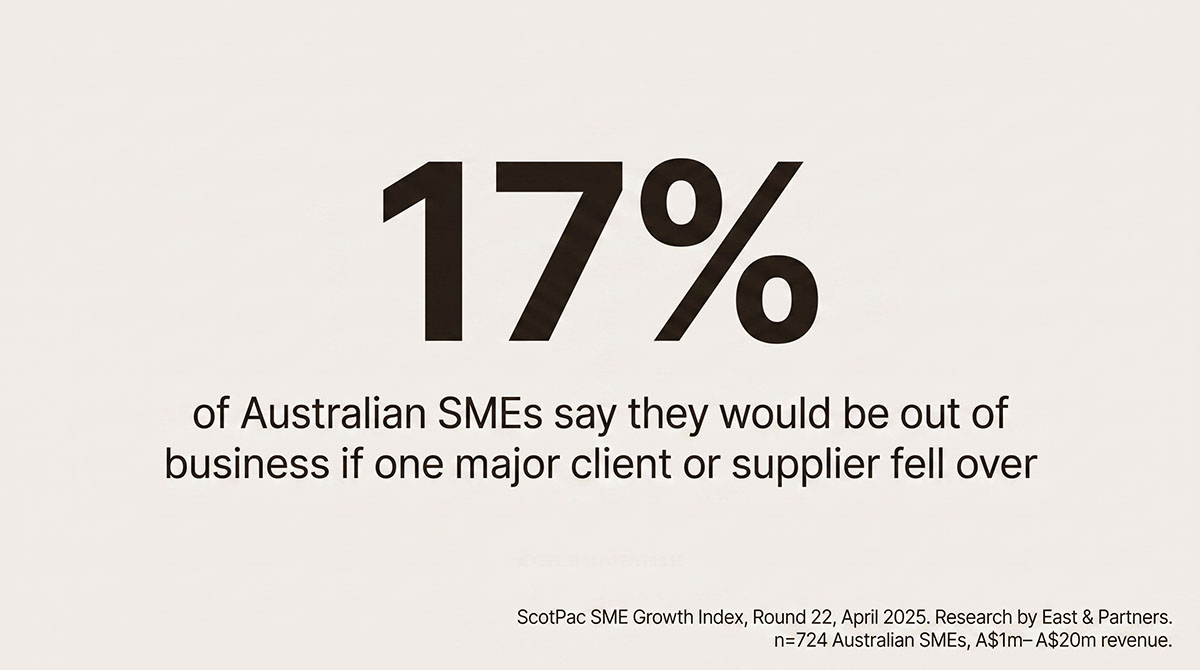
ScotPac’s SME Growth Index, published in April 2025, found that 17% of Australian SMEs believe they’d be out of business if one major client or supplier collapsed. That’s the question as ScotPac asked it, and the report doesn’t split client risk from supplier risk, so some of that 17% sits on the supply side. The number still tells you what it needs to. Almost one in six businesses are one relationship away from the end.
The same round asked what losing a key client would do to revenue. Three quarters of SMEs said it would hurt them, and among those, the average estimate was a 22% revenue hit. That’s businesses estimating their own exposure rather than anyone measuring the aftermath, which is worth saying out loud. It’s also the estimate the owner makes at 2am, and that estimate is what governs how you behave in the negotiation.
The research was run by East and Partners, who interviewed 724 businesses turning over between A$1 million and A$20 million.
Xero’s Small Business Insights tracks the other half of the same squeeze. For the March 2026 quarter, Australian small businesses waited an average of 24.1 days to be paid after issuing an invoice, and payments landed 6.9 days past the due date. Xero has since revised the wait to 24.2 days.
For businesses running on thin margins, a week’s delay isn’t a minor inconvenience. It’s involuntary financing. You’re lending money to a larger, wealthier business because you can’t afford to push back on their payment terms.
Why can’t you push back? Because stopping work, or walking away from a slow-paying client, feels impossible when they represent too much of your revenue. A weak BATNA doesn’t just hurt you in price negotiations. It shapes every interaction you have with that client, every invoice you send, every limit you fail to hold.
But I need the revenue now
Here’s where most people stop reading. Because the logical response to everything above is this. All very nice, but I have bills to pay this month.
That’s a fair objection. It’s also the trap.
Think about what that client is actually costing you. Not just in money, but in time, in energy, and in the better work you’re not doing because this one is consuming everything.
A freelance writer had a client paying $1,500 a month for almost two years. Four blog posts, predictable income, no late invoices. On paper, a solid gig. In practice: three different people reviewed every draft and never agreed with each other. She’d submit, get contradictory feedback, revise twice, and end up with something worse than she started with. Around 20 hours a month, all in.
She kept them because $1,500 felt like real money when she was building her business. “That was my rent. Losing it felt reckless.”
What finally shifted wasn’t confidence. It was arithmetic. She was earning $375 a post. She had real prospects in her niche, actual names and live conversations, who would pay closer to three times that. The same 20 hours going to the $1,500 client could be going to a $4,000 relationship. The alternative wasn’t theoretical anymore. It was sitting in her inbox.
She fired them. Called it one of the best business decisions she’d ever made.
The math is consistent across industries. A personal trainer had a client paying $2,000 a month for a premium package. By month two, the client was challenging every exercise based on YouTube videos, texting at 10 PM, cancelling sessions and demanding make-ups, showing up late. The trainer sat down and counted the hours. Once the extra messages, the make-up sessions and the emotional labour went into the column, that one client was taking more of his week than his three best clients combined.
“I realised I’d been so desperate to keep the revenue that I’d become an enabler instead of a trainer.”
He fired the client, refunded the current month, and referred him elsewhere. Within a month, three new clients replaced the income. They showed up on time, followed the program, and got results. His girlfriend said he seemed lighter.
The revenue you fear losing is often blocking the revenue you actually want.
What a strong BATNA actually looks like
Building a genuine alternative isn’t a mindset shift. It’s three specific things.
The first is lead flow. A queue of potential customers, even a short one, changes the entire dynamic of every conversation you have. When you have more interest than capacity, “no” becomes genuinely available to you in a way it simply isn’t when the pipeline is dry. This is why consistent marketing isn’t optional. It’s the structural foundation of your negotiating position.
The second is diversification. No regulator sets a line here for a business your size, but corporate finance has a working rule of thumb that’s worth borrowing. Any single customer above 10% of revenue counts as a concentration risk, and your top five customers above 25% counts as another. The 10% figure isn’t arbitrary. US accounting rules require a public company to disclose that a single customer accounts for 10% or more of its revenue, though not that customer’s name. The SEC dropped its own bright-line naming test in 2020. Ten percent is the level at which the outside world starts treating one relationship as a fact about the whole business.
Ten percent is the number to aim at. No single customer accounting for more than a tenth of your income. It’s not always achievable overnight, but it’s the direction that matters. Every new client you bring in reduces the leverage any single one holds over you.
The third is enforcing your own terms. When you have a genuine alternative, you can hold payment terms, push back on scope without apologising, and set limits that stick, because the cost of a client leaving is manageable. Without one, you can’t. Getting serious about your BATNA means getting serious about the things you’ve been quietly letting slide.
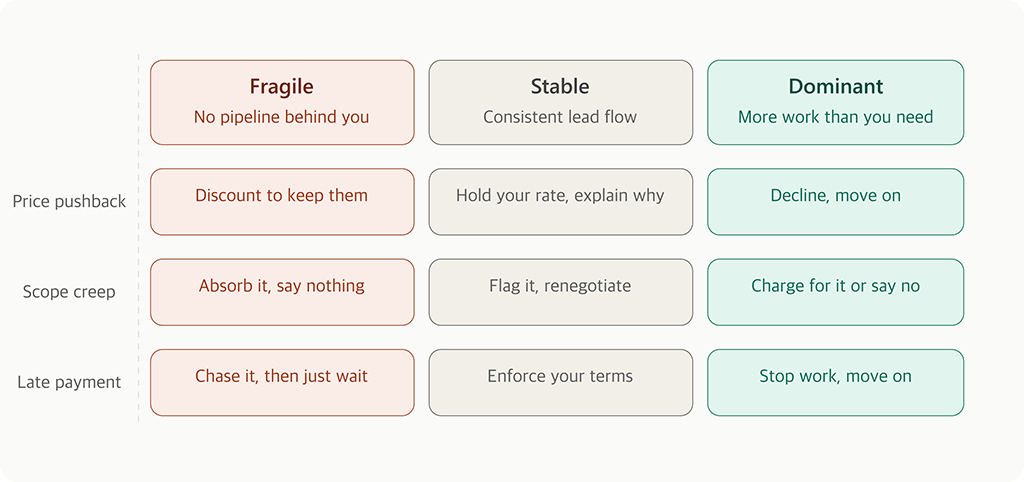
Where you sit on this spectrum is less about how you’ve been negotiating and more about what you’ve been building. The business owner with a waiting list negotiates from a completely different position than the one checking their email on a slow January, hoping something will land.
Back to that slow January
The version of you who said yes to that difficult client wasn’t weak. You were responding rationally to a structural problem. With no alternative in sight, keeping the client made sense.
The fix isn’t to be braver next time. It’s to make sure there’s an alternative next time. It’s to treat your marketing pipeline not as a nice-to-have but as the actual source of your power in every conversation you’ll ever have with every client you’ll ever work with.
Fisher and Ury wrote the book on this. Confidence barely appears in it. Having somewhere else to go does.
A slow January is a marketing problem dressed up as a negotiation problem. Solve the marketing problem first, and the negotiations largely take care of themselves.
Your marketing, looked at properly
Thirty minutes on your current setup — what’s working, what’s quietly leaking budget, and what I’d fix first. You’ll leave with a clearer picture whether we work together or not.
Got something specific bugging you? Flag it when you book and I’ll have it looked at before we talk.
Sources
- ScotPac SME Growth Index, Round 22, April 2025. Research by East & Partners, n=724 Australian SMEs with A$1m–A$20m annual revenue. The 17% figure covers a major client or supplier failing; the report does not separate the two. The 22% is the average revenue loss estimated by the 76% of SMEs who said losing a key client would harm them.
- Xero Small Business Insights, Australia. March quarter 2026: 24.1 days average time to be paid as first reported, since revised to 24.2; 6.9 days late, as reported in the June quarter release describing the prior quarter.
- Roger Fisher and William Ury, Getting to Yes, Harvard Negotiation Project.
- The orange parable originates with Mary Parker Follett, 1920s.
- Customer concentration: ASC 280-10-50-42 requires a public entity to disclose that a single external customer accounts for 10% or more of revenues, along with the amount and the reporting segment, but expressly does not require the customer’s identity. The SEC removed the bright-line naming test from Regulation S-K Item 101 in the 2020 amendments (Release 33-10825); the current text refers only to any dependence on customers. The top-five-above-25% figure is a corporate finance rule of thumb, not a rule.

AboutBruce Marjoribanks
Bruce Marjoribanks has spent 27 years in marketing, including building, running and selling his own agency before going independent. He now runs every channel - paid, organic, social, email, creative and automation - as one integrated system, with AI ehancing production and the judgment staying human.