
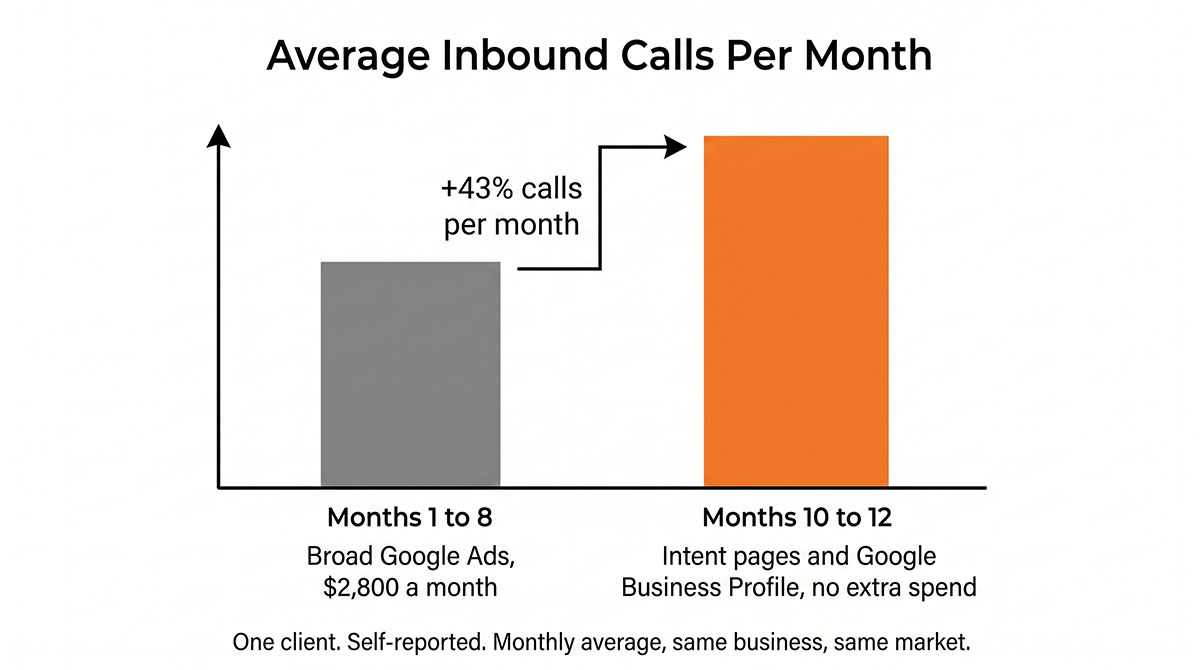
Mark spent $2,800 a month on Google Ads. He followed the targeting recommendations. He hired someone to write the copy. He ran it for eight months.
The phone rang. Sometimes.
Not enough. Never consistently enough to justify the spend or the anxiety that came with it. So he did what most business owners do when marketing isn’t working. He assumed he needed more of it. Better creative. A bigger budget. A stronger message.
He was wrong about all of it. Not because the ads were bad. Because he was solving the wrong problem entirely.
Mark is a client of mine. He runs a plumbing business in a mid-sized US city, and every number in this piece is his, self-reported, from his own account.
The belief that’s costing small businesses the most money
There’s a belief buried so deep in how small businesses think about marketing that almost nobody questions it. It goes like this: marketing’s job is to convince people.
You make something good. Most people don’t know about it yet. So you get in front of them, tell them why it’s great, and persuade enough of them to buy. You run ads. You post content. You build awareness. You educate the market.
It sounds right. It feels like strategy. And for most small businesses it is the reason the marketing budget keeps underperforming.
You cannot talk someone into needing a plumber
Most of the people who will ever buy from you are not buying today. They haven’t hit the problem yet. Or they have and it isn’t urgent. Or it’s urgent and they already called someone else this morning.
No amount of clever copy moves a person from “not thinking about this” to “ready to spend money” on your schedule. They buy when the water heater fails.
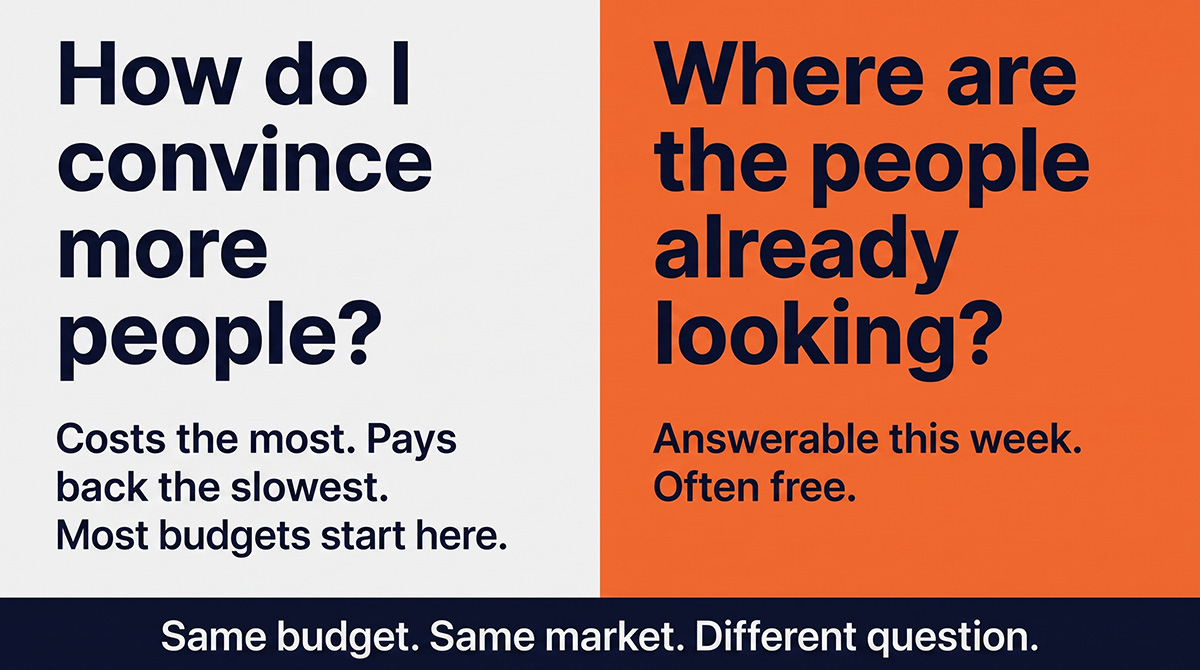
That sounds bleak. It’s the opposite. It means the question was never “how do I convince more people?” The question is simpler and far cheaper to answer: where are the people who are already looking, and am I in their path?
Eugene Schwartz, a copywriter and theorist rather than a researcher, put it flatly in 1966. Copy “cannot create desire for a product.” It can only take the hopes, fears and desires already sitting in millions of people and aim them at one particular product. (Breakthrough Advertising, 1966.) The copywriter’s job isn’t to manufacture want. It’s to meet want where it already lives.
What has changed since 1966 is the cost of finding it. AI has made locating an existing want, an active search, a hand already in the air, cheaper and more precise than at any point in the history of the trade.
What Mark did differently, and why it worked
Think about what Mark was buying with that $2,800 a month.
Google Ads runs on a targeting radius and a keyword match. You cast wide, you pay for every click, and you hope the person clicking had already decided to spend money rather than idly reading. It’s a volume game. You need enough impressions to surface enough intent to justify the spend. Without an enterprise budget behind it, that’s an expensive way to fish in the wrong part of the lake.
What Mark switched to wasn’t more marketing. It was a different question.
He built service pages around the exact phrases people type once they’ve already decided to call someone: emergency plumber near me, water heater replacement cost, licensed plumber open now. He completed his Google Business Profile, which is the first thing I fix for any local service business, so he appeared while the pipe was still leaking. He automated review requests so proof kept stacking up without him chasing it.
Across the next three months he averaged 43% more calls a month than he had across the eight months of ads. Zero additional ad spend.
He hadn’t convinced anyone of anything. He’d got better at being present in the moment the want was already there.
AI made this affordable for businesses without an enterprise budget
Five years ago, watching the places where intent surfaces meant either hours of manual work or software priced for corporate procurement. Google Search, Reddit, local Facebook groups, review sites, niche forums. Neither route was realistic on a $3,000 marketing budget.
Today a solo operator can run tools that scan those channels continuously for the signals that come before a purchase. Someone asking “who knows a good accountant?” in a local Facebook group. A one-star review on a competitor’s profile from a customer who is clearly ready to switch. A Reddit thread asking for recommendations in your exact category. Those arrive in an inbox each morning for well under $100 a month.
Here is what that stack actually costs. Syften starts at $29.95 a month for Reddit and forum monitoring. YouTube and social sit on the tiers above, so the full configuration runs closer to $49.95. F5Bot covers Reddit, Hacker News and Lobsters for nothing. Google Business Profile captures local search intent at the moment it peaks and costs nothing. Apollo.io’s free plan opens a contact database the company puts at over 240 million, with buying intent included but capped at three topics.
Every one of those figures comes from the vendor. Prices move. Check them before you commit.
The trade changes. The question doesn’t. Stop trying to talk the market into buying. Start showing up for the part of it that already decided.
Speed belongs in the same conversation. A whole software category now sells on response time, and the numbers those companies publish are their own marketing rather than independent research, so I won’t quote them at you. The logic survives without them. A buyer who has just raised a hand is comparing you against whoever answers first. If that isn’t you, your marketing worked. For someone else.
That’s demand capture. Finding desire, not manufacturing it.
"But what if I'm building something genuinely new?"
Here’s the objection, and it’s a fair one.
Some of you are building something new. Your customers don’t know your solution exists. There’s no search traffic for what you do because nobody knows to search for it. Nobody is posting on Reddit asking for your service because they don’t have the words for it yet.
If that’s you, doesn’t someone have to create the demand? Doesn’t education have to come before capture?
Sometimes, yes. But the principle holds, because even category creators aren’t manufacturing desire from nothing. They’re finding a desire that already exists and giving it a name.
Steve Jobs didn’t create the wish to carry the internet, a music library and a camera in one pocket. People were already lugging iPods and cursing their BlackBerrys. He found the frustration that was already there and built the thing that resolved it.
If you’re genuinely building something new, your first question still isn’t “how do I create demand?” It’s “what existing frustration does this fix, and where do the people who feel it already gather?” The channel changes. The question doesn’t.
And for most small service businesses, plumbers, coaches, accountants, consultants, agencies, tradespeople, the want already exists in abundance. People already need what you do. They’re already searching for it. The gap isn’t awareness. It’s interception.
Where to start this week
The tools exist and none of this requires an overhaul. Here’s the shortest path to a working capture engine.
Step one: claim and complete your Google Business Profile. In my experience it is the highest-return free action available to a local service business. It decides whether you appear when intent peaks, on the emergency searches, the “near me” searches, the queries people type once they’ve already agreed to spend money. Complete every field. Post weekly. Request a review after every job.
Step two: set up one intent alert. F5Bot is free and will monitor Reddit for your service category and your city. Google Alerts covers competitor names and the problems you solve. Spend five minutes each morning on the results. When someone posts a hand-raise, “looking for a recommendation,” “who does everyone use for,” answer like a person who knows the answer, not like a salesperson.
Step three: audit your three highest-traffic pages for intent match. Open Google Search Console and find the queries already bringing people to your site. If those queries are informational and your pages don’t answer buying-stage questions, how much does it cost, best in city, you have a gap. Rewrite one page this week to match what the people already finding you actually want.
Three steps. Zero ad spend. One week. The people who need you this month are already looking. The only question is whether you’re standing where they look.
The cost of getting this backwards
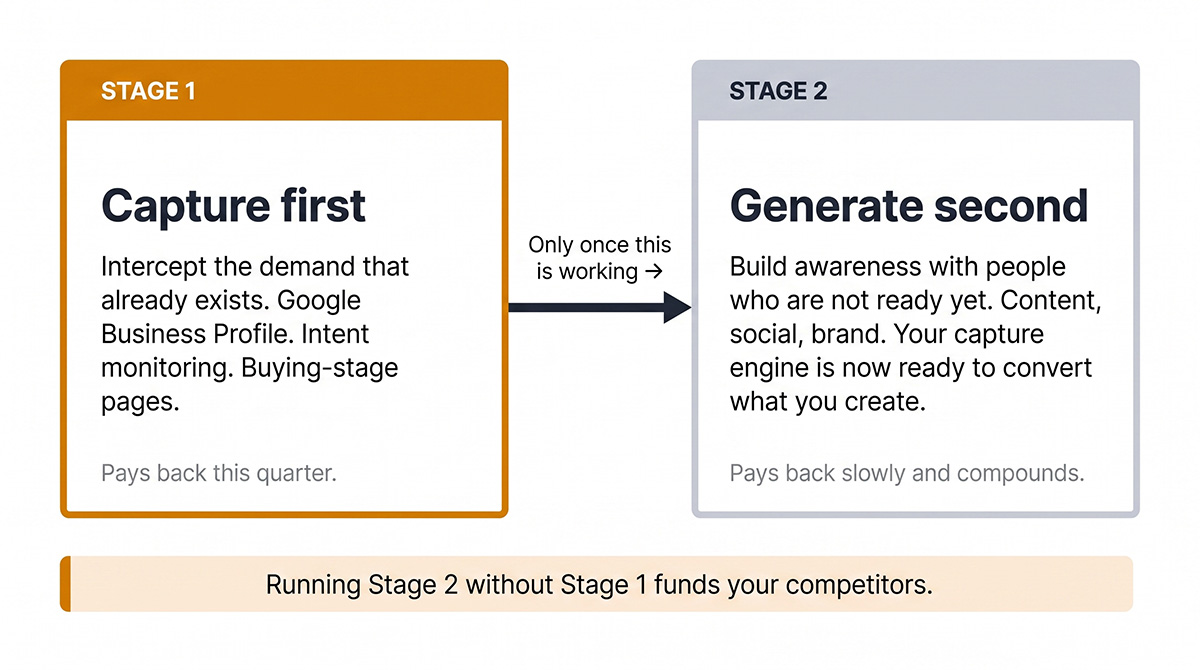
Every dollar you spend on demand generation without a capture engine in place isn’t wasted. It’s gifted.
You run the awareness campaign. You build the content. You generate the interest. Then someone in your market who has quietly been fixing their Google Business Profile, running the monitoring alerts, building pages around buying-stage queries, intercepts the buyer at the moment of search. Your awareness. Their sale.
Demand generation without demand capture subsidises your competitors. It’s the marketing equivalent of filling someone else’s pool.
The sequencing decides everything: capture first, then generate. Build the infrastructure to intercept the demand that already exists. Make sure you’re present when people are already searching. Then, once that’s working and the people searching this week are finding you reliably, put money into awareness for everyone who isn’t ready yet.
That second stage is not optional. Binet and Field’s analysis of 996 case studies in the IPA Databank found the two things behave differently over time: activation produces a fast spike that decays almost as fast, while brand building starts slowly and compounds. Skip it long enough and you cap yourself. (The Long and the Short of It, IPA, 2013.)
What their work doesn’t tell you is which to build first, because it was measuring campaign budget splits, not startup order. That part is mine, and it’s a cash-flow argument rather than an effectiveness one. Capture pays this quarter and costs almost nothing. Awareness with no capture engine underneath it is a gift to whoever built one.
Mark worked this out in month nine. The question he’d been asking, how do I convince more people, was never going to get him there. The question that changed everything was smaller.
Where are the people who are already looking?
That’s the only marketing question that pays off in a hurry. AI has just made the answer easy to find.
Your marketing, looked at properly
Thirty minutes on your current setup — what’s working, what’s quietly leaking budget, and what I’d fix first. You’ll leave with a clearer picture whether we work together or not.
Got something specific bugging you? Flag it when you book and I’ll have it looked at before we talk.

AboutBruce Marjoribanks
Bruce Marjoribanks has spent 27 years in marketing, including building, running and selling his own agency before going independent. He now runs every channel - paid, organic, social, email, creative and automation - as one integrated system, with AI ehancing production and the judgment staying human.