
“Down goes you, down goes your career as a leading man. Or do you go to Rome and star in Westerns and win fucking fights?”
That’s 24 words. It’s spoken by a fictional Hollywood agent named Marvin Schwarz in Quentin Tarantino’s Once Upon a Time in Hollywood. And it’s one of the most structurally perfect sales pitches ever put on screen.
Not because of what Schwarz says in those 24 words. Because of what he does in the three minutes before them.
Here’s what Schwarz doesn’t do: he doesn’t walk into the bar and pitch Rome. He doesn’t open a deck. He doesn’t list the benefits of the Italian film industry, the shooting schedule, the pay bump. He doesn’t mention Rome at all—not for the first 80% of the conversation.
Instead, he does something most small business owners never think to do when they’re writing a proposal, drafting an email, or sitting across from a potential client.
He builds two futures. And he makes damn sure one of them hurts.
The architecture of a three-minute pitch
Watch what Schwarz actually does, beat by beat.
He opens with flattery—but not generic flattery. Specific flattery. He watched Rick Dalton’s films in a private screening room. On 35mm prints. His wife loved the western so much they watched it over dinner. Then he stayed up late, alone, with a cognac, rewatching The Fourteen Fists of McCluskey. He even quotes specific scenes. Acts them out.
This isn’t small talk. It’s strategic positioning. Schwarz is establishing that Rick Dalton has real value—value that Schwarz personally recognizes and appreciates. He’s building the pedestal before he pushes Rick off it.
Then comes the pivot. Schwarz asks a casual question: “You always play the bad guy on these shows?”
Rick says yes. He’s the heavy. Of course he loses the fight at the end—that’s the gig.
And here’s where Schwarz does something brutal. He names the pattern Rick can’t see.
You take a new actor like Scott Brown, he explains. You want to build his credibility. So you hire someone from a cancelled show to play the villain. The audience watches the new guy beat the old guy. But what they’re really seeing? Bingo Martin whipping Jake Cahill’s ass. The character wins, but the actor loses. Every week, a different show. A different rising star using Rick Dalton as a stepping stone.
Schwarz doesn’t say “your career is declining.” He makes Rick see the decline—week by week, show by show, punch by punch. Mannix. The Man from UNCLE. The Girl from UNCLE. Batman and Robin. Each name is a specific, vivid humiliation Rick can picture himself living through.
Then—and only then—does he offer the exit.
“Or do you go to Rome and star in Westerns and win fucking fights?”
One sentence. Fifteen words. That’s the entire pitch for the alternative future.
Why the pain gets a monologue and the gain gets a sentence
This isn’t sloppy writing. It’s instinctive behavioral economics.
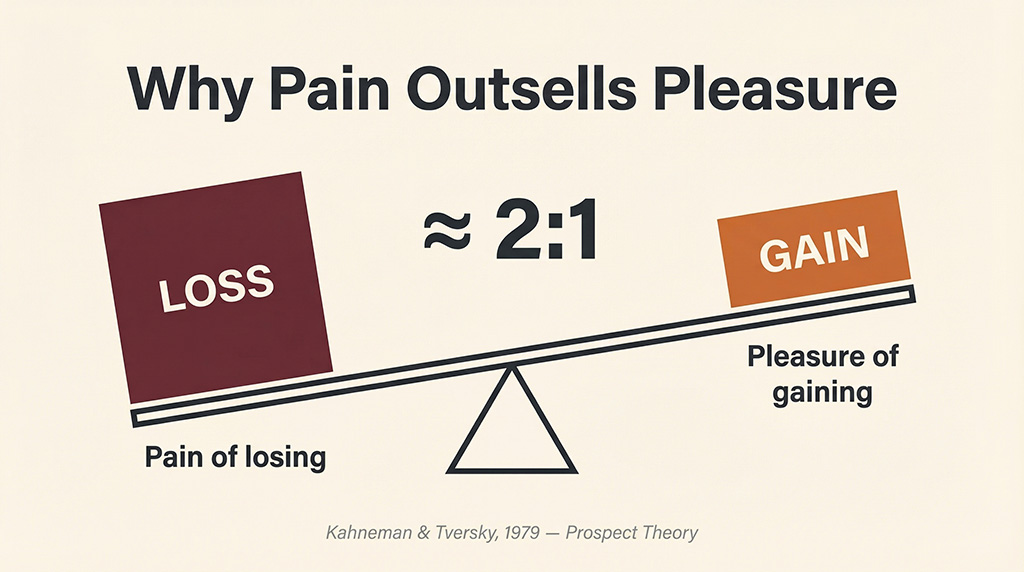
In 1979, psychologists Daniel Kahneman and Amos Tversky published a paper that would eventually win the Nobel Prize. Their finding, known as prospect theory, is simple to state and profound in its implications: the pain of losing something is psychologically about twice as powerful as the pleasure of gaining the equivalent.
Lose $1,000 and the only thing that compensates for that feeling is gaining $2,000. The asymmetry is roughly 2:1, and it holds across cultures, income levels, and contexts.
Schwarz’s pitch is structured exactly along this ratio—whether he knows it or not. The dark future (career humiliation, public decline, being a punching bag for every new face on network TV) gets two full minutes of vivid, specific detail. The bright future (Rome, leading roles, winning) gets one line.
He doesn’t need to sell Rome. He just needs to make staying unbearable.
You've already seen this technique make $2 billion
Schwarz’s pitch might be fictional, but the structure isn’t. The most successful sales letter in advertising history runs on the same architecture.
In 1975, a copywriter named Martin Conroy sat down to write a subscription pitch for The Wall Street Journal. What he produced was 775 words—a simple story about two young men who graduated from the same college on the same beautiful spring afternoon.
Same ambitions. Same company. Same starting line.
Twenty-five years later, they return for their reunion. Both happily married. Both with three children. Both still at the same company.
But one is a department manager. The other is the company president.
That letter ran for 28 years with almost no changes. It generated an estimated $2 billion in subscriptions—roughly $2.58 million per word. Scores of copywriters were hired to beat it. None succeeded.
And the letter barely mentions The Wall Street Journal itself. It doesn’t list features. Doesn’t quote subscription rates until the back page. Doesn’t talk about editorial quality or reporting depth. The entire selling mechanism is the gap between two futures: the man you could become, and the man you’re becoming right now.
Same structure as Schwarz. Build parity. Reveal divergence. Let the reader sit in the discomfort of which one am I?
The product is almost an afterthought. The vision does the selling.
"But I'm a plumber, not a Hollywood agent"
Right. You’re not delivering monologues in hotel bars, and your quotes don’t need to win Oscars. But here’s the thing: you’re already writing two-futures pitches. You’re just writing them badly.
Look at most small business quotes. They read like spec sheets. Here’s what we do. Here’s how long it takes. Here’s what it costs. That’s a parts list—and parts lists ask the customer to do all the emotional work of imagining why those parts matter.
Now imagine restructuring the same quote using Schwarz’s architecture.
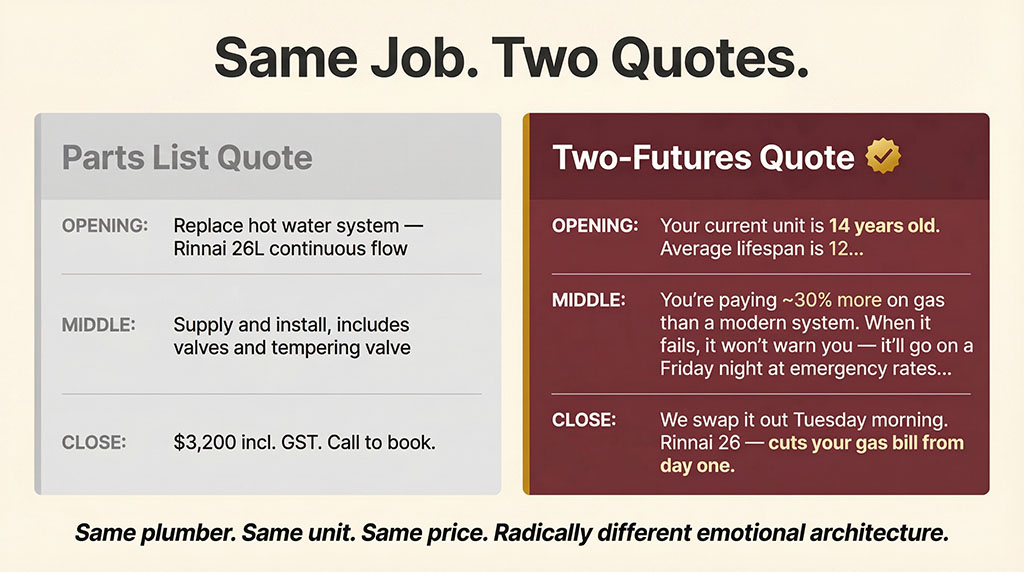
Instead of: “Replace hot water system — Rinnai 26L continuous flow unit, supply and install, $3,200 including GST”—
You write: “Your current unit is 14 years old. The average lifespan is 12. Right now it’s running, but every month it stays in, you’re paying roughly 30% more on gas than a modern system costs to run — and when it fails, it won’t give you a warning. It’ll go on a Friday night when every emergency plumber in town is charging double. We swap it out Tuesday morning for a Rinnai 26 that cuts your gas bill from day one.”
One version describes a part and a price. The other describes two futures — the slow bleed you’re ignoring and the quick fix that stops it. The pain future is specific: 14 years old, 30% gas penalty, Friday night emergency callout. The bright future is brief: Tuesday morning, lower bills immediately.
You don’t need to oversell the solution when the problem is vivid enough.
The framework you can steal
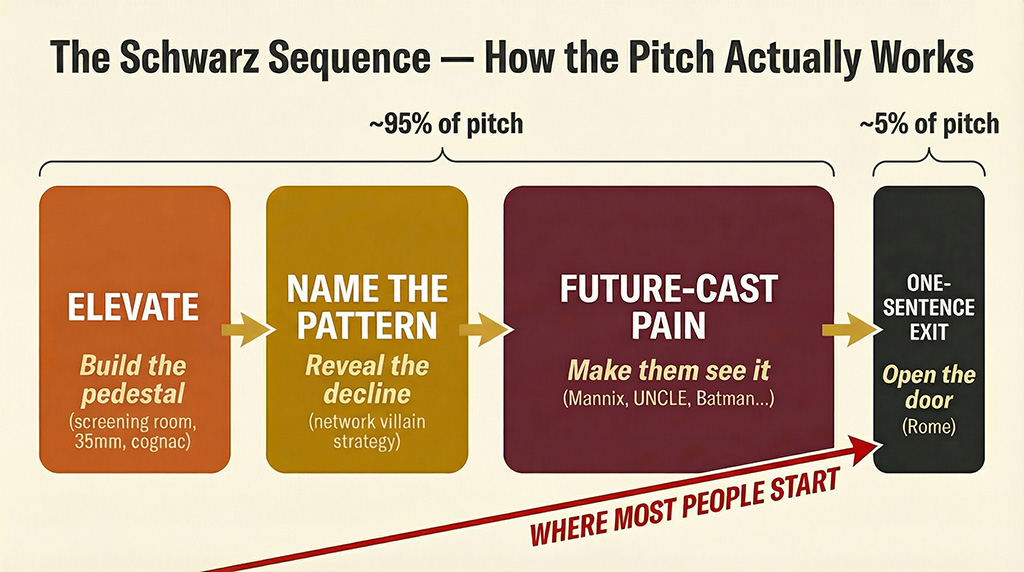
Here’s the structure, stripped to its bones:
Step one—Establish value. Schwarz watches the films. Conroy makes both graduates successful. You demonstrate that you understand the client’s business, their strengths, what they’ve built. This isn’t flattery. It’s positioning. You’re earning the right to deliver bad news.
Step two—Name the pattern they can’t see. Schwarz identifies the network strategy of using Rick as a punching bag. Conroy creates the invisible divergence between two identical starting points. You identify the specific, concrete trend that’s working against them—and you name it with enough specificity that they can’t dismiss it as generic sales talk.
Step three—Future-cast the pain. Make it sequential, specific, and escalating. Not “things could get worse.” Instead: “Here’s what next month looks like. Here’s what six months looks like. Here’s what a year looks like.” Give the dark future more space, more detail, more emotional weight than the solution. The 2:1 ratio isn’t a suggestion—it’s how the brain processes risk.
Step four—Offer the exit in one sentence. Rome. The Wall Street Journal. Your service. Keep it short. If the pain future is vivid enough, you don’t need to hard-sell the alternative. You just need to open the door.
The part most people get backwards
Most proposals, most emails, most landing pages spend 80% of their space on the solution and 20% on the problem. Schwarz does the opposite. Conroy does the opposite. Prospect theory explains why the opposite works: because humans are twice as motivated to avoid a loss as they are to pursue an equivalent gain.
You don’t need a better pitch for what you do. You need a more vivid picture of what happens if they don’t.
Schwarz understood this. Conroy understood this. And neither of them needed to read a psychology textbook to figure it out—they understood it the way anyone who’s sold anything eventually does. People don’t move toward opportunity. They move away from a future they can’t stomach.
Down goes you, down goes your career as a leading man.
Or do you go to Rome?
Your marketing, looked at properly
Thirty minutes on your current setup — what’s working, what’s quietly leaking budget, and what I’d fix first. You’ll leave with a clearer picture whether we work together or not.
Got something specific bugging you? Flag it when you book and I’ll have it looked at before we talk.

AboutBruce Marjoribanks
Bruce Marjoribanks has spent 27 years in marketing, including building, running and selling his own agency before going independent. He now runs every channel - paid, organic, social, email, creative and automation - as one integrated system, with AI ehancing production and the judgment staying human.