
It's not price. It's not quality. It's a word in the dictionary you've probably never thought about.
She’d been a client for four years. Paid on time. Sent two referrals without being asked. Never once complained about price.
Then she didn’t renew.
The business owner sent a discount offer. She didn’t respond. He assumed she’d found someone cheaper, wrote it off as a competitive market, and moved on.
Six months later he ran into her at a networking event. She’d moved to a competitor. He asked what happened.
“You never once checked in,” she said. “Not in four years.”
Pull up a dictionary. Not a marketing blog — an actual dictionary.
Look up customer: a person who buys a commodity or service.
Now look up client: a person under the care and protection of another.
Most business owners have spent years building a base of customers while believing they were building a base of clients. Those aren’t the same thing. And the gap between those two definitions is where most long-term relationships quietly end.
Jay Abraham — who spent four decades consulting businesses across hundreds of industries — built an entire philosophy around this distinction in How to Think Like a Marketing Genius. His argument: the moment you genuinely see a client as someone under your care — not just someone who pays your invoices — everything changes. What you proactively share. What you push back on. What you feel responsible for when a job is done.
Most businesses have never made that shift. Most don’t realise there’s one to make.
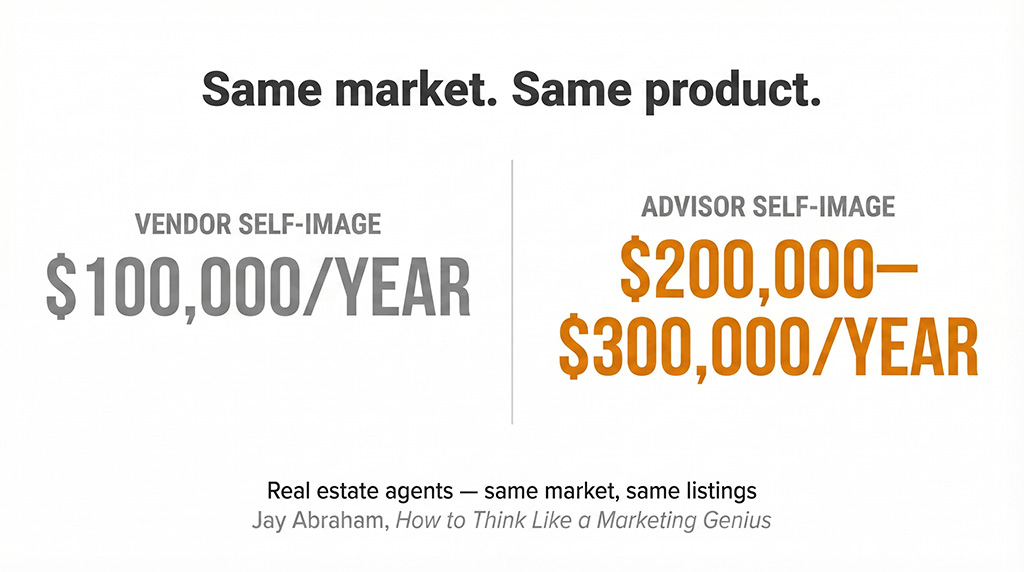
The consequences show up in the numbers. Abraham’s work with real estate agents found the single biggest factor separating agents earning $100,000 a year from those earning $200,000 to $300,000 wasn’t their listings, their negotiation skills, or their marketing spend. It was whether they saw themselves as commodity salespeople or as the most trusted advisor their client had in property. Same market. Same product. The self-image determined the income.
Two things advisors do that vendors never think to
The distinction isn’t philosophical. It shows up in specific behaviours — usually small ones — that compound over time.
Advisors share things clients didn’t ask for.
A vendor delivers what was ordered. An advisor notices something on the way out the door and mentions it. Not because there’s a sale in it. Because it’s relevant to the client’s outcome and they’d want to know.
The accountant who sends a two-line email in March — “there’s a change to the instant asset write-off threshold that affects businesses your size, worth a conversation before EOFY” — isn’t pitching. They’re protecting. That’s what being under someone’s care looks like in practice.
Advisors push back when clients are about to make the wrong call.
This is the counterintuitive one. Abraham’s phrasing in the book is blunt: “You will never, ever again, take the order just because they’re willing to buy.”
A vendor takes whatever the client offers. An advisor takes responsibility for the outcome. Those are different jobs with different dynamics and, eventually, very different retention numbers. The advisor who tells a client “that’s not what you need right now” — even when it costs them the transaction — is the one that client calls back in six months.
Now here's the objection
You’re thinking: I’m not a consultant. I run a plumbing business. A cleaning company. A bookkeeping practice. My clients hired me to do a job — fix the pipe, clean the office, file the return. They don’t want me checking in. I’ll come across as needy. Or worse, like I’m fishing for more work.
That instinct is understandable. It’s also wrong in a specific way worth unpacking.
The vendor who calls to check in is fishing for more work. The client can feel it. The question is perfunctory. The interest is conditional. It reads as a sales call with a thin layer of warmth over the top.
The advisor who calls has a different purpose. They’re asking because they have a genuine stake in how things landed. Whether the campaign generated the leads that were needed. Whether the new system is actually working for the team using it every day. Whether anything has changed that’s worth knowing about.
Same call. Completely different energy. Clients know the difference within about thirty seconds.
We see this consistently with the service businesses we work with. The ones struggling with repeat business almost always say the same thing: “I do great work, the client was happy, and then they just didn’t come back.” The work was fine. The relationship was a transaction.
Abraham’s finding, after four decades and hundreds of consulting engagements: “Your clients want to feel like you worry about them.” Not in a hand-holding way. In the way a good doctor worries about a patient between appointments. Because the outcome matters – not just the procedure.
Same action, different intent
Vendor
Advisor
Checking in
Following up to see if there's more work available
Calling to see how the result actually landed
Pushing back
Never — the client knows what they want
Sometimes — because their outcome matters more than the sale
Sharing information
When asked
When relevant — asked or not
Measuring success
Invoice paid, job complete
Client better off than before I started
What the advisor model looks like in practice
This isn’t about adding hours to your week. The behaviours that separate advisors from vendors are mostly about orientation, not workload.
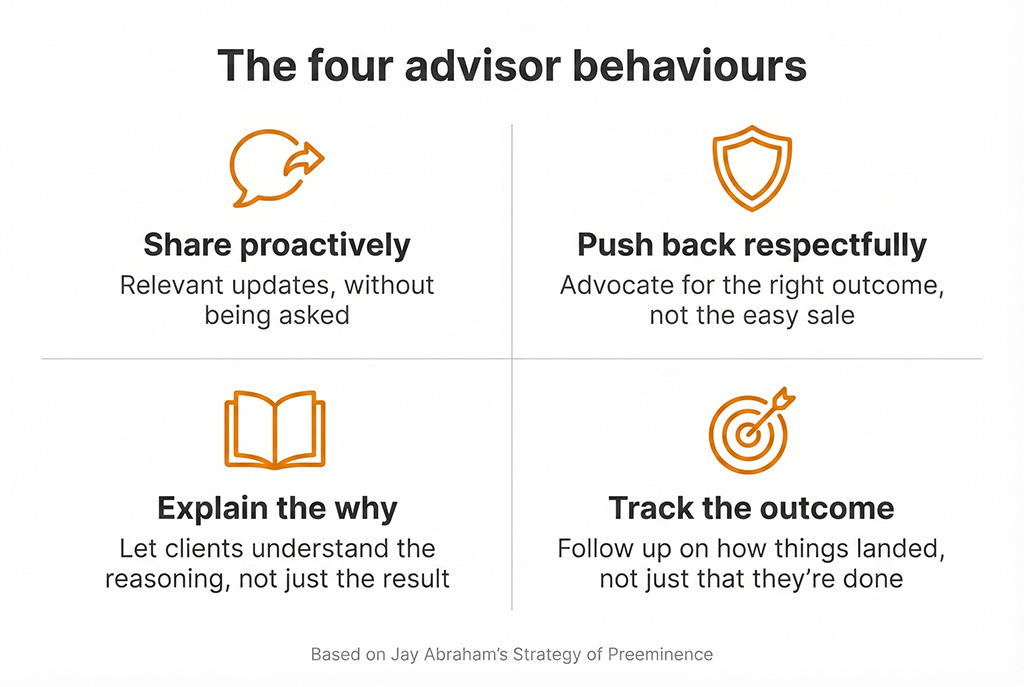
Share relevant information proactively. Not a newsletter. A specific message when something changes that directly affects this client. The regulatory update. The market shift. The thing you noticed on the last job that’s worth a second look. One email. Ten minutes. The signal it sends lasts months.
Push back when it matters. When a client is about to spend budget on something that won’t work, buy less than they need, or make a decision on wrong information — say so. Not to protect the sale. To protect the outcome. This is what Abraham calls operating as their “ultimate trusted advisor” — advocating for what’s actually in their interest, not waiting to be asked.
Stop explaining what and start explaining why. Abraham found a direct correlation between how much a client understood about why something was being done and how deeply they trusted the result. The plumber who walks through the reasoning behind a particular fix — not just what they’re doing — creates a client who doesn’t need three comparison quotes next time. Transparency builds loyalty faster than results alone.
Call about the outcome, not the invoice. The cleaning company that calls three months into a new contract — “is the schedule still working for the team, or has anything shifted?” — is doing something most competitors never bother with. That one call signals something the contract never could: the relationship didn’t end when the paperwork was signed.
The four-question vendor audit
Run through these honestly. A “no” in any area means you’re operating as a vendor there — and your clients can feel it.
1. When did you last contact a current client about something that had nothing to do with a sale or a problem? If you can’t remember, they can’t either. That silence reads as indifference.
2. Have you ever talked a client out of buying something because it wasn’t right for them? If the answer is never, you’re not protecting their interests. You’re processing their orders.
3. Do your clients understand why you do what you do, not just what you do? If not, they have no basis for loyalty beyond whether this particular job went smoothly.
4. If your best client left tomorrow, what reason would they give? “We grew apart” means you didn’t grow with them. “They never really checked in” means exactly the same thing, said differently.
The four-question vendor audit
A "no" in any area means you're operating as a vendor there — and your clients can feel it.
1
When did you last contact a current client about something that had nothing to do with a sale or a problem?
Your answer
2
Have you ever talked a client out of buying something because it wasn't right for them?
Your answer
3
Do your clients understand why you do what you do, not just what you do?
Your answer
4
If your best client left tomorrow, what reason would they give?
Your answer
Based on Jay Abraham's Strategy of Preeminence — untappedprofits.co
The second story
Same client. Four years of on-time payments and referrals sent without being asked.
Three weeks before her renewal, her provider called. Not to talk about the renewal. To ask how the last six months had landed — whether the leads had been the right quality, whether the team had enough pipeline going into the next quarter, what she was thinking about for the year ahead.
She renewed. Brought in a referral the following month. Has been a client for seven years.
The difference between that story and the first one isn’t marketing. It’s not pricing strategy or service quality or a better proposal template.
It’s the word in the dictionary.
Ready to shift from vendor to advisor with your existing clients?
We work with service businesses to build the positioning and follow-up systems that turn good work into long-term relationships.
Book Your Audit →