
Imagine the agent ran all night. By 7am it’s produced forty video variants – captions burned in, three hooks each, every aspect ratio sorted for every placement. Polished. Fast. Genuinely impressive work.
And all forty are built on an angle you’d have killed in ten seconds.
Nobody checked whether the idea underneath them was any good, because nobody was asked to. You handed the machine a goal and let it run the whole chain – concept to finished asset – exactly the way the demos tell you to. And it did. It just ran in the wrong direction, beautifully, forty times over.
That morning is the one the end-to-end pitch never shows you. It’s also the one I’ve built my entire process to avoid – not by automating less, but by automating in a very particular shape.
The pitch is good. That's the problem.
The most seductive thing in marketing software right now is the end-to-end agent. Connect your channels – ads, email, CRM, analytics – hand it a goal, and let it plan, build, publish, and tune on its own. The screenshot that sells it is eleven platforms lit up green, all connected, all feeding one tireless operator that works while you sleep.
The tooling is real. This isn’t a slide deck promising something that doesn’t exist yet. Marketing teams running at least one autonomous agent in production roughly doubled in six months – from around 14% of enterprises in late 2025 to 34% by early 2026, per HubSpot’s and Salesforce’s 2026 marketing surveys. The models got reliable enough for multi-step work. The plumbing standardised. The agents ship actual output.
So when someone says “run your entire operation from one terminal,” they’re not lying. The capability is here.
But look one layer past the headline and the picture changes. Even now, the 2026 State of AI Content Marketing report puts the share of teams running agents that genuinely make their own decisions at about a quarter, and McKinsey has barely 7% of marketing teams fully scaling agentic work. The honest summary, even from the bullish reports, is that most teams are still babysitting the thing. And the agents themselves are mostly modest – pulling reports, summarising data, drafting content briefs. The top production use case is generating SEO outlines, not steering campaigns. “Runs an agent” rarely means “lets one decide.” Which raises the obvious question the demo skips: if the capability is real, why is almost nobody actually letting it off the leash?
What the demo quietly assumes
The end-to-end pitch treats one thing as if it were single: the work.
There’s a reason it gets built this way. These systems are made by engineers, and to an engineer a completed task is a job done – the function returned, the asset rendered, no errors thrown. To a marketer, a completed task is just a thing that now has to go and earn its keep. The job isn’t done when the forty variants exist. It’s done when one of them works.
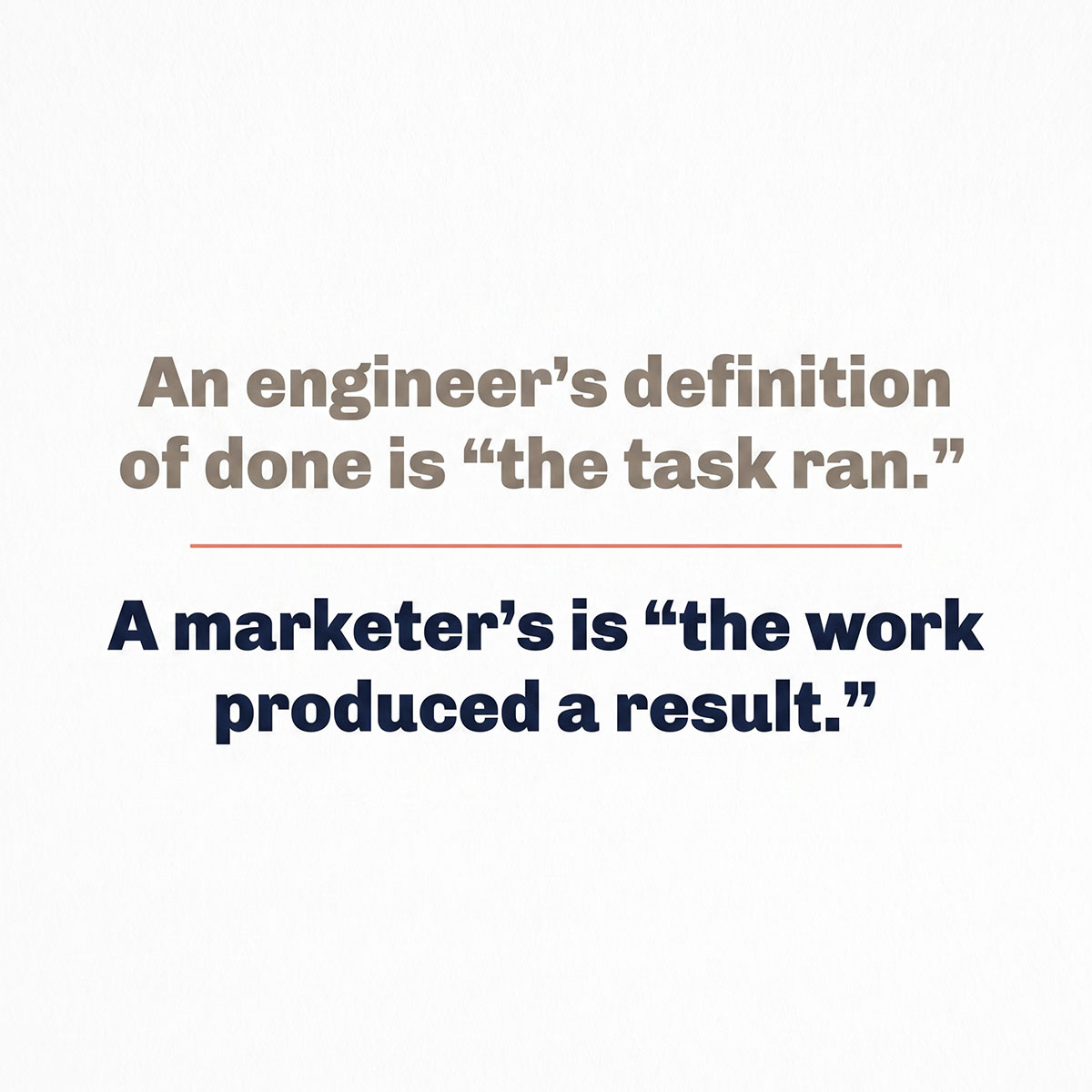
That blind spot is why the pitch treats the work as one continuous run. It isn’t. Creative work moves in phases, and anyone who’s done it knows the shape. First you get the angle right. Then the copy and the scripts. Then the images and the video. Each phase is a real stop, not a formality – and here’s the part the demo glides past: every phase’s output becomes the next phase’s input.
That changes where a mistake actually costs you.
A wrong angle isn’t one wrong thing. Run it forward automatically and it becomes fifteen scripts and forty video variants – forty assets built on a foundation you’d have thrown out at the gate. The cost was never the bad angle. It’s everything stacked on top of it before anyone looked.
Which means the boundary between phases was never a quality checkpoint. It’s where you change direction. It’s the moment you see what you’ve got and decide the script’s funnier with the setup cut, or that the whole thing should be a customer testimonial instead of a product demo. Pull that gate out and you don’t lose error-catching. You lose steering – the exact thing that made working in phases worth doing.
And look again at what the overnight run was allowed to invent: the angle itself. The one decision every later phase inherits was treated as just another step in the chain – something the machine generates at 2am, somewhere between the captions and the aspect ratios. Hold that thought. It’s the whole problem, and we’ll come back to where that decision actually belongs.
"So you've just got a fast intern"
I know the objection, because it was mine.
If a human has to bless every phase, you don’t have automation. You’ve got a quick assistant. The whole promise – the reason you’d buy any of this – was the agent running while you sleep, untouched. Gate every boundary and you’ve handed all that speed straight back. You’re babysitting the machine you bought to stop babysitting things.
Fair. And wrong about where the leverage lives.
The speed was never in chaining the phases together. It’s inside a single phase. Give an agent one committed angle and it’ll hand you thirty hooks, fifteen thumbnail concepts, ten script directions – in the time it takes to make a coffee. That’s the gain. It’s enormous. And it’s all still cheap, throwaway, reversible: hate all thirty hooks and you’ve lost a minute, nothing more.
The gate between phases costs you ten seconds of looking. Skipping it costs you forty variants on a dead idea. You don’t lose the leverage by adding the gate. You aim it.
Automate inside the phase. Gate between them.
That’s the whole rule. Inside a phase, let the thing run as wide and fast as it can – generate everything, explore every direction, no hand-holding. At each phase boundary, stop. Look. Commit one direction. Then turn the next phase loose on it.
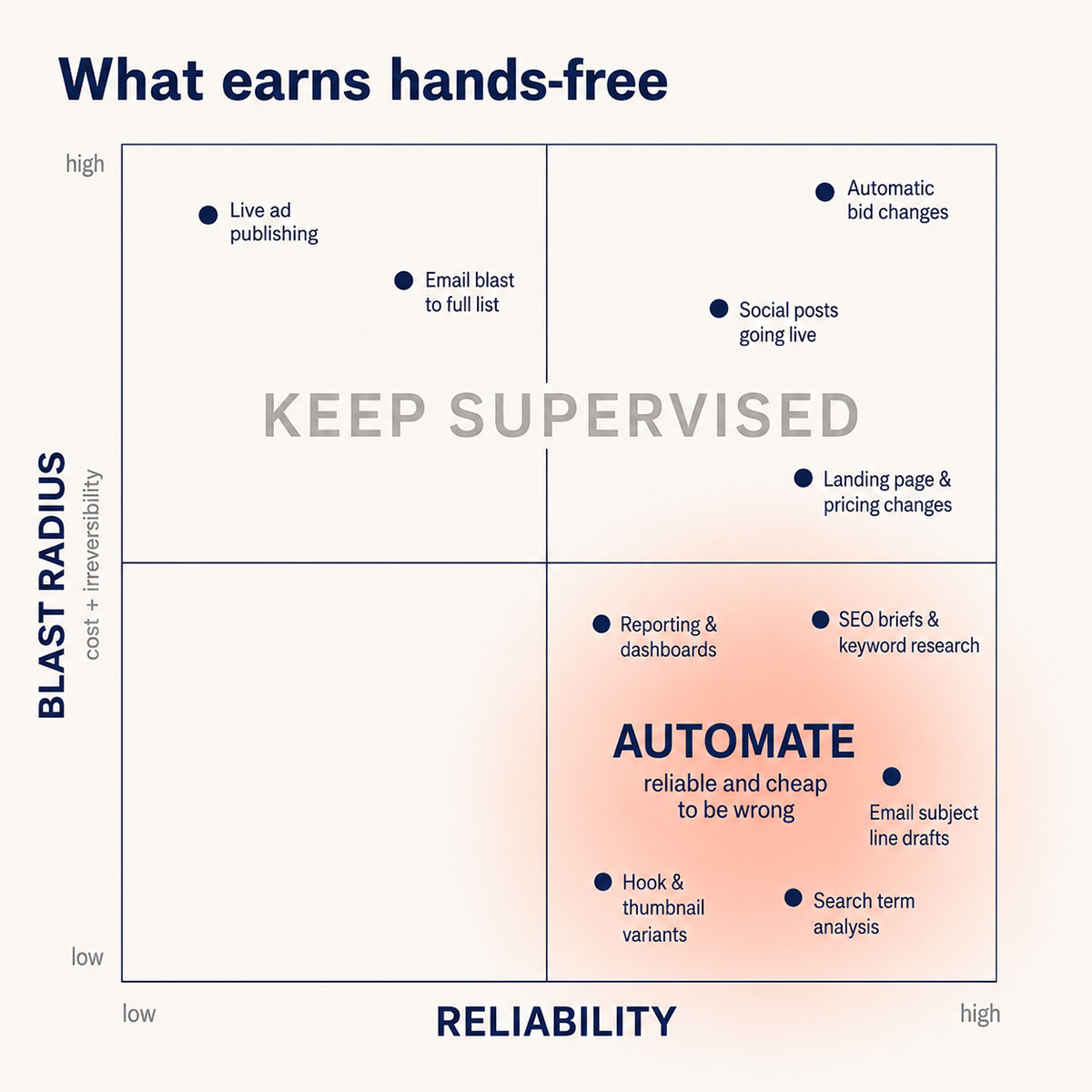
It sits on a ladder worth being honest about. A workflow you’ve run by hand enough times to know what “right” looks like becomes a skill. A skill that produces correct output across enough real runs – different accounts, odd data shapes, an edge case or two – becomes one you trust. And only the trusted ones where a bad run is cheap and visible ever earn the right to run hands-free.
“Enough runs” isn’t a feeling. For a recurring-search-ad analysis, trusted means it didn’t choke on a thin ad group or a weird date range across ten clean passes. For a forecast, it means it caught the double-counted channel rather than sailing past it. The skill graduates by behaving, repeatedly, under conditions that used to trip it — not because a month went by.
Notice the condition on that top rung: a bad run is cheap and visible. Promotion to autonomous isn’t only about reliability. It’s about what happens when the thing is wrong.
The front gate is a page, not a feeling
Strategy comes first – always, even for ads. Everyone nods at that. Then “the strategy’s set” turns out to mean a kickoff call and a shared understanding, and the machine starts running against a foundation nobody can point at.
The front gate produces an artifact. Mine is one page. The offer in one plain line. The big idea – the one angle that makes the offer compelling, not what it is but why it wins. The goal, with numbers attached. The segments, cut the way a platform can actually find them, each with the one belief to shift. And a funnel where every figure backs into the goal, so a $60 lead either adds up to the month’s target or it doesn’t.
Fill it in once. Then every ad, email, post and landing page – human-made or machine-made – checks back against it.
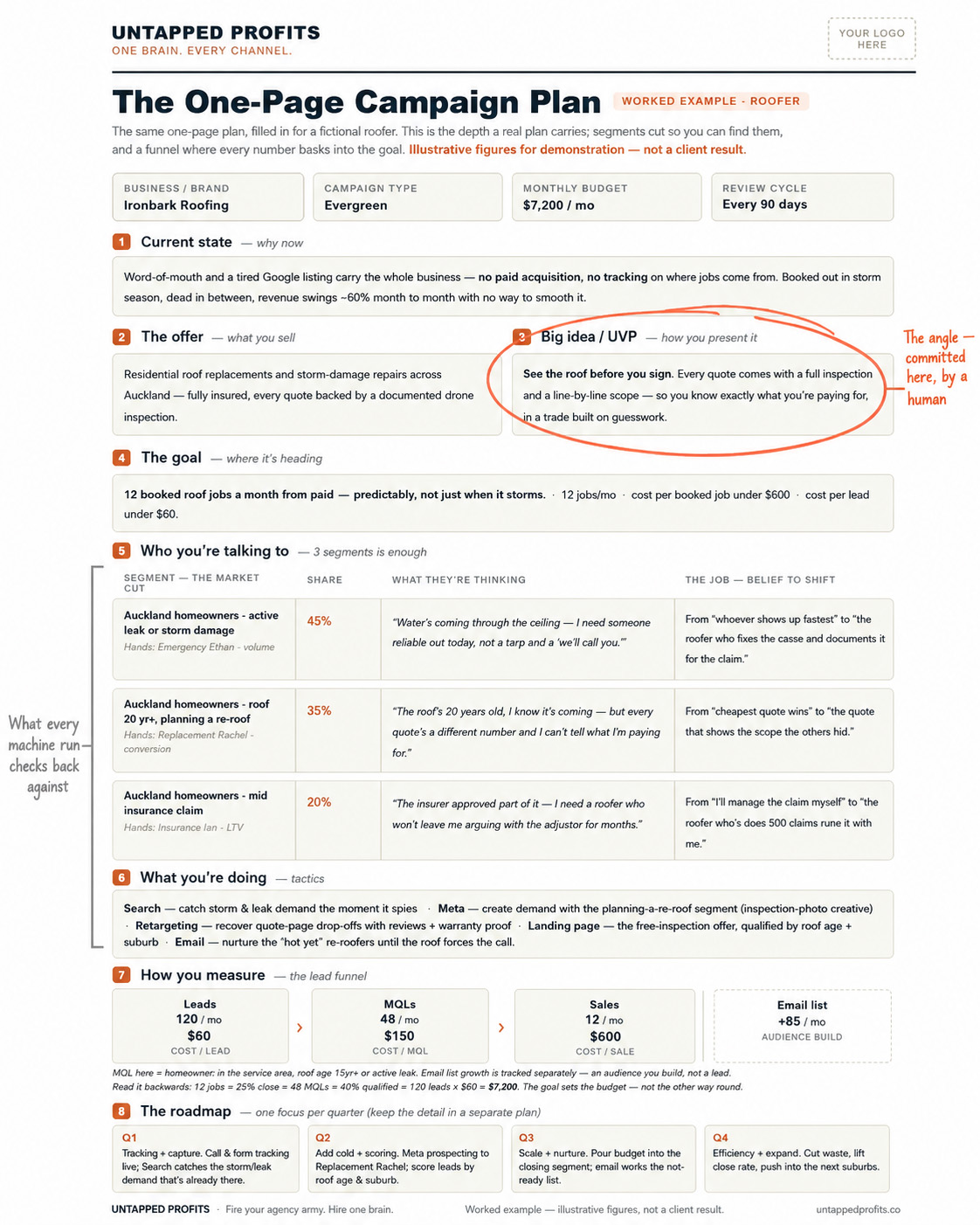
Watch what that does to the automation question. The angle now lives on the page. It’s a line a person wrote, argued over, and committed to – the person paid to decide it. It was never the overnight run’s to invent. And once it’s committed, the machine’s job changes shape entirely: it stops exploring what to say and starts exploring how many ways to say it. That’s the version of the work agents are genuinely brilliant at.
Remember the thought you were holding. The morning with forty dead variants didn’t happen because the agent was fast. It happened because the run started upstream of any page – so the machine made a strategy decision by default, at generation speed, and nobody had agreed to that.
Not every gate is equal
Here’s where I’d loosen my own rule, because over-gating is its own kind of waste.
Once the page is set, the work fans out into exploration inside the committed angle: concept treatments, ad styles and the moodboards that define them, hooks, script directions. Inside that fan-out, generating options is cheap and reversible. Thirty treatments of one angle, a dozen style boards, twenty hooks – throwaway, fast, none of it worth a ceremonial sign-off before the agent explores the next spread. Let that run wide.
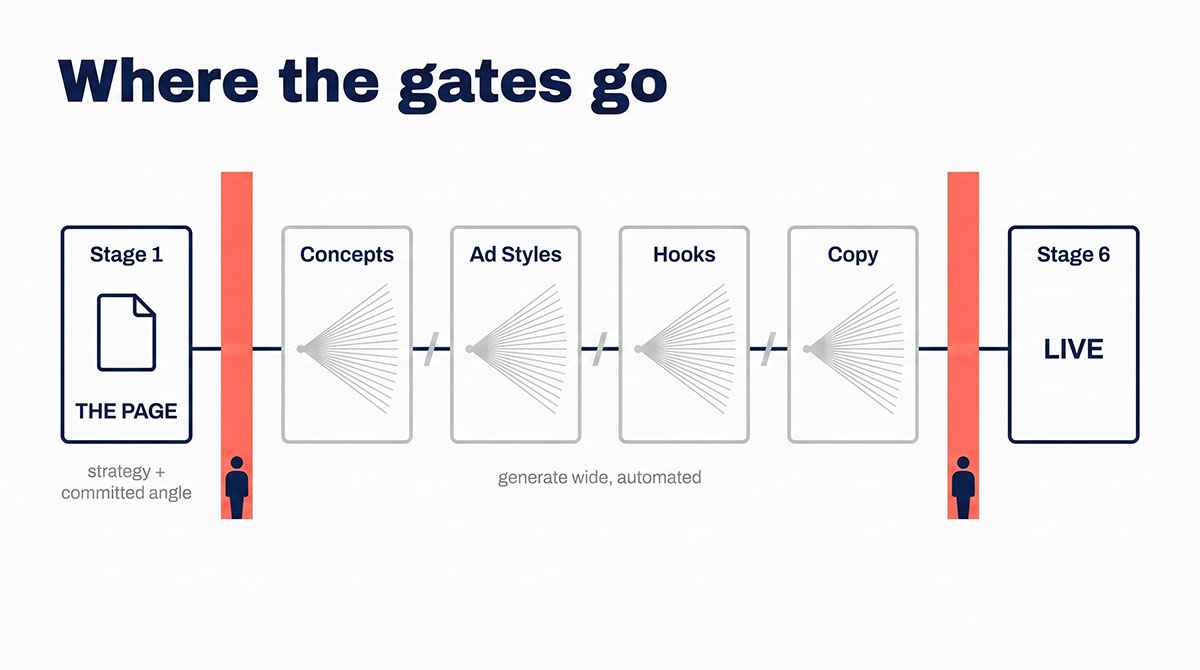
So the hard human stops sit at the two ends, not in the middle. The page at the front, where the foundation gets set – the one gate that’s non-negotiable, because it’s what every later phase inherits. And anything nearest money and audience at the back — anything that publishes, anything that spends, anything a customer will see. That’s where a wrong autonomous move stops being a throwaway draft and becomes a live, expensive, slow-to-undo fact.
The rule, stated plainly
Gate hardest wherever a wrong move is most expensive and least reversible.
That single line governs your ad accounts too, and it’s not a separate principle. Analysis is read-only. An agent pulling your numbers, flagging a wasted ad group, catching a forecast that double-counts a channel – reversible, and safe to automate, because the worst case is you ignore a weak suggestion. Acting on that analysis is a different animal. An automatic bid change spends real money, and a big enough one knocks Smart Bidding into a fresh learning period – costly, and slow to undo. So analysis runs free. Account edits stay in the loop no matter how reliable the agent gets, because the cost of a silent failure is asymmetric.
Read freely. Act deliberately. Same rule on the creative side and the media side.
Now imagine the morning again
Same agent. Same forty-variant capacity. Same overnight speed.
But this time the run starts from the page. The angle isn’t the machine’s to invent. It’s already committed, written by the one person in the operation who’s paid to decide it. Overnight, the agent fans out inside it: hooks, treatments, script directions. At 7am there’s a spread to choose from, not a graveyard to mourn. You pick the strongest – thirty seconds – and turn the build phase loose. By the time the coffee’s done, the forty variants exist.
Forty good ones. Same machine, same speed. The only thing that changed is what the machine was never asked to decide.
Your marketing, looked at properly
Thirty minutes on your current setup — what’s working, what’s quietly leaking budget, and what I’d fix first. You’ll leave with a clearer picture whether we work together or not.
Got something specific bugging you? Flag it when you book and I’ll have it looked at before we talk.

AboutBruce Marjoribanks
Bruce Marjoribanks has spent 27 years in marketing, including building, running and selling his own agency before going independent. He now runs every channel - paid, organic, social, email, creative and automation - as one integrated system, with AI ehancing production and the judgment staying human.