
The invoice arrives on the first of the month. Same tidy PDF, same familiar total. It lists deliverables: campaign management, creative production, monthly reporting, strategy sessions. What it doesn’t list is what most of the money actually buys: the account manager who translates your brief to the strategist, the strategist who translates it to the copywriter, the internal meetings where four people align on work one person could hold in their head, and a pricing model that quietly punishes the agency for finishing anything quickly.
None of that is on the invoice. All of it is in the price.
The agency model wasn’t built to overcharge you. It was built for a world where specialist skill was scarce, a world where the only way to access a senior copywriter, a media buyer, and a strategist was to rent slices of each from a firm that employed all three. That world is gone. AI collapsed the scarcity that justified the bundle, and what’s left in the retainer is mostly the cost of coordinating people who no longer need to be separate people.
Here’s the short version, then the twelve reasons in full.
The case in three sentences
Specialist skill used to be the expensive part of marketing; now, for most digital work, a senior generalist directing AI matches or beats a team of specialists on speed and quality. The research behind that claim is peer-reviewed, not a software company’s blog post. What you’re still paying an agency for is handoffs, account management, and a billing model whose incentives point away from your outcomes. One brain across every channel removes all three. There is a genuine boundary to that claim, and the final section of this article maps it honestly.
1. The scarcity that justified the agency model has collapsed
Agencies exist to bundle specialists who were once too scarce and expensive to hire individually. AI has ended that scarcity for most digital marketing work. The structural premium you pay to house multiple specialists under one roof no longer buys you capability you can’t get from one senior generalist.
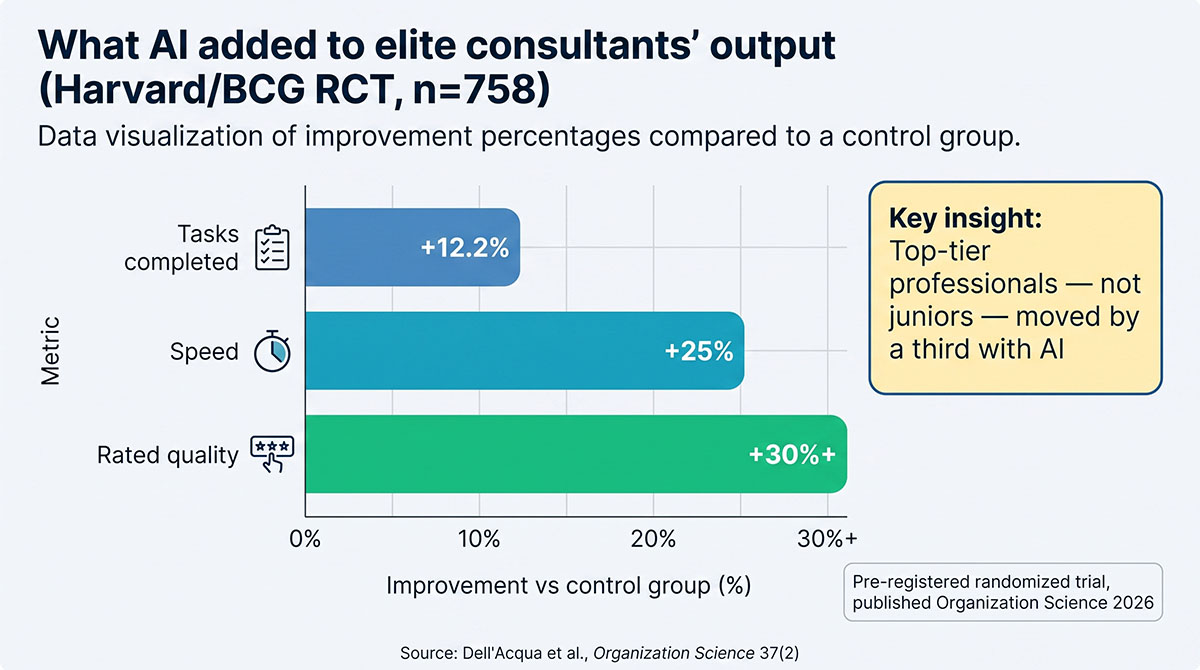
The evidence here is unusually strong, because it doesn’t come from anyone selling AI. In a pre-registered randomized trial published in Organization Science, researchers from Harvard and BCG tested 758 BCG consultants on realistic analytical and creative knowledge work. Consultants using AI completed 12.2% more tasks, worked roughly 25% faster, and produced output rated over 30% higher in quality than the control group.
Read that again with the agency model in mind. These weren’t interns. They were consultants at one of the most selective firms in the world, and a machine assistant still moved their output by a third.
A separate experiment published in Science found the same shape: 453 professionals given ChatGPT for occupation-specific writing tasks cut their time by 40% and lifted quality by 18%. Short, generic tasks, not client campaigns (the researchers say so themselves), but the direction is the point. The wall between “person who can do this” and “person who can’t” is coming down across discipline after discipline.
When one person can execute across domains at professional standard, paying a structural premium for a building full of separated specialists stops being an investment. It becomes a subscription to history. I made that case in full in The End of the Marketing Agency Model.
2. Handoffs are where your speed dies
Every transfer between strategist, designer, and media buyer loses time and meaning. Agency turnaround is slow not because the work takes weeks, but because the work spends most of those weeks sitting in someone’s queue waiting to be started. One brain holding the whole thread has no queue.
The translation loss is measurable, and marketers themselves admit it. The BetterBriefs Project surveyed more than 1,700 marketers and agency staff across 70-plus countries and found a chasm nobody talks about at the pitch meeting: 80% of marketers believe they write good briefs. 10% of agencies agree. The same research estimated roughly a third of marketing budgets are wasted on work sent back or done to a misread brief. That’s a survey estimate, not an audit, but the perception gap alone should worry you. The two parties in the relationship don’t even agree on whether the instructions were clear.
That gap isn’t a talent problem. It’s an architecture problem. Fred Brooks named the underlying law in 1975, watching software projects fail: adding people to work adds communication before it adds output. Fifty years later, your campaign brief is still being handed down an assembly line, shedding intent at every station.
A single brain doesn’t write a brief for anyone. The person who heard your goals is the person moving the budget.
3. Coordination costs grow faster than headcount
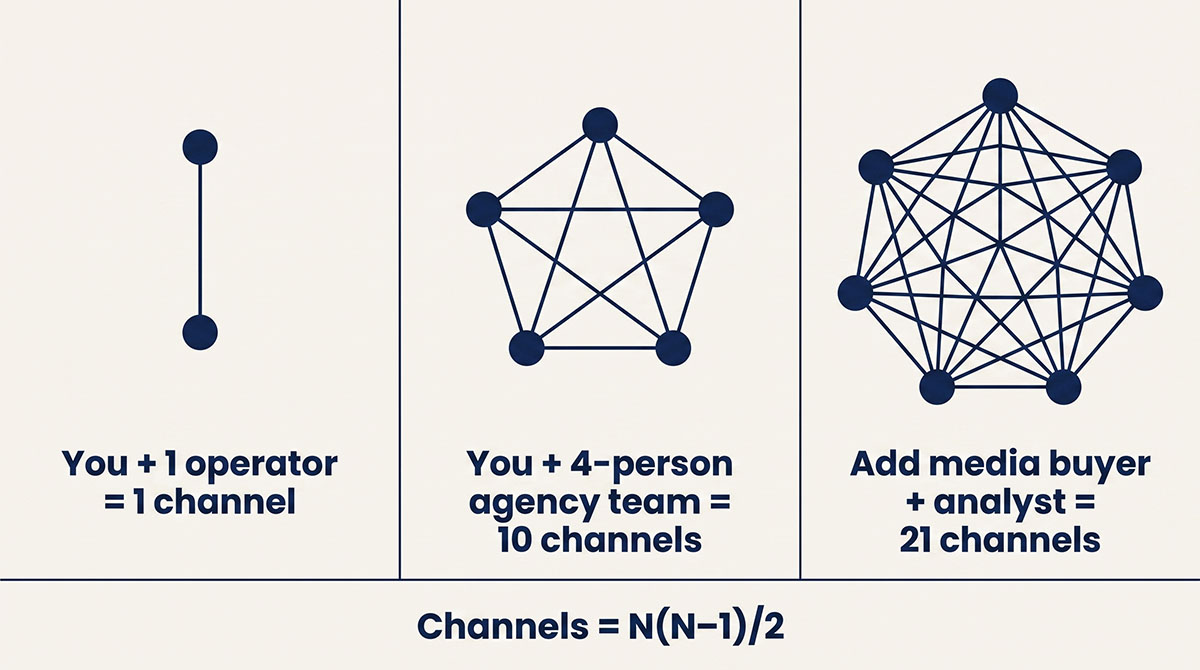
Adding specialists to your account doesn’t add output in a straight line. It multiplies communication channels geometrically. You end up funding the conversations between your specialists rather than the work itself. Holding the team at one brain holds the channel count at one.
The math is old and merciless. The number of communication channels in a group is N(N−1)/2, where N is the number of people involved. You plus one brain: one channel. You plus an account manager, strategist, copywriter, and designer: ten channels. Add a media buyer and an analyst and you’re at twenty-one distinct lines along which your message can mutate.
Agencies know this, which is why they employ people whose entire job is managing the channels: account managers, project managers, traffic coordinators. None of them produce anything you can publish. All of them are on your invoice.
This is Brooks’s Law wearing a lanyard. The agency isn’t staffed to maximise your output. It’s staffed to manage the complexity that its own staffing created. As I’ve argued before, hiring a “full-service” agency doesn’t fix it, because full-service just moves the silos indoors.
4. Billable-hour economics punish the agency for being fast
Most agency compensation is still anchored to time and labor. Under that model, every efficiency AI creates is revenue the agency loses, so the agency’s rational move is to absorb the gains, not pass them on. An independent generalist with no hours to protect can hand you the speed directly.
Sit with the incentive for a second. The Harvard/BCG trial found AI made skilled professionals about 25% faster. Now imagine you bill by the hour. That finding isn’t good news for you. It’s a quarter of your revenue evaporating. Your options are to avoid the tools, quietly keep billing the old hours, or pocket the margin. None of those options involve your client’s interests.
This is not an accusation of bad character. It’s the pricing model doing exactly what pricing models do: shaping behavior. Agencies staffed with decent, hardworking people will still drift toward whatever keeps the hours defensible, because the alternative is shrinking their own firm.
A generalist charging for outcomes has the opposite incentive. Every hour AI saves is an hour spent on the next lever, not an hour that needs replacing on a timesheet. Speed stops being a threat to the business model and becomes the business model.
5. You're funding the cost of the agency talking to itself
A team spread across specialists lives inside a storm of pings, status meetings, and channel-switching, and you pay for every minute of it. Communication overhead inside the team is pure cost to you: it produces alignment at best, nothing at worst. One brain carries the context in one head and spends the day producing.
Microsoft, which sells the workplace software this data comes from (so weight it accordingly), has measured the shape of this from inside its own tools. Its 2025 Work Trend Index shows the heaviest-hit fifth of users interrupted roughly every two minutes across the day; its 2023 edition found workers spending 57% of their time in Microsoft 365 apps communicating and only 43% creating. Self-interested source, real pattern: anyone who has worked inside a team of specialists recognises the shape. The day fills with talking about the work.
Here’s what that means for your retainer. When your account team spends most of its day in coordination, in briefing meetings, status updates, and internal reviews, you are paying professional rates for synchronisation. I’ve run the numbers on what that costs a real business in Five Agencies. Five Wins. One Losing Business. The deliverable you receive is the residue of the hours, not the substance of them.
One brain doesn’t attend a status meeting about your account. There’s no one to update.
6. The agency has to keep its people busy, and that shapes what it sells you
An agency’s survival depends on keeping its specialists utilised: billable, occupied, deployed. That pressure quietly shapes recommendations: an under-used design department produces a sudden case for more design work. You aren’t buying advice from a neutral party; you’re subscribing to an agency’s payroll obligations.
This is the least discussed conflict in the industry, and the most structural. I can say that plainly because I built, ran, and sold an agency. Nothing in this section is a guess. An agency carries fixed salaries across every discipline it houses. When a discipline sits idle, it bleeds. So the pressure flows downhill to the people who talk to you: find billable work for the bench. Not because anyone is dishonest, but because the alternative is layoffs.
Watch how this plays out in your own history with agencies. Notice how the recommended strategy so often maps neatly onto the services the agency happens to staff. A content team’s agency finds your problem is content. A paid-media shop finds it’s media mix. The diagnosis follows the payroll. Even the org chart tells you this before the pitch does; the account-manager layer is the first place to look.
One brain has no bench to feed. When the smartest move for your business is unglamorous (fix the landing page, kill an underperforming channel, do nothing for two weeks while a test runs), nothing in the model punishes saying so.
Stop here, because you’re already arguing with me. A generalist is a jack of all trades. Your dedicated media buyer lives inside Meta eight hours a day; your SEO specialist reads algorithm patch notes for fun. Depth is real. What happens when one brain hits the edge of what they actually know, and doesn’t notice?
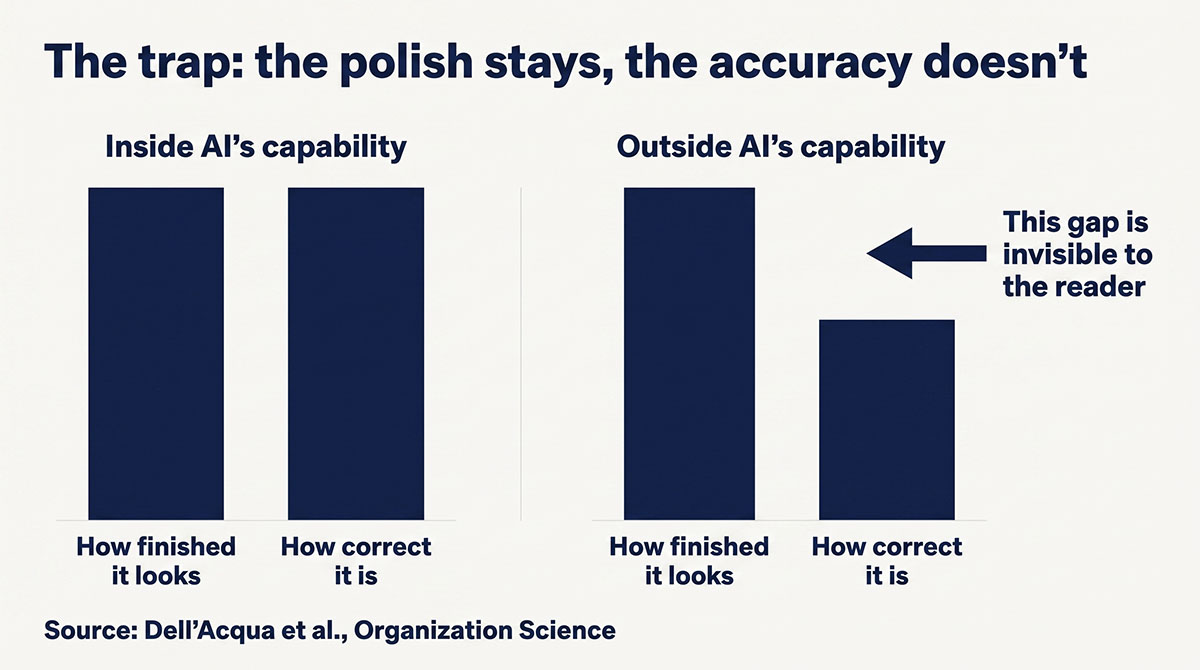
That objection isn’t just fair. It’s measured. The same Harvard/BCG study that produced the productivity numbers above ran a second test on a task deliberately chosen to sit outside AI’s capability. There, AI assistance made consultants 19 percentage points less likely to reach the correct answer. Worse, the work still looked polished. Confidence without competence, at scale.
So the objection stands, as a boundary rather than a rebuttal. The question was never whether an edge exists. It’s where the edge sits, and how much of your marketing lives on each side of it. For the vast bulk of digital work (strategy, content, paid media, analytics, funnel building) the evidence says one senior generalist with AI now sits comfortably inside the capability line. What sits outside it, and when a room full of specialists is still the right call, is the final section of this article. First, the remaining six reasons.
7. Junior production work is now a commodity, so stop paying senior rates for it
The pyramid of junior staff that agencies bill out at healthy margins (formatting, first drafts, data pulls, resizing) is exactly the work AI now does at professional standard. Paying blended agency rates for commodity execution is a capital allocation error. A generalist automates the mechanical layer and points your entire budget at judgment.
The evidence for this isn’t just the consulting trial. A study published in the Quarterly Journal of Economics tracked 5,172 customer-support agents through a staged AI rollout at a Fortune 500 firm. Average productivity rose 15%, but the distribution is the story. The least experienced workers improved around 30%, while the most experienced saw little productivity effect and a small decline in quality. AI functions as a floor-raiser: it lifts baseline execution to professional standard almost instantly.
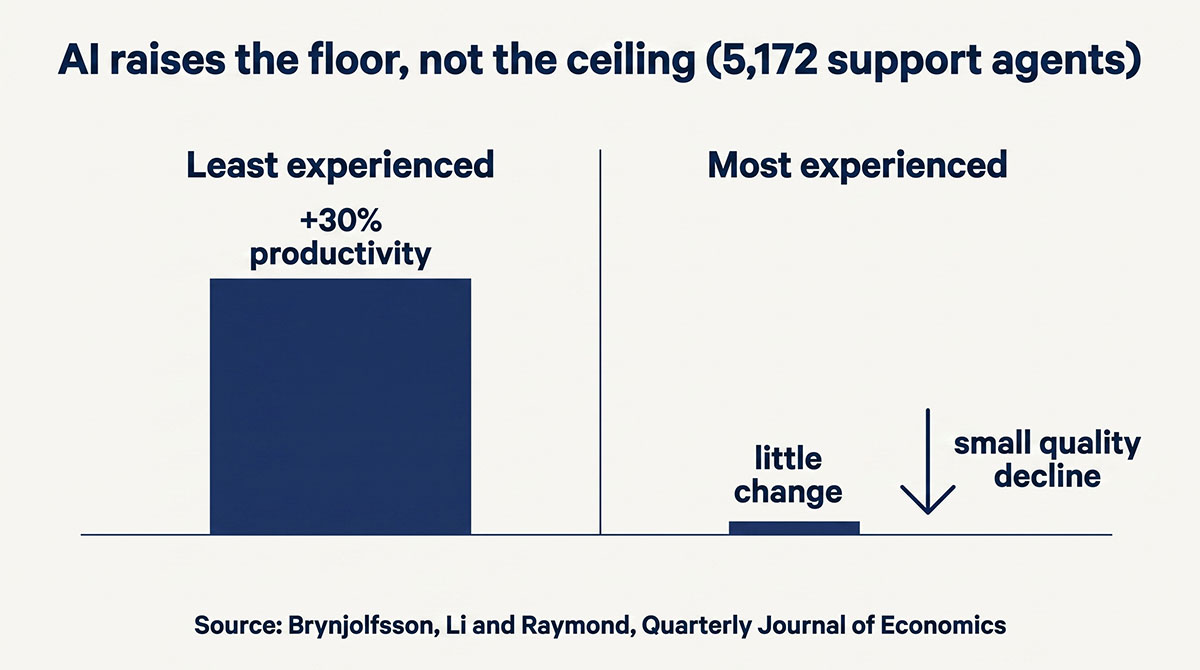
That finding should terrify anyone whose business model is billing out juniors. The junior layer of the agency pyramid, the associates and coordinators whose hours generate delivery margin, is precisely the layer AI absorbs first. When you pay an agency’s blended rate, you are paying a markup on work a model completes in seconds.
The senior layer is different. Which is the next reason.
8. AI multiplies senior judgment, and a generalist is all senior
While AI commoditises junior production, it amplifies the thing juniors never had: pattern recognition, strategic framing, knowing which question to ask. A senior generalist with AI runs what amounts to an instant research department, applying thirty years of judgment from the first prompt. The agency pyramid inverts: one expert at the top, machines below, nobody in between.
The Science writing study found something more interesting than its headline numbers: ChatGPT restructured how professionals worked, shifting effort away from rough drafting and toward idea generation and editing. The machine absorbed the production; the human moved up the stack to selection and refinement, the work where experience actually pays.
That restructuring is the entire generalist thesis in miniature. The traditional agency puts its senior strategist at the start of your engagement (the pitch) and occasionally at the end (the review), with layers of junior production in between. It’s a structure built for a problem AI just made worse. One brain collapses the middle. Every deliverable passes through senior judgment because senior judgment is the only human layer left.
You’ve experienced the difference from the other side: the pitch delivered by the impressive grey-haired strategist, the account subsequently run by someone three years out of university. The generalist model simply makes the person from the pitch the person doing the work.
9. Deep work needs continuous context. The agency model shreds it
High-stakes creative and strategic thinking requires unbroken focus and full context, and the multi-specialist model structurally prevents both. Work fragmented across people and platforms arrives assembled but never thought through as a whole. One brain holds the entire strategic picture in working memory, every day.
The interruption data above described the cost in time. The deeper cost is in kind. There is thinking that only happens when one mind holds the whole problem simultaneously: your positioning, your funnel economics, your creative history, last month’s test results. That thinking produces the moves that matter: noticing the winning ad angle contradicts the landing page, or that a channel’s “decline” is actually an attribution shift.
No specialist inside an agency can have that thought about your business, because no specialist holds your whole business. The media buyer holds the media. The content lead holds the content. The person who holds everything is an account manager, the one person on the team who doesn’t do the work.
The generalist model isn’t just cheaper coordination. It’s the only structure where whole-picture thinking can happen at all, because it’s the only structure where a whole picture exists in one place.
10. Rigid scopes protect the agency's margin, not your results
Agencies police scope because scope creep destroys their margins, so when live data says pivot, the model says change order. That rigidity is rational for the agency and expensive for you. One brain without a resource-allocation matrix pivots the same afternoon the data arrives.
Scope discipline is taught to agencies as survival, and from their side of the table it is. Every unplanned request stretches scheduled people across unscheduled work. So the well-run agency builds process armor: statements of work, change controls, re-negotiations. The better managed the agency, the more rigid the armor.
But your market doesn’t read the statement of work. When the campaign data says the money should move to a different channel, a different angle, a different offer, the agency’s machinery starts: pause, document, re-scope, re-price, re-schedule the specialists. By the time the change order is signed, the moment has passed.
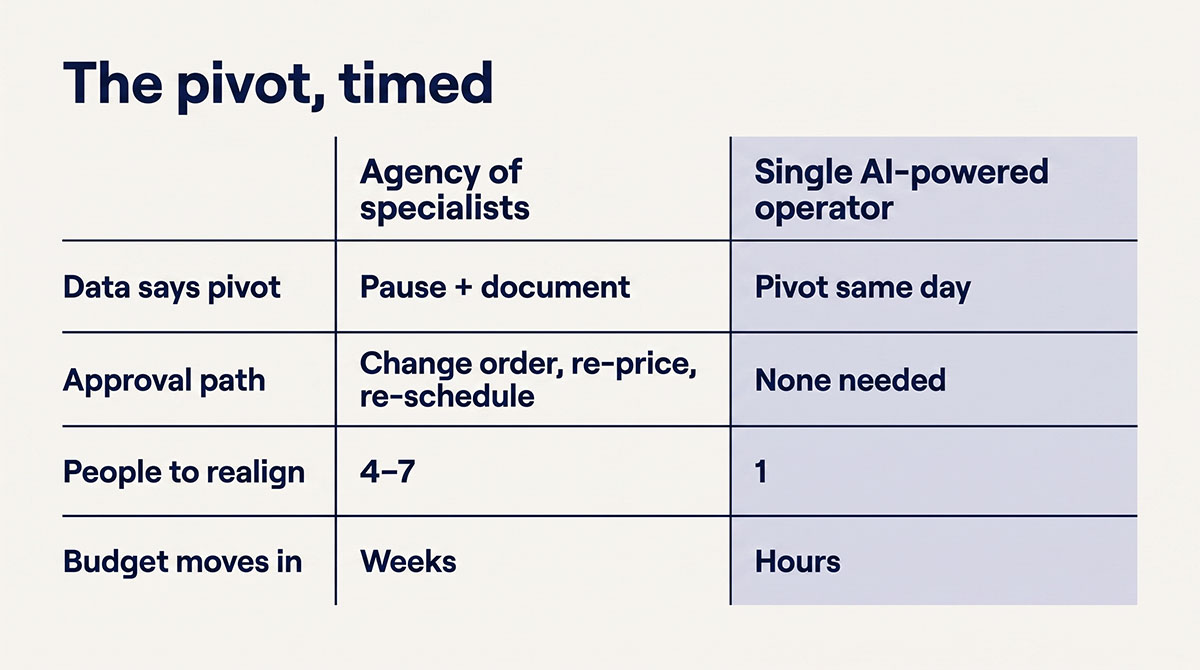
One brain’s scope is your outcome. If Tuesday’s data says Wednesday’s plan is wrong, Wednesday’s plan changes. Nothing needs renegotiating, because nothing was ever carved into a resourcing schedule defended by someone whose bonus depends on it.
11. Media money leaks inside the supply chain. History says trust nothing you can't see
The advertising supply chain has a documented record of money going missing between you and the audience. Direct control of your own ad accounts, with spend deployed from your own cards, removes entire categories of leakage. A generalist model makes that transparency the default, not a negotiated concession.
Two pieces of evidence, both dated and scoped honestly. In 2016, the ANA commissioned K2 Intelligence to investigate US media transparency; the investigation confirmed undisclosed cash rebates flowing from media sellers to agencies, and principal-transaction markups of 30% to 90% on media resold to clients. That study described large US holding companies a decade ago, not your local shop today. But the industry never rebutted it. And it permanently answered the question of whether the incentive exists.
More recently: the ANA’s 2023 programmatic transparency study followed $123 million of open-web programmatic spend and found that of each dollar entering a demand-side platform, only 36 cents reached an actual consumer. Agency fees were explicitly outside that count. Open-web programmatic is not where most SME budgets go, so carry the number carefully. But the shape of the finding is the lesson: layers between you and the ad inventory are where value disappears, and every layer you remove is money that stays yours.
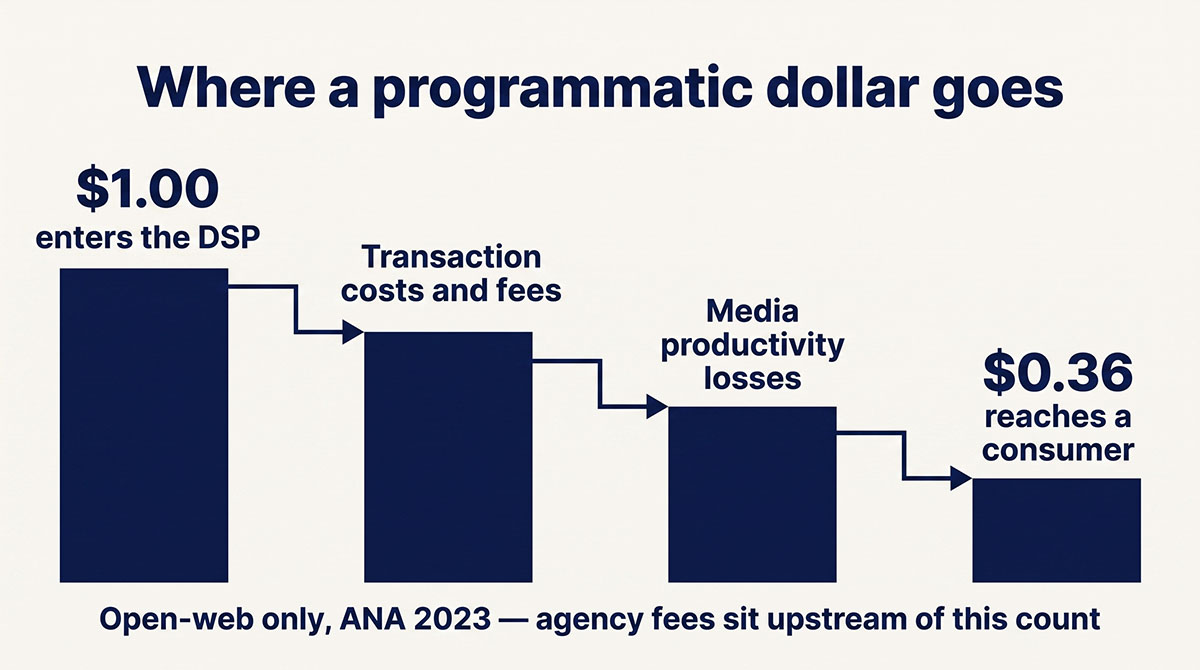
Your ad accounts, your billing, your data, one brain inside it. Nothing structural between your budget and the auction.
12. Strategy survives only when one mind carries it end to end
Distribute your brand’s thinking across a dozen specialists and it arrives diluted. Each handler interprets the strategy through their own discipline, and the output drifts toward disconnected competence. One brain carrying context from boardroom to published asset loses nothing in translation, because there is no translation.
This is the reason the other eleven add up to. Handoffs (reason 2), channel math (reason 3), and shredded context (reason 9) are all symptoms of one architecture decision: splitting a single strategic intent across multiple heads. Every head is a lossy copy. The BetterBriefs gap (80% of marketers sure they were clear, 10% of agencies agreeing) is what lossy copying looks like when someone finally measures it.
The one-brain model isn’t a cheaper version of the agency. It’s a different architecture: strategy and execution living in the same head, so that every ad, email, and landing page is the strategy, not an interpretation of a summary of a brief about it. For a business that wants that architecture across everything, from paid and content to email and funnel, that’s precisely the model our marketing takeover packages are built on: one brain, every channel, no relay.
Which leaves the honest question this article owes you.
When an agency is still the right call
The generalist case has a boundary, and pretending otherwise would make this a sales page. Three situations still favor a room of specialists, and the strongest evidence for them comes from the same studies quoted above.
Work outside AI’s capability line. The Harvard/BCG jagged-frontier result (19 points worse with AI on out-of-frontier tasks, with output that still looked polished) is the permanent warning. The frontier moves, but it always exists. Work involving deep regulatory nuance, novel category creation, or high-stakes judgments with thin precedent belongs with humans who specialise in exactly that terrain. A good generalist’s most valuable skill is naming what sits outside their line before you find out the expensive way.
Physical scale and institutional machinery. National TV upfronts, global out-of-home, experiential production, multi-market compliance all run on purchasing power, legal infrastructure, and relationships that only large organisations carry. No solo operator should pretend otherwise, and none worth hiring will.
The homogenisation risk. Research in Science Advances found AI assistance made individual writers better but their collective output measurably more similar. Stories written with AI ideas were 10.7% more alike. It’s the same trap that makes AI-generated ads look like everyone else’s. For most performance marketing, this doesn’t bind. But if your brand’s entire edge is a voice no one else can produce, the craft-specialist case remains real, and you should weigh it.
And one piece of counter-evidence deserves daylight rather than a footnote: agency relationships are lengthening, not collapsing. R3 Worldwide put average agency-of-record tenure at 3.2 years in 2016; the ANA/4A’s 2025 tenure report has it near 7. And 92% of respondents to the ANA’s 2023 in-house agency survey still use external agencies. Those respondents skew toward large US advertisers, exactly the businesses living in the three exceptions above. The model isn’t dying at the top of the market. It’s dying in the middle, where the work is digital, the frontier has moved past it, and the coordination tax lands hardest.
Which brings us back to the invoice on the first of the month. The line items were never the problem. The work listed on it is real. The problem is the model behind it, priced for a scarcity that ended. Read it again this month. Then ask the only question that matters now: how much of this buys marketing, and how much buys the machinery of keeping specialists coordinated?
The scarcity is gone. The invoice hasn’t noticed yet.

AboutBruce Marjoribanks
Bruce Marjoribanks has spent 27 years in marketing, including building, running and selling his own agency before going independent. He now runs every channel - paid, organic, social, email, creative and automation - as one integrated system, with AI ehancing production and the judgment staying human.