
The Campaign Plan is the one-page contract every campaign answers to: what's being sold, to whom, through what, and what the numbers must be. It is the output of Plan and the reference everything downstream checks against.
Key takeaways
- The page answers eight questions, in the same order for every campaign in every business, from why now through to what this quarter is for.
- The named framework is the Compounding Brief: a plan that expires every 90 days on purpose, and comes back knowing more than it did.
- Inside the quarter, tactics flex and the contract holds. Budgets shift and creative rotates, but the goal, the segments and the KPIs stay put until the reset.
- 59% of CMOs say they lack the budget to execute their strategy, per Gartner's 2025 survey of 402 marketing leaders.1 A dollar spent against no written commitment is a dollar nobody can defend.
- One page, because a contract nobody can hold in view is a contract nobody honours.
Why do campaigns drift without a written plan?
Because when nobody writes the contract, every channel quietly optimises its own number. The ads chase clicks, the emails chase opens, and each vendor chases whatever its dashboard flatters. At quarter's end everyone presents success against a target they chose themselves, afterwards. A campaign that never said what winning was can't lose, and it can't win. It just spends.
The era that could afford that is over. In Gartner's 2025 CMO Spend Survey, 59% of CMOs reported insufficient budget to execute their strategy, down five points on 2024 but still most of the profession.1 When marketing leaders can't fund everything they want to do, the first thing a flat budget demands is a contract that says in advance what every dollar is for and how it will be judged.
Measurement makes the same demand from the other direction. Platforms report on the windows that flatter them, the pattern Your Ad Platform Is Hiding 60% of Your Returns by Design takes apart, so the numbers a campaign is judged on have to be agreed before the dashboards start talking.
How does the Campaign Plan work?
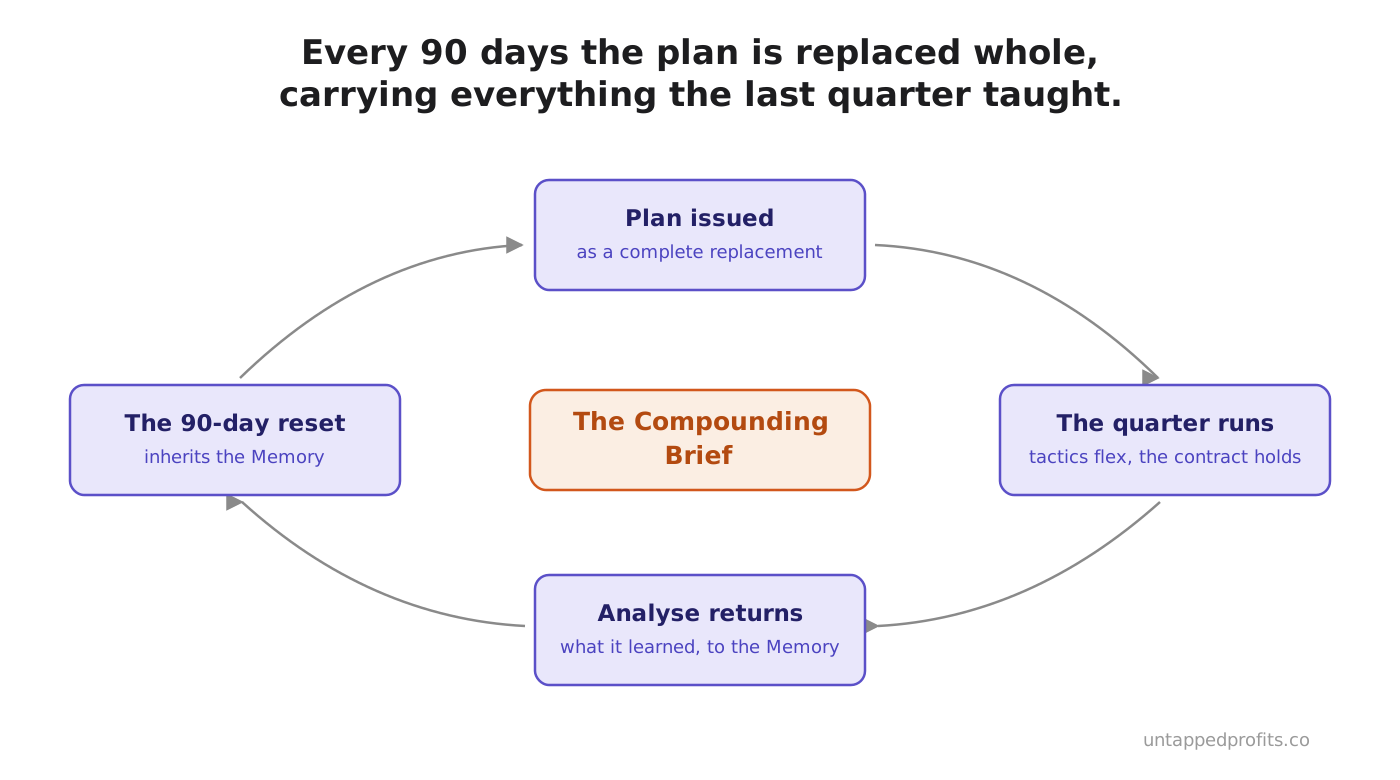
As a contract with a fixed shape and a fixed expiry. The page answers eight questions in the same order every time, so anyone can find any commitment in seconds. The named framework is the Compounding Brief: it is reissued on a 90-day reset, and each reset inherits everything the Memory has learned since the last one, so the plan gets smarter without anyone remembering to make it smarter.
The page itself answers eight questions, in order, and the structure is identical for every campaign in every business:
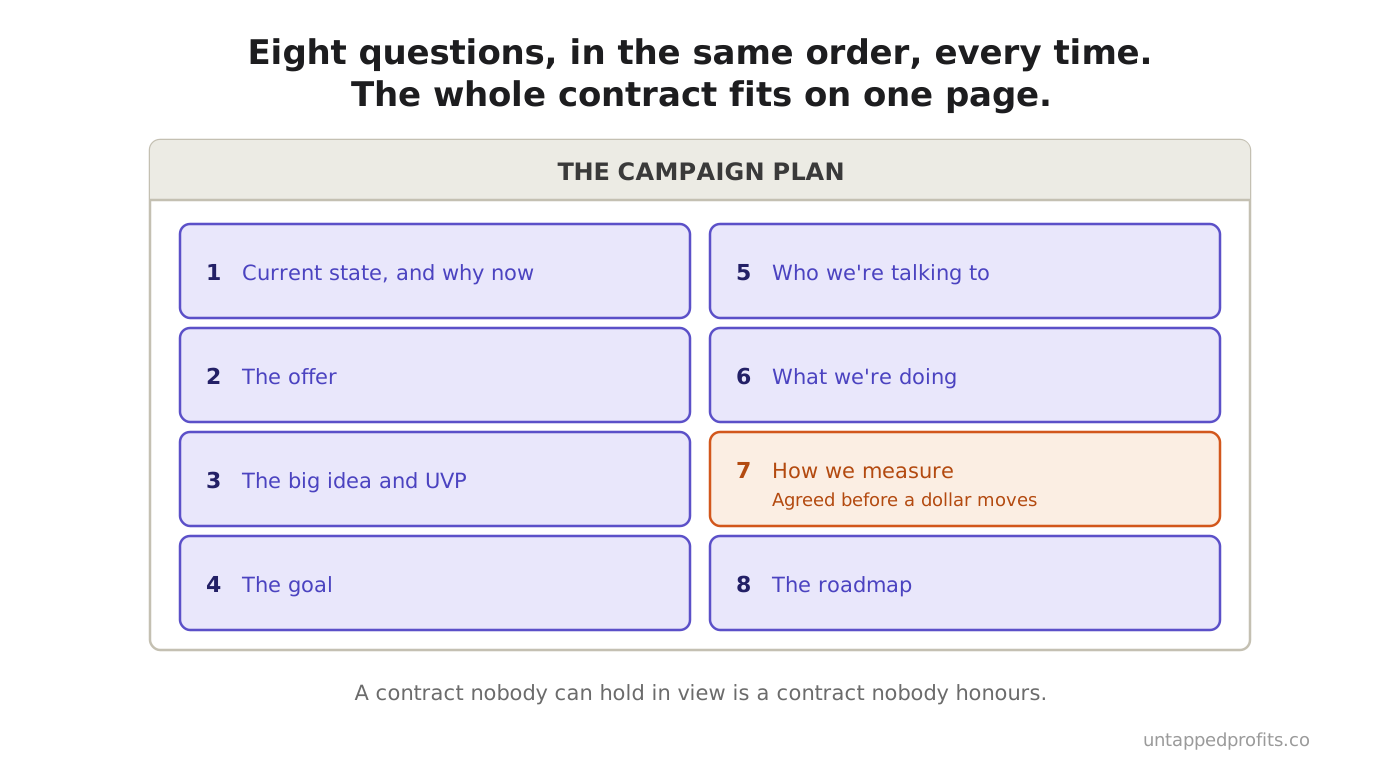
- Current state, and why now. What's actually broken or possible, stated plainly enough to falsify.
- The offer. What's being sold, as the market would describe it.
- The big idea and UVP. How it's presented, meaning the one framing every channel will carry. Claiming an ordinary thing first and plainly often beats searching for novelty, which is the argument of Stop Trying to Be Different.
- The goal. Where this is heading, in business terms, never channel terms.
- Who we're talking to. The segments, drawn from the Memory's customer intelligence, each with what they're thinking and what the campaign must do to them.
- What we're doing. The tactics, each with a job: capture, reach, recover, convert.
- How we measure. The funnel KPIs, agreed before a dollar moves. This is the line Analyse will hold everything against.
- The roadmap. The quarter focus, so scope has a boundary.
Then three mechanics make it compound rather than expire:
- It is reissued on a 90-day reset, as a complete replacement. Never annotated, never amended, so the current contract is always one page long.
- Each reset inherits the Memory. Everything Analyse learned and returned since the last reset, from sharpened segments to proven messages and closed dead ends, is in the next plan by default.
- Inside the quarter, tactics flex and the contract holds. Budgets shift between channels, creative rotates, bids move. The goal, the segments and the KPIs hold until the reset says otherwise, so change is deliberate and dated, never ambient.
Eisenhower, a man with some experience of plans meeting reality, gave the reset discipline its reason in remarks to the National Defense Executive Reserve Conference in 1957, quoting a saying he had picked up in the Army: "Plans are worthless, but planning is everything."2 The one-pager will be wrong somewhere, because every plan is. The asset is the discipline of deciding in writing, in advance, and re-deciding on schedule with everything the last quarter taught.
In practice
The KPI line is the one to write first and argue about hardest. Every other section can be revised at the reset without much cost, but a number agreed after the spend started is not a target, it's a description. If the conversation gets uncomfortable there, that discomfort is the plan doing its job early instead of the quarter doing it late.
What should the plan pin down?
Four things, and each has a tell when it slips. KPIs agreed before spend starts show whether success is defined in advance or negotiated afterwards. Assets that checked back against the plan show whether the contract governs the work. Resets completed on schedule show whether the plan is living. And learnings carried into each reset show whether the brief actually compounds.
| Measure | What it tells you | Target |
|---|---|---|
| KPIs agreed before spend starts | Whether success is defined in advance or negotiated after | Always, with no live campaign without a signed number |
| Assets that checked back against the plan | Whether the contract governs the work or decorates it | All of them, because it is Build's first gate |
| Resets completed on schedule | Whether the plan is living or expiring | Every 90 days, as a complete replacement |
| Memory learnings carried into each reset | Whether the brief actually compounds | Every reset starts from the current Memory, never from recollection |
Watch for
The plan that grows. A second page appears, then an appendix, then a deck behind the appendix, and the contract quietly becomes a library nobody checks against. The reset is the moment to cut it back, because anything that needs more than a page belongs in the Memory, and the page keeps only the line that points there.
What does running without one cost?
Success theatre, mostly. Without one contract, every vendor owns a number and nobody owns the number, so quarter after quarter ends in a meeting where everything performed well and revenue didn't move. Strategy drifts mid-quarter because nothing anchored it, and the big idea mutates channel by channel until the ads, the emails and the landing page are three different businesses.
Underneath both is the failure to compound. With no reset inheriting the last quarter's learning, each campaign is a fresh improvisation by whoever briefed it, and the business pays again for lessons it already bought. The plan costs a page. Its absence costs the ability to ever say what worked.
Frequently asked questions
One page? Our business is more complex than that.
The page is the contract, not the thinking. The depth, meaning research, intelligence and playbooks, lives in the Memory behind it and gets loaded when needed. What has to fit on a page is the set of commitments everything will be judged against, and commitments that don't fit on a page aren't commitments yet. They're a discussion.
Isn't a 90-day lock too rigid?
The lock is on the contract, not the controls. Tactics adjust continuously inside the quarter, which is just operating. What doesn't move weekly is what winning means, who it's for, and the idea being carried, because a strategy that changes with every dashboard refresh is thrashing, not steering. The reset is where change happens on purpose, with the learning attached, and strategy-first gating is argued in full in Stop Automating Across Phases. Start Automating Inside Them.
We already have a strategy deck.
When did anyone last open it? Decks describe strategy once, at presentation length, and then go to sleep. The plan is one page for exactly that reason: so it can be checked against daily. That is the difference between a document about the campaign and the document the campaign answers to.
What happens if the quarter goes badly in week three?
Tactics change immediately, because that is what tactics are for. The contract holds unless the Operator rules an early reset, which happens when the plan's assumption about the market turns out to be wrong rather than when a channel underperforms. The distinction matters: bad results inside a sound plan are an execution problem, and bad results because the plan was wrong are a reset.
Who signs it off?
The Operator rules on it and the business owner agrees the numbers, and that agreement is the whole point of writing it down. A KPI nobody outside marketing has looked at is a target marketing set for itself, which is where success theatre starts.
The bottom line
Campaigns drift because nobody wrote down what winning meant while it was still possible to disagree about it. The Campaign Plan puts eight answers on one page, gets the numbers agreed before the spend starts, and reissues whole every 90 days carrying everything the last quarter taught. That is what turns a run of campaigns into a system that gets smarter, rather than a series of fresh starts wearing the same brand.
Where this connects
The plan is Plan's output and the Memory's first customer. It draws its segments and its framing from The Memory, its audience depth from Customer Intelligence, and its permissible claims from The Proof Bank, which are the next two chapters. Downstream, every asset in Build checks against it, the creative law of Creative Production enforces it, and The Return Arrow closes the loop its KPIs open. Its reissue discipline is the Complete Replacement law from The Operator's Laws. Back to the One Brain Method hub.
Part 3 · Plan · Chapter 6 of the One Brain Guide
Previous: The Operator's Laws ·
Next: Customer Intelligence ·
All chapters
Sources
- Gartner, 2025 CMO Spend Survey press release, 12 May 2025. Fifty-nine percent of CMOs reported insufficient budget to execute their strategy in 2025, down five percentage points on 2024, from 402 CMOs and marketing leaders surveyed February to March 2025.
- Dwight D. Eisenhower, remarks at the National Defense Executive Reserve Conference, 14 November 1957. Eisenhower presented the line as a saying he had heard in the Army rather than his own: "I tell this story to illustrate the truth of the statement I heard long ago in the Army: Plans are worthless, but planning is everything."
Every statistic and quotation on this page has been checked against its primary source. Last verified 24 August 2026.
Free guide
Take the method with you. The complete One Brain Method as one PDF: every chapter, the diagrams, and every named framework, ready to hand to whoever runs your marketing. Enter your email and it's yours.
Want your next quarter to run on a contract instead of a vibe?
Book a 30-minute call → See what it takes to have this installed