
Lead Tracking and Pipeline is the discipline that joins a lead back to what it eventually became. Without it a business knows what marketing cost and has no idea what it was worth.
Key takeaways
- Raw lead volume is a vanity read. The source producing the cheapest leads is frequently producing the worst ones, and only outcome data joined back can show it.
- Where the customer record does not track a stage, the stage is dropped, never invented. A funnel with a fabricated step reports on something that does not exist.
- This month's leads are next month's sales, so lag is measured from the account's own record, never assumed from a benchmark.
- Privacy obligations are enforced and counted: Australia's Privacy Commissioner logged 532 breach notifications in six months, with human error's share rising to 37 percent.1
- Outsourcing the handling does not outsource the responsibility, which matters the moment lead data starts moving between a form, a CRM and a reporting tool.1
What is this discipline for?
Answering one question: which marketing produced customers, and not which produced enquiries. That means every lead carries its source into the customer record, and the record carries the outcome back. Without that join a business can report cost per lead forever and never learn that one channel's leads close at three times the rate of another's at twice the price, which changes where every dollar should go.
| System | What it is the truth for | What it is not |
|---|---|---|
| The ad platforms | Spend, impressions, clicks, and what happened at the top | Qualified leads or sales. They count generously and overlap |
| Web analytics | Sessions, behaviour, and the path across the site | Revenue, or whether a lead was any good |
| The customer record | Qualified leads, opportunities, sales, and lead source | Anything about traffic that never made contact |
The stage definitions come from the campaign plan word for word and never from a template. Where the customer record genuinely does not track an opportunity stage, that stage is dropped from the reporting. Inventing one produces a funnel chart that looks complete and describes nothing, and platform-reported conversions cannot fill the gap because they are counted by parties with an interest in the number being large — Your Ad Platform Is Hiding 60% of Your Returns by Design shows the design doing exactly that.
Why does lag change the conclusion?
Because the leads generated this month become sales in the months after it, so any window shorter than the buying cycle reports a partial answer as though it were the whole one. A source judged on thirty days in a business with a ninety-day cycle looks expensive and may be the best one running. Lag is measured from the account's own history, because it differs by business and by source.
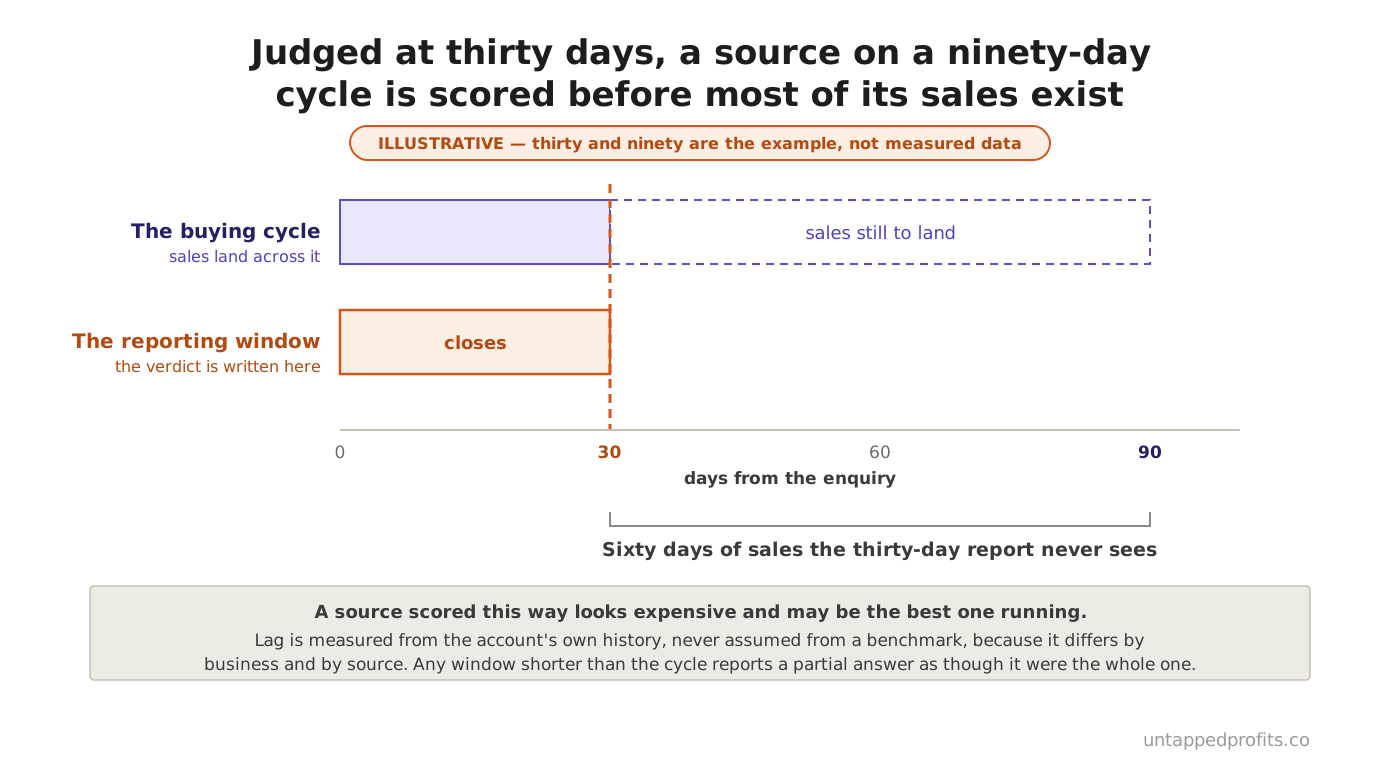
That measurement is the thing that makes lead quality visible at all. Once the lag is known, the monthly cycle can ask the question most reports never do: did lead quality move, not just lead volume. A month with more leads and a lower close rate is not a good month with a caveat, it is a different month entirely, and only the joined data can tell the two apart.
The discipline also decides who is accountable for the join. It sits between marketing and sales, which in most businesses means nobody owns it, and it stays broken for years because each side can point at the other. Accountability for the whole system rather than a piece of it is the thing worth buying — The One Word That Determines Which Agency You Should Hire hangs the entire hiring decision on it.
What is wired today, and what is not?
Being straight about this matters more than the method reading tidily. The stage definitions, the lag measurement and the reporting laws are settled and running. The automated connection between the ad platforms, the analytics and the customer record is not finished. For now the join is done from exports on a stated cadence, which works and costs Operator time. The connector build is in progress and not yet scheduled to a date.
Status as at August 2026
| Component | Status | How it works today |
|---|---|---|
| Stage definitions | Settled and running | Taken word for word from the campaign plan. Stages the customer record does not track are dropped, never invented |
| Lag measurement | Settled and running | Measured from the account's own history, not from a benchmark or a platform default window |
| Reporting laws | Settled and running | Consent recorded at the point of capture, only the fields actually needed collected, and each new tool assessed before it joins the chain |
| Automated connector between ad platforms, analytics and the customer record | Not finished. Build in progress, no date set | The join is done from exports on a stated cadence. Same answer, arriving less often, at about an hour a month per account |
What that means in practice is worth saying plainly, because a reader deciding whether to trust this system deserves to know which parts are running and which are being built. The manual join produces the same answer as an automated one. It arrives less often, it costs an hour a month per account, and it depends on somebody remembering to do it. Those are real limitations and none of them affect whether the numbers are right.
Where a client's customer record is not connected or not source-tracked at all, the position is stated and not papered over: lead quality is unknown, every recommendation carries that caveat, and getting the tracking in place becomes the first piece of work, not an eventual improvement. A system with more moving parts than the Operator can hold is its own failure mode — The 22 Skills Nobody Told You Marketing Actually Requires counts exactly how many parts that is.
In practice
Write the lead source into the customer record at the moment of capture, not later. Retrofitting attribution onto records created without it is guesswork wearing a spreadsheet, and the business ends up with six months of leads that can never be attributed to anything. One hidden field on the form is the entire cost of getting this right.
What obligations come with the data?
Real ones, and they arrive the moment lead information starts moving between systems. A form, a customer record and a reporting tool are usually three separate companies, and Australian privacy law does not treat that as three separate responsibilities. The business that collected the information stays accountable for what happens to it, whoever is holding it at the time.
The regulator's own numbers give the scale. In one six-month period the Privacy Commissioner received 532 breach notifications, with malicious attacks the largest source at 59 percent and human error accounting for 37 percent, up from 29 percent in the previous period. Writing about a case where a third-party developer exposed private documents, Commissioner Carly Kind noted that "organisations are responsible for the actions of third-party providers" when personal information handling is outsourced.1
Three things follow for any business wiring a pipeline. Consent is captured at the point of capture and recorded, so it can be demonstrated later. Only the fields actually needed are collected, because data nobody uses is risk nobody is managing. And when a tool is added to the chain, its handling of the data is part of the decision to add it, not something checked after a problem.
Watch for
The pipeline that reports beautifully and has been broken for weeks. Tracking failures are silent, and a chart with a smooth line through a period when nothing was recorded looks healthier than one showing the truth. Confirm that outcomes are still arriving from the customer record before reading anything into the numbers, and treat an unusually clean month as a question, not a result.
Frequently asked questions
What if the client has no CRM?
Then the honest report says lead quality is unknown, and every recommendation made in that period carries the caveat. Substituting platform-reported conversions is not the answer, because they measure something else. Getting a simple record in place is usually the highest-return work available in the account.
How far back should attribution look?
As far as the business's own measured lag, which usually exceeds the default window every platform ships with. Those defaults were chosen by the platforms, and a business using them without checking has let somebody else decide what counts as a result.
Which system wins when two disagree?
The customer record, for anything about leads and sales. The platforms are the truth for spend and for what happened before the click. Most reporting arguments are two systems answering different questions and being read as though they answered the same one.
Is manual reporting a problem?
It is a cost rather than an accuracy problem. A joined export produces the same answer as an automated pipeline, less often and with an hour of work behind it. What it cannot do is catch a break the day it happens, which is why the check runs before the reading.
Who owns this in the business?
Whoever is accountable for the whole system, which is the point of running marketing through one Operator. Split between a marketing provider and a sales team, this discipline is the first thing to break and the last thing anybody claims.
The bottom line
A business that measures cost per lead and stops there is optimising toward the cheapest enquiries it can find, which is rarely the same as the most profitable ones. Join the lead back to what it became, measure the lag from your own record rather than a benchmark, drop stages the data cannot support instead of inventing them, and treat the data you collect as something you remain responsible for. Then the reporting finally describes the business rather than the advertising.
Where this connects
Lead Tracking and Pipeline supplies the outcome data that Performance Analytics needs to say anything about quality, and the stage definitions come word for word from The Campaign Plan. It measures what Paid Acquisition, Content & Channel and Lead Nurture actually produced, and what it learns returns through The Return Arrow into The Memory. That return is what closes the loop this guide describes, and it is the subject of the final chapter.
Part 9 · Analyse · Chapter 37 of the One Brain Guide
Previous: Performance Analytics ·
Next: The Return Arrow ·
All chapters
Sources
- Carly Kind, Australian Privacy Commissioner, Latest Notifiable Data Breach statistics for January to June 2025, Office of the Australian Information Commissioner, 4 November 2025. The OAIC received 532 data breach notifications in the January to June 2025 period, a 10 per cent decrease on the previous six months. Malicious or criminal attacks were the largest source at 59 per cent, or 308 notifications, and human error accounted for 37 per cent, or 193 notifications, up from 29 per cent in the previous period. The average number of individuals affected by cyber incidents was just over 10,000. The quoted words appear in the post's case study on outsourcing to third-party service providers. Figures cover a single six-month period and the OAIC now publishes an ongoing dashboard, so current numbers will differ. One reading note: the 10 per cent decrease describes that half-year against the one before it and does not describe the trend. The OAIC reported in 2026 that 2025 recorded the highest number of notifications in any year since the scheme began in 2018.
Every statistic and quotation on this page has been checked against its primary source. Last verified 27 August 2026.
Free guide
Take the method with you. The complete One Brain Method as one PDF: every chapter, the diagrams, and every named framework, ready to hand to whoever runs your marketing. Enter your email and it's yours.
Knowing what marketing cost is half a number. Knowing what it was worth is the other half.
Book a 30-minute call → See what it takes to have this installed