
Writing for Clarity is the law governing every sentence the system produces, and most of it exists to stop copy that passes every other check from still saying nothing.
Key takeaways
- Persuasive copy is made of five substances: pain, promise, proof, constraints and curiosity. A paragraph carrying none of them is filler, and naming them makes thinness visible.
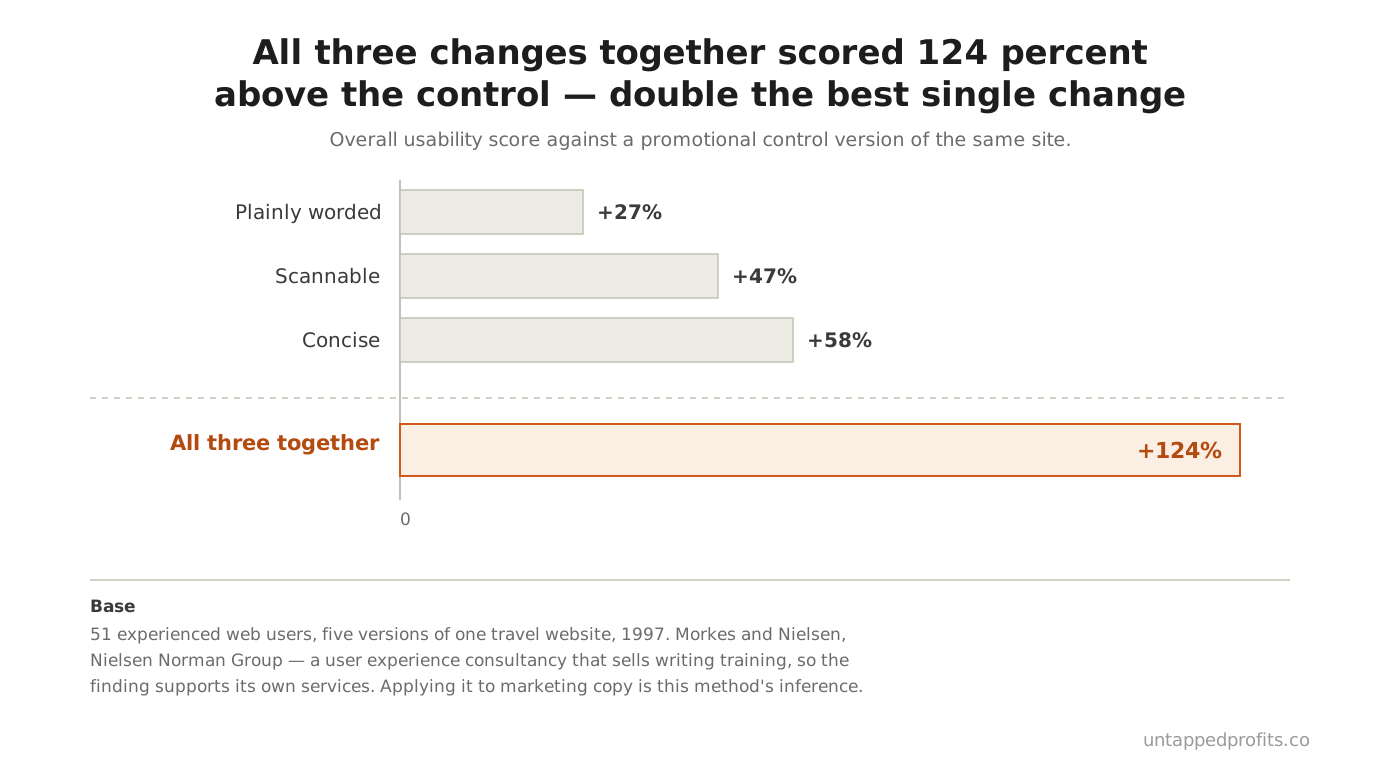
- Morkes and Nielsen tested five versions of the same site with 51 users. Concise writing scored 58 percent higher on measured usability, scannable 47, plain factual language 27, and all three together 124 percent.1
- Density is blocks divided by words, which makes it countable at review instead of a matter of taste.
- Constructions this business used as signature have been retired by ruling, because a stylometric profile records habits and cannot tell authorship from contamination.
- The writer never reviews its own draft. The cold read runs in a fresh context, and the final pass is six countable checks rather than six judgments.
What actually makes copy thin?
Missing substance, which is different from missing polish. Persuasive writing is built from five things: what the reader suffers, what they get, why they should believe it, what they avoid, and the mechanism that makes it work. Mark those five through a draft and the empty paragraphs light up. A piece running on one of them is a slogan with paragraph breaks in it.
| Block | What it carries | Where it comes from |
|---|---|---|
| Pain | What they are suffering, named precisely | The avatars and the Intelligence Packs |
| Promise | The outcome, stated as a result and not a feature | The avatars and the offer |
| Proof | The reason to believe it | The Proof Bank, and nowhere else |
| Constraints | What they will not have to do or give up | The objections already on record |
| Curiosity | The named mechanism that makes it work | The campaign idea, once it is ruled |
The measure is density, meaning how many blocks arrive per sentence. One line can carry four of them, and a paragraph can carry none. Cutting for length and cutting for density are the same pass, because a sentence carrying no block was never short enough to survive on charm. This layer is also where the plain-language discipline sits: shorter words from older roots, one idea per paragraph, and specific numbers wherever a vague quantity was standing in.
Morkes and Nielsen put numbers on the cost of ignoring that. Their promotional control site took users 359 seconds to complete tasks against 149 on the version that was concise, scannable and plainly worded, with task errors falling from 0.82 to 0.10.1 They found that users "detest anything that seems like marketing fluff", which is the same instinct that makes an overproduced ad underperform a rough one — Your Best-Looking Ad Is Probably Your Worst Performer has the receipts.
Why retire constructions that read as voice?
Because prose written in the AI era carries AI patterns, and a profile built from that prose records them faithfully as signature. Constructions this business had used for years now read as machine patterns rather than as signature, so they were retired by ruling. The reasoning generalises: an analysis measures what someone writes and cannot tell whether a habit is authorship or contamination.
What survives is the part machines do not reach for. Real proper nouns, actual figures, conceding the strongest version of the other side before taking it apart, and admitting where the method is thin. None of that is rhetorical machinery, and all of it is unavailable to anyone who has not done the work. Slop is a substance problem before it is a style problem, and a piece anchored on a real number cannot say nothing.
Structural symmetry is the harder half, because it survives every word-level check. Forced groups of three. Lists where every item runs the same length and shape. Consecutive paragraphs opening the same way. Those read as generated even when every individual word is fine, and slight natural variation beats perfect consistency every time. When production costs nothing, what is left to compete on is judgment — The Vibe Marketing Stack builds its whole case from that premise.
In practice
Mark the blocks in a draft with a highlighter before editing a single word. Paragraphs with nothing marked are the cut list, and the argument about whether a sentence is good enough usually ends the moment somebody asks what it is carrying. It costs one pass with a highlighter.
Who checks the writing?
Not the person who wrote it. The review runs in a fresh context holding the client's own samples, the ban list and the correction pairs, with no knowledge of how the draft was produced. A writer reviewing itself regresses to the defaults it just used, and the cold read is what catches style problems early.
The pass has an order and the first two steps are hard gates. Every factual assertion maps to a banked proof or the line is rewritten to drop the claim. The persona's trigger list runs word by word. Only after those two does anything about voice, structure or rhythm get considered, because a beautifully edited sentence carrying an unbanked claim is a liability with better verbs.
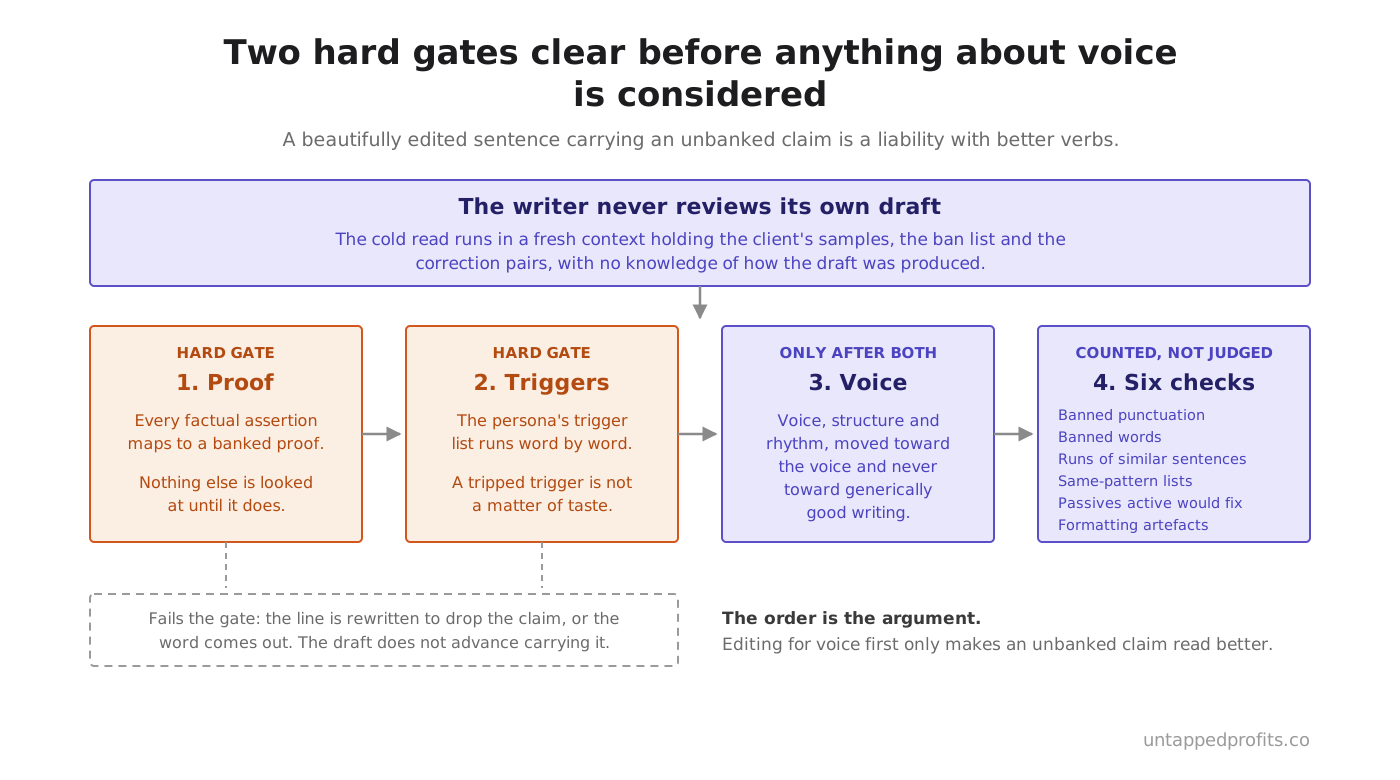
The last step is deliberately mechanical. Six countable items run on every piece: banned punctuation, banned words, runs of three or more similar sentences, lists where every item follows the same pattern, passives that active voice would strengthen, and formatting artefacts that would survive a paste into the publishing tool. Countable checks catch what judgment misses at the end of a long session, which is most of what judgment misses.
How do the rules get better?
Through the Ratchet. Every correction the Operator makes is logged with what it was, what it became, and the rule it implies. A correction made twice stops being feedback and becomes law, written into the standard the same session. The list is never inherited from another client either, because one business's measured habits are not another's, and borrowed calibration is a guess wearing evidence.
This is what stops the same argument recurring monthly. Without it, corrections live in somebody's memory and decay at the speed memory decays, so skill plateaus while the years accumulate. Your Best Marketer Has Been Getting Worse for Three Years watched that plateau form. A logged correction compounds. A remembered one gets made again.
Watch for
Editing toward smoothness. It is the most common failure in this pass and the hardest to spot, because the result reads well. The test is the brochure question: if this sentence could appear unchanged in any competitor's brochure, it is wrong no matter how clean it is. Move the copy toward the voice, never toward generically good writing.
Frequently asked questions
Isn't a banned word list just a style preference?
It started as one and became a ruling. Entries go on the list when a construction is caught doing the damage, and an entry that cannot be justified when it is challenged comes off. What makes it more than taste is that it is written down, dated and applied consistently, so it can be argued with. Words in the top tier never appear. Words in the second are rationed by count per thousand. The third tier gets argued case by case.
Does this make everything sound the same?
The opposite, and that is the point of the per-client calibration. The universal list removes machine patterns. What sits on top of it is measured from that business's own writing: punchline budget, hedge density, sentence-length range, the kind of analogy they naturally reach for. Two clients running this pass do not converge, because the calibrations differ.
What if the Operator likes a banned construction?
The Operator rules and the exception is recorded. This is not a system where the list wins arguments with the person who owns the business. What it does is force the exception to be deliberate rather than accidental, and once it is written down it applies consistently instead of appearing on alternate Tuesdays.
Where does this apply?
Every lane. Ad copy, social posts, email, landing pages, proposals and the pages of this guide all answer to the same sentence law. The only things that change by lane are the length and the format, and a system with a different quality bar per channel does not have a quality bar.
How is this different from having a good editor?
It is a good editor with the arguments already settled. Every correction cites its authority, whether that is the voice file, the trigger list, the Proof Bank or the standing list, so nothing rests on one person's taste being trusted on the day. Nothing here reads better as a reason on its own.
The bottom line
Most bad marketing copy is not badly written. It is empty, and editing makes empty copy read more smoothly without adding anything to it. Check the substance first, strip the patterns that mark writing as generated, hand the draft to a reader who did not write it, and finish with checks a person can count rather than argue about. Do that and the writing stops being the part of the system that runs on whoever happened to be available.
Where this connects
Writing for Clarity governs every sentence produced anywhere in the method, so it reaches well past Content & Channel. Claims answer first to The Proof Bank, openers to The Hook Law, and the ideas arriving here come from Content Ideation. The corrections this pass generates are ratcheted into standing law under The Operator's Laws and land in The Memory, which is what makes the standard rise instead of resetting.
Part 6 · Content & Channel · Chapter 28 of the One Brain Guide
Previous: Content Ideation ·
Next: Content Repurposing ·
All chapters
Sources
- John Morkes and Jakob Nielsen, Concise, SCANNABLE, and Objective: How to Write for the Web, Nielsen Norman Group, 1997. The measurement study tested 51 experienced web users across five versions of the same site, with a promotional version as the control. Overall usability scores against that control were 158 for the concise version, 147 scannable, 127 plainly worded and 224 for all three combined, which are the 58, 47, 27 and 124 percent figures. Task time fell from 359 seconds to 149 and task errors from 0.82 to 0.10 on the combined version. Nielsen Norman Group is a user experience consultancy that sells writing training, so the finding supports its own services. The study concerns a travel website in 1997. Applying it to marketing copy generally is this method's inference.
Every statistic and quotation on this page has been checked against its primary source. Last verified 27 August 2026.
Free guide
Take the method with you. The complete One Brain Method as one PDF: every chapter, the diagrams, and every named framework, ready to hand to whoever runs your marketing. Enter your email and it's yours.
Copy that carries something beats copy that reads nicely and says nothing.
Book a 30-minute call → See what it takes to have this installed