
The Memory is the persistent layer every campaign draws from and every result returns to: the part of a marketing system that doesn't reset when a campaign ends, a vendor changes, or someone leaves.
Key takeaways
- The Memory holds four things: durable goals, brand and UVP, customer intelligence, playbooks. One test decides every entry: does it stay true between campaigns?
- Its operating principle is Index, Not Encyclopedia. The Memory stays short and points. Detail lives in the documents it references, loaded when a decision needs it.
- The cost of knowledge nobody can retrieve is old and measured: McKinsey found interaction workers spending nearly 20 percent of the workweek hunting internal information, back in 2012.1 Marketing pays its version every time a new vendor asks "tell us about your business."
- It is the only version of marketing documentation with a maintenance contract: every loop writes back into it through the Return Arrow, and entries carry review dates.
- Method-level memory belongs in the engine. Everything specific to one business belongs in that business's Cartridge. Confusing the two is what makes systems impossible to lift and reuse.
Why does marketing keep re-learning the same business?
Marketing re-learns the same business because the knowledge lives in people and vendors. The system itself holds none of it. Every new agency, hire or platform rep opens with "tell us about your business", and every retelling drifts a little further from the last. The wider cost of knowledge nobody can retrieve has been on the books since 2012, when McKinsey found interaction workers spending nearly a fifth of the workweek hunting internal information the organisation already paid to create.1 Marketing's version is the re-explaining ritual, and it never appears on an invoice.
Sit in on that first meeting and you'll hear the ritual: your goals, your customers, your voice, what's been tried. Eighteen months later a different vendor asks the same questions. The business hasn't changed. The memory of it just never survived the handover. Multiply that across every channel and every staffing change and a business ends up explaining itself dozens of times to its own marketing, each retelling slightly different. That is how message drift starts. It is also how an agency ends up owning the accumulated learning your budget paid for, which is the argument of Whose Brain Is Your Ad Spend Training?
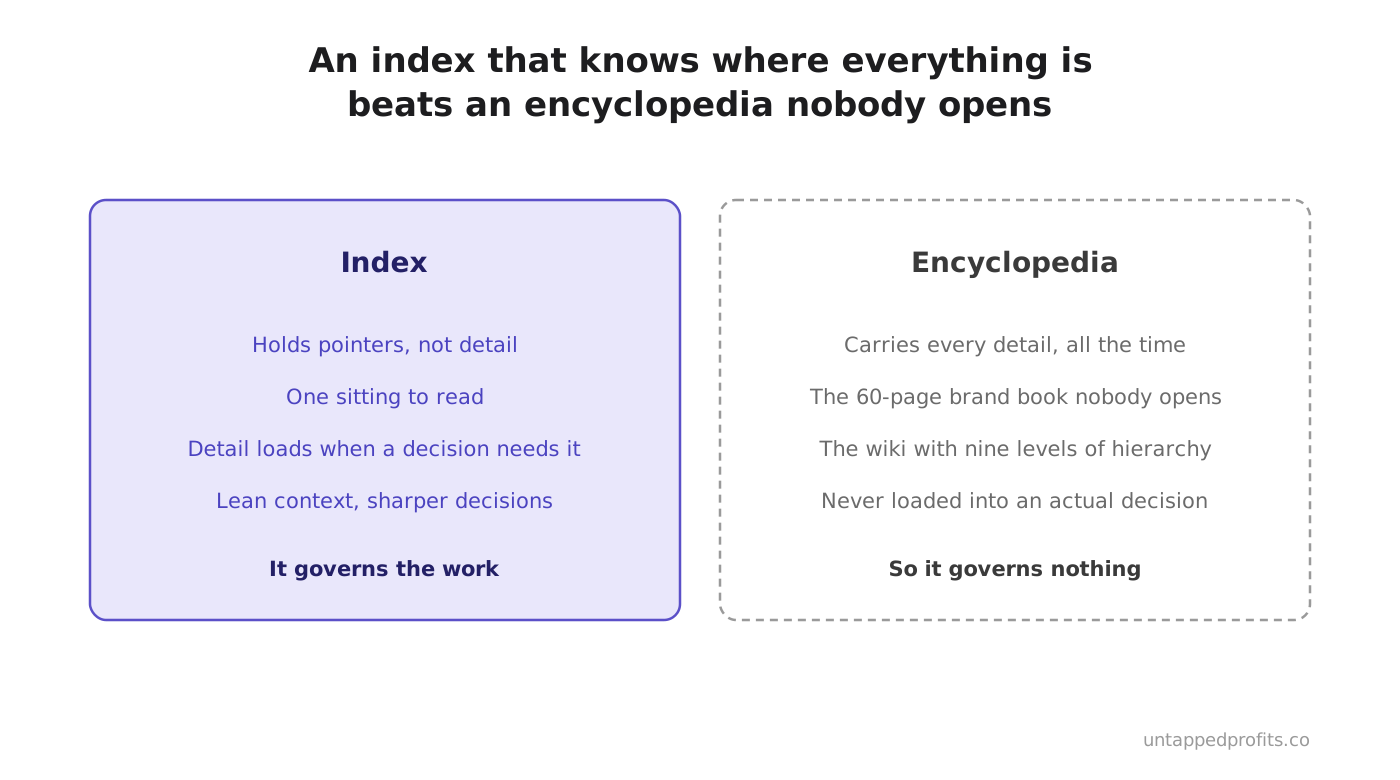
There is a second failure mode, and it catches the diligent: the encyclopedia. The 60-page brand book nobody has opened since the rebrand, the wiki with nine levels of hierarchy. Documentation so comprehensive that nobody loads it into an actual decision, so it governs nothing.
What lives in the Memory?
Four things, and one test decides all of them: durability. The Memory holds durable goals, brand and UVP, customer intelligence, and playbooks, and nothing else earns a place, however useful it looks in the moment. If an entry stays true between campaigns it belongs here. Anything specific to a single campaign goes in that campaign's plan.
- Durable goals. The standing definition of what marketing is for in this business, and what a result worth having looks like. This quarter's targets live in the campaign plan.
- Brand and UVP. How the business presents, sounds and wins. The value proposition and the voice every asset in every channel must carry.
- Customer intelligence. Who the buyers are, what they're thinking, what they respond to and what makes them close the tab. The raw material usually exists already, scattered across vendors who never compare notes — Your Customers Already Told You Why They Buy is the full argument. This is the entry every loop keeps current.
- Playbooks. The standing methods for how work gets done, so quality is a property of the system and survives whoever showed up that day.
Jeff Bezos gave the underlying logic its cleanest form at AWS re:Invent in 2012. Asked constantly what will change in ten years and almost never what won't, he pointed at the second question: "You can build a business strategy around the things that are stable in time."2 The Memory is that idea applied to marketing: the system is built around what is stable, so the campaigns are free to change fast on top of it.
How does the Memory stay useful?
By staying short. The Memory runs on one operating principle, Index, Not Encyclopedia, and that principle is what separates it from every dead wiki. The Memory holds pointers. Detail lives in the documents it references, loaded when a decision needs it, never carried everywhere at once. Lean context produces sharper decisions, from humans and machines alike.
- It holds only what stays true between campaigns. The durability test, applied without sentiment.
- It stays lean. One sitting to read, and anything longer than that has failed the test.
- Every campaign starts by drawing from it. Plan's first act is reading the Memory, so no campaign begins with a blank page.
- Every loop returns to it. Analyse writes back what it learned through the Return Arrow, so the Memory is always as smart as everything the marketing has ever learned.
- It is maintained like the asset it is. Entries carry review dates. Stale knowledge is retired deliberately, on a date, before a campaign trips over it.
| In the Memory | Not in the Memory: lives downstream |
|---|---|
| What a lead worth having looks like | This quarter's lead target, which belongs to the campaign plan |
| The UVP and the voice | This month's promotion copy |
| Who the buyers are and what makes them close the tab | Last week's click-through rates, which belong to Analyse |
| The playbook for deriving segments | The segments derived for the current campaign |
| Pointers to every detailed reference | The detailed references themselves |
In practice
The Memory is a short index, but the things it points at should be structured. Ad results, test outcomes and claim evidence belong in something queryable: a sheet, a table, a small database. The index tells you where the answer lives. The store holds what worked, when, and why.
Watch for
The Memory quietly becoming the encyclopedia again. The signal is length: if nobody can read it in one sitting, it has stopped being loaded into decisions and started being cited in meetings. Push the detail down into referenced documents and leave a one-line pointer behind.
What does running without a Memory cost?
Three costs. A re-explaining tax, paid forever, on every new vendor, hire, tool and channel. Message drift, because five retellings of a business produce five slightly different businesses. And a compounding failure, the quietest of the three: year three runs on roughly the same knowledge as year one, with more invoices behind it.
That last cost is the flattest and the least visible, because nothing appears broken. Campaigns still ship and the reports still arrive on time. What's missing is the accumulation, the sense that this year's work starts from a higher place than last year's did. Learning velocity is the real advantage in advertising, the case The Brand That Learns Fastest Wins makes at the campaign level, and the Memory is where that learning has to land before it can compound. Without a persistent layer receiving what each campaign taught, there is nothing for the work to accumulate into.
Frequently asked questions
Isn't a brand book the same thing?
A brand book describes the business. The Memory governs the marketing, because it is read at the start of every loop and written to at the end of it. That is the whole difference: a document every campaign must pass through is a system, and a brand book is a description nothing draws from.
Won't it go stale like every other internal document?
Everything goes stale. The Memory is the only version with a maintenance contract. The Return Arrow updates it every loop, entries carry review dates, and staleness is hunted on a schedule instead of discovered mid-campaign. Compare that honestly with the last-modified date on your brand book.
Shouldn't it hold everything? Isn't more context better?
The opposite. Overloaded context produces mushy decisions, from people and from models alike, and the AI era has made the effect stronger. The Memory stays sharp because it stays small: an index that knows where everything is beats an encyclopedia nobody opens.
Is the Memory a file, a database, or a tool?
It is a layer, defined by what it does, which is persist. The index itself is short and readable, a document. What it points at should suit the data: structured stores for anything you want to query later, documents for anything you want to read.
Where does the Memory physically live?
Method-level memory lives in the engine, which is built once and loaded per client. Everything specific to one business lives in that business's Cartridge. Keeping the two apart is what makes the system portable, and it is the subject of Engine, Cartridge and Connectors.
The bottom line
Most marketing has no memory, so it re-learns the same business forever and never compounds. The fix is a short, governed, persistent layer holding only what stays true between campaigns, read at the start of every loop and written to at the end of it. More documentation is the trap. Get the layer right and every campaign starts smarter than the last one, and the "tell us about your business" meeting happens once, ever.
Where this connects
The Memory is governed by the laws in The Operator's Laws: what may change it, and on whose ruling. Where it lives is Part 1's territory in Engine, Cartridge and Connectors. Downstream, The Campaign Plan is what Plan produces after drawing from the Memory, and The Return Arrow is how the Memory gets smarter with every loop. The case for one integrated mind over five partial ones is Your Marketing Conductor Can't Hear the Flat Note.
Part 2 · The Memory · Chapter 4 of the One Brain Guide
Previous: The Build Ledger ·
Next: The Operator's Laws ·
All chapters
Sources
- McKinsey Global Institute, The social economy: Unlocking value and productivity through social technologies, 2012. The average interaction worker spends nearly 20 percent of the workweek looking for internal information or tracking down colleagues who can help with specific tasks.
- Jeff Bezos, AWS re:Invent fireside chat with Werner Vogels, November 2012. Wording and provenance confirmed via Quote Investigator.
Every statistic and quotation on this page has been checked against its primary source. Last verified 24 August 2026.
Free guide
Take the method with you. The complete One Brain Method as one PDF: every chapter, the diagrams, and every named framework, ready to hand to whoever runs your marketing. Enter your email and it's yours.
Your business can own its marketing memory instead of renting it.
Book a 30-minute call → See what it takes to have this installed