
Content & Channel is the discipline that turns one substantial piece of work into everything a business publishes, and points all of it at a property the business actually owns.
Key takeaways
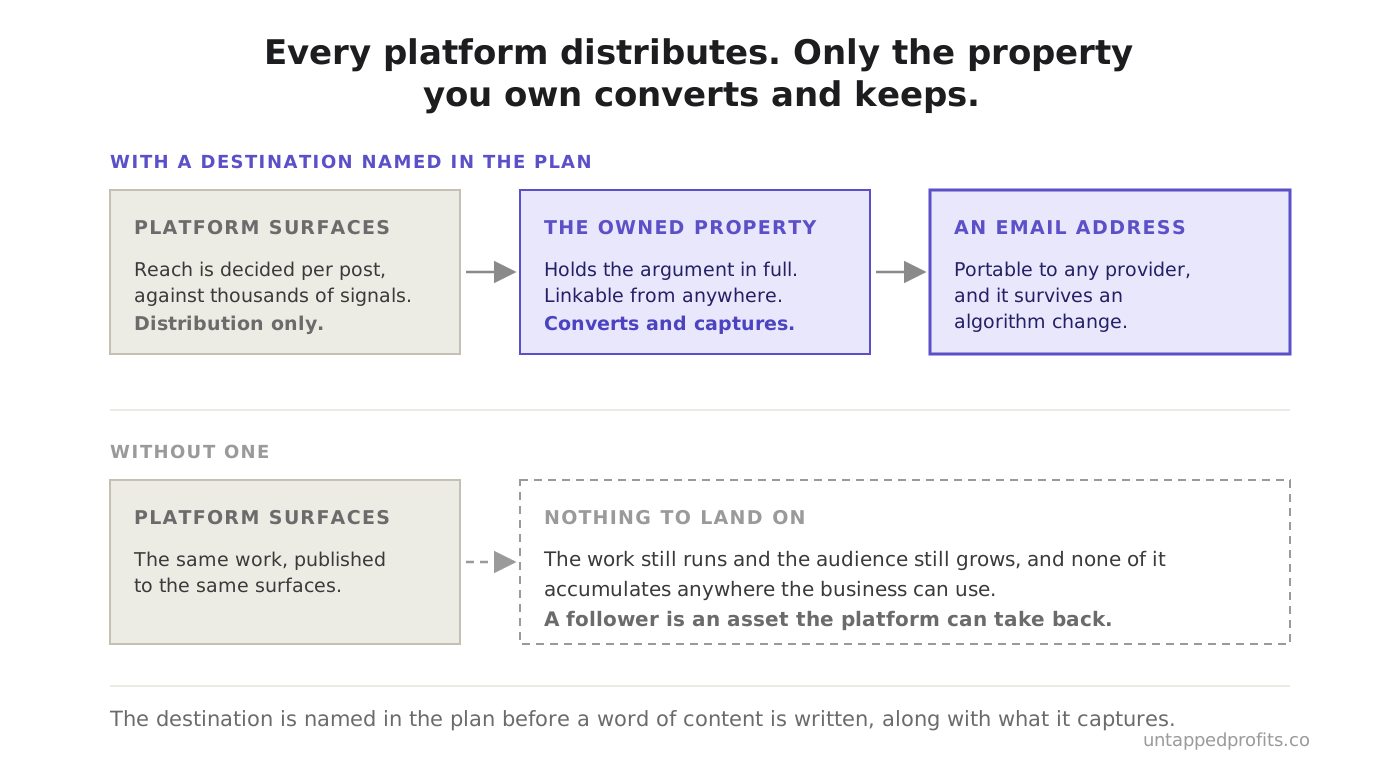
- The discipline runs on one principle, Distribution, Not Destination. Every platform distributes. The owned property converts and captures.
- The audience is genuinely there — 21.0 million social identities in Australia alone, over three-quarters of the population1 — but access to it is rented, and the terms change without notice.
- The destination is named in the plan before a single post is written, and the thing it captures is an email address, because a follower is an asset the platform can take back.
- How many derivatives a pillar asset should yield is set by the campaign plan and the budget, not by a fixed count. A pillar that yields very little was too thin to be worth publishing at all.
- Cadence is set to hours that exist, not to a platform's appetite — Social Strategy carries the scoring, the verdicts and the cadence law. Two platforms held beat five abandoned.
What job does content do in a marketing system?
Content does two jobs and they are easy to confuse. It earns attention on surfaces the business does not control, and it moves that attention to a property the business does control. Every post is distribution pointing at a destination. When the destination is missing, the work still runs and the audience still grows, and none of it accumulates anywhere the business can use.
Adam Mosseri, who runs Instagram, published the mechanics of this plainly. On Reels, "the majority of what you see is from accounts you don't follow".2 Reach is decided per post against thousands of signals. A follower count buys social proof and a retargeting pool. It does not buy distribution, and it never did.
That changes what a channel is for. A business posting to build a following is trying to own something the platform owns. A business posting to move readers into an owned property is using the platform for the one thing it reliably does, which is put work in front of people who have never heard of the business. The owned property then does what platforms will not do. It holds the argument in full, it can be linked to from anywhere, and it captures an address that survives an algorithm change.
The scale of what is rented is the point. DataReportal counted 21.0 million social media user identities in Australia in October 2025, equal to 77.7 percent of the population.1 Every one of them is reachable, and none of them is yours until an address changes hands.
Why does so much business content produce nothing?
Because volume gets mistaken for the work. A business publishes constantly, the calendar fills, and nothing compounds, because there was no pillar underneath any of it and no destination in front of it. The output is real and the effect is nil. This is the failure the discipline exists to prevent, and it survives inside agencies because output is what a content retainer prices.
The economics are the giveaway. Content built one asset at a time is markedly slower per asset than the same output produced from a single pillar, because the thinking was done once and the derivatives inherit it. An operation producing 20 unrelated posts a month is paying full price for each one and getting no accumulation — Your Agency Loves Content Marketing Because Selling Is Hard prices out exactly why a retainer likes it that way.
There is a quieter version that catches good operators. The content is strong, the audience responds, and the business still cannot say what any of it did, because each channel was measured against itself. Nobody owned the gap between them. Your Marketing Partners Aren't Hiding Anything found that gap on the paid side. Organic is where it hides best.
| What the platform owns | What the business owns |
|---|---|
| Whether any given post is shown, and to whom | The page the click lands on, and everything it says |
| The follower relationship, revocable at any time | The email list, portable to any provider |
| The ranking rules, rewritten without notice | The pillar asset the derivatives were cut from |
| The archive, searchable only inside the app | The published archive, citable by anyone |
| The account itself | The record of what the audience responded to |
In practice
Name the destination in the campaign plan before a word of content is written, and name what it captures. If the honest answer is that a reader who loves the post has nowhere to go afterwards, the content is not ready to start. Building the destination is cheaper than a year of posting into one that never existed.
How does one Operator publish at any real volume?
By producing one thing properly and cutting it up. A pillar asset is a long-form article, a long video, a case study or a recorded interview, and how many derivatives it should yield across formats is set by the campaign plan and the budget rather than by a fixed count. Direct cuts come first, then transformations such as carousels and stat cards, then engagement pieces. A pillar that yields very little was too thin, and that is a verdict on the pillar.
The waterfall has a ceiling, which is the part most systems leave off. Each format is produced once per source. Secondary ideas are ranked in a register and produce short video and images only, capped per run. Without the cap the method turns into a volume machine, and volume is the thing this whole approach argues against.
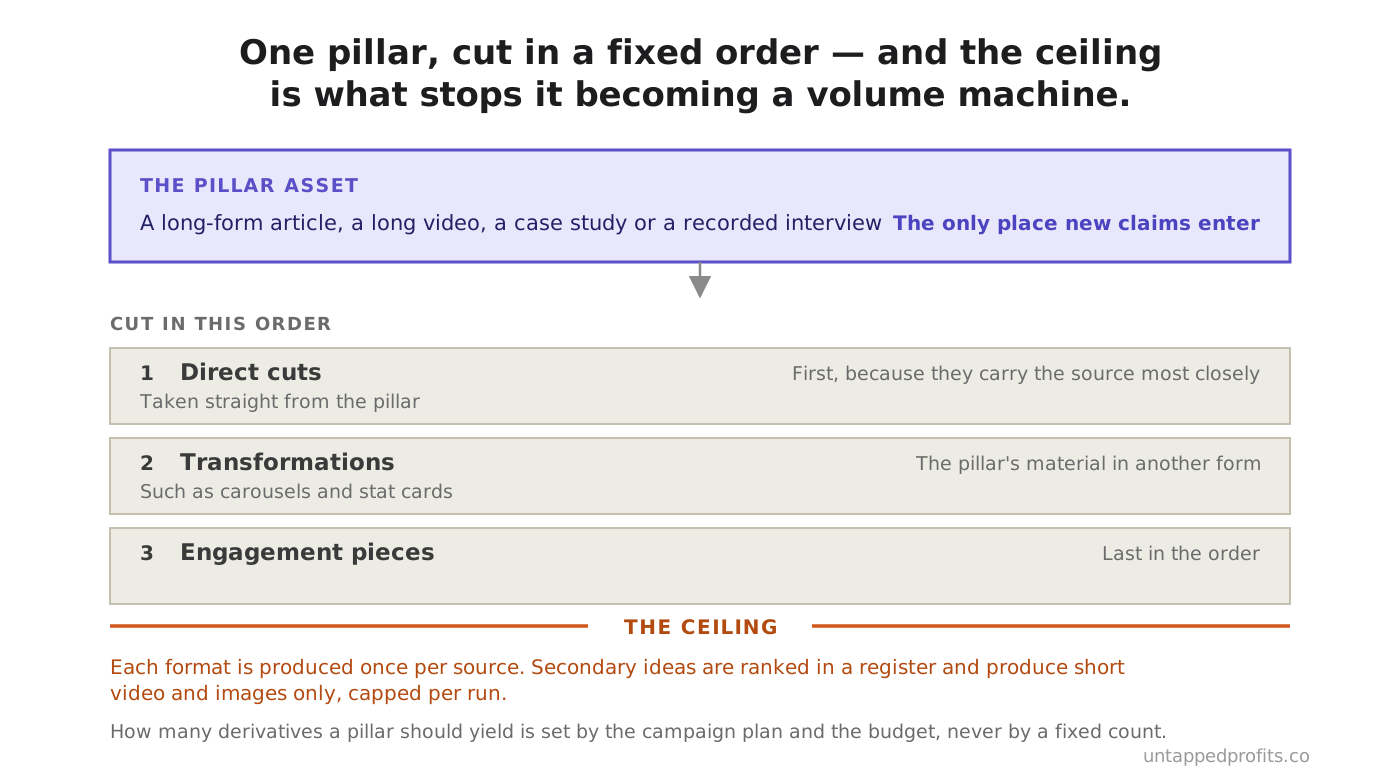
Two constraints hold the quality. Every derivative serves the source's own argument, so a consequence of the argument never gets promoted over the argument itself, and every number in every derivative comes from the source. Nothing is sharpened on the way down. The pillar is the only place new claims enter, which is why it passes the same evidence discipline as The Proof Bank before anything is cut from it.
How many platforms should a business actually be on?
Two, in most cases, run properly. Candidate platforms are scored against weighted criteria: audience alignment, goal alignment, format fit, the resource needed to sustain quality, and competitive white space. The outcomes are invest, pilot for 60 days, secure the handle and walk away, or ignore. A platform that scores well and cannot be sustained at the required cadence is not a platform this business is on.
Cadence follows capacity, and this is where most plans break: the calendar gets written to the platform's appetite instead of the Operator's hours, and dies in its second month. Social Strategy sets the rule, consistency held beating volume abandoned, and the maturity reading that calibrates it.
Platform specifics live outside the chapters entirely, in a dated file that names when it expires — the rule and its schedule are in Social Strategy. Algorithm behaviour, format priorities and reach bands move every few months. The method above survives that. A cadence number quoted from a two-year-old deck does not, and the same problem now applies to where content gets cited at all, which is the ground AI Search Platforms Don't Agree on Who's Trustworthy covers.
Watch for
The content that performs well and sells nothing. It is a real pattern and it looks like success on every dashboard. The check is whether the piece pointed anywhere, and whether the destination asked for anything. Content that entertains an audience into no next step is a hobby with a reporting layer on top.
Frequently asked questions
Isn't this just content marketing with different words?
Content marketing usually names the output. This names the destination first and treats every channel as a way of getting people there, which changes what gets made. It also puts the work under the same laws as everything else in the system. Openers answer to The Hook Law, claims answer to the Proof Bank, and nothing publishes because the calendar had a gap.
Does organic content still work when reach keeps falling?
Reach on business pages has been compressing for years and will keep compressing. What still works is the founder's own face, real community surfaces, and video, because the recommendation systems are built to find content people want rather than content brands paid to place. A plan promising organic reach at scale with nothing paid behind it gets flagged at review.
What makes a good pillar asset?
Something with enough argument in it to survive being cut many different ways. A strong pillar has a claim, evidence for the claim, and at least one thing the reader has not heard before. The honest test is whether the derivatives each stand up on their own, applied after the fact.
Where do content ideas come from?
From three standing inputs — the buyer's own questions, the competition's running arguments, and the business's own results — never from a brainstorm or a keyword tool. Content Ideation carries the full sourcing system, the scoring and the queue; the case against keyword tools is Why the Best Content Positions Can't Be Found in Any Keyword Tool.
Who handles comments and complaints?
The Operator, under a written escalation matrix agreed at onboarding, with tiers running from routine questions up to anything legal or reputational. Replies and community management are never automated. For a business selling something considered, one badly handled public comment costs more than a month of posts earn.
The bottom line
Content fails commercially far more often than it fails creatively. The work is usually fine and it goes nowhere, because it was produced one asset at a time and pointed at a profile instead of a property. Fix the direction first. Name the destination, name what it captures, build one pillar properly and cut it into everything else. Do that and the audience the platforms rent you starts turning into an audience the business keeps.
Where this connects
Content & Channel is one of the five Build disciplines, and it inherits from Plan. The destination, the pillars and the cadence are decided in The Campaign Plan, the audience it speaks to comes from Customer Intelligence, and what the content learns goes back through The Return Arrow into The Memory. Creative law does not stop at the boundary either. Everything in this discipline runs the same gates and the same hook standard as Creative Production. The chapters below take the parts of it that need their own rules.
Part 6 · Content & Channel · Chapter 24 of the One Brain Guide
Previous: Synthetic Assets: Avatars and Voices ·
Next: Social Strategy ·
All chapters
Sources
- DataReportal, Digital 2026: Australia, published November 2025 from an October 2025 snapshot. Analysis by Kepios. DataReportal states that its social media user identity figures may not represent unique individuals, and advises caution when comparing the figure with earlier reports. The report is published in partnership with We Are Social and Meltwater, both of which sell social media services.
- Adam Mosseri, Head of Instagram, Instagram Ranking Explained, about.instagram.com, 31 May 2023. The quoted sentence describes Reels. Published by Meta, which sells advertising on the same surfaces.
Every statistic and quotation on this page has been checked against its primary source. Last verified 27 August 2026.
Free guide
Take the method with you. The complete One Brain Method as one PDF: every chapter, the diagrams, and every named framework, ready to hand to whoever runs your marketing. Enter your email and it's yours.
Your content can build an audience you own instead of one you rent.
Book a 30-minute call → See what it takes to have this installed