
Engine, Cartridge and Connectors is the three-part architecture of every One Brain client project, and the part of the method that decides whether marketing knowledge compounds or evaporates.
Key takeaways
- Every client project is three parts: one client-agnostic engine holding the method, a Cartridge holding everything specific to the business, and connectors wiring it to the live platforms.
- The named framework is the Cartridge Principle. The engine is built once, clients load into it, and every method-level lesson flows back to the master for every future load to inherit.
- High performers are roughly three times as likely to have fundamentally redesigned workflows around AI, per McKinsey's State of AI survey.1 This architecture is that redesign, applied to marketing.
- A Cartridge loads in place of a six-week onboarding, because the engine already knows how to run marketing. It just needs to know about you.
- The separation is measurable: client-identifiable material found in the engine has one acceptable count, which is zero.
Why does marketing knowledge keep getting rebuilt from scratch?
Because method and client knowledge are tangled into one lump, so when anything changes hands, everything resets. Eighteen months of learning walks out the door with the old agency, the new one starts with a questionnaire, and you pay again for lessons you already paid for. And when marketing lives in a person's head, the person leaving is the system leaving.
Think about what the departing knowledge actually contains: which audiences responded, which messages died, what a qualified lead looks like, why the March campaign worked. None of it was written into anything the business keeps. The agency's way of running search is threaded through your account structure. Your brand voice lives in some copywriter's drafts. Nobody can say which parts are reusable know-how and which parts are facts about your business, so nothing survives the handover. It is also how your budget ends up training someone else's system, the pattern Whose Brain Is Your Ad Spend Training? documents.
W. Edwards Deming's line applies to marketing exactly as it applied to manufacturing: "A bad system will beat a good person every time."2 Talented people inside an architecture with no separation between method and client will lose to average people inside one that has it.
This is also why bolting AI onto a tangled setup changes so little, the failure The $10 Million Difference Between Using AI and Being Built On It takes apart. McKinsey's State of AI research puts a number on the gap: nearly three-quarters of high performers report fundamentally redesigning workflows because of their AI use, against about one-quarter of everyone else.1 The engine and Cartridge split is that redesign, done once, for marketing.
How does the engine, Cartridge and connectors model work?
On the Cartridge Principle: the engine is built once, clients load into it, and what is learned in one client's work flows back to the master so every future load inherits it. The engine holds the method. The Cartridge holds everything true about one business. Connectors wire the pair into that business's live platforms.
In practice, the model has five moves:
- Build the engine once. The Master Engine is everything that stays true across clients. Its Memory holds the system's identity, its Rules are the standing law the engine enforces, its Skills are the portable playbooks for Plan, Build and Analyse, and its Agents do the automated execution. Not one line of it belongs to a client.
- Load the client as a Cartridge. The Cartridge is one client's layer: plan, avatars, brand, voice, competitors. Everything true about the business lives here, and only here.
- Wire the connectors. Connectors are the client's data and publishing surfaces: GA4, Ads, CRM, CMS. They are swappable by design, and the method doesn't marry a tool.
- Run the loop. The Client Project, engine plus Cartridge plus connectors, runs Plan → Build → Analyse against that client's plan, drawing method from the engine and facts from the Cartridge.
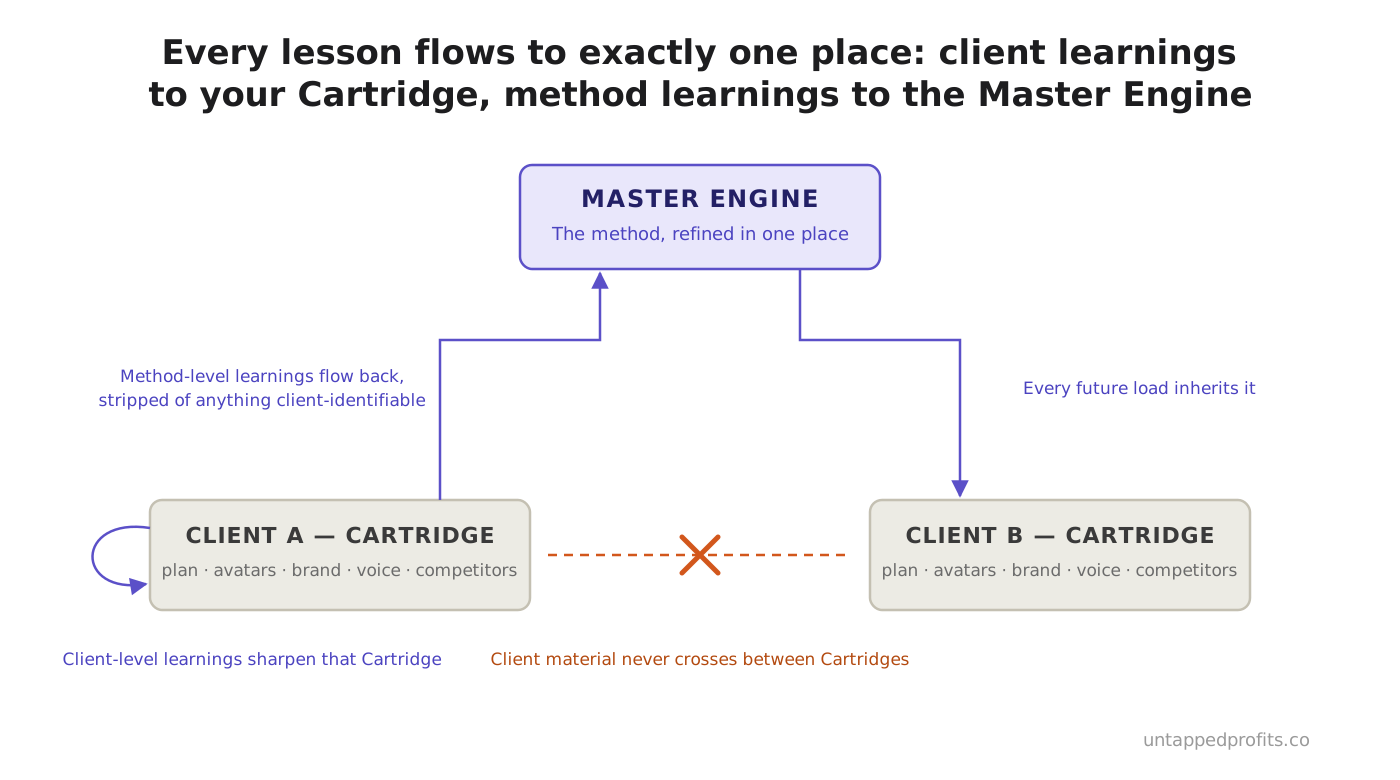
- Return the learning to the right place. Client-level learnings sharpen that client's Cartridge. Method-level learnings flow back to the Master Engine, stripped of anything client-identifiable, and every future load inherits them. Client material never crosses between Cartridges.
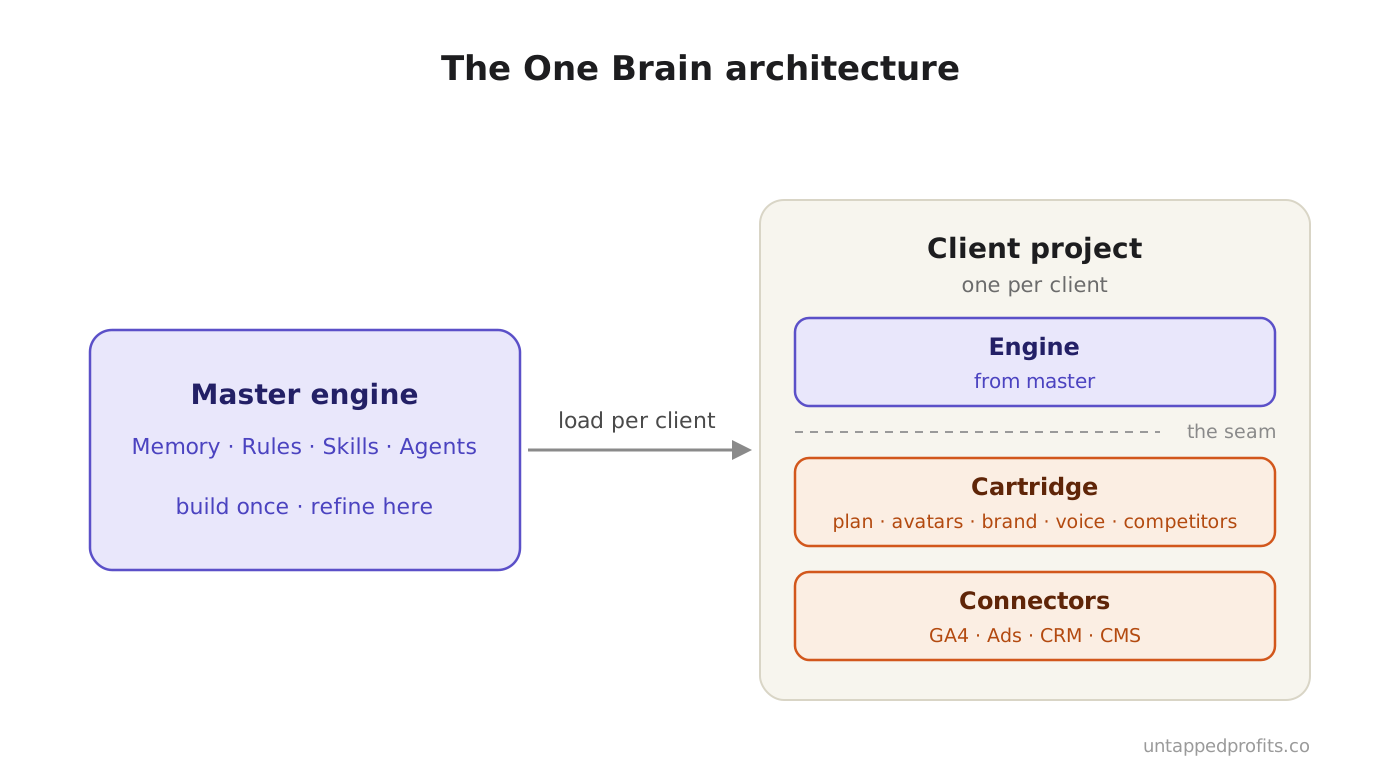
| Part | What it holds | Contents | Whose it is |
|---|---|---|---|
| The Master Engine | The method: client-agnostic, built once, refined in one place | Memory · Rules · Skills · Agents | The Operator's, shared as method by every client project |
| The Cartridge | Everything specific to one business | plan · avatars · brand · voice · competitors | The client's, and it never mixes with anyone else's |
| Connectors | The wiring to live platforms | GA4 · Ads · CRM · CMS | The client's accounts. The system plugs in, it doesn't own them |
The word is load, deliberately. A Cartridge doesn't get onboarded over six weeks of discovery calls. It loads into an engine that already knows how to run marketing, and the engine just needs to know about you. Because the engine is one thing refined in one place, a lesson learned running anyone's marketing makes the system better for everyone loaded into it, without any client's material touching another's. That structural discipline is the difference between AI projects that return and AI projects that don't, and the missing-architecture failure has its own post: Why Most AI Projects Produce No Return.
In practice
The load test tells you if the engine is real. The time a new business takes to load should fall with every load, and the share of a setup that is reused should rise until only the Cartridge is new. If setup keeps taking as long as it did last time, the engine isn't holding the method. The people are.
What should you measure in a marketing system's architecture?
Measure what the architecture makes cheap and what it makes impossible. Time to load a new business should fall with every load. The share of a setup reused should rise until only the Cartridge is new. And the amount of client-identifiable material found in the engine has exactly one acceptable value, which is zero.
| Measure | What it tells you | Target |
|---|---|---|
| Time to load a new business | How much of the system is genuinely reusable method | Falling with every load |
| Share of a new setup reused | Whether the engine actually holds the method | Rising toward everything but the Cartridge |
| Client-identifiable material found in the engine | Whether the separation is real | Zero, always |
| Engine improvements inherited by existing loads | Whether learning compounds across the system | Every ruling, same system, no re-implementation per client |
| Cartridge freshness | Whether the system is running on current facts | Reviewed on the campaign plan's 90-day reset |
Watch for
Client material creeping into the engine. It always starts as a convenient shortcut: one client's segment list pasted into a playbook, one brand rule hard-coded where every load will inherit it. The acceptable count of client-identifiable material in the engine is zero, and the audit for it runs on a schedule, because creep never announces itself.
What does running without an architecture cost?
A treadmill and a blindfold. The treadmill: every vendor change is a cold start, and you buy the same customer insights three times in five years and call it onboarding. The blindfold: with method and client knowledge tangled, there is no document to inspect, no law to check the work against, and nothing to take with you.
The treadmill's worst property is that nothing compounds. Year three of your marketing is barely smarter than year one, because the learning kept leaving with whoever held it. The automation philosophy that stops this is boundary-shaped, and it has its own argument in Stop Automating Across Phases. Start Automating Inside Them.
The blindfold matters most on the day you want out. The architecture is what makes this guide possible at all: the engine is publishable because it contains no client. Your Cartridge is private because it contains nothing but you.
| Without the split — the treadmill and the blindfold | With the engine and Cartridge split | |
|---|---|---|
| When the vendor changes | Every vendor change is a cold start, beginning with a questionnaire | The Cartridge loads, and the next system to touch your marketing already knows how to run it |
| Customer insights | You buy the same customer insights three times in five years and call it onboarding | Insights live in your Cartridge and load with it, paid for once |
| What compounds | Nothing. The learning keeps leaving with whoever held it | Method is refined in one place, so a lesson learned on any load makes the system better for everyone |
| On the day you want out | No document to inspect, no law to check the work against, nothing to take with you | Your Cartridge — plan, avatars, brand, accounts — loads, travels and leaves with you |
Frequently asked questions
Every business is different. How can one engine fit us?
The engine doesn't hold answers. It holds the method for finding them. Everything that makes your business different, from your customers and voice to your competitors and plan, is exactly the material the Cartridge exists to hold. The claim is narrower than it sounds: the discipline of running marketing well transfers between businesses, and nothing else has to.
What happens when we leave?
The Cartridge is yours and the seam makes the separation real. Your plan, your avatars, your brand material, your accounts: none of it is threaded through the engine. Compare that to extracting eighteen months of learning from an agency's internal folders.
Is our data training other clients' marketing?
No. The standing law is that no client's data, proof, copy or competitive intelligence ever crosses to another Cartridge. What flows back to the engine is method: anonymised, structural, the kind of lesson that says "gate hooks before production", never "here's what worked for that finance client".
Do we have to change our tools to load?
Rarely. Connectors exist so the method plugs into the platforms you already run: GA4, your ad accounts, your CRM, your CMS. They are swappable by design, so a tool change later swaps a connector without touching the engine or the Cartridge.
How is this different from an agency's proprietary process?
A proprietary process is a claim you can't check. This one is published: the engine's laws, gates and playbooks are documented across this guide, so you can read the method before you load into it. The other difference is where the learning goes. Here it flows back into a system you can inspect, with your material held in a Cartridge that stays yours.
The bottom line
Marketing knowledge evaporates because most setups tangle the method with the client, so every handover resets both. The engine and Cartridge split ends that: method in one place, refined once for everyone, and everything true about your business in a Cartridge that loads, travels and leaves with you. Get the architecture right and the questionnaire ritual dies on day one, because the next system to touch your marketing already knows how to run it.
Where this connects
This chapter is the anatomy. The two laws that keep it honest come next: The Seam Rule, which governs the boundary between engine and Cartridge and why that boundary is physical, and The Build Ledger, which keeps the whole build reconstructable from a single artefact. The engine's own layers are covered in The Memory and The Operator's Laws, and the loop the architecture exists to run starts at The Campaign Plan. Back to the One Brain Method hub.
Part 1 · Architecture · Chapter 1 of the One Brain Guide
Previous: The One Brain Method ·
Next: The Seam Rule ·
All chapters
Sources
- McKinsey, The State of AI global survey, 2025 edition. "Nearly three-quarters of high performers report fundamentally redesigning workflows because of their AI use", compared with about one-quarter of other respondents.
- W. Edwards Deming, February 1993 Deming Four Day seminar, Phoenix. Wording per the Deming Institute.
Every statistic and quotation on this page has been checked against its primary source. Last verified 24 August 2026.
Free guide
Take the method with you. The complete One Brain Method as one PDF: every chapter, the diagrams, and every named framework, ready to hand to whoever runs your marketing. Enter your email and it's yours.
Rather see your marketing loaded into it than read about it?
Book a 30-minute call → See what it takes to have this installed