
The Five Gates are the locks creative must pass to exist: Concepts, Angles, Hooks, The Cut, Ad Concepts. At every gate the AI generates the field, the Operator picks, and files are written only after locks.
Key takeaways
- Five gates, in order: Concepts, Angles, Hooks, The Cut, Ad Concepts. Each is one read by one Operator.
- Files follow locks. No speculative artefacts and no half-built directions waiting on an approval that never comes.
- The field to select from is dire: across System1's database of more than 150,000 ads, just 1% score five stars, and most land at one and two.1 The method reads that curve as a selection failure — nobody chose these ads over better ones.
- At the Angles gate, the Angle-by-Style Fit Matrix scores angles against the styles they would have to live in. An angle that only works in a style the brand can't wear is a dead angle wearing makeup.
- Every recurring reason-for-death becomes written law, so the gates teach as well as filter.
Why does creative volume need gates?
Because most creative deserves to die, and the only real question is where you let it happen. Either it dies at a gate, for the price of one read, or it dies in the market, with media spend attached. There is no third option where the weak work quietly succeeds.
The industry's report card is public. System1's Test Your Ad database of more than 150,000 ads puts just 1% at the top five-star rating, with the majority landing at one and two stars, predicting low or modest growth potential.1 That is work real businesses paid real money to make and run, and it is what happens when the field ships instead of the winner.
AI sharpens the stakes instead of softening them. A system that can generate thirty concepts before lunch is a gift when selection is strong, and a catastrophe when it isn't, because now the mediocre majority arrives at production speed. The same volume-without-judgment failure runs through 47 Funnels in 5 Minutes, Zero Revenue. Steve Jobs named the missing discipline at WWDC in 1997: "Focusing is about saying no."2 A gate is a machine for saying no, on schedule, before the expensive part.
How do the Five Gates work?
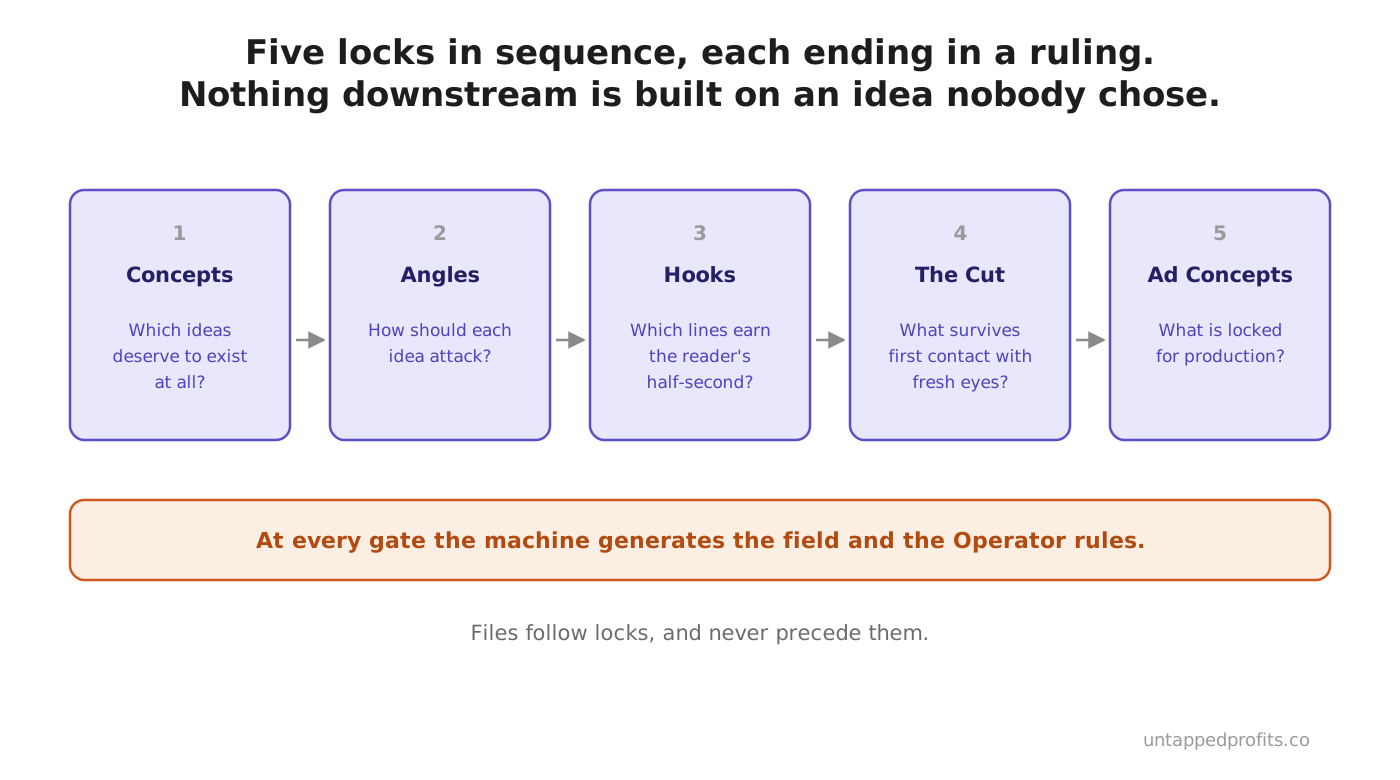
As five locks in sequence, each answering one question and each ending in a ruling. The machine generates the field at every stage and the Operator decides what continues. Nothing downstream is ever built on an idea nobody chose, and no file exists before the lock that justifies it.
- Concepts. The AI generates the field of ideas: wide, fast, unprecious. The Operator rules on which concepts deserve angles, and everything else dies here, at the cheapest possible price.
- Angles. For each surviving concept, the ways it could attack: the framings, the arguments. The Angle-by-Style Fit Matrix is the tool at this gate, scoring angles against the creative styles they would have to live in, so only the fits survive.
- Hooks. The lines themselves, and they don't reach the Operator raw. Every hook passes the Hook Law's tests and a cold-read before it appears on a selection sheet, so the Operator chooses between lines that have already survived the reader's half-second.
- The Cut. The Operator reads the assembled candidates and kills without ceremony. The method's own first run is the honest picture: a wide slate cut hard at first read, then cut again when new creative law arrived, with every one of those kills happening before production money was spent.
- Ad Concepts. The survivors are locked into the Ad Concepts document, and only now do files get written. Files follow locks, and never precede them.
| Gate | The question it answers | How it's decided |
|---|---|---|
| 1 · Concepts | Which ideas deserve to exist at all? | AI generates the field, and the Operator rules |
| 2 · Angles | How should each idea attack? | The Angle-by-Style Fit Matrix filters, and the Operator rules |
| 3 · Hooks | Which lines earn the reader's half-second? | The Hook Law and a cold-read filter, then the Operator rules |
| 4 · The Cut | What survives first contact with fresh eyes? | The Operator reads and kills, with no committee and no ceremony |
| 5 · Ad Concepts | What is locked for production? | Survivors written to file, because files follow locks |
What is the Angle-by-Style Fit Matrix?
The tool at the Angles gate. Every surviving angle is laid against the creative styles it would have to live in, and each cell answers one question: can this style carry this angle without breaking it? An angle left with no surviving style is a dead angle wearing makeup, and it dies here rather than in production.
Style capacity is the usual reason a cell fails, because the amount of on-image text a style can carry differs enormously. A bold-typography ad carries a short commanding line, an ugly ad carries a dominant headline and a subline, and a meme carries a setup and a punchline. An angle whose argument needs a setup and a punchline therefore has no home in bold typography, however strong the angle is on its own terms. The style families and what each one pins down are set out in Generated Imagery.
| The matrix | What goes there |
|---|---|
| Rows | The angles that survived the Concepts gate, for one concept |
| Columns | The creative styles the brand can actually wear |
| Each cell | Can this style carry this angle without breaking it? |
| The verdict | An angle with at least one surviving style continues to Hooks. An angle with none dies here. |
Two vetoes override any score in the grid. A style that trips the avatar's Ejection Triggers is unavailable in that lane whatever its general strength, so a fit that would work commercially is still struck out if it trips the buyer's reflexes. And a style the brand can't wear is unavailable everywhere, which is what makes the matrix a filter on angles rather than a menu of executions. The triggers come from that avatar's Intelligence Pack, built in Customer Intelligence.
The matrix is deliberately a pass-or-fail grid rather than a graded score. A number invites averaging, and an angle that scores moderately everywhere and works nowhere is exactly the kind of survivor the gates exist to kill.
In practice
Record the reason for every kill in one line, at the moment of the kill. Not for the archive, but because the third time the same reason appears it has stopped being a judgment call and become a rule the system should be enforcing before the Operator ever sees the work.
What should you measure at the gates?
Whether the field is wide enough to select from, and where the killing happens. A thin field entering a gate makes that gate a rubber stamp. A heavy kill ratio at the gates means failure is being paid for in reads. And production files with no gate trail behind them mean somebody started building before anybody decided.
| Measure | What it tells you | Target |
|---|---|---|
| Width of the field entering each gate | Whether generation is running wide enough to select from | Wide, because a thin field makes every gate a rubber stamp |
| Kill ratio at the gates against kills in-market | Where failure is being paid for | Heavy at the gates, before production money moves |
| Production files without a gate trail | Whether files follow locks or precede them | Zero, because every artefact traces to a lock |
| Rules ratcheted from kills | Whether the gates teach or just filter | Every recurring reason-for-death becomes written law |
Watch for
The gate that never rejects. When a stage passes everything it receives, either the field arriving is too thin to choose from or the reading has become a formality. Both look identical on a project plan and both mean the pipeline has quietly lost a lock.
What does skipping the gates cost?
Production spend on ideas nobody chose: rendered, revised, uploaded, then discovered to be wrong at the only gate left, which is the market, where a lesson costs media budget instead of a read. Legacy slates that grow without improving, because without kill-points old work is never formally superseded, only accumulated.
The least visible cost is that an ungated pipeline learns nothing. There is no moment where a cut forces the question why did this die?, so the same weak idea returns in a new outfit every quarter. Volume without that question produces variations rather than knowledge — the testing-stage twin of You Haven't Tested 20 Ads. The gates aren't where creative slows down. They are where the system gets smarter.
Frequently asked questions
Isn't five approval steps just bureaucracy?
Each gate is one read by one Operator, so minutes rather than meetings. Between the gates nothing is throttled, and the field is generated at machine speed. Compare the bureaucracy of the alternative honestly: the revision cycles, stakeholder rounds and post-hoc rationalisation that follow work nobody consciously selected. The gates are the cheap version of decision-making.
Why not ship everything and let the algorithm decide?
Because that outsources the gate's job to an auction, at CPM prices. The platform optimises delivery of what you give it. It doesn't check claims against the Proof Bank, codes against the Register, or hooks against a cold reader, and it will happily find the audience most tolerant of your worst ad. In-market testing is for calibrated finalists, never for the whole ungraded field.
What if the Operator's taste is wrong?
The gates don't run on taste alone. The matrix, the Hook Law, the Ejection Triggers and the cold-read all filter before judgment, so the Operator rules between strong options and never grades raw output. And when a ruling does prove wrong, the correction becomes law the same day. Wrong once is tuition, and wrong twice is a missing rule.
Can gates be run in parallel to go faster?
No, and the reason is the whole design. Each gate's output is the next gate's input, so angles generated before concepts are locked are angles for ideas that may not survive. Parallel running feels faster and produces work that has to be thrown away, which is the expensive kind of speed.
What happens when nothing survives a gate?
The gate did its job and the phase runs again. A slate where everything dies at Concepts usually means the brief was wrong rather than the generation, so the fix is upstream, in the plan or the Intelligence Pack. An empty gate is uncomfortable and cheap. A full gate nobody believes in is comfortable and expensive.
The bottom line
Machines made generating creative nearly free, which means the constraint moved entirely to selection, and most advertising still ships without anybody having genuinely chosen it. The Five Gates put a lock at each point where a wrong idea starts getting expensive, hand the machine the generating and the human the deciding, and write nothing to file until something is locked. Kill early, kill often, and let every kill leave a rule behind.
Where this connects
The gates are Findings Are Not Decisions built into a pipeline: the machine proposes and the Operator rules, five times over. What survivors must carry is set upstream by The Brand Codes Register, the law hooks face at gate three is the next chapter in The Hook Law, and what happens after the locks belongs to Static Ads and The Review Seams. The phase-gate economics behind all of it is the argument of Stop Automating Across Phases. Start Automating Inside Them. Back to the One Brain Method hub.
Part 5 · Creative Production · Chapter 17 of the One Brain Guide
Previous: The Brand Codes Register ·
Next: The Hook Law ·
All chapters
Sources
- System1, "The 1% Leaves Room for Brands to Harness the Multiplier Effect", February 2025. 1% of ads in System1's Test Your Ad Premium database of more than 150,000 ads score five stars, the maximum on its creative effectiveness scale, and the majority land at one and two stars, predicting low or modest growth potential. System1 sells creative testing, so the finding that most untested creative is weak supports its own product. The Premium database has since been relaunched as Test Your Ad Competitive Edge. Attributing the distribution to selection rather than to briefing or generation is this method's inference.
- Steve Jobs, closing Q&A at Apple's Worldwide Developers Conference, 1997. Verified against the session transcript.
Every statistic and quotation on this page has been checked against its primary source. Last verified 24 August 2026.
Free guide
Take the method with you. The complete One Brain Method as one PDF: every chapter, the diagrams, and every named framework, ready to hand to whoever runs your marketing. Enter your email and it's yours.
Want creative that's chosen, not just generated?
Book a 30-minute call → See what it takes to have this installed